2017 Paper 1 Q3
Year: 2017
Paper: 1
Question Number: 3
Course: LFM Pure and Mechanics
Section: Parametric equations
Problem
Solution
Examiner's report
— 2017 STEP 1, Question 3The pure questions were again the most popular of the paper with questions 1 and 3 being attempted by almost all candidates. The least popular questions on the paper were questions 10, 11, 12 and 13 and a significant proportion of attempts at these were brief, attracting few or no marks. Candidates generally demonstrated a high level of competence when completing the standard processes and there were many good attempts made when questions required explanations to be given, particularly within the pure questions. A common feature of the stronger responses to questions was the inclusion of diagrams.
Rating Information
Difficulty Rating: 1500.0
Difficulty Comparisons: 0
Banger Rating: 1500.0
Banger Comparisons: 0
Show LaTeX source
Problem source
The points $P(ap^2, 2ap)$ and $Q(aq^2, 2aq)$, where $p>0$ and $q<0$, lie on the curve $C$ with equation
$$y^2= 4ax\,,$$
where $a>0\,$. Show that the equation of the tangent to $C$ at $P$ is $$y= \frac 1 p \, x +ap\,.$$
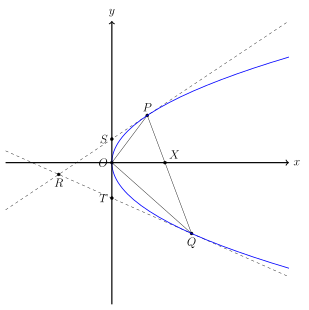
The tangents to the curve at $P$ and at $Q $ meet at $R$. These tangents meet the $y$-axis at $S$ and $T$ respectively, and $O$ is the origin. Prove that the area of triangle $OPQ$ is  twice the area of triangle $RST$.
Solution source
\begin{align*}
&& 2yy' &= 4a \\
\Rightarrow && y' &= \frac{2a}{y} = \frac{2a}{2ap} = \frac1p \\
\Rightarrow && \frac{y-2ap}{x-ap^2} &= \frac1p \\
\Rightarrow && y &= \frac1p x +ap
\end{align*}

The other tangent will be $y = \frac1qx+aq$

\begin{align*}
&&& \begin{cases} py-x &= ap^2 \\
qy - x &= aq^2 \end{cases} \\
\Rightarrow && y(p-q) &= a(p^2-q^2) \\
\Rightarrow && y &= a(p+q) \\
&& x &= apq
\end{align*}

Therefore $R(apq, a(p+q)), S(0, ap), T(0, aq)$.


\begin{center}
    \begin{tikzpicture}
    \def\functionf(#1){((#1)+.5)*((#1)-1)*((#1)-2.1)};
    \def\xl{-3};
    \def\xu{5};
    \def\yl{-6};
    \def\yu{6};

    % Calculate scaling factors to make the plot square
    \pgfmathsetmacro{\xrange}{\xu-\xl}
    \pgfmathsetmacro{\yrange}{\yu-\yl}
    \pgfmathsetmacro{\xscale}{10/\xrange}
    \pgfmathsetmacro{\yscale}{10/\yrange}

    % Define the styles for the axes and grid
    \tikzset{
        axis/.style={very thick, ->},
        grid/.style={thin, gray!30},
        x=\xscale cm,
        y=\yscale cm
    }

    % Define the bounding region with clip
    \begin{scope}
        % You can modify these values to change your plotting region
        \clip (\xl,\yl) rectangle (\xu,\yu);

        % Draw a grid (optional)
        % \draw[grid] (-5,-3) grid (5,3);

        \def\a{1};
        \def\b{-1.5};

        \coordinate (O) at (0,0);
        \coordinate (P) at (\a,2*\a);
        \coordinate (Q) at ({\b*\b}, 2*\b);
        \coordinate (R) at ({\a*\b},{\a+\b});
        \coordinate (S) at ({0},{\a});
        \coordinate (T) at ({0},{\b});
        \coordinate (X) at ({-\a*\b},{0});

        \draw[dashed] (\xl, {1/\a * \xl + \a}) -- (\xu, {1/\a * \xu + \a});
        \draw[dashed] (\xl, {(1/\b) * \xl + \b}) -- (\xu, {(1/\b) * \xu + \b});

        \filldraw (O) circle (1.5pt) node[below, left]{$O$};
        \filldraw (P) circle (1.5pt) node[above]{$P$};
        \filldraw (Q) circle (1.5pt) node[below]{$Q$};
        \filldraw (R) circle (1.5pt) node[below]{$R$};
        \filldraw (S) circle (1.5pt) node[left]{$S$};
        \filldraw (T) circle (1.5pt) node[left]{$T$};
        \filldraw (X) circle (1.5pt) node[above right]{$X$};


        \draw (O) -- (P) -- (Q) -- cycle;

        \draw[thick, blue, smooth, domain=\yl:\yu, samples=100]
            plot (\x*\x, 2*\x);

    \end{scope}

    % Set up axes
    \draw[axis] (\xl,0) -- (\xu,0) node[right] {$x$};
    \draw[axis] (0,\yl) -- (0,\yu) node[above] {$y$};

    \end{tikzpicture}
\end{center}

The line $PQ$ has equation
\begin{align*}
&& \frac{y - 2ap}{x-ap^2} &= \frac{2aq-2ap}{aq^2-ap^2} \\
&&&= \frac{2}{p+q} \\
y= 0: && x - ap^2 &= -(p+q)ap \\
\Rightarrow && x&= -apq
\end{align*}

So set $X(-apq, 0)$

\begin{align*}
&& [RST] &= \frac12 \cdot a(p-q) \cdot (-apq) = \frac12 a^2 |qp(p-q)| \\
\\
&& [OPQ] &= [OPX] + [OQX] \\
&&&= \frac12 \cdot (-apq) \cdot 2ap + \frac12 \cdot (-apq) \cdot (-2aq) \\
&&&= -\frac12a^2pq \left (2p-2q \right) = a^2|pq(p-q)| = 2[RST]
\end{align*}

as required
This was another popular question, attempted by 94% of the candidates. The average mark achieved on this question was the highest of the paper and there were also more fully correct solutions for this question than any other on the paper. The majority of candidates appeared to be able to identify the steps that needed to be taken to complete this question and were able to perform the appropriate operations competently. The final part of the question involved calculating the area of two triangles and many different valid approaches were seen. In many cases the successful solutions were accompanied by clear sketches, which enabled most of the remaining work to be completed successfully, or with only minor errors.