2011 Paper 3 Q5
Year: 2011
Paper: 3
Question Number: 5
Course: UFM Pure
Section: Polar coordinates
Problem
Solution
Examiner's report
— 2011 STEP 3, Question 5The percentages attempting larger numbers of questions were higher this year than formerly. More than 90% attempted at least five questions and there were 30% that didn't attempt at least six questions. About 25% made substantive attempts at more than six questions, of which a very small number indeed were high scoring candidates that had perhaps done extra questions (well) for fun, but mostly these were cases of candidates not being able to complete six good solutions.
Rating Information
Difficulty Rating: 1700.0
Difficulty Comparisons: 0
Banger Rating: 1476.9
Banger Comparisons: 2
Show LaTeX source
Problem source
A  movable  point $P$ has cartesian coordinates $(x,y)$, where  $x$ and $y$ are functions of $t$.  The polar coordinates of  $P$ with respect to the origin $O$ are $r$ and $\theta$.
Starting with the expression
\[
\tfrac12 \int r^2 \, \d \theta
\] for the area swept out by $OP$, obtain the equivalent expression
\[
\tfrac12 \int \left( x\frac{\d y}{\d t} - y \frac{\d x}{\d t}\right)\d t
\,.
\tag{$*$}
\]
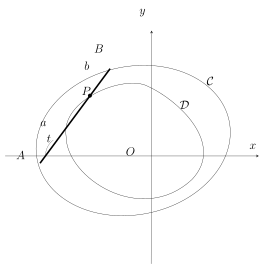
The ends of a thin  straight rod $AB$ lie on a closed convex curve $\cal C$. The point $P$ on the rod is a fixed distance $a$ from $A$ and a fixed distance $b$ from $B$.  The angle between  $AB$ and the positive $x$ direction  is $t$.  As $A$ and $B$ move anticlockwise round $\cal C$, the angle $t$ increases from $0$ to $2\pi$ and  $P$ traces a closed convex curve $\cal D$ inside $\cal C$, with the origin $O$ lying inside $\cal D$, as shown in the diagram.
\begin{center}
\begin{tikzpicture}[
    scale=0.8,
    >=stealth,
    line width=0.3pt,
    dot/.style={circle, fill=black, inner sep=0pt, minimum size=3pt}
]
% Bezier curves forming the main shape
\draw (0.04,2.13) .. controls (-0.22,3.77) and (2.63,4.87) .. (3.63,4.35);
\draw (3.63,4.35) .. controls (4.97,3.75) and (7.09,1.81) .. (5.59,0.23);
\draw (0.04,2.13) .. controls (0.05,0.29) and (3.37,-1.84) .. (5.59,0.23);
% Rotated ellipse
\draw[rotate around={11.46:(3,1.95)}] (3,1.95) ellipse (4.32 and 3.27);
% Thick line AB
\draw[line width=1.6pt] (-1.11,0.95) -- (1.98,5.12);
% Coordinate axes
\draw[->] (-2.65,1.27) -- (8.54,1.27);
\draw[->] (3.79,-3.49) -- (3.81,6.8);
% Small arc (approximating the parametric plot)
\draw[line width=0.2pt] (-0.87,1.28) arc (180:126.87:0.87);
\draw[line width=0.2pt] (-0.87,1.28) -- (-0.87,1.28);
% Labels
\node[above left] at (1.31,3.78) {$P$};
\node[above left] at (1.24,4.89) {$b$};
\node[above left] at (-0.65,2.41) {$a$};
\node[above left] at (1.87,5.65) {$B$};
\node[above left] at (-1.6,0.95) {$A$};
\node[above left] at (3.26,1.11) {$O$};
\node[above left] at (5.65,3.17) {$\mathcal{D}$};
\node[above left] at (6.73,4.22) {$\mathcal{C}$};
\node[above left] at (-0.45,1.7) {$t$};
\node[above left] at (3.72,7.25) {$y$};
\node[above left] at (8.6,1.4) {$x$};
% Dot
\fill (1.09,3.93) circle (2.5pt);
\end{tikzpicture}
\end{center}
Let $(x,y)$ be the coordinates of $P$. Write down the coordinates of $A$ and $B$ in terms of $a$, $b$, $x$, $y$ and $t$.
The areas swept out by $OA$, $OB$ and $OP$ are
denoted by $[A]$, $[B]$ and $[P]$, respectively.
Show, using $(*)$, that
\[
[A] = [P] +\pi a^2 - af
\]
where
\[
f = \tfrac12 \int _0^{2\pi} \left(
 \Big(x+\frac{\d y}{\d t}\Big)\cos t
+
  \Big(y- \frac{\d x}{\d t}\Big)\sin t
\right) \d t\,.
\]
Obtain a corresponding expression for $[B]$ involving $b$. Hence show that the area between the curves $\cal C$ and $\cal D$ is $\pi ab$.
Solution source
\begin{align*}
&& \tan \theta &= y/x \\
\Rightarrow && \sec^2 \theta \frac{\d \theta}{\d t} &= \frac{x \frac{\d y}{\d t} - y \frac{\d x}{\d t}}{x^2}
\\
\Rightarrow && \frac{\d \theta}{\d t} &=\left (x \frac{\d y}{\d t} - y \frac{\d x}{\d t} \right) \frac{\cos^2 \theta}{x^2}  \\
&&&=\left (x \frac{\d y}{\d t} - y \frac{\d x}{\d t} \right) \frac{\cos^2 \theta}{r^2 \cos^2 \theta } \\
&&&=\left (x \frac{\d y}{\d t} - y \frac{\d x}{\d t} \right) \frac{1}{r^2 } \\
&& \tfrac12 \int r^2 \, \d \theta &= \tfrac12 \int \left (x \frac{\d y}{\d t} - y \frac{\d x}{\d t} \right) \d t
\end{align*}


$A = (x - a \cos t, y - a \sin t), B = (x + b \cos t , y + b \sin t)$

\begin{align*}
&& [A] &= \tfrac12 \int_0^{2\pi} \left ((x-a \cos t) \frac{\d (y-a \sin t)}{\d t} - (y-a \sin t) \frac{\d (x-a \cos t)}{\d t} \right) \d t \\
&&&= \tfrac12 \int_0^{2\pi} \left ((x - a \cos t) \left ( \frac{\d y}{\d t} - a \cos t \right)  - (y - a \sin t) \left ( \frac{\d x}{\d t} + a \sin t \right)\right) \d t \\
&&&= \tfrac12 \int_0^{2\pi} \left ( x \frac{\d y}{\d t} - y \frac{\d x}{\d t} - a \cos t \frac{\d y}{\d t}-ax \cos t +a^2 \cos^2 t + a \sin t \frac{\d x}{\d t}-y a \sin t + a^2 \sin^2 t \right) \d t \\
&&&= \tfrac12 \int_0^{2\pi} \left ( \underbrace{x \frac{\d y}{\d t} - y \frac{\d x}{\d t}}_{[P]}-a\left ((x + \frac{\d y}{\d x}) \cos t + (y - \frac{\d x}{\d t}) \sin t \right) + \underbrace{a^2}_{\pi a^2}  \right) \d t \\
&&&= [P] + \pi a^2 - af
\end{align*}

\begin{align*}
&& [B] &= \tfrac12 \int_0^{2\pi} \left ((x+b \cos t) \frac{\d (y+b \sin t)}{\d t} - (y+b \sin t) \frac{\d (x+b \cos t)}{\d t} \right) \d t \\
&&&= \tfrac12 \int_0^{2\pi} \left ((x+b \cos t) (\frac{\d y}{\d t} + b \cos t) - (y+b \sin t)(\frac{\d x}{\d t} - b \sin t) \right) \d t \\
&&&=  \tfrac12 \int_0^{2\pi} \left (x \frac{\d y}{\d t} - y \frac{\d x}{\d t} + b^2 + b(\cos t (x + \frac{\d y}{\d t}) +(y - \frac{\d x}{\d t})\sin t\right) \d t \\
&&&= [P] + \pi b^2 + b f
\end{align*}

Since $A$ and $B$ trace out the same area, we must have $\pi a^2 - af = \pi b^2 + bf \Rightarrow \pi (a^2-b^2) = f(b+a) \Rightarrow f = \pi (a-b)$.

In particular the area inbetween is $[A] - [P] = \pi a^2 - a \pi (a-b)$
Less than a third of the candidates attempted this. There were quite a few perfect scores, however the vast majority scored less than a quarter of the marks, which was the mean mark. The general result at the start of the question was the key to success. Those that stumbled with handling four variables in terms of the fifth one, and the consequent calculus, did not attempt to make further progress into the rest of the question.