2024 Paper 2 Q3
Year: 2024
Paper: 2
Question Number: 3
Course: LFM Pure
Section: Coordinate Geometry
Problem
- Show that \(q = \tan\frac{1}{2}\theta\).
- In this part, \(q \neq 1\).
- Let \(\mathrm{f}_1(q) = \dfrac{1+q}{1-q}\). Show that \(\mathrm{f}_1(q) = \tan\frac{1}{2}\!\left(\theta + \frac{1}{2}\pi\right)\).
- Let \(Q_1\) be the point with coordinates \((0, \mathrm{f}_1(q))\) and \(P_1\) be the point of intersection (other than \(N\)) of the line \(NQ_1\) and the unit circle. Describe geometrically the relationship between \(P\) and \(P_1\).
- \(P_2\) is the image of \(P\) under an anti-clockwise rotation about \(O\) through angle \(\frac{1}{3}\pi\). The line \(NP_2\) intersects the \(y\)-axis at the point \(Q_2\) with co-ordinates \((0, \mathrm{f}_2(q))\). Find \(\mathrm{f}_2(q)\) in terms of \(q\), for \(q \neq \sqrt{3}\).
- In this part, \(q \neq -1\). Let \(\mathrm{f}_3(q) = \dfrac{1-q}{1+q}\), let \(Q_3\) be the point with coordinates \((0, \mathrm{f}_3(q))\) and let \(P_3\) be the point of intersection (other than \(N\)) of the line \(NQ_3\) and the unit circle. Describe geometrically the relationship between \(P\) and \(P_3\).
- In this part, \(0 < q < 1\). Let \(\mathrm{f}_4(q) = \mathrm{f}_2^{-1}\!\Big(\mathrm{f}_3\!\big(\mathrm{f}_2(q)\big)\Big)\), let \(Q_4\) be the point with coordinates \((0, \mathrm{f}_4(q))\) and let \(P_4\) be the point of intersection (other than \(N\)) of the line \(NQ_4\) and the unit circle. Describe geometrically the relationship between \(P\) and \(P_4\).
Solution
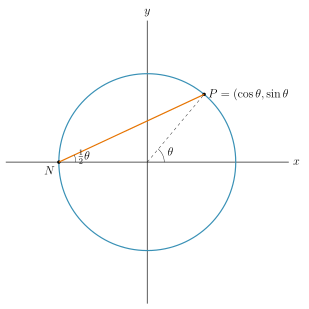
- \(\,\) \begin{align*} && \frac{y-0}{x-(-1)} &= \frac{\sin \theta }{\cos \theta + 1} \\ \Rightarrow && y_0 &= \frac{\sin \theta}{\cos \theta + 1} \\ &&&= \frac{\frac{2t}{1+t^2}}{\frac{1-t^2}{1+t^2}+1} \\ &&&= t = \tan \tfrac{\theta}{2} \end{align*} Alternatively, it is straightforward to see from the angles.
- \(f_1(q) = \frac{1+q}{1-q}\) so \begin{align*} && f_1(\tan\tfrac12\theta) &= \frac{1+\tan\tfrac12\theta}{1-\tan\tfrac12\theta} \\ &&&= \frac{\cos \tfrac12 \theta + \sin \tfrac12 \theta}{\cos \tfrac12 \theta - \sin \tfrac12 \theta} \\ &&&= \frac{\sin(\tfrac14 \pi + \tfrac12 \theta)}{\cos(\tfrac14 \pi + \tfrac12 \theta)} \\ &&&= \tan \tfrac12(\theta + \tfrac{\pi}{2}) \end{align*}
- \(Q_1\) is the point \((0, f_1(q))\) so \(P_1\) will be the point \((\cos (\theta + \tfrac{\pi}{2}), \sin (\theta + \tfrac{\pi}{2}))\) which is a rotation anticlockwise by \(\frac{\pi}{2}\)
- \(P_2 = (\cos(\theta + \tfrac{\pi}{3}), \sin( \theta + \tfrac{\pi}{3})\) and so \(f_2(q) = \tan (\tfrac12(\theta + \tfrac{\pi}{3}))\) so \begin{align*} && f_2(q) &= \tan (\tfrac12(\theta + \tfrac{\pi}{3})) \\ &&&= \frac{q + \tan \frac{\pi}{3}}{1 - \tan \frac{\pi}{3} \cdot q} \\ &&&= \frac{q + \frac{1}{\sqrt3}}{1 - \frac{q}{\sqrt{3}}} \\ &&&= \frac{\sqrt3 q + 1}{\sqrt3-q} \end{align*}
- Since \(q \to -q\) reflects \((0,q)\) in the \(x\)-axis, \(f_3(q) = f_1(-q)\) so \(P_3\) is the reflection of \(P_1\) so it's rotation by \(\frac{\pi}{2}\) followed by reflection in the \(x\)-axis, which is reflection in \(y=x\). [ie \(\theta \to -\theta + \frac{\pi}{2} \to \frac{\pi}{2}-\theta\)]
- We are rotating by \(\frac{\pi}{3}\) then reflecting in \(y=x\) and then rotating by \(-\frac{\pi}{3}\), ie \(\theta \to \theta + \frac{\pi}{3} \to \frac{\pi}{6}-\theta \to -\theta -\frac{\pi}{6} \)
Examiner's report
— 2024 STEP 2, Question 3Many candidates produced good solutions to the questions, with the majority of candidates opting to focus on the pure questions of the paper. Candidates demonstrated very good ability, particularly in the area of manipulating algebra. Many candidates produced clear diagrams which in many cases meant that they were more successful in their attempts at their questions than those who did not do so. The paper also contained a number of places where the answer to be reached was given in the question. In such cases, candidates must be careful to ensure that they provide sufficient evidence of the method used to reach the result in order to gain full credit.
Rating Information
Difficulty Rating: 1500.0
Difficulty Comparisons: 0
Banger Rating: 1500.0
Banger Comparisons: 0
Show LaTeX source
Problem source
The unit circle is the circle with radius 1 and centre the origin, $O$.
$N$ and $P$ are distinct points on the unit circle. $N$ has coordinates $(-1, 0)$, and $P$ has coordinates $(\cos\theta, \sin\theta)$, where $-\pi < \theta < \pi$. The line $NP$ intersects the $y$-axis at $Q$, which has coordinates $(0, q)$.
\begin{questionparts}
\item Show that $q = \tan\frac{1}{2}\theta$.
\item In this part, $q \neq 1$.
\begin{enumerate}
\item Let $\mathrm{f}_1(q) = \dfrac{1+q}{1-q}$. Show that $\mathrm{f}_1(q) = \tan\frac{1}{2}\!\left(\theta + \frac{1}{2}\pi\right)$.
\item Let $Q_1$ be the point with coordinates $(0, \mathrm{f}_1(q))$ and $P_1$ be the point of intersection (other than $N$) of the line $NQ_1$ and the unit circle. Describe geometrically the relationship between $P$ and $P_1$.
\end{enumerate}
\item
\begin{enumerate}
\item $P_2$ is the image of $P$ under an anti-clockwise rotation about $O$ through angle $\frac{1}{3}\pi$. The line $NP_2$ intersects the $y$-axis at the point $Q_2$ with co-ordinates $(0, \mathrm{f}_2(q))$. Find $\mathrm{f}_2(q)$ in terms of $q$, for $q \neq \sqrt{3}$.
\item In this part, $q \neq -1$. Let $\mathrm{f}_3(q) = \dfrac{1-q}{1+q}$, let $Q_3$ be the point with coordinates $(0, \mathrm{f}_3(q))$ and let $P_3$ be the point of intersection (other than $N$) of the line $NQ_3$ and the unit circle. Describe geometrically the relationship between $P$ and $P_3$.
\item In this part, $0 < q < 1$. Let $\mathrm{f}_4(q) = \mathrm{f}_2^{-1}\!\Big(\mathrm{f}_3\!\big(\mathrm{f}_2(q)\big)\Big)$, let $Q_4$ be the point with coordinates $(0, \mathrm{f}_4(q))$ and let $P_4$ be the point of intersection (other than $N$) of the line $NQ_4$ and the unit circle. Describe geometrically the relationship between $P$ and $P_4$.
\end{enumerate}
\end{questionparts}
Solution source
\begin{center}
    \begin{tikzpicture}
    \def\functionf(#1){exp(1/(#1)*ln(#1))};
    \def\xl{-1.6};
    \def\xu{1.6};
    \def\yl{-1.6};
    \def\yu{1.6};

    % Calculate scaling factors to make the plot square
    \pgfmathsetmacro{\xrange}{\xu-\xl}
    \pgfmathsetmacro{\yrange}{\yu-\yl}
    \pgfmathsetmacro{\xscale}{10/\xrange}
    \pgfmathsetmacro{\yscale}{10/\yrange}

    % Define the reusable styles to keep code clean
    \tikzset{
        x=\xscale cm, y=\yscale cm,
        axis/.style={thick, draw=black!80, -{Stealth[scale=1.2]}},
        grid/.style={thin, dashed, gray!30},
        curveA/.style={very thick, color=cyan!70!black, smooth},
        curveB/.style={very thick, color=orange!90!black, smooth},
        curveC/.style={very thick, color=green!90!black, smooth},
        curveBlack/.style={very thick, color=black, smooth},
        dot/.style={circle, fill=black, inner sep=1.2pt},
        labelbox/.style={fill=white, inner sep=2pt, rounded corners=2pt} % Protects text from lines
    }

    % Draw background grid
    \draw[grid] (\xl,\yl) (\xu,\yu);

    % Set up axes
    \draw[axis] (\xl,0) -- (\xu,0) node[right, black] {$x$};
    \draw[axis] (0,\yl) -- (0,\yu) node[above, black] {$y$};

    % Define the bounding region with clip
    \begin{scope}
        \clip (\xl,\yl) rectangle (\xu,\yu);

        \draw[curveA] (0,0) circle (1);

        \coordinate (O) at (0,0);
        \coordinate (X) at (1,0);
        \coordinate (P) at  ({cos(50)}, {sin(50)});
        \coordinate (N) at  (-1, 0);

        \filldraw (P) circle (1.5pt) node[right] {$P = (\cos \theta, \sin \theta)$};
        \filldraw (N) circle (1.5pt) node[below left] {$N$};

        \draw[curveB] (P) -- (N);

        \draw[dashed] (O) -- (P);

        \pic [draw, angle radius=.6cm, angle eccentricity=1.5, "$\theta$"] {angle = X--O--P};
        \pic [draw, angle radius=.6cm, angle eccentricity=1.5, "$\frac12\theta$"] {angle = O--N--P};

    \end{scope}

    % Annotate Function Names
    % \node[curveB, labelbox] at (1.85, -1.1) {$x = \frac{4y^2+1}{3}$};


    \end{tikzpicture}
\end{center}
\begin{questionparts}

\item $\,$ \begin{align*}
&& \frac{y-0}{x-(-1)} &= \frac{\sin \theta }{\cos \theta + 1} \\
\Rightarrow && y_0 &= \frac{\sin \theta}{\cos \theta + 1} \\
&&&= \frac{\frac{2t}{1+t^2}}{\frac{1-t^2}{1+t^2}+1} \\
&&&= t = \tan \tfrac{\theta}{2}
\end{align*}
Alternatively, it is straightforward to see from the angles.

\item \begin{enumerate}
\item $f_1(q) = \frac{1+q}{1-q}$ so \begin{align*}
&& f_1(\tan\tfrac12\theta) &= \frac{1+\tan\tfrac12\theta}{1-\tan\tfrac12\theta} \\
&&&= \frac{\cos \tfrac12 \theta + \sin \tfrac12 \theta}{\cos \tfrac12 \theta  - \sin \tfrac12 \theta} \\
&&&= \frac{\sin(\tfrac14 \pi + \tfrac12 \theta)}{\cos(\tfrac14 \pi + \tfrac12 \theta)} \\
&&&= \tan \tfrac12(\theta + \tfrac{\pi}{2})
\end{align*}

\item $Q_1$ is the point $(0, f_1(q))$ so $P_1$ will be the point $(\cos (\theta + \tfrac{\pi}{2}), \sin (\theta + \tfrac{\pi}{2}))$ which is a rotation anticlockwise by $\frac{\pi}{2}$
\end{enumerate}


\item \begin{enumerate}
\item $P_2 = (\cos(\theta + \tfrac{\pi}{3}), \sin( \theta + \tfrac{\pi}{3})$ and so $f_2(q) = \tan (\tfrac12(\theta + \tfrac{\pi}{3}))$ so
\begin{align*}
&& f_2(q) &= \tan (\tfrac12(\theta + \tfrac{\pi}{3})) \\
&&&= \frac{q + \tan \frac{\pi}{3}}{1 - \tan \frac{\pi}{3} \cdot q} \\
&&&= \frac{q + \frac{1}{\sqrt3}}{1 - \frac{q}{\sqrt{3}}} \\
&&&= \frac{\sqrt3 q + 1}{\sqrt3-q}
\end{align*}

\item Since $q \to -q$ reflects $(0,q)$ in the $x$-axis, $f_3(q) = f_1(-q)$ so $P_3$ is the reflection of $P_1$ so it's rotation by $\frac{\pi}{2}$ followed by reflection in the $x$-axis, which is reflection in $y=x$. [ie $\theta \to -\theta + \frac{\pi}{2} \to \frac{\pi}{2}-\theta$]

\item We are rotating by $\frac{\pi}{3}$ then reflecting in $y=x$ and then rotating by $-\frac{\pi}{3}$, ie $\theta \to \theta + \frac{\pi}{3} \to \frac{\pi}{6}-\theta  \to -\theta -\frac{\pi}{6} $
\end{enumerate}

\end{questionparts}
This question was attempted by approximately three-quarters of the candidates, but only a few were able to achieve a fully complete solution to the question. This question was one where a diagram was very helpful and approaches that were supported by geometrical understanding were generally more successful than attempts that relied solely on algebra. Part (i) was very well done, but candidates who used geometrical arguments generally did not address cases not covered by their diagram – usually this was the case where the value of θ was negative. Part (ii) was also done well, but some candidates failed to give enough working to support their answer in (a), which is very important in questions where the answer is given. Similarly, in (b) a number of candidates did not show clearly how they interpreted their algebraic work to reach a geometrical description. Part (iii) was found to be difficult by a large number of candidates. Part (a) was generally done well, although some care with the algebra and exact trigonometric values was needed. Many were then unable to identify a relationship between f3 and the previously seen functions and did not reach a correct geometrical description in words. A small number did well on part (c) and were able to interpret the inverse of function f2 geometrically, but very few reached a fully simplified geometrical transformation.