2021 Paper 2 Q6
Year: 2021
Paper: 2
Question Number: 6
Course: LFM Pure
Section: Coordinate Geometry
Problem
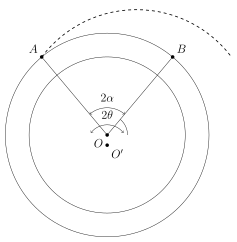
- Show that I cannot cycle from \(A\) to \(B\) in a straight line, while remaining on the road.
- I take a path from \(A\) to \(B\) that is an arc of a circle. This circle is tangent to the inner edge of the road, and has radius \(R + d\) (where \(d > w\)) and centre~\(O'\).
My path is represented by the dashed arc in the above diagram.
Let \(\angle AO'B = 2\theta\).
- Use the cosine rule to find \(d\) in terms of \(w\), \(R\) and \(\cos\alpha\).
- Find also an expression for \(\sin(\alpha - \theta)\) in terms of \(R\), \(d\) and \(\sin\alpha\).
- Show that \(\dfrac{d}{R}\) and \(\alpha - \theta\) are also both much less than \(1\).
- My friend cycles from \(A\) to \(B\) along the outer edge of the road. Let my path be shorter than my friend's path by distance~\(S\). Show that \[ S = 2(R+d)(\alpha - \theta) + 2\alpha(w - d). \] Hence show that \(S\) is approximately a fraction \[ \frac{\sin\alpha - \alpha\cos\alpha}{\alpha(1 - \cos\alpha)} \cdot \frac{w}{R} \] of the length of my friend's path.
No solution available for this problem.
Examiner's report
— 2021 STEP 2, Question 6Candidates were generally well prepared for many of the questions on this paper, with the questions requiring more standard operations seeing the greatest levels of success. Candidates need to ensure that solutions to the questions are supported by sufficient evidence of the mathematical steps, for example when proving a given result or deducing the properties of graphs that are to be sketched. In a significant number of steps there were marks lost through simple errors such as mistakes in arithmetic or confusion of sine and cosine functions, so it is important for candidates to maintain accuracy in their solutions to these questions.
Rating Information
Difficulty Rating: 1500.0
Difficulty Comparisons: 0
Banger Rating: 1500.0
Banger Comparisons: 0
Show LaTeX source
Problem source
A plane circular road is bounded by two concentric circles with centres at point~$O$. The inner circle has radius $R$ and the outer circle has radius $R + w$. The points $A$ and $B$ lie on the outer circle, as shown in the diagram, with $\angle AOB = 2\alpha$, $\tfrac{1}{3}\pi \leqslant \alpha \leqslant \tfrac{1}{2}\pi$ and $0 < w < R$.

\begin{center}
\begin{tikzpicture}[scale=1.2]
    % Outer circle
    \draw (0,0) circle (3cm);
    % Inner circle
    \draw (0,0) circle (2.3cm);
    % Centre O
    \fill (0,0) circle (1.5pt) node[below left]{$O$};
    % Points A and B on outer circle
    \coordinate (A) at (130:3);
    \coordinate (B) at (50:3);
    \fill (A) circle (1.5pt) node[above left]{$A$};
    \fill (B) circle (1.5pt) node[above right]{$B$};
    % Lines OA and OB
    \draw (0,0) -- (A);
    \draw (0,0) -- (B);
    % Angle 2alpha
    \draw (0.6,0) arc[start angle=0, end angle=50, radius=0.6] node[midway, right, xshift=2pt]{};
    \draw[<->] (50:0.8) arc[start angle=50, end angle=130, radius=0.8];
    \node at (90:1.1) {$2\alpha$};
    % Centre O'
    \coordinate (Op) at (90:-0.3);
    \fill (Op) circle (1.5pt) node[below right]{$O'$};
    % Dashed arc (path from A to B)
    \draw[dashed, thick] (A) arc[start angle=143, end angle=37, radius=3.5cm];
    % Angle 2theta
    \draw[<->] ([shift=(143:0.6)]90:-0.3) arc[start angle=143, end angle=37, radius=0.6];
    \node at ([shift=(90:0.9)]90:-0.3) {$2\theta$};
\end{tikzpicture}
\end{center}

\begin{questionparts}
    \item Show that I cannot cycle from $A$ to $B$ in a straight line, while remaining on the road.

    \item I take a path from $A$ to $B$ that is an arc of a circle. This circle is tangent to the inner edge of the road, and has radius $R + d$ (where $d > w$) and centre~$O'$.

    My path is represented by the dashed arc in the above diagram.

    Let $\angle AO'B = 2\theta$.
    \begin{enumerate}[label=(\alph*)]
        \item Use the cosine rule to find $d$ in terms of $w$, $R$ and $\cos\alpha$.
        \item Find also an expression for $\sin(\alpha - \theta)$ in terms of $R$, $d$ and $\sin\alpha$.
    \end{enumerate}

    You are now given that $\dfrac{w}{R}$ is much less than $1$.

    \item Show that $\dfrac{d}{R}$ and $\alpha - \theta$ are also both much less than $1$.

    \item My friend cycles from $A$ to $B$ along the outer edge of the road.

    Let my path be shorter than my friend's path by distance~$S$. Show that
    \[
        S = 2(R+d)(\alpha - \theta) + 2\alpha(w - d).
    \]
    Hence show that $S$ is approximately a fraction
    \[
        \frac{\sin\alpha - \alpha\cos\alpha}{\alpha(1 - \cos\alpha)} \cdot \frac{w}{R}
    \]
    of the length of my friend's path.
\end{questionparts}
This was not a popular question and many of the attempts made did not score well. Part (i) was relatively successful with most candidates able to show that the perpendicular distance from O to the line segment AB must be less than R for the given constraints. Part (ii) proved to be relatively simple for those who chose to draw a clear diagram, although some candidates chose to focus on the wrong triangle meaning that the wrong angles were used. Part (iii) caused more difficulty and many candidates were not able to understand the significance of the phrase "much less than 1" and so candidates who made assumptions about variables tending to 0 rather than using small angle approximations often scored no marks. Solutions in part (iv) often jumped too quickly to the result printed in the question. It is important that solutions to questions in which the result to be proved has been given contain sufficient detail to show all of the steps being taken.