2016 Paper 1 Q5
Year: 2016
Paper: 1
Question Number: 5
Course: LFM Pure
Section: Coordinate Geometry
Problem
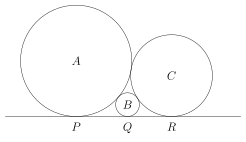
- The diagram shows three touching circles \(A\), \(B\) and \(C\), with a common tangent \(PQR\). The radii of the circles are \(a\), \(b\) and \(c\), respectively. Show that \[ \frac 1 {\sqrt b} = \frac 1 {\sqrt{a}} + \frac1{\sqrt{c}} \tag{\(*\)} \] and deduce that \[ 2\left(\frac1{a^2} + \frac1 {b^2} + \frac1 {c^2} \right) = \left(\frac1 a + \frac1 {b} + \frac1 {c} \right)^{\!2} . \tag{\(**\)} \]
- Instead, let \(a\), \(b\) and \(c\) be positive numbers, with \(b < c < a\), which satisfy \((**)\). Show that they also satisfy \((*)\).
Solution
- \(\,\)
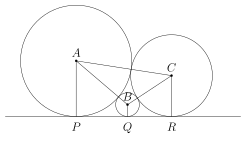
Notice that \begin{align*} && (a+b)^2 &= PQ^2 + (a-b)^2 \\ \Rightarrow && PQ^2 &= 4ab \\ && (b+c)^2 &= QR^2 + (c-b)^2 \\ \Rightarrow && QR^2 &= 4bc \\ && (a+c)^2 &= PR^2 + (a-c)^2 \\ \Rightarrow && PR^2 &= 4ac \\ \Rightarrow && 2\sqrt{ac} &= 2\sqrt{ab}+2\sqrt{bc} \\ \Rightarrow && \frac{1}{\sqrt{b}} &= \frac{1}{\sqrt{c}} + \frac1{\sqrt{a}} \\ \end{align*} Let \(x, y, z = \frac{1}{\sqrt{a}}, \frac1{\sqrt{b}}, \frac{1}{\sqrt{z}}\) so we would like to prove that \(2(x^4+y^4+z^4) = (x^2+y^2+z^2)^2\) or \(x^4+y^4+z^4 = 2x^2y^2+2y^2z^2+2z^2x^2\). We also have \begin{align*} && y &= x+z \\ \Rightarrow &&y^2 &= x^2+z^2+2xz \\ \Rightarrow && (y^2-x^2-z^2)^2 &= 4x^2z^2 \\ \Rightarrow && y^4+x^4+z^4 - 2x^2y^2-2y^2z^2+2x^2z^2 &= 4x^2z^2\\ \Rightarrow && y^4+x^4+z^4 &= 2x^2y^2+2y^2z^2+2z^2x^2 \end{align*}
- Notice that subject to \(y > z > x\) all these steps are reversible, so we must have the equality we desire
Examiner's report
— 2016 STEP 1, Question 5This year, more than 2000 candidates signed up to sit this paper, though just under 2000 actually sat it. This figure is about the same as the entry figure for 2015, though the number of candidates opting to sit STEP I has risen significantly over recent years; for instance, it was around 1500 in 2013. There is no doubt that the purpose of the STEPs is to learn which students can genuinely use their mathematical knowledge, skills and techniques in an arena that demands of them a level of performance that exceeds anything they will have encountered within the standard A-level (or equivalent) assessments. The ability to work at an extended piece of mathematical work, often with the minimum of specific guidance, allied to the need for both determination and the ability to "make connections" at speed and under considerable time pressure, are characteristics that only follow from careful preparation, and there is a great benefit to be had from an early encounter with, and subsequent prolonged exposure to, these kinds of questions. It is not always easy to say what level of preparation has been undertaken by candidates, but the minimum expected requirement is the ability to undertake routine A-level-standard tasks and procedures with speed and accuracy. At the top end of the scale, almost 100 candidates produced a three-figure score to the paper, which is a phenomenal achievement; and around 250 others scored a mark of 70+, which is also exceptionally impressive. At the other end of the scale, over 400 candidates failed to reach a total of 40 marks out of the 120 available. For STEP I, the most approachable questions are always set as Qs.1 & 2 on the paper, with Q1 in particular intended to afford every candidate the opportunity to get something done successfully. So it is perfectly reasonable for a candidate, upon opening the paper, to make an immediate start at the first and/or second question(s) before looking around to decide which of the remaining 10 or 11 questions they feel they can tackle. It is very important that candidates spend a few minutes – possibly at the beginning – reading through the questions to decide which six they intend to work, since they will ultimately only be credited with their best six question marks. Many students spend time attempting seven, eight, or more questions and find themselves giving up too easily on a question the moment the going gets tough, and this is a great pity, since they are not allowing themselves thinking time, either on the paper as a whole or on individual questions. The other side to the notion of strategy is that most candidates clearly believe that they need to attempt (at least) six questions when, in fact, four questions (almost) completely done would guarantee a Grade 1 (Distinction), especially if their score on these first four questions were then to be supplemented by a couple of early attempts at the starting parts of a couple more questions (for the first five or six marks); attempts which need not take longer than, say, ten minutes of their time. It is thus perfectly reasonable to suggest to candidates, in their preparations, that they can spend more than 30 minutes on a question, but only IF they think they are going to finish it off satisfactorily, although it might be best if they were advised to spend absolutely no more than 40-45 minutes on any single question; if they haven't finished by then, it really is time to move on. Curve-sketching skills are usually a common weakness, but were only tested on this paper in Q3. The other common area of weakness – algebra – was tested relatively frequently, and proved to be as testing as usual. Calculus skills were generally "okay" although the integration of first-order differential equations by the separation of variables, as appearing repeatedly in Q4, was found challenging by many of the candidates who attempted this question. The most noticeable deficiency, however, was in the widespread inability to construct an argument, particularly in Qs. 5, 7 & 8. Vectors are often poorly handled, and this year proved no exception.
Rating Information
Difficulty Rating: 1484.0
Difficulty Comparisons: 1
Banger Rating: 1516.0
Banger Comparisons: 1
Show LaTeX source
Problem source
\begin{questionparts}
\item
\begin{center}
\begin{tikzpicture}
% Define the precise coordinates and sizes mathematically
% to guarantee perfect tangency everywhere.
\coordinate (A) at (0, 1.96);
\coordinate (C) at (3.36, 1.44);
\coordinate (B) at (1.80923, 0.41751);
\coordinate (P) at (0, 0);
\coordinate (Q) at (1.80923, 0);
\coordinate (R) at (3.36, 0);
% Draw the horizontal bottom line
% (Extends comfortably past the outer edges of A and C)
\draw (-2.5, 0) -- (5.8, 0);
% Draw the three tangent circles
\draw (A) circle (1.96);
\draw (C) circle (1.44);
\draw (B) circle (0.41751);
% Add the circle center labels
\node at (A) {$A$};
\node at (C) {$C$};
\node at (B) {$B$};
% Add the point labels along the line
\node[below=2pt] at (P) {$P$};
\node[below=2pt] at (Q) {$Q$};
\node[below=2pt] at (R) {$R$};
\end{tikzpicture}
\end{center}
The diagram shows three touching circles $A$, $B$ and $C$, with a common tangent $PQR$. The radii of the circles are $a$, $b$ and $c$, respectively.
Show that
\[
\frac 1 {\sqrt b} = \frac 1 {\sqrt{a}} + \frac1{\sqrt{c}}
\tag{$*$}
\]
and deduce that
\[
2\left(\frac1{a^2} + \frac1 {b^2} + \frac1 {c^2}
\right)
=
\left(\frac1 a + \frac1 {b} + \frac1 {c}
\right)^{\!2}
.
\tag{$**$}
\]
\item
Instead, let $a$, $b$ and $c$ be  positive numbers, with  $b < c < a$, which satisfy $(**)$. Show that they also satisfy $(*)$.
\end{questionparts}
Solution source
\begin{questionparts}
\item $\,$
\begin{center}
\begin{tikzpicture}

% Define the precise coordinates and sizes mathematically
% to guarantee perfect tangency everywhere.
\coordinate (A) at (0, 1.96);
\coordinate (C) at (3.36, 1.44);
\coordinate (B) at (1.80923, 0.41751);

\coordinate (P) at (0, 0);
\coordinate (Q) at (1.80923, 0);
\coordinate (R) at (3.36, 0);

% Draw the horizontal bottom line
% (Extends comfortably past the outer edges of A and C)
\draw (-2.5, 0) -- (5.8, 0);

% Draw the three tangent circles
\draw (A) circle (1.96);
\draw (C) circle (1.44);
\draw (B) circle (0.41751);

% Add the circle center labels
\filldraw (A) circle (1pt) node[above] {$A$};
\filldraw (B) circle (1pt) node[above] {$B$};
\filldraw (C) circle (1pt) node[above] {$C$};

\draw (Q) -- (B) -- (A) -- (C) -- (B);
\draw (P) -- (A);
\draw (R) -- (C);

% Add the point labels along the line
\node[below=2pt] at (P) {$P$};
\node[below=2pt] at (Q) {$Q$};
\node[below=2pt] at (R) {$R$};

\end{tikzpicture}
\end{center}

Notice that
\begin{align*}
    && (a+b)^2 &= PQ^2 + (a-b)^2 \\
    \Rightarrow && PQ^2 &= 4ab \\
    && (b+c)^2 &= QR^2 + (c-b)^2 \\
    \Rightarrow && QR^2 &= 4bc \\
    && (a+c)^2 &= PR^2 + (a-c)^2 \\
    \Rightarrow && PR^2 &= 4ac \\
    \Rightarrow && 2\sqrt{ac} &= 2\sqrt{ab}+2\sqrt{bc} \\
    \Rightarrow && \frac{1}{\sqrt{b}} &= \frac{1}{\sqrt{c}} + \frac1{\sqrt{a}} \\
\end{align*}

Let $x, y, z = \frac{1}{\sqrt{a}}, \frac1{\sqrt{b}}, \frac{1}{\sqrt{z}}$ so we would like to prove that $2(x^4+y^4+z^4) = (x^2+y^2+z^2)^2$ or $x^4+y^4+z^4 = 2x^2y^2+2y^2z^2+2z^2x^2$.

We also have
\begin{align*}
   && y &= x+z \\
   \Rightarrow &&y^2 &= x^2+z^2+2xz \\
   \Rightarrow && (y^2-x^2-z^2)^2 &= 4x^2z^2 \\
   \Rightarrow && y^4+x^4+z^4 - 2x^2y^2-2y^2z^2+2x^2z^2 &= 4x^2z^2\\
   \Rightarrow && y^4+x^4+z^4 &= 2x^2y^2+2y^2z^2+2z^2x^2
\end{align*}

\item  Notice that subject to $y > z > x$ all these steps are reversible, so we must have the equality we desire
\end{questionparts}
Attempts at this question were down to around a third of the candidature and, overall, it proved to be the lowest scoring question on the paper with a mean score of just 3 out of 20. The big problem here was the widespread inability to draw some suitable lines onto the diagram, or to realise that the lines joining the centres necessarily passed through the points of contact. Once this is done, there is an obvious right-angled triangle to be found embedded within this geometric arrangement that then requires only the use of Pythagoras' Theorem to make a start. Although there were relatively few complete efforts to be found, many who did manage to make a good start found aspects of the algebra difficult: for instance, turning result (*) into (**). Here, there are several good approaches provided one uses (*) sensibly to eliminate (say) b. Admittedly, the last part to the question was more demanding to deal with, but it was clear from responses that the majority of even those candidates who got this far struggled to see the logical difference between proving A⇒B and proving B⇒A.