Problems
Filters
37 problems found
2023 Paper 3 Q9
Two particles, \(A\) of mass \(m\) and \(B\) of mass \(M\), are fixed to the ends of a light inextensible string \(AB\) of length \(r\) and lie on a smooth horizontal plane. The origin of coordinates and the \(x\)- and \(y\)-axes are in the plane. Initially, \(A\) is at \((0,\,0)\) and \(B\) is at \((r,\,0)\). \(B\) is at rest and \(A\) is given an instantaneous velocity of magnitude \(u\) in the positive \(y\) direction. At a time \(t\) after this, \(A\) has position \((x,\,y)\) and \(B\) has position \((X,\,Y)\). You may assume that, in the subsequent motion, the string remains taut.
- Explain by means of a diagram why \[X = x + r\cos\theta\] \[Y = y - r\sin\theta\] where \(\theta\) is the angle clockwise from the positive \(x\)-axis of the vector \(\overrightarrow{AB}\).
- Find expressions for \(\dot{X}\), \(\dot{Y}\), \(\ddot{X}\) and \(\ddot{Y}\) in terms of \(\ddot{x}\), \(\ddot{y}\), \(\dot{x}\), \(\dot{y}\), \(r\), \(\ddot{\theta}\), \(\dot{\theta}\) and \(\theta\), as appropriate. Assume that the tension \(T\) in the string is the only force acting on either particle.
- Show that \[\ddot{x}\sin\theta + \ddot{y}\cos\theta = 0\] \[\ddot{X}\sin\theta + \ddot{Y}\cos\theta = 0\] and hence that \(\theta = \dfrac{ut}{r}\).
- Show that \[m\ddot{x} + M\ddot{X} = 0\] \[m\ddot{y} + M\ddot{Y} = 0\] and find \(my + MY\) in terms of \(t\) and \(m, M, u, r\) as appropriate.
- Show that \[y = \frac{1}{m+M}\left(mut + Mr\sin\!\left(\frac{ut}{r}\right)\right).\]
- Show that, if \(M > m\), then the \(y\) component of the velocity of particle \(A\) will be negative at some time in the subsequent motion.
2022 Paper 3 Q9
- Two particles \(A\) and \(B\), of masses \(m\) and \(km\) respectively, lie at rest on a smooth horizontal surface. The coefficient of restitution between the particles is \(e\), where \(0 < e < 1\). Particle \(A\) is then projected directly towards particle \(B\) with speed \(u\). Let \(v_1\) and \(v_2\) be the velocities of particles \(A\) and \(B\), respectively, after the collision, in the direction of the initial velocity of \(A\). Show that \(v_1 = \alpha u\) and \(v_2 = \beta u\), where \(\alpha = \dfrac{1 - ke}{k+1}\) and \(\beta = \dfrac{1+e}{k+1}\). Particle \(B\) strikes a vertical wall which is perpendicular to its direction of motion and a distance \(D\) from the point of collision with \(A\), and rebounds. The coefficient of restitution between particle \(B\) and the wall is also \(e\). Show that, if \(A\) and \(B\) collide for a second time at a point \(\frac{1}{2}D\) from the wall, then \[ k = \frac{1+e-e^2}{e(2e+1)}\,. \]
- Three particles \(A\), \(B\) and \(C\), of masses \(m\), \(km\) and \(k^2m\) respectively, lie at rest on a smooth horizontal surface in a straight line, with \(B\) between \(A\) and \(C\). A vertical wall is perpendicular to this line and lies on the side of \(C\) away from \(A\) and \(B\). The distance between \(B\) and \(C\) is equal to \(d\) and the distance between \(C\) and the wall is equal to \(3d\). The coefficient of restitution between each pair of particles, and between particle \(C\) and the wall, is \(e\), where \(0 < e < 1\). Particle \(A\) is then projected directly towards particle \(B\) with speed \(u\). Show that, if all three particles collide simultaneously at a point \(\frac{3}{2}d\) from the wall, then \(e = \frac{1}{2}\).
2019 Paper 3 Q9
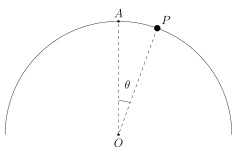
In this question, \(\mathbf{i}\) and \(\mathbf{j}\) are perpendicular unit vectors and \(\mathbf{j}\) is vertically upwards. A smooth hemisphere of mass \(M\) and radius \(a\) rests on a smooth horizontal table with its plane face in contact with the table. The point \(A\) is at the top of the hemisphere and the point \(O\) is at the centre of its plane face. Initially, a particle \(P\) of mass \(m\) rests at \(A\). It is then given a small displacement in the positive \(\mathbf{i}\) direction. At a later time \(t\), when the particle is still in contact with the hemisphere, the hemisphere has been displaced by \(-s\mathbf{i}\) and \(\angle AOP = \theta\).
- Let \(\mathbf{r}\) be the position vector of the particle at time \(t\) with respect to the initial position of \(O\). Write down an expression for \(\mathbf{r}\) in terms of \(a\), \(\theta\) and \(s\) and show that $$\dot{\mathbf{r}} = (a\dot{\theta} \cos \theta - \dot{s})\mathbf{i} - a\dot{\theta} \sin \theta \mathbf{j}.$$ Show also that $$\dot{s} = (1 - k)a\dot{\theta} \cos \theta,$$ where \(k = \frac{M}{m + M}\), and deduce that $$\dot{\mathbf{r}} = a\dot{\theta}(k \cos \theta \mathbf{i} - \sin \theta \mathbf{j}).$$
- Show that $$a\dot{\theta}^2 \left(k \cos^2 \theta + \sin^2 \theta\right) = 2g(1 - \cos \theta).$$
- At time \(T\), when \(\theta = \alpha\), the particle leaves the hemisphere. By considering the component of \(\ddot{\mathbf{r}}\) parallel to the vector \(\sin \theta \mathbf{i} + k \cos \theta \mathbf{j}\), or otherwise, show that at time \(T\) $$a\dot{\theta}^2 = g \cos \alpha.$$ Find a cubic equation for \(\cos \alpha\) and deduce that \(\cos \alpha > \frac{2}{3}\).
Solution:
- \(\mathbf{r} = (a \sin \theta - s) \mathbf{i}+a\cos \theta\mathbf{j}\), so \begin{align*} && \dot{\mathbf{r}} &=(a \dot{\theta} \cos \theta - \dot{s}) \mathbf{i}- a\dot{\theta} \sin \theta \mathbf{j}\\ \\ \text{COM}(\rightarrow): && 0 &= M(-\dot{s}) + m(a \dot{\theta} \cos \theta - \dot{s}) \\ \Rightarrow && \dot{s} &= \frac{ma \dot{\theta} \cos \theta}{m+M} \\ &&&= \left ( 1- \frac{M}{m+M} \right) a\dot{\theta} \cos \theta \\ &&&= (1 - k) a\dot{\theta} \cos \theta \\ \\ \Rightarrow && \dot{\mathbf{r}} &=(a \dot{\theta} \cos \theta - \dot{s}) \mathbf{i}- a\dot{\theta} \sin \theta \mathbf{j} \\ &&&= (a \dot{\theta} \cos \theta - (1 - k) a\dot{\theta} \cos \theta) \mathbf{i}- a\dot{\theta} \sin \theta \mathbf{j} \\ &&&= a\dot{\theta} \left ( k \cos \theta \mathbf{i} - \sin \theta \mathbf{j} \right) \end{align*}
- \(\,\) \begin{align*} COE: &&\underbrace{0}_{\text{k.e.}}+ \underbrace{mga}_{\text{GPE}} &= \underbrace{\frac12 m \mathbf{\dot{r}}\cdot\mathbf{\dot{r}}}_{\text{k.e. }P} + \underbrace{mg a\cos \theta}_{\text{GPE}} + \underbrace{\frac12 M \dot{s}^2}_{\text{k.e. hemisphere}} \\ \Rightarrow && 2amg(1-\cos \theta) &= a^2m \dot{\theta}^2(k^2 \cos^2 \theta + \sin^2 \theta)+ M(1 - k)^2 a^2\dot{\theta}^2 \cos^2 \theta \\ \Rightarrow && 2mg(1-\cos \theta) &= a \dot{\theta}^2 \left (m\sin^2 \theta + (mk^2 + M(1-k)^2)\cos^2 \theta \right) \\ &&&= a \dot{\theta}^2 \left (m\sin^2 \theta + mk\cos^2 \theta \right) \\ \Rightarrow && 2g(1-\cos \theta) &= a \dot{\theta}^2 \left (\sin^2 \theta + k\cos^2 \theta \right) \\ \end{align*}
- The equation of motion is \(m \ddot{\mathbf{r}} = \mathbf{R} - mg\mathbf{j}\) and the particle will leave the surface when \(\mathbf{R} = 0\). If we take the component in the directions suggested: \begin{align*} && \ddot{\mathbf{r}} &= a\ddot{\theta}(k \cos \theta \mathbf{i}- \sin \theta \mathbf{j}) + a \dot{\theta}(-k\dot{\theta} \sin \theta \mathbf{i}- \dot{\theta} \cos \theta \mathbf{j}) \\ &&&= ak (\ddot{\theta} \cos \theta - \dot{\theta}^2 \sin \theta) \mathbf{i} -a(\ddot{\theta} \sin \theta + \dot{\theta}^2 \cos \theta) \mathbf{j} \\ \Rightarrow && \mathbf{\ddot{r}} \cdot (\sin \theta \mathbf{i} + k \cos \theta \mathbf{j}) &= ak (\ddot{\theta} \cos \theta - \dot{\theta}^2 \sin \theta) \sin \theta -ak(\ddot{\theta} \sin \theta + \dot{\theta}^2 \cos \theta)\cos \theta \\ &&&= - ak \dot{\theta}^2 \\ && (-g\mathbf{j}) \cdot (\sin \theta \mathbf{i} + k \cos \theta \mathbf{j}) &= -gk \cos \theta \\ \mathbf{R} = 0: && gk \cos \theta &= ak \dot{\theta}^2 \\ \Rightarrow && g \cos \theta &= a \dot{\theta}^2 \end{align*}
- \(\,\) \begin{align*} && 2g(1-\cos \theta) &= a \dot{\theta}^2(k \cos^2 \theta + \sin^2 \theta) \\ && a \dot{\theta}^2 &= g \cos \alpha \\ \Rightarrow && 2g(1-\cos \alpha) &= g \cos \alpha(k \cos^2 \alpha + (1-\cos^2 \alpha)) \\ \Rightarrow && 0 &= g(k-1)c^3+3gc-2g \\ \Rightarrow && 0 &= (k-1)c^3+3c - 2 \end{align*} When \(c =1, f(c) = k > 0\) when \(c = \frac23, f(c) = k-1 < 0\). Therefore there is a root with \(\cos \alpha > \frac23\)
2017 Paper 3 Q11
A railway truck, initially at rest, can move forwards without friction on a long straight horizontal track. On the truck, \(n\) guns are mounted parallel to the track and facing backwards, where \(n>1\). Each of the guns is loaded with a single projectile of mass \(m\). The mass of the truck and guns (but not including the projectiles) is \(M\). When a gun is fired, the projectile leaves its muzzle horizontally with a speed \(v-V\) relative to the ground, where \(V\) is the speed of the truck immediately before the gun is fired.
- All \(n\) guns are fired simultaneously. Find the speed, \(u\), with which the truck moves, and show that the kinetic energy, \(K\), which is gained by the system (truck, guns and projectiles) is given by \[ K= \tfrac{1}{2}nmv^2\left(1 +\frac{nm}{M} \right) . \]
- Instead, the guns are fired one at a time. Let \(u_r\) be the speed of the truck when \(r\) guns have been fired, so that \(u_0= 0\). Show that, for \(1\le r \le n\,\), \[ u_r - u_{r-1} = \frac{mv}{M+(n-r)m} \tag{\(*\)} \] and hence that \(u_n < u\,\).
- Let \(K_r\) be the total kinetic energy of the system when \(r\) guns have been fired (one at a time), so that \(K_0 = 0\). Using \((*)\), show that, for \(1\le r\le n\,\), \[ K_r -K_{r-1} = \tfrac 12 mv^2 + \tfrac12 mv (u_r-u_{r-1}) \] and hence show that \[ K_n = \tfrac{1}{2}nmv^2 +\tfrac{1}{2}mvu_n \,. \] Deduce that \(K_n < K\).
Solution:
- \(\,\) \begin{align*} \text{COM}: && 0 &= nm(v-0) - Mu \\ \Rightarrow && u &= \frac{nm}{M}v \\ \\ \Rightarrow && \text{K.E.} &= \underbrace{\tfrac12 nmv^2}_{\text{projectiles}} + \underbrace{\tfrac12Mu^2}_{\text{guns and truck}} \\ &&&= \tfrac12nmv^2 + \tfrac12M \frac{n^2m^2}{M^2}v^2 \\ &&&= \tfrac12 nmv^2 \left (1 + \frac{nm}{M} \right) \end{align*}
- \(\,\) \begin{align*} \text{COM}: && ((n-r+1)m+M)u_{r-1} &= -m(v-u_{r-1})+ ((n-r)m+M)u_r \\ \Rightarrow && mv &= -((n-r+1)m+M-m)u_{r-1}+((n-r)m+M)u_r \\ \Rightarrow && u_r-u_{r-1} &= \frac{mv}{M+(n-r)m} \\ \\ && u_n &= \frac{mv}{M+(n-1)m} + \frac{mv}{M+(n-2)m} + \cdots + \frac{mv}{M} \\ &&&< \frac{mv}M + \cdots + \frac{mv}{M} \\ &&&= \frac{mn}{M}v = u \end{align*}
- \(\,\) \begin{align*} && K_r &= \underbrace{K_{r-1}-\frac12(m(n-r+1)+M)u_{r-1}^2}_{\text{energy of already dispersed projectiles}} + \frac12m(v-u_{r-1})^2 + \frac12(m(n-r)+M)u_r^2 \\ \Rightarrow && K_r-K_{r-1} &= \tfrac12(u_r^2-u_{r-1}^2)(M+m(n-r))+\tfrac12mv^2-mvu_{r-1} \\ &&&=\tfrac12mv^2+ \tfrac12(u_r+u_{r-1})mv-mvu_{r-1} \\ &&&= \tfrac12mv^2 + \tfrac12mv(u_r-u_{r-1}) \\ \\ && K_n &= \frac12nmv^2 + \tfrac12mv(u_n - u_0) \\ &&&= \tfrac12nmv^2 + \tfrac12mvu_n \\ &&&< \tfrac12nmv^2 + \tfrac12mvu \\ &&&= \tfrac12nmv^2 + \tfrac12mv \frac{nm}{M}v \\ &&&= \tfrac12nmv^2 \left (1 +\frac{m}{M} \right) \\ &&&\leq K \end{align*}
2016 Paper 1 Q10
Four particles \(A\), \(B\), \(C\) and \(D\) are initially at rest on a smooth horizontal table. They lie equally spaced a small distance apart, in the order \(ABCD\), in a straight line. Their masses are \(\lambda m\), \(m\), \(m\) and \(m\), respectively, where \(\lambda>1\). Particles \(A\) and \(D\) are simultaneously projected, both at speed \(u\), so that they collide with \(B\) and \(C\) (respectively). In the following collision between \(B\) and \(C\), particle \(B\) is brought to rest. The coefficient of restitution in each collision is \(e\).
- Show that \(e = \dfrac {\lambda-1}{3\lambda+1}\) and deduce that \(e < \frac 13\,\).
- Given also that \(C\) and \(D\) move towards each other with the same speed, find the value of \(\lambda\) and of \(e\).
Solution:


- \begin{align*} \text{NEL}: && w_C &= e(v_B - v_C) \\ \text{COM}: && mv_B+ mv_C &= m w_C \\ \Rightarrow && w_C &= v_B + v_C\\ \Rightarrow && e(v_B - v_C) &= (v_B + v_C) \\ \Rightarrow && (1-e)v_B &= -(1+e)v_C \\ \Rightarrow && (1-e) \frac{\lambda(1+ e)}{1+\lambda} &= (1+e) \frac{1+e}{2} \\ \Rightarrow && 2\lambda - 2\lambda e &= 1+\lambda + e + \lambda e \\ \Rightarrow && (3\lambda +1)e &= \lambda - 1 \\ \Rightarrow && e &= \frac{\lambda -1}{3\lambda + 1} \\ &&&< \frac{\lambda - 1 + \frac{4}{3}}{3\lambda + 1} \\ &&& = \frac13 \end{align*}

- Since they move towards each other at the same speed \(w_C = - v_D\) \begin{align*} && w_C &= - v_D \\ \Rightarrow && v_B + v_C &= -(v_C+eu) \\ \Rightarrow && -eu &= v_B +2v_C \\ &&&= \frac{\lambda(1+ e)}{1+\lambda} u -(1+e)u \\ \Rightarrow && 1 &= \frac{\lambda(1+e)}{1+\lambda} \\ \Rightarrow && 1+\lambda &= \lambda \left ( 1 + \frac{\lambda -1}{3\lambda+1} \right) \\ &&&= \lambda \frac{4\lambda}{3\lambda +1} \\ \Rightarrow && 1+4\lambda + 3\lambda^2 &= 4\lambda^2 \\ \Rightarrow && 0 &= \lambda^2 - 4\lambda - 1 \\ \Rightarrow && \lambda &= \frac{4 \pm \sqrt{20}}{2} \\ &&&= 2\pm \sqrt{5} \\ \Rightarrow && \lambda &= 2 + \sqrt{5} \\ && e &= \frac{1+\sqrt{5}}{7+3\sqrt{5}} \\ &&&=\sqrt{5}-2 \end{align*}
2016 Paper 2 Q9
A small bullet of mass \(m\) is fired into a block of wood of mass \(M\) which is at rest. The speed of the bullet on entering the block is \(u\). Its trajectory within the block is a horizontal straight line and the resistance to the bullet's motion is \(R\), which is constant.
- The block is fixed. The bullet travels a distance \(a\) inside the block before coming to rest. Find an expression for \(a\) in terms of \(m\), \(u\) and \(R\).
- Instead, the block is free to move on a smooth horizontal table. The bullet travels a distance \(b\) inside the block before coming to rest relative to the block, at which time the block has moved a distance \(c\) on the table. Find expressions for \(b\) and \(c\) in terms of \(M\), \(m\) and \(a\).
Solution:
- Since \(R\) is constant, \(F=ma \Rightarrow \text{acc} = \frac{R}{m}\) and \(v^2 = u^2 + 2as\) so \(0 = u^2 - 2 \frac{R}{m}a\), ie \(a = \frac{m u^2}{2R}\)
- By conservation of momentum, the bullet/block combination will eventually be travelling at \(v = \frac{m}{m+M}u\). The bullet will slow down to this speed in a time of \(\frac{m}{m+M}u = u - \frac{R}{m} T \Rightarrow T = \frac{Mm}{R(m+M)}u\) and will travel \(b+c = \frac{\left ( 1 - \left ( \frac{m}{m+M} \right)^2\right)u^2m}{2R}= \left ( 1 - \left ( \frac{m}{m+M} \right)^2\right)a\). The block will travell \(c = \frac12 \frac{R}{M} \frac{M^2m^2u^2}{R^2(m+M)^2} = \frac{Mm}{(m+M)^2}a\) Therefore the \(b = \left ( 1 - \left ( \frac{m}{m+M} \right)^2\right)a - \frac{Mm}{(m+M)^2}a = \frac{M}{M+m}a\)
2015 Paper 2 Q11
Three particles, \(A\), \(B\) and \(C\), each of mass \(m\), lie on a smooth horizontal table. Particles \(A\) and \(C\) are attached to the two ends of a light inextensible string of length \(2a\) and particle \(B\) is attached to the midpoint of the string. Initially, \(A\), \(B\) and \(C\) are at rest at points \((0,a)\), \((0,0)\) and \((0,-a)\), respectively. An impulse is delivered to \(B\), imparting to it a speed \(u\) in the positive \(x\) direction. The string remains taut throughout the subsequent motion.
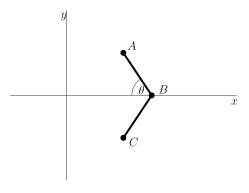
- At time \(t\), the angle between the \(x\)-axis and the string joining \(A\) and \(B\) is \(\theta\), as shown in the diagram, and \(B\) is at \((x,0)\). Write down the coordinates of \(A\) in terms of \(x,a\) and \(\theta\). Given that the velocity of \(B\) is \((v,0)\), show that the velocity of \(A\) is \((\dot x + a\sin\theta \,\dot \theta\,,\, a\cos\theta\, \dot\theta)\), where the dot denotes differentiation with respect to time.
- Show that, before particles \(A\) and \(C\) first collide, \[ 3\dot x + 2a \dot\theta \sin\theta =u \text{ and } \dot \theta^2 = \frac{u^2}{a^2(3-2\sin^2\theta)} \,. \]
- When \(A\) and \(C\) collide, the collision is elastic (no energy is lost). At what value of \(\theta\) does the second collision between particles \(A\) and \(C\) occur? (You should justify your answer.)
- When \(v=0\), what are the possible values of \(\theta\)? Is \(v =0\) whenever \(\theta\) takes these values?
Solution:
- \(A\) has coordinates \((x-a\cos \theta, a\sin \theta)\). Differentiating with respect to \(t\) the velocity of \(A\) is \((\dot{x}+a\sin \theta \cdot \dot{\theta}, a \cos \theta \cdot \dot{\theta})\)
- By considervation of momentum \(\rightarrow\) we must have \(mu = m(\dot{x}+a\dot{\theta}\sin \theta) + m\dot{x} + m(\dot{x}+a\dot{\theta}\sin \theta) = m(3\dot{x} + 2a \dot{\theta} \sin \theta)\) and the first equation follows. By conservation of energy, we must have \begin{align*} && \frac12 m u^2 &= \frac12 m \dot{x}^2 + \frac12m((\dot{x}+a\dot{\theta}\sin \theta)^2 + a^2 \dot{\theta}^2 \cos^2\theta ) + \frac12m((\dot{x}+a\dot{\theta}\sin \theta)^2 + a^2 \dot{\theta}^2 \cos^2\theta ) \\ &&&= \frac32m\dot{x}^2 + 2m a\dot{x}\dot{\theta}\sin \theta + ma^2\dot{\theta}^2(\sin^2\theta+\cos^2\theta) \\ \Rightarrow && u^2 &= \dot{x}(3\dot{x} + 4a \dot{\theta} \sin \theta) + 2a^2\dot{\theta}^2 \\ &&&= \left ( \frac{u-2a\dot{\theta}\sin \theta}{3}\right)\left ( 3\left ( \frac{u-2a\dot{\theta}\sin \theta}{3}\right)+ 4a \dot{x}\dot{\theta} \sin \theta \right) + 2a^2\dot{\theta}^2 \\ \Rightarrow && 3u^2 &= (u - 2a\dot{\theta} \sin \theta)^2 + 4a(u - 2 a \dot{\theta} \sin \theta) \dot{\theta}\sin \theta + 6a^2 \dot{\theta}^2 \\ &&&= u^2 + 4a^2\dot{\theta}^2 \sin^2 \theta - 8a^2\dot{\theta}^2\sin^2\theta + 6a^2 \dot{\theta}^2 \\ \Rightarrow && \dot{\theta}^2 &= \frac{u^2}{a^2(3-2\sin^2\theta)} \end{align*}
- Since \(\dot{\theta}^2 > 0\) \(\theta\) is strictly increasing or decreasing, therefore the first collision will be when \(\theta = 0\), the second when \(\theta = \pi\)
- If \(v = 0\), from our first equation we have \(2a \dot{\theta} \sin \theta = u \Rightarrow \dot{\theta}^2 = \frac{u^2}{4a^2 \sin^2 \theta} = \frac{u^2}{a^2(3-2\sin^2\theta)}\) so \(4\sin^2 \theta = 3 - 2\sin^2 \theta \Rightarrow \sin^2 \theta = \frac{1}{2}\) therefore the angles are all the multiples of \(\frac{\pi}{4}\).
2014 Paper 1 Q10
- A uniform spherical ball of mass \(M\) and radius \(R\) is released from rest with its centre a distance \(H+R\) above horizontal ground. The coefficient of restitution between the ball and the ground is \(e\). Show that, after bouncing, the centre of the ball reaches a height \(R+He^2\) above the ground.
- A second uniform spherical ball, of mass \(m\) and radius \(r\), is now released from rest together with the first ball (whose centre is again a distance \(H+R\) above the ground when it is released). The two balls are initially one on top of the other, with the second ball (of mass \(m\)) above the first. The two balls separate slightly during their fall, with their centres remaining in the same vertical line, so that they collide immediately after the first ball has bounced on the ground. The coefficient of restitution between the balls is also \(e\). The centre of the second ball attains a height \(h\) above the ground. Given that \(R=0.2\), \(r=0.05\), \(H=1.8\), \(h=4.5\) and \(e=\frac23\), determine the value of \(M/m\).
Solution:
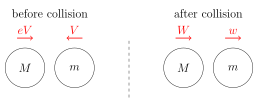
- The story for first ball (before it collides with the second ball) will be exactly the same, ie it rebounds with speed \(eV\).
For the second ball, it will also have fallen a distance \(H\) and will be travelling with the same speed \(V\). Their speed of approach therefore will be \((1+e)V\), and the speed of separating therefore must be \(e(1+e)V\)
Given the centre of the second ball reaches a height of \(h\) (from a position of height) \(2R+r\), we must have:
\begin{align*}
&& v^2 &= u^2 + 2as \\
&& 0 &= w^2 - 2g(h - 2R-r) \\
\Rightarrow && w^2 &= 2g(h-2R-r)
\end{align*}
Taking upwards to be positive, then we have:
\begin{align*} \text{COM}: && MeV + m(-V) &= M(w-e(1+e)V) + mw \\ \Rightarrow && V(Me-m)+e(1+e)MV &= w(M+m) \\ \Rightarrow && w &= \frac{2Me+e^2M-m}{M+m} V \\ \Rightarrow && w^2 &= \left ( \frac{M/m(2e+e^2)-1}{M/m+1}\right)^2 V^2 \\ \Rightarrow && 2g(h-2R-r) &= \left ( \frac{M/m(2e+e^2)-1}{M/m+1}\right)^2 2gH \\ \Rightarrow && \left ( \frac{M/m(2e+e^2)-1}{M/m+1}\right)^2 &= \frac{h-2R-r}{H} \\ &&&= \frac{4.5-0.4-0.05}{1.8} \\ &&&= \frac{9}{4} \\ \Rightarrow && \frac{M/m(\frac43+\frac49)-1}{M/m+1} &= \frac32 \\ \Rightarrow && \frac{16}9M/m-1 &= \frac32 M/m+\frac32 \\ \Rightarrow && \frac{5}{18}M/m &= \frac{5}{2} \\ \Rightarrow && M/m &= 9 \end{align*}
2013 Paper 1 Q9
Two particles, \(A\) and \(B\), are projected simultaneously towards each other from two points which are a distance \(d\) apart in a horizontal plane. Particle \(A\) has mass \(m\) and is projected at speed \(u\) at angle \(\alpha\) above the horizontal. Particle \(B\) has mass \(M\) and is projected at speed \(v\) at angle \(\beta\) above the horizontal. The trajectories of the two particles lie in the same vertical plane. The particles collide directly when each is at its point of greatest height above the plane. Given that both \(A\) and \(B\) return to their starting points, and that momentum is conserved in the collision, show that \[ m\cot \alpha = M \cot \beta\,. \] Show further that the collision occurs at a point which is a horizontal distance \(b\) from the point of projection of \(A\) where \[ b= \frac{Md}{m+M}\, , \] and find, in terms of \(b\) and \(\alpha\), the height above the horizontal plane at which the collision occurs.
Solution: Since \(A\) and \(B\) return to their starting points, and at their highest points there is no vertical component to their velocities, their horizontal must perfectly reverse, ie \begin{align*} && m u \cos \alpha - M v \cos \beta &= -m u \cos \alpha + M v \cos \beta \\ \Rightarrow && mu \cos \alpha &= Mv \cos \beta \end{align*} Since they reach their highest points at the same time, they must have the same initial vertical speed, ie \(u \sin \alpha = v \sin \beta\), so \begin{align*} && m v \frac{\sin \beta}{\sin \alpha} \cos \alpha &= M v \cos \beta \\ \Rightarrow && m \cot \alpha &= M \cot \beta \end{align*} The horizontal distance travelled by \(A\) & \(B\) will be: \begin{align*} && d_A &= u \cos \alpha t \\ && d_B &= v \cos \beta t \\ \Rightarrow && \frac{d_A}{d_A+d_B} &= \frac{u \cos \alpha}{u \cos \alpha + v \cos \beta} \\ &&&= \frac{\frac{M}{m}v \cos \beta}{\frac{M}{m}v \cos \beta + v \cos \beta} \\ &&&= \frac{M}{M+m} \\ \Rightarrow && d_A = b &= \frac{Md}{m+M} \end{align*} Applying \(v^2 = u^2 + 2as\) we see that \begin{align*} && 0 &= u \sin \alpha - gt \\ \Rightarrow && t &= \frac{u \sin \alpha}{g} \\ && b &=u \cos \alpha \frac{u \sin \alpha}{g} \\ \Rightarrow && u^2 &= \frac{2bg}{\sin 2 \alpha} \\ && 0 &= u^2 \sin^2 \alpha - 2g h \\ \Rightarrow && h &= \frac{u^2 \sin^2 \alpha}{2g} \\ &&&= \frac{2bg}{\sin 2 \alpha} \frac{ \sin^2 \alpha}{2g} \\ &&&= \frac12 b \tan \alpha \end{align*}
2013 Paper 2 Q11
Three identical particles lie, not touching one another, in a straight line on a smooth horizontal surface. One particle is projected with speed \(u\) directly towards the other two which are at rest. The coefficient of restitution in all collisions is \(e\), where \(0 < e < 1\,\).
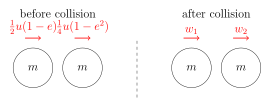
- Show that, after the second collision, the speeds of the particles are \(\frac12u(1-e)\), \(\frac14u (1-e^2)\) and \(\frac14u(1+e)^2\). Deduce that there will be a third collision whatever the value of \(e\).
- Show that there will be a fourth collision if and only if \(e\) is less than a particular value which you should determine.
Solution:
- First Collision:
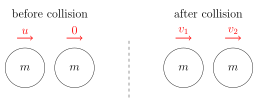
By NEL, \(v_2 = v_1 + eu\), so \begin{align*} \text{COM}: && mu &= mv_1 + m(v_1 + eu) \\ \Rightarrow && 2mv_1 &= mu(1-e) \\ \Rightarrow && v_1 &= \frac12 u(1-e) \\ && v_2 &= \frac12 u(1-e) + eu \\ &&&= \frac12 u(1+e) \end{align*} The second collision is identical to the first except replacing \(u\) with \(\frac12u(1+e)\), therefore after that collision: \begin{align*} && \text{first particle} &= \frac12 u(1-e) \\ && \text{second particle} &= \frac12 \left (\frac12 u(1+e) \right)(1-e) \\ &&&= \frac14 u(1-e^2) \\ && \text{third particle} &= \frac12 \left (\frac12 u(1+e) \right)(1+e) \\ &&&= \frac14 u(1+e)^2 \end{align*} After all these collisions, all particles are moving in the same direction (since they all have positive velocity), but the first particle is now travelling faster than the second particle (as \(\frac12(1-e) < 1\)). Therefore they will collide again.
- The third collision:
The speed of approach will be \(\frac12u(1-e) - \frac14u(1-e^2) = \frac14u(1-e)(2 - (1+e)) = \frac14 u(1-e)^2\), therefore by NEL, \(w_2 = w_1 + \frac14ue(1-e)^2\) \begin{align*} \text{COM}: && m\frac12u(1-e) + m \frac14u(1-e^2) &= mw_1 + m\left (w_1 + \frac14ue(1-e)^2 \right) \\ \Rightarrow && \frac14u(1-e)(2+(1+e)) &= 2w_1 + \frac14ue(1-e)^2 \\ \Rightarrow && 2w_1 &= \frac14u(1-e)(3+e)-\frac14ue(1-e)^2 \\ &&&= \frac14u(1-e)(3+e-e(1-e)) \\ &&&= \frac14u(1-e)(3+e^2) \\ \Rightarrow && w_1 &= \frac18 u(1-e)(3+e^2) \\ && w_2 &= \frac18 u(1-e)(3+e^2) + \frac14ue(1-e)^2 \\ &&&= \frac18u(1-e)(3+e^2+2e(1-e)) \\ &&&= \frac18u(1-e)(3+2e-e^2) \\ &&&= \frac18u(1-e)(1+e)(3-e) \\ \end{align*} A fourth collision is possible, iff \begin{align*} && \frac18u(1-e)(1+e)(3-e)&> \frac14 u(1+e)^2 \\ \Leftrightarrow && (1-e)(3-e)&> 2 (1+e) \\ \Leftrightarrow &&3-4e-e^2&> 2+2e \\ \Leftrightarrow &&1-5e-e^2&>0 \\ \Leftrightarrow && e &< 3-\sqrt{2} \end{align*}
2011 Paper 2 Q9
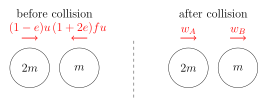
Two particles, \(A\) of mass \(2m\) and \(B\) of mass \(m\), are moving towards each other in a straight line on a smooth horizontal plane, with speeds \(2u\) and \(u\) respectively. They collide directly. Given that the coefficient of restitution between the particles is \(e\), where \(0 < e \le 1\), determine the speeds of the particles after the collision. After the collision, \(B\) collides directly with a smooth vertical wall, rebounding and then colliding directly with \(A\) for a second time. The coefficient of restitution between \(B\) and the wall is \(f\), where \(0 < f \le 1\). Show that the velocity of \(B\) after its second collision with \(A\) is \[ \tfrac23 (1-e^2)u - \tfrac13(1-4e^2)fu \] towards the wall and that \(B\) moves towards (not away from) the wall for all values of \(e\) and \(f\).
Solution:

2011 Paper 2 Q10
A particle is projected from a point on a horizontal plane, at speed \(u\) and at an angle~\(\theta\) above the horizontal. Let \(H\) be the maximum height of the particle above the plane. Derive an expression for \(H\) in terms of \(u\), \(g\) and \(\theta\). A particle \(P\) is projected from a point \(O\) on a smooth horizontal plane, at speed \(u\) and at an angle~\(\theta\) above the horizontal. At the same instant, a second particle \(R\) is projected horizontally from \(O\) in such a way that \(R\) is vertically below \(P\) in the ensuing motion. A light inextensible string of length \(\frac12 H\) connects \(P\) and \(R\). Show that the time that elapses before the string becomes taut is \[ (\sqrt2 -1)\sqrt{H/g\,}\,. \] When the string becomes taut, \(R\) leaves the plane, the string remaining taut. Given that \(P\) and \(R\) have equal masses, determine the total horizontal distance, \(D\), travelled by \(R\) from the moment its motion begins to the moment it lands on the plane again, giving your answer in terms of \(u\), \(g\) and \(\theta\). Given that \(D=H\), find the value of \(\tan\theta\).
2010 Paper 1 Q11
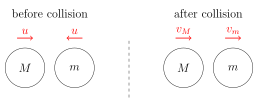
Two particles of masses \(m\) and \(M\), with \(M>m\), lie in a smooth circular groove on a horizontal plane. The coefficient of restitution between the particles is \(e\). The particles are initially projected round the groove with the same speed \(u\) but in opposite directions. Find the speeds of the particles after they collide for the first time and show that they will both change direction if \(2em> M-m\). After a further \(2n\) collisions, the speed of the particle of mass \(m\) is \(v\) and the speed of the particle of mass \(M\) is \(V\). Given that at each collision both particles change their directions of motion, explain why \[ mv-MV = u(M-m), \] and find \(v\) and \(V\) in terms of \(m\), \(M\), \(e\), \(u\) and \(n\).
Solution: All the forces in the circular groove will be perpendicular to the direction of motion. Therefore the particles will continue moving with constant speed at all times (aside from collisions). We can consider the collisions to occur as if along a tangent, (since they will be travelling perfectly perpendicular at the collisions).
2010 Paper 2 Q10
- In an experiment, a particle \(A\) of mass \(m\) is at rest on a smooth horizontal table. A particle \(B\) of mass \(bm\), where \(b >1\), is projected along the table directly towards \(A\) with speed \(u\). The collision is perfectly elastic. Find an expression for the speed of \(A\) after the collision in terms of \(b\) and \(u\), and show that, irrespective of the relative masses of the particles, \(A\) cannot be made to move at twice the initial speed of \(B\).
- In a second experiment, a particle \(B_1\) is projected along the table directly towards \(A\) with speed \(u\). This time, particles \(B_2\), \(B_3\), \(\ldots\,\), \(B_n\) are at rest in order on the line between \(B_1\) and \(A\). The mass of \(B_i\) (\(i=1\), \(2\), \(\ldots\,\), \(n\)) is \(\lambda^{n+1-i}m\), where \(\lambda>1\). All collisions are perfectly elastic. Show that, by choosing \(n\) sufficiently large, there is no upper limit on the speed at which \(A\) can be made to move. In the case \(\lambda=4\), determine the least value of \(n\) for which \(A\) moves at more than \(20u\). You may use the approximation \(\log_{10}2 \approx 0.30103\).
Solution:
- Since the collision is perfectly elastic, the speed of approach and separation are equal, ie \(v_B = v_A - u\) \begin{align*} \text{COM}: && bmu &= bm(v_A - u) + mv_A \\ \Rightarrow && (b+1)v_A &= 2bu \\ \Rightarrow && v_A &= \frac{2b}{b+1} u \end{align*} Since \(0 < \frac{b}{b+1} < 1\), the largest \(0 < v_A < 2u\)

- After the first collision with each \(B_i\) we will have \(\displaystyle v_{i+1} = \frac{2\lambda}{\lambda + 1}v_i\), ie \(\displaystyle v_{i+1} = \left (\frac{2\lambda}{\lambda + 1} \right)^i u\) and so \(\displaystyle v_A = \left (\frac{2\lambda}{\lambda + 1} \right)^n u\) which can be arbitrarily large. Suppose \(\lambda = 4\), then \begin{align*} && 20u &< v_A \\ &&&= \left (\frac{8}{5} \right)^n u \\ \Rightarrow && \log_{10} 20 < n \log_{10}(16/10) \\ && \log_{10} 2 + 1 < n 4\log_{10} 2 - n \\ \Rightarrow && n &> \frac{ \log_{10} 2 + 1}{ 4\log_{10} 2 - 1} \\ &&&\approx \frac{0.30103+1}{4 \times 0.30103 -1}\\ &&&= \frac{1.30103}{0.20412} \\ &&&>6 \end{align*} So \(n =7\) is the smallest possible
2009 Paper 1 Q11
Two particles move on a smooth horizontal table and collide. The masses of the particles are \(m\) and \(M\). Their velocities before the collision are \(u{\bf i}\) and \(v{\bf i}\,\), respectively, where \(\bf i\) is a unit vector and \(u>v\). Their velocities after the collision are \(p{\bf i}\) and \(q{\bf i}\,\), respectively. The coefficient of restitution between the two particles is \(e\), where \(e<1\).
- Show that the loss of kinetic energy due to the collision is \[ \tfrac12 m (u-p)(u-v)(1-e)\,, \] and deduce that \(u\ge p\).
- Given that each particle loses the same (non-zero) amount of kinetic energy in the collision, show that \[ u+v+p+q=0\,, \] and that, if \(m\ne M\), \[ e= \frac{(M+3m)u + (3M+m)v}{(M-m)(u-v)}\,. \]
Solution:
- \begin{align*} \text{COM}: && mu + Mv &= mp + Mq \\ \Rightarrow && m(u-p) &= M(q-v) \\ \text{NEL}: && q-p &= e(u-v) \\ && q +ev &= p+eu \\ && \Delta \text{ k.e.} &= \frac12 m u^2 + \frac12 M v^2 -\frac12 m p^2 - \frac12 M q^2 \\ &&&= \frac12m (u^2 - p^2)+\frac12M(v^2-q^2) \\ &&&= \frac12m (u^2 - p^2)+\frac12M(v-q)(v+q) \\ &&&= \frac12m(u^2-p^2) - \frac12 m(u-p)(v+q) \\ &&&= \frac12 m(u-p) \left ( u+p-v-q\right) \\ &&&= \frac12 m(u-p) \left (u-v+(p-q)\right) \\ &&&= \frac12 m(u-p) \left (u-v-e(u-v)\right) \\ &&&= \frac12m(u-p)(u-v)(1-e) \end{align*} Since the loss in energy is positive, and \(m\), \(u-v\) and \(1-e\) are all positive, so is \(u-p\), ie \(u \geq p\)
- \begin{align*} && \frac12 m u^2 - \frac12mp^2 &= \frac12Mv^2 - \frac12Mq^2 \\ && \frac12 m(u-p)(u+p) &= \frac12 M (v-q)(v+q) \\ && \frac12 m (u-p)(u+p) &= -\frac12 m(u-p)(v+q) \\ \Rightarrow && u+p+v+q &= 0 \end{align*} \begin{align*} && p+q &= -(u+v)\\ &&mp+Mq &= mu+Mv \\ \Rightarrow && (M-m)q &= mu+Mv+mu+mv\\ \Rightarrow && q &= \frac{(M+m)v+2mu}{M-m} \\ \Rightarrow && (m-M)p &= mu+Mv+Mu+Mv \\ \Rightarrow && p &= -\frac{(M+m)u+2Mv}{M-m} \\ \\ && e &= \frac{q-p}{u-v} \\ &&&= \frac{(M+m)v+2mu+(M+m)u+2Mv}{(u-v)(M-m)} \\ &&&= \frac{(3M+m)v+(3m+M)u}{(u-v)(M-m)} \end{align*}