2015 Paper 2 Q11
Year: 2015
Paper: 2
Question Number: 11
Course: UFM Mechanics
Section: Circular Motion 1
Problem
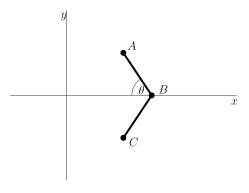
- At time \(t\), the angle between the \(x\)-axis and the string joining \(A\) and \(B\) is \(\theta\), as shown in the diagram, and \(B\) is at \((x,0)\). Write down the coordinates of \(A\) in terms of \(x,a\) and \(\theta\). Given that the velocity of \(B\) is \((v,0)\), show that the velocity of \(A\) is \((\dot x + a\sin\theta \,\dot \theta\,,\, a\cos\theta\, \dot\theta)\), where the dot denotes differentiation with respect to time.
- Show that, before particles \(A\) and \(C\) first collide, \[ 3\dot x + 2a \dot\theta \sin\theta =u \text{ and } \dot \theta^2 = \frac{u^2}{a^2(3-2\sin^2\theta)} \,. \]
- When \(A\) and \(C\) collide, the collision is elastic (no energy is lost). At what value of \(\theta\) does the second collision between particles \(A\) and \(C\) occur? (You should justify your answer.)
- When \(v=0\), what are the possible values of \(\theta\)? Is \(v =0\) whenever \(\theta\) takes these values?
Solution
- \(A\) has coordinates \((x-a\cos \theta, a\sin \theta)\). Differentiating with respect to \(t\) the velocity of \(A\) is \((\dot{x}+a\sin \theta \cdot \dot{\theta}, a \cos \theta \cdot \dot{\theta})\)
- By considervation of momentum \(\rightarrow\) we must have \(mu = m(\dot{x}+a\dot{\theta}\sin \theta) + m\dot{x} + m(\dot{x}+a\dot{\theta}\sin \theta) = m(3\dot{x} + 2a \dot{\theta} \sin \theta)\) and the first equation follows. By conservation of energy, we must have \begin{align*} && \frac12 m u^2 &= \frac12 m \dot{x}^2 + \frac12m((\dot{x}+a\dot{\theta}\sin \theta)^2 + a^2 \dot{\theta}^2 \cos^2\theta ) + \frac12m((\dot{x}+a\dot{\theta}\sin \theta)^2 + a^2 \dot{\theta}^2 \cos^2\theta ) \\ &&&= \frac32m\dot{x}^2 + 2m a\dot{x}\dot{\theta}\sin \theta + ma^2\dot{\theta}^2(\sin^2\theta+\cos^2\theta) \\ \Rightarrow && u^2 &= \dot{x}(3\dot{x} + 4a \dot{\theta} \sin \theta) + 2a^2\dot{\theta}^2 \\ &&&= \left ( \frac{u-2a\dot{\theta}\sin \theta}{3}\right)\left ( 3\left ( \frac{u-2a\dot{\theta}\sin \theta}{3}\right)+ 4a \dot{x}\dot{\theta} \sin \theta \right) + 2a^2\dot{\theta}^2 \\ \Rightarrow && 3u^2 &= (u - 2a\dot{\theta} \sin \theta)^2 + 4a(u - 2 a \dot{\theta} \sin \theta) \dot{\theta}\sin \theta + 6a^2 \dot{\theta}^2 \\ &&&= u^2 + 4a^2\dot{\theta}^2 \sin^2 \theta - 8a^2\dot{\theta}^2\sin^2\theta + 6a^2 \dot{\theta}^2 \\ \Rightarrow && \dot{\theta}^2 &= \frac{u^2}{a^2(3-2\sin^2\theta)} \end{align*}
- Since \(\dot{\theta}^2 > 0\) \(\theta\) is strictly increasing or decreasing, therefore the first collision will be when \(\theta = 0\), the second when \(\theta = \pi\)
- If \(v = 0\), from our first equation we have \(2a \dot{\theta} \sin \theta = u \Rightarrow \dot{\theta}^2 = \frac{u^2}{4a^2 \sin^2 \theta} = \frac{u^2}{a^2(3-2\sin^2\theta)}\) so \(4\sin^2 \theta = 3 - 2\sin^2 \theta \Rightarrow \sin^2 \theta = \frac{1}{2}\) therefore the angles are all the multiples of \(\frac{\pi}{4}\).
Examiner's report
— 2015 STEP 2, Question 11As in previous years the Pure questions were the most popular of the paper with questions 1, 2 and 6 the most popular. The least popular questions on the paper were questions 8, 11 and 13 with fewer than 250 attempts for each of them. There were many examples of solutions in this paper that were insufficiently well explained given that the answer to be reached had been provided in the question.
Rating Information
Difficulty Rating: 1600.0
Difficulty Comparisons: 0
Banger Rating: 1484.0
Banger Comparisons: 1
Show LaTeX source
Problem source
Three particles, $A$, $B$ and $C$, each of mass $m$, lie on a smooth horizontal table. Particles $A$ and $C$ are attached to the two ends of a light inextensible string of length $2a$ and  particle $B$ is attached to the midpoint of the string. Initially, $A$, $B$ and $C$ are at rest at points $(0,a)$, $(0,0)$ and $(0,-a)$, respectively.
An  impulse is delivered to $B$, imparting to it a speed $u$ in the positive $x$ direction. The string remains taut throughout the subsequent motion.
\begin{center}
\begin{tikzpicture}[x=1.0cm,y=1.0cm]
    % Clip to match the \begin{pspicture*} boundaries
    \clip (-2.18,-3.26) rectangle (6.26,3.18);
    % Axes
    \draw (-2,0) -- (6,0);
    \draw (0,-3) -- (0,3);
    % Thick lines
    \draw[line width=2pt] (2,1.5) -- (3,0);
    \draw[line width=2pt] (3,0) -- (2,-1.5);
    % Angle arc \theta
    % The start angle is exactly 180 - atan(1.5/1) ≈ 123.69 degrees, ending at 180 degrees.
    \draw (3,0) ++({180-atan(1.5)}:0.7) arc ({180-atan(1.5)}:180:0.7);
    % Labels
    \node[anchor=north west, inner sep=1pt] at (-0.25,2.96) {$y$};
    \node[anchor=north west, inner sep=1pt] at (5.76,-0.1) {$x$};
    \node[anchor=north west, inner sep=1pt] at (2.5,0.38) {$\theta$};
    \node[anchor=north west, inner sep=1pt] at (2.1,1.94) {$A$};
    \node[anchor=north west, inner sep=1pt] at (3.2,0.4) {$B$};
    \node[anchor=north west, inner sep=1pt] at (2.16,-1.46) {$C$};
    % Points
    % dotsize=8pt corresponds to a radius of 4pt (or you can adjust to standard 2.5pt)
    \fill (2,1.5) circle (3pt);
    \fill (3,0) circle (3pt);
    \fill (2,-1.5) circle (3pt);
\end{tikzpicture}
\end{center}
\begin{questionparts}
\item At time $t$, the angle between the $x$-axis and the string joining $A$ and $B$ is $\theta$, as shown in the diagram, and $B$ is at $(x,0)$. Write down the coordinates of $A$ in terms of $x,a$ and $\theta$. Given that the velocity of $B$ is $(v,0)$, show that the velocity of $A$ is $(\dot x + a\sin\theta \,\dot \theta\,,\, a\cos\theta\, \dot\theta)$, where the dot denotes differentiation with respect to time.
\item Show that,  before particles $A$ and $C$ first collide,
\[
3\dot x + 2a \dot\theta \sin\theta =u \text{      and       } \dot \theta^2  = \frac{u^2}{a^2(3-2\sin^2\theta)}
\,.
\]
\item When $A$ and $C$ collide, the collision is elastic (no energy is lost). At what value of $\theta$ does the second collision between particles $A$ and $C$ occur? (You should justify your answer.)
\item When $v=0$, what are the possible values of $\theta$? Is $v =0$ whenever $\theta$ takes these values?
\end{questionparts}
Solution source
\begin{questionparts}
\item $A$ has coordinates $(x-a\cos \theta, a\sin \theta)$. Differentiating with respect to $t$ the velocity of $A$ is $(\dot{x}+a\sin \theta \cdot \dot{\theta}, a \cos \theta \cdot \dot{\theta})$

\item By considervation of momentum $\rightarrow$ we must have $mu = m(\dot{x}+a\dot{\theta}\sin \theta) + m\dot{x} + m(\dot{x}+a\dot{\theta}\sin \theta) = m(3\dot{x} + 2a \dot{\theta} \sin \theta)$ and the first equation follows.

By conservation of energy, we must have \begin{align*}
&& \frac12 m u^2 &= \frac12 m \dot{x}^2 + \frac12m((\dot{x}+a\dot{\theta}\sin \theta)^2 + a^2 \dot{\theta}^2 \cos^2\theta ) + \frac12m((\dot{x}+a\dot{\theta}\sin \theta)^2 + a^2 \dot{\theta}^2 \cos^2\theta ) \\
&&&= \frac32m\dot{x}^2 + 2m a\dot{x}\dot{\theta}\sin \theta + ma^2\dot{\theta}^2(\sin^2\theta+\cos^2\theta) \\
\Rightarrow && u^2 &= \dot{x}(3\dot{x} + 4a \dot{\theta} \sin \theta) + 2a^2\dot{\theta}^2 \\
&&&= \left ( \frac{u-2a\dot{\theta}\sin \theta}{3}\right)\left ( 3\left ( \frac{u-2a\dot{\theta}\sin \theta}{3}\right)+ 4a \dot{x}\dot{\theta} \sin \theta \right) + 2a^2\dot{\theta}^2 \\
\Rightarrow && 3u^2 &= (u - 2a\dot{\theta} \sin \theta)^2 + 4a(u - 2 a \dot{\theta} \sin \theta) \dot{\theta}\sin \theta + 6a^2 \dot{\theta}^2 \\
&&&= u^2  + 4a^2\dot{\theta}^2 \sin^2 \theta - 8a^2\dot{\theta}^2\sin^2\theta + 6a^2 \dot{\theta}^2 \\
\Rightarrow && \dot{\theta}^2 &= \frac{u^2}{a^2(3-2\sin^2\theta)}
\end{align*}

\item Since $\dot{\theta}^2 > 0$ $\theta$ is strictly increasing or decreasing, therefore the first collision will be when $\theta = 0$, the second when $\theta = \pi$

\item If $v = 0$, from our first equation we have $2a \dot{\theta} \sin \theta = u \Rightarrow \dot{\theta}^2  = \frac{u^2}{4a^2 \sin^2 \theta} = \frac{u^2}{a^2(3-2\sin^2\theta)}$ so $4\sin^2 \theta = 3 - 2\sin^2 \theta \Rightarrow \sin^2 \theta = \frac{1}{2}$ therefore the angles are all the multiples of $\frac{\pi}{4}$.
\end{questionparts}
This was the least popular question on the paper. Many answers to the first part did not give good explanations of the method for obtaining the velocity of A. Similarly, in the second part there were a number of statements such as "conservation of velocity" or "conservation of the modulus of momentum" used to support the answer without sufficient explanation to show that a valid method was being applied. Those candidates who attempted to use the equations of motion under uniform acceleration were unable to reach the solution. Part (iii) was very poorly answered with almost no correct solutions offered. In the final part of the question very few candidates were able to identify the part of the reasoning that led to v not being equal to zero in all of the cases identified.