Problems
Filters
49 problems found
2025 Paper 2 Q6
- The circle \(x^2 + (y-a)^2 = r^2\) touches the parabola \(2ky = x^2\), where \(k > 0\), tangentially at two points. Show that \(r^2 = k(2a - k)\). Show further that if \(r^2 = k(2a - k)\) and \(a > k > 0\), then the circle \(x^2 + (y-a)^2 = r^2\) touches the parabola \(2ky = x^2\) tangentially at two points.
- The lines \(y = c \pm x\) are tangents to the circle \(x^2 + (y-a)^2 = r^2\). Find \(r^2\), and the coordinates of the points of contact, in terms of \(a\) and \(c\).
- \(C_1\) and \(C_2\) are circles with equations \(x^2 + (y-a_1)^2 = r_1^2\) and \(x^2 + (y-a_2)^2 = r_2^2\) respectively, where \(a_1 \neq a_2\) and \(r_1 \neq r_2\).
Each circle touches the parabola \(2ky = x^2\) tangentially at two points and the lines \(y = c \pm x\) are tangents to both circles.
- Show that \(a_1 + a_2 = 2c + 4k\) and that \(a_1^2 + a_2^2 = 2c^2 + 16kc + 12k^2\).
- The circle \(x^2 + (y-d)^2 = p^2\) passes through the four points of tangency of the lines \(y = c \pm x\) to the two circles, \(C_1\) and \(C_2\). Find \(d\) and \(p^2\) in terms of \(k\) and \(c\).
- Show that the circle \(x^2 + (y-d)^2 = p^2\) also touches the parabola \(2ky = x^2\) tangentially at two points.
Solution:
- By symmetry we can observe that the parabola and circle will intersect \(0, 1\) (at the base), \(2, 4\) times. So setting up our system of equations we have: \begin{align*} &&& \begin{cases} x^2 + (y-a)^2 &= r^2 \\ 2ky &= x^2 \end{cases} \\ \Rightarrow && r^2 &= x^2 + \left (\frac{x^2}{2k} - a \right )^2 \\ \Rightarrow &&r^2 &= x^2 + a^2 - \frac{ax^2}{k} + \frac{x^4}{4k^2} \\ \Rightarrow &&0 &= \frac{1}{4k^2} x^4 + \left ( 1 - \frac{a}{k} \right) x^2 + a^2 - r^2 \\ \Rightarrow && \Delta &= \left ( 1 - \frac{a}{k} \right)^2-4 \cdot \frac{1}{4k^2} (a^2 - r^2) \\ &&&= 1 - \frac{2a}{k} + \frac{a^2}{k^2} - \frac{a^2}{k^2} + \frac{r^2}{k^2} \\ &&&= \frac{k^2-2ka+r^2}{k^2} \end{align*} Since there will be (at most) two solutions if \(\Delta = 0\) we must have if the circle and parabola are tangent \(r^2 - 2ka + k^2 = 0 \Rightarrow r^2 = k(2a-k)\). So long as there is a solution \(x^2 > 0\) there will be two tangent points, so if \(-\left(1 - \frac{a}{k}\right) > 0\) or \(a > k > 0\)

- Since \(y = c \pm x\) are tangent to the circle with radius \(r\) and centre \((0,a)\) we have the following equations: \begin{align*} &&& \begin{cases} x^2 + (y-a)^2 &= r^2 \\ c \pm x &= y \end{cases} \\ \Rightarrow && r^2 &= x^2 + (c -a\pm x)^2 \\ &&&= 2x^2+(c-a)^2 \pm 2x(c-a) \\ \Rightarrow && \Delta &= 4(c-a)^2 -4 \cdot 2 \left ( (c-a)^2 -r^2 \right)\\ &&&= 8r^2-4(c-a)^2 \\ \Rightarrow && x &= \frac{\mp 2(c-a) \pm \sqrt{\Delta}}{4} \\ &&&= \mp \frac12 (c-a) \\ && y &= \pm \frac12 (c+a) \\ && (x,y) &= \left (\frac12 (c-a), \frac12 (c+a)\right), \left (-\frac12 (c-a), -\frac12 (c+a)\right) \end{align*}
2024 Paper 2 Q7
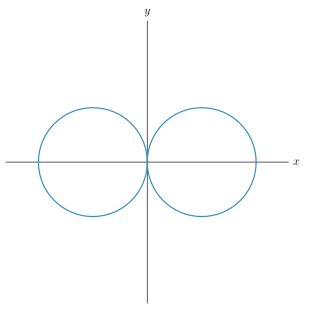
- Sketch the curve \(C_1\) with equation \[ \left(y^2 + (x-1)^2 - 1\right)\left(y^2 + (x+1)^2 - 1\right) = 0. \]
- Consider the curve \(C_2\) with equation
\[ \left(y^2 + (x-1)^2 - 1\right)\left(y^2 + (x+1)^2 - 1\right) = \tfrac{1}{16}. \]
- Show that the line \(y = k\) meets the curve \(C_2\) at points for which \[ x^4 + 2(k^2 - 2)x^2 + \left(k^4 - \tfrac{1}{16}\right) = 0. \] Hence determine the number of intersections between curve \(C_2\) and the line \(y = k\) for each positive value of \(k\).
- Determine whether the points on curve \(C_2\) with the greatest possible \(y\)-coordinate are further from, or closer to, the \(y\)-axis than those on curve \(C_1\).
- Show that it is not possible for both \(y^2 + (x-1)^2 - 1\) and \(y^2 + (x+1)^2 - 1\) to be negative, and deduce that curve \(C_2\) lies entirely outside curve \(C_1\).
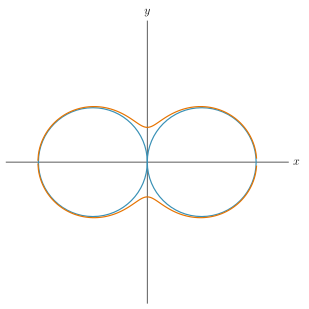
- Sketch the curves \(C_1\) and \(C_2\) on the same axes.
Solution:
- \(\,\)
- Suppose \(y=k\) meets the curve \(C_2\) then \begin{align*} && \tfrac1{16} &= (k^2+(x-1)^2-1)(k^2+(x+1)^2-1) \\ &&&= (k^2+x^2-2x)(k^2+x^2+2x) \\ &&&= k^4+2k^2x^2+x^4-4x^2 \\ &&&= x^4+(2k^2-4)x^2+k^4 \\ \Rightarrow && 0 &= x^4+(2k^2-4)x^2+(k^4-\tfrac1{16}) \\ \\ && \Delta &= 4(k^2-2)^2 - 4 \cdot 1 \cdot (k^4-\tfrac1{16}) \\ &&&= 4(k^4-4k^2+4 - k^4 +\tfrac{1}{16}) \\ &&&= 16(1+\tfrac{1}{64} - k^2) \\ &&&= 16(\tfrac{65}{64} - k^2) \end{align*} Therefore if \(|k| < \frac{\sqrt{65}}{8}\) there are \(4\) intersections. If \(|k| = \frac{\sqrt{65}}{8}\) there are \(2\) intersections, otherwise there are \(0\).
- The greatest possible \(y\) value is \( \frac{\sqrt{65}}{8}\) and at this point \(x^2 = \frac{2(2-\frac{65}{64}}{2} =1 - \frac{1}{64} < 1\) so they are close to the \(y\)-axis.
- The regions where \(y^2+(x-1)^2-1 < 0\) and \(y^2+(x+1)^2-1 < 0\) is the interior of the two circles from the first part. However, since they don't overlap they can never both be negative. Therefore in our equation both are positive and therefore \(C_2\) is entirely outside \(C_1\)
- \(\,\)
2022 Paper 3 Q1
Let \(C_1\) be the curve given by the parametric equations \[ x = ct\,, \quad y = \frac{c}{t}\,, \] where \(c > 0\) and \(t \neq 0\), and let \(C_2\) be the circle \[ (x-a)^2 + (y-b)^2 = r^2\,. \] \(C_1\) and \(C_2\) intersect at the four points \(P_i\) (\(i = 1,2,3,4\)), and the corresponding values of the parameter \(t\) at these points are \(t_i\).
- Show that \(t_i\) are the roots of the equation \[ c^2 t^4 - 2act^3 + (a^2 + b^2 - r^2)t^2 - 2bct + c^2 = 0\,. \qquad (*) \]
- Show that \[ \sum_{i=1}^{4} t_i^2 = \frac{2}{c^2}(a^2 - b^2 + r^2) \] and find a similar expression for \(\displaystyle\sum_{i=1}^{4} \frac{1}{t_i^2}\).
- Hence show that \(\displaystyle\sum_{i=1}^{4} OP_i^2 = 4r^2\), where \(OP_i\) denotes the distance of the point \(P_i\) from the origin.
- Suppose that the curves \(C_1\) and \(C_2\) touch at two distinct points. By considering the product of the roots of \((*)\), or otherwise, show that the centre of circle \(C_2\) must lie on either the line \(y = x\) or \(y = -x\).
Solution:
- Suppose \((ct, c/t)\) is on \(C_2\) then \begin{align*} && r^2 &= \left ( ct - a \right)^2 + \left ( \frac{c}{t} - b \right)^2 \\ &&&= c^2t^2 - 2cta + a^2 + \frac{c^2}{t^2} - \frac{2cb}{t} + b^2 \\ \Rightarrow && 0 &= c^2t^4 - 2act^3 + (a^2+b^2-r^2)t^2 - 2bct + c^2 \end{align*}
- Notice that \(\displaystyle \sum t_i = \frac{2a}{c}\) and \(\displaystyle \sum t_it_j = \frac{a^2+b^2-r^2}{c^2}\) so \begin{align*} && \sum t_i^2 &= \left ( \sum t_i \right)^2 - 2 \sum t_it_j \\ &&&= \frac{4a^2}{c^2} - \frac{2a^2+2b^2-2r^2}{c^2} \\ &&&= \frac{2}{c^2} \left (a^2 - b^2 + r^2 \right) \end{align*} Note that \(\frac{1}{t}\) are roots of the \(c^2 - 2act + (a^2+b^2-r^2)t^2 - 2bct^3 + c^2t^4 = 0\) which is the same equation but with \(a \leftrightarrow b\) so \(\displaystyle \sum \frac{1}{t_i^2} = \frac{2}{c^2} (b^2 - a^2 + r^2)\)
- Therefore \begin{align*} && \sum_{i=1}^4 OP_i^2 &= \sum_{i=1}^4 \left (c^2t_i^2 + \frac{c^2}{t_i^2} \right) \\ &&&= 2(a^2-b^2+r^2) + 2(b^2-a^2+r^2) \\ &&&= 4r^2 \end{align*}
- If they touch at two distinct points it must be the case that \(t_1 = t_2\) and \(t_3 = t_4\). We must also have \(t_1t_2t_3t_4 = t_1^2t_3^2 = 1\) so \(t_1t_3 = \pm 1\). Therefore our points are \((ct_1, \frac{c}{t_1})\) and \(\pm(\frac{c}{t_1}, ct_1)\) but these are reflections in \(y = \pm x\). But if these two points are reflections of one another the line of reflection is the perpendicular bisector, which must run through the centre of the circle.
2019 Paper 3 Q6
The point \(P\) in the Argand diagram is represented by the the complex number \(z\), which satisfies $$zz^* - az^* - a^*z + aa^* - r^2 = 0.$$ Here, \(r\) is a positive real number and \(r^2 \neq a^*a\). By writing \(|z - a|^2\) as \((z - a)(z - a)^*\), show that the locus of \(P\) is a circle, \(C\), the radius and the centre of which you should give.
- The point \(Q\) is represented by \(\omega\), and is related to \(P\) by \(\omega = \frac{1}{z}\). Let \(C'\) be the locus of \(Q\). Show that \(C'\) is also a circle, and give its radius and centre. If \(C\) and \(C'\) are the same circle, show that $$(|a|^2 - r^2)^2 = 1$$ and that either \(a\) is real or \(a\) is imaginary. Give sketches to indicate the position of \(C\) in these two cases.
- Suppose instead that the point \(Q\) is represented by \(\omega\), where \(\omega = \frac{1}{z^*}\). If the locus of \(Q\) is \(C\), is it the case that either \(a\) is real or \(a\) is imaginary?
Solution: \begin{align*} && |z-a|^2 &= (z-a)(z-a)^* \\ &&&= (z-a)(z^*-a^*) \\ &&&= zz^*-az^*-a^*z+aa^* \\ &&&= r^2 \end{align*} Therefore the locus of \(P\) is a circle centre \(a\) radius \(r\).
- \begin{align*} && 0 &= zz^* - az^* - a^*z + aa^* - r^2 \\ &&&= \frac{1}{\omega \omega^{*}} - \frac{a}{\omega^*} - \frac{a^*}{\omega} + aa^*-r^2 \\ \Rightarrow && 0 &= 1-a\omega-a^*\omega^*+(|a|^2-r^2)\omega\omega^* \\ \Rightarrow && 0 &= \omega\omega^* - \left ( \frac{a^*}{|a|^2-r^2}\right)^*\omega - \left ( \frac{a^*}{|a|^2-r^2}\right)\omega^*+\left ( \frac{a^*}{|a|^2-r^2}\right)\left ( \frac{a}{|a|^2-r^2}\right)-\left ( \frac{a^*}{|a|^2-r^2}\right)\left ( \frac{a}{|a|^2-r^2}\right)+ \frac{1}{|a|^2-r^2} \\ &&&= \omega\omega^* - \left ( \frac{a^*}{|a|^2-r^2}\right)^*\omega - \left ( \frac{a^*}{|a|^2-r^2}\right)\omega^*+\frac{|a|^2}{(|a|^2-r^2)^2}-\frac{|a|^2}{(|a|^2-r^2)^2}+ \frac{1}{|a|^2-r^2} \\ &&&=\omega\omega^* - \left ( \frac{a^*}{|a|^2-r^2}\right)^*\omega - \left ( \frac{a^*}{|a|^2-r^2}\right)\omega^*+\frac{|a|^2}{(|a|^2-r^2)^2}- \frac{r^2}{(|a|^2-r^2)^2} \end{align*} Therefore \(\displaystyle \left|\omega-\left ( \frac{a^*}{|a|^2-r^2}\right)\right|^2 = \frac{r^2}{(|a|^2-r^2)^2}\) ie \(\omega\) lies on a circle centre \(\frac{a^*}{|a|^2-r^2}\), radius \(\frac{r}{||a|^2-r^2|}\). If these are the same circle then \(r = \frac{r}{||a|^2-r^2|} \Rightarrow (|a|^2-r^2)^2 = 1\) and \(a = \frac{a^*}{|a|^2-r^2} \Rightarrow a = \pm a^*\), ie \(a\) is purely real or imaginary.
- This is the same story, except we end up with centre \(\frac{a}{|a|^2-r^2}\), so we do not end up with the same conditions
2017 Paper 1 Q5
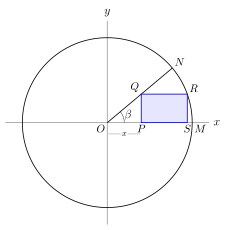
A circle of radius \(a\) is centred at the origin \(O\). A rectangle \(PQRS\) lies in the minor sector \(OMN\) of this circle where \(M\) is \((a,0)\) and \(N\) is \((a \cos \beta, a \sin \beta)\), and \(\beta\) is a constant with \(0 < \beta < \frac{\pi}{2}\,\). Vertex \(P\) lies on the positive \(x\)-axis at \((x,0)\); vertex \(Q\) lies on \(ON\); vertex \(R\) lies on the arc of the circle between \(M\) and \(N\); and vertex \(S\) lies on the positive \(x\)-axis at \((s,0)\). Show that the area \(A\) of the rectangle can be written in the form \[ A= x(s-x)\tan\beta \,. \] Obtain an expression for \(s\) in terms of \(a\), \(x\) and \(\beta\), and use it to show that \[ \frac{\d A}{\d x} = (s-2x) \tan \beta - \frac {x^2} s \tan^3\beta \,. \] Deduce that the greatest possible area of rectangle \(PQRS\) occurs when \(s= x(1+\sec\beta)\) and show that this greatest area is \(\tfrac12 a^2 \tan \frac12 \beta\,\). Show also that this greatest area occurs when \(\angle ROS = \frac12\beta\,\).
Solution:
2017 Paper 2 Q5
A curve \(C\) is determined by the parametric equations \[ x=at^2 \, , \; y = 2at\,, \] where \(a > 0\).
- Show that the normal to \(C\) at a point \(P\), with non-zero parameter \(p\), meets \(C\) again at a point \(N\), with parameter \(n\), where \[ n= - \left( p + \frac{2}{p} \right). \]
- Show that the distance \(\left| PN \right|\) is given by \[ \vert PN\vert^2 = 16a^2\frac{(p^2+1)^3}{p^4} \] and that this is minimised when \(p^2=2\,\).
- The point \(Q\), with parameter \(q\), is the point at which the circle with diameter \(PN\) cuts \(C\) again. By considering the gradients of \(QP\) and \(QN\), show that \[ 2 = p^2-q^2 + \frac{2q}p. \] Deduce that \(\left| PN \right|\) is at its minimum when \(Q\) is at the origin.
Solution:
- \(\,\) \begin{align*} && \frac{\d x}{\d t} &= 2at \\ && \frac{\d y}{\d t} &= 2a \\ \Rightarrow && \frac{\d y}{\d x} &= \frac1t \\ && -p &= \text{grad of normal} \\ &&&= \frac{y-2ap}{x-ap^2} \\ \Rightarrow && y &= -px + ap^3+2ap \\ && 2an &= -pan^2 + ap^3 + 2ap \\ \Rightarrow && 0 &= pan^2+2an-ap(2+p^2) \\ \Rightarrow && n &= p, -\left ( p + \frac2{p}\right) \\ \Rightarrow && n &= -\left ( p + \frac2{p}\right) \end{align*}
- \(\,\) \begin{align*} && |PN|^2 &= (ap^2-an^2)^2 +(2ap-2an)^2 \\ &&&= a^2(p-n)^2(p+n)^2+4a^2(p-n)^2 \\ &&&= a^2(p-n)^2((p+n)^2+4) \\ &&&= a^2\left(p+p+\frac2p \right)^2 \left ( \left ( -\frac2p\right)^2+4\right)\\ &&&= a^2\left(\frac{2p^2+2}p \right)^2 \left ( \frac{4}{p^2}+4\right)\\ &&&= 16a^2 \frac{(p^2+1)^3}{p^4} \\ \\ && \frac{\d |PN|^2}{\d p^2} &= 16a^2\frac{3(p^2+1)^2p^4-2(p^2+1)^3p^2}{p^8} \\ &&&= 16a^2(p^2+1)^2 \frac{3p^2-2(p^2+1)}{p^6} \\ &&&= 16a^2(p^2+1)^2 \frac{p^2-2}{p^6} \end{align*} Therefore minimized when \(p^2=2\) (clearly a minimum by considering behaviour as \(p^2 \to 0, \infty\))
- If \(PN\) is the diameter of \(PNQ\) then \(QP\) and \(QN\) are perpendicular, ie \begin{align*} && -1 &= \frac{2ap-2aq}{ap^2-aq^2} \cdot \frac{2aq-2an}{aq^2-an^2} \\ &&&= \frac{2}{p+q} \cdot \frac{2}{q+n} \\ &&&= \frac{2}{p+q} \cdot \frac{2}{q - p -\frac{2}{p}} \\ \Rightarrow && 4 &= (p+q)(p+\frac2{p}-q) \\ &&&= p^2-q^2 + \frac{2q}{p} + 2 \\ \Rightarrow && 2 &= p^2 - q^2 + \frac{2q}{p} \end{align*} Therefore \(q = 0 \Rightarrow p^2 = 2 \Rightarrow |PN|\) is at it's minimum.
2016 Paper 1 Q4
- Differentiate $\displaystyle \; \frac z {(1+z^2)^{\frac12}} \;$ with respect to \(z\).
- The {\em signed curvature} \(\kappa\) of the curve \(y=\f(x)\) is defined by \[ \kappa = \frac {\f''(x)}{\big({1+ (\f'(x))^2\big)^{\frac32}}} \,.\] Use this definition to determine all curves for which the signed curvature is a non-zero constant. For these curves, what is the geometrical significance of \(\kappa\)?
Solution:
- Let \(\displaystyle y = \frac z {(1+z^2)^{\frac12}}\) then \(\frac{d y}{d x} = \frac{(1+z^2)^{\frac12} - z^2(1+z^2)^{-\frac12}}{1+z^2} = \frac{(1+z^2)-z^2}{(1+z^2)^\frac32} = \frac{1}{(1+z^2)^\frac32}\)
- \(\kappa = \frac {f''(x)}{\big({1+ (f'(x))^2\big)^{\frac32}}}\) then \begin{align*} && \int \kappa \, dx &= \int \frac{f''(x)}{( 1 + (f'(x))^2)^{\frac32}} \, dx \\ && \kappa x &= \frac{f'(x)}{(1 + (f'(x))^2)^\frac12} + C \\ \Rightarrow && (\kappa x-C)^2 &= \frac{f'(x)^2}{1 + (f'(x))^2} \\ \Rightarrow && f'(x)^2((\kappa x - C)^2 - 1) &= -(\kappa x-C)^2 \\ \Rightarrow && f'(x) &= \frac{\kappa x - C}{\sqrt{1-(\kappa x - C)^2 }} \\ \Rightarrow && f(x) &= \frac{1}{\kappa} \sqrt{1 - (\kappa x - C)^2} \\ \Rightarrow && (\kappa y)^2 + (\kappa x - C)^2 &= 1 \\ \Rightarrow && y^2 + (x - C')^2 &= \frac{1}{\kappa^2} \end{align*} Therefore all the curves are circles and \(\kappa\) is the reciprocal of the radius.
2014 Paper 2 Q3
- Show, geometrically or otherwise, that the shortest distance between the origin and the line \(y= mx+c\), where \(c\ge0\), is \(c(m^2+1)^{-\frac12}\).
- The curve \(C\) lies in the \(x\)-\(y\) plane. Let the line \(L\) be tangent to \(C\) at a point \(P\) on \(C\), and let \(a\) be the shortest distance between the origin and \(L\). The curve \(C\) has the property that the distance \(a\) is the same for all points \(P\) on \(C\). Let \(P\) be the point on \(C\) with coordinates \((x,y(x))\). Given that the tangent to \(C\) at \(P\) is not vertical, show that \begin{equation} (y-xy')^2 = a^2\big (1+(y')^2 \big) \,. \tag{\(*\)} \end{equation} By first differentiating \((*)\) with respect to \(x\), show that either \(y= mx \pm a(1+m^2)^{\frac12}\) for some \(m\) or \(x^2+y^2 =a^2\).
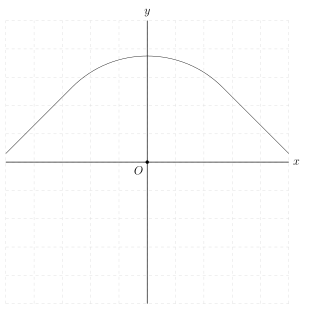
- Now suppose that \(C\) (as defined above) is a continuous curve for \(-\infty < x < \infty\), consisting of the arc of a circle and two straight lines. Sketch an example of such a curve which has a non-vertical tangent at each point.
Solution:
- \(\,\)
Note that we have a right angled triangle, with the sides in a ratio of \(m\). So if our target length is \(x\) we have \(x^2 + (mx)^2 = c^2\) and so \(x = c(m^2+1)^{-\frac12}\)
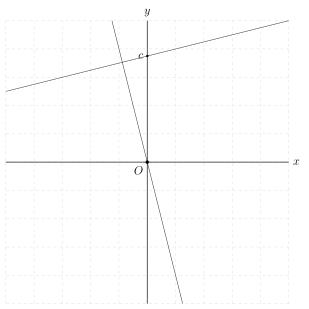
- The distance from the origin to \(L\) is \(a = c(m^2+1)^{-\frac12}\) so \begin{align*} && a^2(m^2+1) &= c^2 \\ && \frac{c-y(x)}{0-x} &= y' \\ \Rightarrow && c-y &= -xy' \\ \Rightarrow && a^2((y')^2+1) &= (y-xy')^2 \\ \\ && 2a^2y'y'' &= 2(y-xy')(y'-xy''-y') \\ &&&= 2(xy'-y)xy'' \\ \Rightarrow && y'' &= 0 \\ \text{ or } && 2a^2y' &= 2(xy'-y)x \end{align*} If \(y'' = 0\) then \(y = mx + c\) and the result follows immediately. \begin{align*} && 0 &= (a^2-x^2)y' + yx \\ \Rightarrow &&\frac1{y} y' &= -\frac{x}{a^2-x^2} \\ \Rightarrow && \ln y &= \frac12\ln (a^2-x^2) + K \\ \Rightarrow && y^2 &= M(a^2-x^2) \\ \Rightarrow && x^2 + y^2 &= a^2 \end{align*} Where in the last step we know the tangents from an ellipse are not all equidistant to the origin.
2014 Paper 3 Q3
- The line \(L\) has equation \(y=mx+c\), where \(m > 0\) and \(c > 0\). Show that, in the case \(mc > a > 0\), the shortest distance between \(L\) and the parabola \(y^2=4ax\) is \[ \frac{mc-a}{m\sqrt{m^2+1}}\,.\] What is the shortest distance in the case that \(mc\le a\)?
- Find the shortest distance between the point \((p,0)\), where \(p > 0\), and the parabola \(y^2=4ax\), where \(a > 0\), in the different cases that arise according to the value of \(p/a\). [You may wish to use the parametric coordinates \((at^2, 2at)\) of points on the parabola.] Hence find the shortest distance between the circle \((x-p)^2 + y^2 =b^2\), where \(p > 0\) and \(b > 0\), and the parabola \(y^2=4ax\), where \(a > 0\), in the different cases that arise according to the values of \(p\), \(a\) and \(b\).
Solution:
- Suppose we have the shortest distance between the two curves, and the path between the points is not a normal to both curves. Then we could shift the endpoints to reduce the distance. (Assuming we're not at a point of intersection). Therefore, the normal to the curves must be the same (or in other words) the gradients of the curves must be the same. ie we are at a point where \(2y y' = 4a\) we must have \(y' = m\), so \(y = \frac{2a}{m}\) and \(x = \frac{a}{m^2}\) and the distance from this point to the line \(y=mx+c\) is \(\frac{|m \frac{a}{m^2} - \frac{2a}{m}+c|}{\sqrt{m^2+1}} = \frac{|mc-a|}{m\sqrt{m^2+1}} = \frac{mc-a}{m\sqrt{m^2+1}}\). If \(mc \leq a\) then we find \(\frac{a-mc}{m\sqrt{m^2+1}}\) However, we must check that the two curves do not intersect (otherwise the closest distace is \(0\)). ie we need to check if \((mx+c)^2 = 4ax\) has any solutions, this quadratic has discriminant \((2mc-4a)^2 - 4 \cdot m^2 \cdot c^2 = 16a^2-16amc = 16a(a-mc)\) which is clearly greater than \(0\) when \(a \geq mc\). Therefore the shortest distance in this case is \(0\).
- The distance squared between the point \((p,0)\) and a point of the form \((at^2,2at)\) is \(D^2 = (at^2-p)^2+4a^2t^2 = a^2t^4+(4a^2-2ap)t^2+p^2\) \begin{align*} && \frac{D^2}{a^2} &= t^4 + 2\left(2-\frac{p}{a}\right)t^2 + \frac{p^2}{a^2} \\ &&&= \left (t^2 - \left (\frac{p}{a}-2 \right)\right)^2 + \frac{p^2}{a^2} - \left (2-\frac{p}{a} \right)^2 \\ &&&= \left (t^2 - \left (\frac{p}{a}-2 \right)\right)^2 +\frac{4p}{a} -4 \\ \end{align*} Therefore if \(2 \leq \frac{p}{a}\) then we can find a \(t\) such that we attain the minimum for \(D^2/a^2\) of \(\frac{4p}{a}-4\) and so \(D = \sqrt{4pa-4a^2} = 2\sqrt{a(p-a)}\) . If not the smallest value will be when \(t = 0\) and we will have \(|p|\) Now consider all the lines joining points on the parabola to the centre of the circle. The shortest distance from the parabola to the circle will be normal to the circle and therefore will also be a line through the center. Therefore we need only consider the shortest distance from \((p,0)\) to the parabola \(-b\). Case 1: If \(p \geq 2a\) we have \(2\sqrt{a(p-a)} - b\) or \(0\) if \(b \geq 2\sqrt{a(p-a)}\) Case 2: If \(p < 2a\) we have \(p-b\) or \(0\) if \(b \geq p\)
2013 Paper 1 Q5
The point \(P\) has coordinates \((x,y)\) which satisfy \[ x^2+y^2 + kxy +3x +y =0\,. \]
- Sketch the locus of \(P\) in the case \(k=0\), giving the points of intersection with the coordinate axes.
- By factorising \(3x^2 +3y^2 +10xy\), or otherwise, sketch the locus of \(P\) in the case \(k=\frac{10}{3}\,\), giving the points of intersection with the coordinate axes.
- In the case \(k=2\), let \(Q\) be the point obtained by rotating \(P\) clockwise about the origin by an angle~\(\theta\), so that the coordinates \((X,Y)\) of \(Q\) are given by \[ X=x\cos\theta +y\sin\theta\,, \ \ \ \ Y= -x\sin\theta + y\cos\theta\,. \] Show that, for \(\theta =45^\circ\), the locus of \(Q\) is \( \sqrt2 Y= (\sqrt2 X+1 )^2 - 1 .\) Hence, or otherwise, sketch the locus of \(P\) in the case \(k=2\), giving the equation of the line of symmetry.
Solution:
- \(k = 0\), we have \(x^2 + y^2 + 3x + y = 0\), ie \((x+\tfrac32)^2+(y+\tfrac12)^2 = \frac{10}{4}\).

- \(3x^2 + 3y^2 +10xy = (3x+y)(x+3y)\) so \(x^2 + y^2 + \tfrac{10}3xy + 3x+y = (3x+y)(\frac{x+3y}{3}+1) = 0\) so we have the line pair \(3x +y =0\), \(x+3y + 3 = 0\)

- If \(k = 2\) then \((x+y)^2 + (x+y)+2x = 0\). If \(\theta = 45^\circ\) then \( X = \frac1{\sqrt{2}}(x+y), Y = \frac{1}{\sqrt{2}}(y-x)\), ie \(x+y = \sqrt{2}X\) and \(x = \frac{1}{\sqrt2}(X-Y)\), so our equation is:
\begin{align*}
0 &= 2X^2 + \sqrt{2}X + \sqrt{2}(X-Y) \\
&= (\sqrt{2}X + 1)^2 - 1 - \sqrt{2} Y
\end{align*}
which would be a parabola with line of symmetry \(X = -\frac{1}{\sqrt{2}}\).
However, we are actually looking at that parabola rotated by \(45^\circ\) anticlockwise.

2013 Paper 2 Q4
The line passing through the point \((a,0)\) with gradient \(b\) intersects the circle of unit radius centred at the origin at \(P\) and \(Q\), and \(M\) is the midpoint of the chord \(PQ\). Find the coordinates of \(M\) in terms of \(a\) and \(b\).
- Suppose \(b\) is fixed and positive. As \(a\) varies, \(M\) traces out a curve (the locus of \(M\)). Show that \(x=- by\) on this curve. Given that \(a\) varies with \(-1\le a \le 1\), show that the locus is a line segment of length \(2b/(1+b^2)^\frac12\). Give a sketch showing the locus and the unit circle.
- Find the locus of \(M\) in the following cases, giving in each case its cartesian equation, describing it geometrically and sketching it in relation to the unit circle:
- \(a\) is fixed with \(0 < a < 1\), and \(b\) varies with \(-\infty < b < \infty\);
- \(ab=1\), and \(b\) varies with \(0< b\le1\).
Solution: \begin{align*} && y &= bx-ba \\ && 1 &= x^2 + y^2 \\ \Rightarrow && 1 &= x^2 + b^2(x-a)^2 \\ \Rightarrow && 0 &= (1+b^2)x^2-2ab^2x+b^2a^2-1 \end{align*} This will have roots which sum to \(\frac{2ab^2}{1+b^2}\), therefore \(M = \left ( \frac{ab^2}{1+b^2}, \frac{ab^3}{1+b^2}-ba \right)=\left ( \frac{ab^2}{1+b^2}, \frac{-ba}{1+b^2} \right)\)
- Since \(b\) is fixed so is \(\frac{b}{1+b^2} = t\) and all the points are \((bta, -ta)\), ie \(x = -by\). If \(a \in [-1,1]\) we are ranging on the points \((bt, -t)\) to \((-bt, t)\) which is a distance of \begin{align*}
&& d &= \sqrt{(bt+bt)^2+(-2t)^2} \\
&&&= \sqrt{4(b^2+1)t^2} \\
&&&=2 \sqrt{(b^2+1)\frac{b^2}{(b^2+1)^2}} \\
&&&= \frac{2b}{\sqrt{b^2+1}}
\end{align*}

- If \(a\) is fixed we have \(\left ( \frac{ab^2}{1+b^2}, -\frac{ba}{1+b^2} \right)\)
\begin{align*}
&& \frac{x}{y} &= - b \\
\Rightarrow && y &= \frac{a\frac{x}{y}}{1 + \frac{x^2}{y^2}} \\
\Rightarrow && y^2 \left ( 1 + \frac{x^2}{y^2} \right) &= ax \\
\Rightarrow && x^2-ax + y^2 &= 0 \\
\Rightarrow && \left (x - \frac{a}{2} \right)^2 + y^2 &= \frac{a^2}{4}
\end{align*}
Therefore we will end up with a circle centre \((\tfrac{a}{2}, 0)\) going through the origin.

- If \(ab = 1\), we have \(\left ( \frac{b}{1+b^2}, -\frac{1}{1+b^2} \right)\)
\begin{align*}
&& \frac{x}{y} &= -b \\
\Rightarrow && y &= -\frac{1}{1+\frac{x^2}{y^2}} \\
\Rightarrow && y + \frac{x^2}{y} &= - 1 \\
\Rightarrow && y^2 +y+ x^2 &= 0 \\
\Rightarrow && \left ( y + \frac12 \right)^2 + x^2 &= \frac14
\end{align*}

- If \(a\) is fixed we have \(\left ( \frac{ab^2}{1+b^2}, -\frac{ba}{1+b^2} \right)\)
\begin{align*}
&& \frac{x}{y} &= - b \\
\Rightarrow && y &= \frac{a\frac{x}{y}}{1 + \frac{x^2}{y^2}} \\
\Rightarrow && y^2 \left ( 1 + \frac{x^2}{y^2} \right) &= ax \\
\Rightarrow && x^2-ax + y^2 &= 0 \\
\Rightarrow && \left (x - \frac{a}{2} \right)^2 + y^2 &= \frac{a^2}{4}
\end{align*}
Therefore we will end up with a circle centre \((\tfrac{a}{2}, 0)\) going through the origin.
2012 Paper 2 Q7
Three distinct points, \(X_1\), \(X_2\) and \(X_3\), with position vectors \({\bf x}_1\), \({\bf x}_2\) and \({\bf x}_3\) respectively, lie on a circle of radius 1 with its centre at the origin \(O\). The point \(G\) has position vector \(\frac13({\bf x}_1+{\bf x}_2+{\bf x}_3)\). The line through \(X_1\) and \(G\) meets the circle again at the point \(Y_1\) and the points \(Y_2\) and \(Y_3\) are defined correspondingly. Given that \(\overrightarrow{GY_1} =-\lambda_1\overrightarrow{GX_1}\), where \(\lambda_1\) is a positive scalar, show that \[ \overrightarrow{OY_1}= \tfrac13 \big( (1-2\lambda_1){\bf x}_1 +(1+\lambda_1)({\bf x}_2+{\bf x}_3)\big) \] and hence that \[ \lambda_1 = \frac {3-\alpha-\beta-\gamma} {3+\alpha -2\beta-2\gamma} \,,\] where \(\alpha = {\bf x}_2 \,.\, {\bf x}_3\), \(\beta = {\bf x}_3\,.\, {\bf x}_1\) and \(\gamma = {\bf x}_1\,.\, {\bf x}_2\). Deduce that $\dfrac {GX_1}{GY_1} + \dfrac {GX_2}{GY_2} + \dfrac {GX_3}{GY_3} =3 \,$.
Solution:

2012 Paper 3 Q5
- The point with coordinates \((a, b)\), where \(a\) and \(b\) are rational numbers,is called an integer rational point if both \(a\) and \(b\) are integers; a non-integer rational point if neither \(a\) nor \(b\) is an integer.
- \(\bf (a)\) Write down an integer rational point and a non-integer rational point on the circle \(x^2+y^2 =1\).
- [\bf (b)] Write down an integer rational point on the circle \(x^2+y^2=2\). Simplify \[ (\cos\theta + \sqrt m \sin\theta)^2 + (\sin\theta - \sqrt m \cos\theta)^2 \, \] and hence obtain a non-integer rational point on the circle \(x^2+y^2=2\,\).
- The point with coordinates \((p+\sqrt 2 \, q\,,\, r+\sqrt 2 \, s)\), where \(p\), \(q\), \(r\) and \(s\) are rational numbers, is called: an integer \(2\)-rational point if all of \(p\), \(q\), \(r\) and \(s\) are integers; a non-integer \(2\)-rational point if none of \(p\), \(q\), \(r\) and \(s\) is an integer.
- \(\bf (a)\) Write down an integer \(2\)-rational point, and obtain a non-integer \(2\)-rational point, on the circle \(x^2+y^2=3\,\).
- [\bf(b)] Obtain a non-integer \(2\)-rational point on the circle \(x^2+y^2=11\,\).
- [\bf(c)]Obtain a non-integer \(2\)-rational point on the hyperbola \(x^2-y^2 =7 \).
Solution:
- \(\bf (a)\) \((1, \sqrt2)\) is an integer \(2\)-rational point. \((\frac35 + \frac45\sqrt2, \frac45 - \frac{3}{5}\sqrt2)\) is a non-integer \(2\)-rational point.
- [\bf(b)] First notice that \((\sqrt2)^2 +3^2 = 11\) so then consider \((1 + \tfrac32\sqrt2, 1-\tfrac32\sqrt2)\) will work as \(\pi/4\) degree rotation.
- [\bf(c)] First notice \(3^2-(\sqrt2)^2 = 2\). Notice that \((k\sec \theta + \sqrt{m} \tan \theta)^2 - (k\tan \theta + \sqrt{m} \sec \theta)^2 = k^2-m\). Taking \(k= 3\) we have \((3 \cdot \frac{13}{5} + \frac{12}{5}\sqrt{2}, 3\cdot\frac{12}5+\frac{13}{5}\sqrt2)\)
2012 Paper 3 Q6
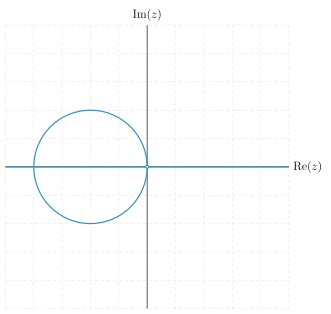
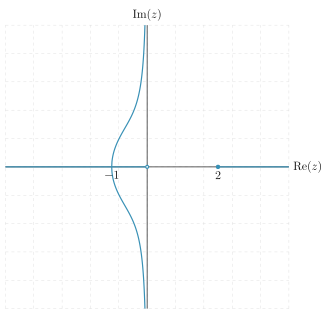
Let \(x+{\rm i} y\) be a root of the quadratic equation \(z^2 + pz +1=0\), where \(p\) is a real number. Show that \(x^2-y^2 +px+1=0\) and \((2x+p)y=0\). Show further that either \(p=-2x\) or \(p=-(x^2+1)/x\) with \(x\ne0\). Hence show that the set of points in the Argand diagram that can (as \(p\) varies) represent roots of the quadratic equation consists of the real axis with one point missing and a circle. This set of points is called the root locus of the quadratic equation. Obtain and sketch in the Argand diagram the root locus of the equation \[ pz^2 +z+1=0\, \] and the root locus of the equation \[ pz^2 + p^2z +2=0\,.\]
Solution: \begin{align*} && 0 &= z^2 + pz + 1\\ &&&= (x+iy)^2 + (x+iy)p + 1 \\ &&& = (x^2-y^2+px+1) + (2xy+py)i \\ \Rightarrow && 0 &= x^2 - y^2 + px + 1 \\ && 0 &= (2x+p)y \\ \Rightarrow && p &= -2x \\ \text{ or } && y &= 0 \\ \Rightarrow && p &= -(x^2+1)/x \end{align*} Therefore as \(p\) varies with either have \(y = 0\) and \(x\) taking any real value except \(0\) ie the real axis minus the origin. Or \(p = -2x\) and \(-y^2-x^2+1 = 0 \Rightarrow x^2 + y^2 = 1\) which is a circle. Suppose \(pz^2 + z + 1 = 0\) \begin{align*} && 0 &= pz^2 + z +1\\ &&&= p(x+iy)^2 + (x+iy) + 1\\ &&&= (px^2-py^2+x+1) + (2xyp + y) i \\ \Rightarrow && 0 &= (2xp+1)y \\ \Rightarrow && y & = 0, p = \frac{-(x+1)}{x^2}, x \neq 0 \\ \text{ or } && p &= -\frac{1}{2x}\\ \Rightarrow && 0 &= -\frac{1}{2}x + \frac{y^2}{2x} + x + 1 \\ &&&= \frac{y^2 - x^2 +2x^2 + 2x}{2x} \\ &&&= \frac{(x+1)^2+y^2-1}{2x} \end{align*} So we either have the real axis (except \(0\)) or a circle radius \(1\) centre \((-1, 0)\) (excluding \(x = 0\)).
2011 Paper 2 Q8
The end \(A\) of an inextensible string \(AB\) of length \(\pi\) is attached to a point on the circumference of a fixed circle of unit radius and centre \(O\). Initially the string is straight and tangent to the circle. The string is then wrapped round the circle until the end \(B\) comes into contact with the circle. The string remains taut during the motion, so that a section of the string is in contact with the circumference and the remaining section is straight. Taking \(O\) to be the origin of cartesian coordinates with \(A\) at \((-1,0)\) and \(B\) initially at \((-1, \pi)\), show that the curve described by \(B\) is given parametrically by \[ x= \cos t + t\sin t\,, \ \ \ \ \ \ y= \sin t - t\cos t\,, \] where \(t\) is the angle shown in the diagram.