2017 Paper 1 Q5
Year: 2017
Paper: 1
Question Number: 5
Course: LFM Pure
Section: Differentiation
Problem
Solution
Examiner's report
— 2017 STEP 1, Question 5The pure questions were again the most popular of the paper with questions 1 and 3 being attempted by almost all candidates. The least popular questions on the paper were questions 10, 11, 12 and 13 and a significant proportion of attempts at these were brief, attracting few or no marks. Candidates generally demonstrated a high level of competence when completing the standard processes and there were many good attempts made when questions required explanations to be given, particularly within the pure questions. A common feature of the stronger responses to questions was the inclusion of diagrams.
Rating Information
Difficulty Rating: 1500.0
Difficulty Comparisons: 0
Banger Rating: 1456.4
Banger Comparisons: 3
Show LaTeX source
Problem source
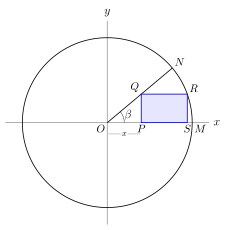
A circle of radius $a$
is centred at the origin $O$. A rectangle $PQRS$ lies in the
minor sector $OMN$ of this circle
where $M$ is $(a,0)$ and $N$ is $(a \cos \beta, a \sin \beta)$,
and $\beta$ is a constant with $0 < \beta < \frac{\pi}{2}\,$.
Vertex $P$ lies on the positive $x$-axis at $(x,0)$;
vertex $Q$ lies on $ON$; vertex $R$ lies on the arc of the circle
between $M$ and $N$; and vertex $S$ lies on the positive $x$-axis at $(s,0)$.
Show that the area $A$ of the rectangle can be written in the form
\[
A= x(s-x)\tan\beta
\,.
\]
Obtain an expression for $s$ in terms of $a$, $x$ and $\beta$, and use it to
show  that
\[
\frac{\d A}{\d x} =
(s-2x) \tan \beta  - \frac {x^2} s \tan^3\beta
\,.
\]
Deduce that  the greatest possible area of
rectangle $PQRS$ occurs when
$s= x(1+\sec\beta)$ and show that this greatest area is $\tfrac12 a^2 \tan \frac12 \beta\,$.
Show also that this greatest area occurs when $\angle ROS = \frac12\beta\,$.
Solution source
\begin{center}

\begin{tikzpicture}

\tikzset{
    % 1. Define Styles for Consistency
    axis/.style={thick, -{Stealth[scale=1.0]}, draw=black!40},
    main/.style={thick, draw=black},
    geometry/.style={thick, draw=blue!70!black},
    shaded/.style={fill=blue!10, draw=blue!70!black, thick},
    label node/.style={font=\small, inner sep=2pt}
}
    % Variables
    \def\a{3}    % Radius
    \def\b{40}   % Angle Beta
    \def\x{1.2}  % x-coordinate for P

    % 2. Coordinate Definitions (using calc for cleaner math)
    \coordinate (O) at (0,0);
    \coordinate (M) at (\a,0);
    \coordinate (N) at (\b:\a); % Using polar coordinates (angle:radius)
    \coordinate (P) at (\x, 0);
    \coordinate (Q) at (\x, {tan(\b)*\x});
    \coordinate (R) at ({sqrt(\a*\a - (tan(\b)*\x)^2)}, {tan(\b)*\x});
    \coordinate (S) at ({sqrt(\a*\a - (tan(\b)*\x)^2)}, 0);

    % 3. Background Layer (Axes should be behind the main drawing)
    \begin{scope}
        \draw[axis] ({-1.2*\a}, 0) -- ({1.2*\a}, 0) node[right] {$x$};
        \draw[axis] (0, {-1.2*\a}) -- (0, {1.2*\a}) node[above] {$y$};
    \end{scope}

    % 4. Main Geometry
    \draw[main] (O) circle (\a);
    \draw[main] (O) -- (N) node[label node, anchor=south west] {$N$};

    % 5. The Inscribed Rectangle (Shaded for emphasis)
    \filldraw[shaded] (P) -- (Q) -- (R) -- (S) -- cycle;

    % 6. Labels and Markings
    \node[label node, below left] at (O) {$O$};
    \node[label node, below right] at (M) {$M$};
    \node[label node, below] at (P) {$P$};
    \node[label node, above left] at (Q) {$Q$};
    \node[label node, above right] at (R) {$R$};
    \node[label node, below] at (S) {$S$};

    % Angle Label (using quotes library)
    \pic [draw, "$\beta$", angle radius=0.6cm, angle eccentricity=1.3] {angle = M--O--N};

    % Dimension indicator for x
    \draw[<->, >=Stealth, shorten <=1pt, shorten >=1pt, draw=gray]
        ($(O)+(0,-0.4)$) -- ($(P)+(0,-0.4)$)
        node[midway, fill=white, inner sep=1pt, font=\scriptsize] {$x$};

\end{tikzpicture}
\end{center}

Clearly the distance $PS$ is $s - x$, so it remains to determine the heigh $PQ$. Notice that $\tan \beta = \frac{PQ}{OP}$ so the height is $x \tan \beta$ and the area is $x(s-x)\tan \beta $


Notice that $R$ has a $y$-coordinate of $x \tan \beta$, but is a distance $a$ from the origin, so

$s^2 + x^2 \tan^2 \beta = a^2 \Rightarrow s = \sqrt{a^2-x^2 \tan^2 \beta}$

\begin{align*}
    && \frac{\d A}{\d x} &= (s-x)\tan \beta + x \left (\frac{\d s}{\d x} - 1 \right) \tan \beta \\
    &&&= (s-x) \tan \beta + \left (\tfrac12(a^2-x^2\tan^2 \beta)^{-1/2} \cdot (-2x \tan^2 \beta) - 1\right) x \tan \beta \\
    &&&= (s-x) \tan \beta + \left ( \frac{-x \tan^2 \beta}{s} -1\right)x \tan \beta \\
    &&&= (s-2x) \tan \beta - \frac{x^2}{s}\tan^3\beta \\
    \\
    \frac{\d A}{\d x} = 0: && 0 &= s(s-2x)-x^2 \tan^2 \beta \\
    &&&= s^2-(2x)s-x^2\tan^2 \beta \\
    &&&= (s-x)^2-(1+\tan^2\beta)x^2 \\
    \Rightarrow && s &= x + x \sec \beta \\
    &&&= (1+\sec \beta)x \\
    \\
    && a^2 &= x^2(1+\sec\beta)^2 + x^2 \tan^2 \beta \\
    &&&= x^2(2\sec \beta +2\sec^2 \beta ) \\
    &&&= 2x^2 \sec \beta(1+\sec \beta) \\
    \\
    && A &= x^2\sec \beta \tan \beta \\
    &&&= \frac12 a^2 \frac{\sec \beta \tan \beta}{\sec \beta(1+\sec \beta)} \\
    &&&= \frac12 a^2 \frac{\tan \beta}{1+\sec \beta}  = \frac12 a^2 \tan \frac{\beta}{2}\\
\end{align*}

This occurs when

\begin{align*}
    && \frac{RS}{SO} &= \frac{x \tan \beta}{s} \\
    &&&= \frac{\tan \beta}{1+\sec \beta} = \tan \frac{\beta}2 \\
    \Rightarrow&& \angle ROS &= \frac{\beta}2
\end{align*}
This question attracted a relatively small number of attempts, many of which did not make very much progress and so did not score very well. As a result this question had the lowest average mark among the pure questions. Those candidates who did make some progress, however, often managed to produce quite good solutions and so there were still a number of attempts that were awarded full marks. The majority of the successful attempts were accompanied by a clear diagram, which helped in understanding the situation as described in the question; candidates were then often able to follow through the steps as required.