2024 Paper 2 Q7
Year: 2024
Paper: 2
Question Number: 7
Course: LFM Stats And Pure
Section: Curve Sketching
Problem
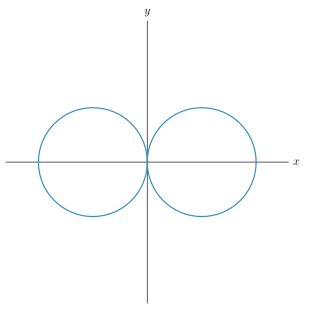
- Sketch the curve \(C_1\) with equation \[ \left(y^2 + (x-1)^2 - 1\right)\left(y^2 + (x+1)^2 - 1\right) = 0. \]
- Consider the curve \(C_2\) with equation
\[ \left(y^2 + (x-1)^2 - 1\right)\left(y^2 + (x+1)^2 - 1\right) = \tfrac{1}{16}. \]
- Show that the line \(y = k\) meets the curve \(C_2\) at points for which \[ x^4 + 2(k^2 - 2)x^2 + \left(k^4 - \tfrac{1}{16}\right) = 0. \] Hence determine the number of intersections between curve \(C_2\) and the line \(y = k\) for each positive value of \(k\).
- Determine whether the points on curve \(C_2\) with the greatest possible \(y\)-coordinate are further from, or closer to, the \(y\)-axis than those on curve \(C_1\).
- Show that it is not possible for both \(y^2 + (x-1)^2 - 1\) and \(y^2 + (x+1)^2 - 1\) to be negative, and deduce that curve \(C_2\) lies entirely outside curve \(C_1\).
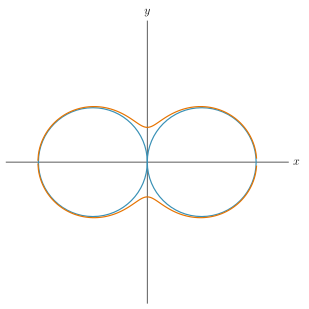
- Sketch the curves \(C_1\) and \(C_2\) on the same axes.
Solution
- \(\,\)
- Suppose \(y=k\) meets the curve \(C_2\) then \begin{align*} && \tfrac1{16} &= (k^2+(x-1)^2-1)(k^2+(x+1)^2-1) \\ &&&= (k^2+x^2-2x)(k^2+x^2+2x) \\ &&&= k^4+2k^2x^2+x^4-4x^2 \\ &&&= x^4+(2k^2-4)x^2+k^4 \\ \Rightarrow && 0 &= x^4+(2k^2-4)x^2+(k^4-\tfrac1{16}) \\ \\ && \Delta &= 4(k^2-2)^2 - 4 \cdot 1 \cdot (k^4-\tfrac1{16}) \\ &&&= 4(k^4-4k^2+4 - k^4 +\tfrac{1}{16}) \\ &&&= 16(1+\tfrac{1}{64} - k^2) \\ &&&= 16(\tfrac{65}{64} - k^2) \end{align*} Therefore if \(|k| < \frac{\sqrt{65}}{8}\) there are \(4\) intersections. If \(|k| = \frac{\sqrt{65}}{8}\) there are \(2\) intersections, otherwise there are \(0\).
- The greatest possible \(y\) value is \( \frac{\sqrt{65}}{8}\) and at this point \(x^2 = \frac{2(2-\frac{65}{64}}{2} =1 - \frac{1}{64} < 1\) so they are close to the \(y\)-axis.
- The regions where \(y^2+(x-1)^2-1 < 0\) and \(y^2+(x+1)^2-1 < 0\) is the interior of the two circles from the first part. However, since they don't overlap they can never both be negative. Therefore in our equation both are positive and therefore \(C_2\) is entirely outside \(C_1\)
- \(\,\)
Examiner's report
— 2024 STEP 2, Question 7Many candidates produced good solutions to the questions, with the majority of candidates opting to focus on the pure questions of the paper. Candidates demonstrated very good ability, particularly in the area of manipulating algebra. Many candidates produced clear diagrams which in many cases meant that they were more successful in their attempts at their questions than those who did not do so. The paper also contained a number of places where the answer to be reached was given in the question. In such cases, candidates must be careful to ensure that they provide sufficient evidence of the method used to reach the result in order to gain full credit.
Rating Information
Difficulty Rating: 1500.0
Difficulty Comparisons: 0
Banger Rating: 1500.0
Banger Comparisons: 0
Show LaTeX source
Problem source
\begin{questionparts}
\item Sketch the curve $C_1$ with equation
\[ \left(y^2 + (x-1)^2 - 1\right)\left(y^2 + (x+1)^2 - 1\right) = 0. \]
\item Consider the curve $C_2$ with equation
\[ \left(y^2 + (x-1)^2 - 1\right)\left(y^2 + (x+1)^2 - 1\right) = \tfrac{1}{16}. \]
\begin{enumerate}
\item Show that the line $y = k$ meets the curve $C_2$ at points for which
\[ x^4 + 2(k^2 - 2)x^2 + \left(k^4 - \tfrac{1}{16}\right) = 0. \]
Hence determine the number of intersections between curve $C_2$ and the line $y = k$ for each positive value of $k$.
\item Determine whether the points on curve $C_2$ with the greatest possible $y$-coordinate are further from, or closer to, the $y$-axis than those on curve $C_1$.
\item Show that it is not possible for both $y^2 + (x-1)^2 - 1$ and $y^2 + (x+1)^2 - 1$ to be negative, and deduce that curve $C_2$ lies entirely outside curve $C_1$.
\item Sketch the curves $C_1$ and $C_2$ on the same axes.
\end{enumerate}
\end{questionparts}
Solution source
\begin{questionparts}
\item $\,$
\begin{center}
    \begin{tikzpicture}
    \def\functionf(#1){exp(1/(#1)*ln(#1))};
    \def\xl{-2.6};
    \def\xu{2.6};
    \def\yl{-2.6};
    \def\yu{2.6};

    % Calculate scaling factors to make the plot square
    \pgfmathsetmacro{\xrange}{\xu-\xl}
    \pgfmathsetmacro{\yrange}{\yu-\yl}
    \pgfmathsetmacro{\xscale}{10/\xrange}
    \pgfmathsetmacro{\yscale}{10/\yrange}

    % Define the reusable styles to keep code clean
    \tikzset{
        x=\xscale cm, y=\yscale cm,
        axis/.style={thick, draw=black!80, -{Stealth[scale=1.2]}},
        grid/.style={thin, dashed, gray!30},
        curveA/.style={very thick, color=cyan!70!black, smooth},
        curveB/.style={very thick, color=orange!90!black, smooth},
        curveC/.style={very thick, color=green!90!black, smooth},
        curveBlack/.style={very thick, color=black, smooth},
        dot/.style={circle, fill=black, inner sep=1.2pt},
        labelbox/.style={fill=white, inner sep=2pt, rounded corners=2pt} % Protects text from lines
    }

    % Draw background grid
    \draw[grid] (\xl,\yl) (\xu,\yu);

    % Set up axes
    \draw[axis] (\xl,0) -- (\xu,0) node[right, black] {$x$};
    \draw[axis] (0,\yl) -- (0,\yu) node[above, black] {$y$};

    % Define the bounding region with clip
    \begin{scope}
        \clip (\xl,\yl) rectangle (\xu,\yu);

        \draw[curveA] (1,0) circle (1);
        \draw[curveA] (-1,0) circle (1);


    \end{scope}

    % Annotate Function Names
    % \node[curveB, labelbox] at (1.85, -1.1) {$x = \frac{4y^2+1}{3}$};


    \end{tikzpicture}
\end{center}

\item \begin{enumerate}
\item Suppose $y=k$ meets the curve $C_2$ then
\begin{align*}
&& \tfrac1{16} &= (k^2+(x-1)^2-1)(k^2+(x+1)^2-1) \\
&&&= (k^2+x^2-2x)(k^2+x^2+2x) \\
&&&= k^4+2k^2x^2+x^4-4x^2 \\
&&&= x^4+(2k^2-4)x^2+k^4 \\
\Rightarrow && 0 &= x^4+(2k^2-4)x^2+(k^4-\tfrac1{16}) \\
\\
&& \Delta &= 4(k^2-2)^2 - 4 \cdot 1 \cdot (k^4-\tfrac1{16}) \\
&&&= 4(k^4-4k^2+4 - k^4 +\tfrac{1}{16}) \\
&&&= 16(1+\tfrac{1}{64} - k^2) \\
&&&= 16(\tfrac{65}{64} - k^2)
\end{align*}
Therefore if $|k| < \frac{\sqrt{65}}{8}$ there are $4$ intersections. If $|k| =  \frac{\sqrt{65}}{8}$ there are $2$ intersections, otherwise there are $0$.
\item The greatest possible $y$ value is $ \frac{\sqrt{65}}{8}$ and at this point $x^2 = \frac{2(2-\frac{65}{64}}{2} =1 - \frac{1}{64} < 1$ so they are close to the $y$-axis.

\item The regions where $y^2+(x-1)^2-1 < 0$ and $y^2+(x+1)^2-1 < 0$ is the interior of the two circles from the first part. However, since they don't overlap they can never both be negative. Therefore  in our equation both are positive and therefore $C_2$ is entirely outside $C_1$

\item $\,$

\begin{center}
    \begin{tikzpicture}
    \def\functionf(#1){exp(1/(#1)*ln(#1))};
    \def\xl{-2.6};
    \def\xu{2.6};
    \def\yl{-2.6};
    \def\yu{2.6};

    % Calculate scaling factors to make the plot square
    \pgfmathsetmacro{\xrange}{\xu-\xl}
    \pgfmathsetmacro{\yrange}{\yu-\yl}
    \pgfmathsetmacro{\xscale}{10/\xrange}
    \pgfmathsetmacro{\yscale}{10/\yrange}

    % Define the reusable styles to keep code clean
    \tikzset{
        x=\xscale cm, y=\yscale cm,
        axis/.style={thick, draw=black!80, -{Stealth[scale=1.2]}},
        grid/.style={thin, dashed, gray!30},
        curveA/.style={very thick, color=cyan!70!black, smooth},
        curveB/.style={very thick, color=orange!90!black, smooth},
        curveC/.style={very thick, color=green!90!black, smooth},
        curveBlack/.style={very thick, color=black, smooth},
        dot/.style={circle, fill=black, inner sep=1.2pt},
        labelbox/.style={fill=white, inner sep=2pt, rounded corners=2pt} % Protects text from lines
    }

    % Draw background grid
    \draw[grid] (\xl,\yl) (\xu,\yu);

    % Set up axes
    \draw[axis] (\xl,0) -- (\xu,0) node[right, black] {$x$};
    \draw[axis] (0,\yl) -- (0,\yu) node[above, black] {$y$};

    % Define the bounding region with clip
    \begin{scope}
        \clip (\xl,\yl) rectangle (\xu,\yu);

        \draw[curveA] (1,0) circle (1);
        \draw[curveA] (-1,0) circle (1);

        \draw[curveB, domain=-2.01:2.01, samples=400]
            plot ({\x},  {sqrt(sqrt(4*(\x)^2 + 1/6) - (\x)^2)});
        \draw[curveB, domain=-2.01:2.01, samples=400]
            plot ({\x},  {-sqrt(sqrt(4*(\x)^2 + 1/6) - (\x)^2)});

    \end{scope}

    % Annotate Function Names
    % \node[curveB, labelbox] at (1.85, -1.1) {$x = \frac{4y^2+1}{3}$};


    \end{tikzpicture}
\end{center}

\end{enumerate}
\end{questionparts}
While there were many attempts at this question, most did not achieve very high marks. The sketch of the graph in part (i) needed to be clear that it was two circles each with a radius of 1, for example by stating that points on the curve must satisfy the equation of one of the circles, or by marking the centres of the circles and having the correct radius in each case. Most candidates were able to reach the required result at the start of part (ii)(a). Candidates often missed important features of the analysis in the remainder of this part, usually believing that the conclusions derived from considering the discriminant of the quadratic in x² was sufficient to analyse the number of roots in each case. In part (ii)(b) candidates were able to use their results from (ii)(a) to find the maximum value for y, but many struggled to obtain the correct value for x or incorrectly considered distances from the x-axis rather than from the y-axis. In (ii)(c) candidates often struggled to explain their reasoning clearly enough to give a fully convincing answer. In general candidates were comfortable in using algebra to prove that the two brackets cannot be negative at the same time and many were able to explain why this would mean that they must both be positive, but found it difficult to explain the significance of this in terms of the graph. In part (ii)(d) candidates often produced a graph that contained some of the features that had been deduced earlier in the question. Many solutions did not show intersections with axes or co-ordinates of maximum and minimum points.