2012 Paper 3 Q6
Year: 2012
Paper: 3
Question Number: 6
Course: LFM Stats And Pure
Section: Complex Numbers (L8th)
Difficulty: 1700.0
Banger: 1516.0
complex numbers
quadratic equation
root locus
Argand diagram
real and imaginary parts
circle
curve sketching
locus
Problem
Let \(x+{\rm i} y\) be a root of the quadratic equation \(z^2 + pz +1=0\), where \(p\) is a real number. Show that \(x^2-y^2 +px+1=0\) and \((2x+p)y=0\).
Show further that either \(p=-2x\) or \(p=-(x^2+1)/x\) with \(x\ne0\).
Hence show that the set of points in the Argand diagram that can (as \(p\) varies) represent roots of the quadratic equation consists of the real axis with one point missing and a circle.
This set of points is called the root locus of the
quadratic equation.
Obtain and sketch in the Argand diagram the root locus of the equation
\[ pz^2 +z+1=0\, \]
and the root locus of the equation
\[ pz^2 + p^2z +2=0\,.\]
Solution
\begin{align*}
&& 0 &= z^2 + pz + 1\\
&&&= (x+iy)^2 + (x+iy)p + 1 \\
&&& = (x^2-y^2+px+1) + (2xy+py)i \\
\Rightarrow && 0 &= x^2 - y^2 + px + 1 \\
&& 0 &= (2x+p)y \\
\Rightarrow && p &= -2x \\
\text{ or } && y &= 0 \\
\Rightarrow && p &= -(x^2+1)/x
\end{align*}
Therefore as \(p\) varies with either have \(y = 0\) and \(x\) taking any real value except \(0\) ie the real axis minus the origin.
Or \(p = -2x\) and \(-y^2-x^2+1 = 0 \Rightarrow x^2 + y^2 = 1\) which is a circle.
Suppose \(pz^2 + z + 1 = 0\)
\begin{align*}
&& 0 &= pz^2 + z +1\\
&&&= p(x+iy)^2 + (x+iy) + 1\\
&&&= (px^2-py^2+x+1) + (2xyp + y) i \\
\Rightarrow && 0 &= (2xp+1)y \\
\Rightarrow && y & = 0, p = \frac{-(x+1)}{x^2}, x \neq 0 \\
\text{ or } && p &= -\frac{1}{2x}\\
\Rightarrow && 0 &= -\frac{1}{2}x + \frac{y^2}{2x} + x + 1 \\
&&&= \frac{y^2 - x^2 +2x^2 + 2x}{2x} \\
&&&= \frac{(x+1)^2+y^2-1}{2x}
\end{align*}
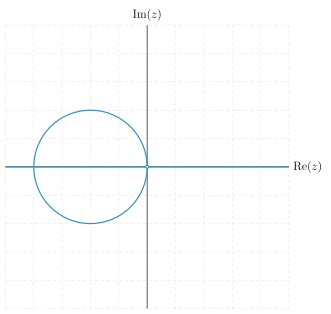
So we either have the real axis (except \(0\)) or a circle radius \(1\) centre \((-1, 0)\) (excluding \(x = 0\)).
 Suppose \(pz^2 + p^2 z + 2 = 0\) then
\begin{align*}
&& 0 &= p(x+iy)^2 + p^2(x+iy) + 2 \\
&&&= (p(x^2-y^2) + p^2x + 2) + (2xyp + p^2y)i \\
\Rightarrow && 0 &= py(2x+p) \\
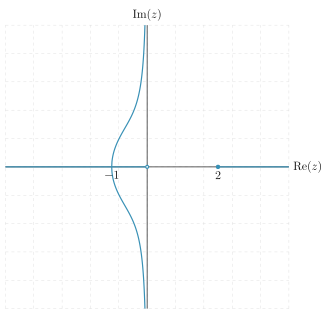
\Rightarrow && y &= 0, \Delta = x^4-8x \\
\Rightarrow && x &\in (-\infty, 0) \cup [2, \infty) \\
\text{ or } && p &= -2x \\
&& 0 &= (-2x)(x^2-y^2) + 4x^3+2 \\
&&&= 2x^3+2xy^2+2 \\
\Rightarrow && 0 &= x^3+xy^2+1
\end{align*}
Suppose \(pz^2 + p^2 z + 2 = 0\) then
\begin{align*}
&& 0 &= p(x+iy)^2 + p^2(x+iy) + 2 \\
&&&= (p(x^2-y^2) + p^2x + 2) + (2xyp + p^2y)i \\
\Rightarrow && 0 &= py(2x+p) \\
\Rightarrow && y &= 0, \Delta = x^4-8x \\
\Rightarrow && x &\in (-\infty, 0) \cup [2, \infty) \\
\text{ or } && p &= -2x \\
&& 0 &= (-2x)(x^2-y^2) + 4x^3+2 \\
&&&= 2x^3+2xy^2+2 \\
\Rightarrow && 0 &= x^3+xy^2+1
\end{align*}
Examiner's report
— 2012 STEP 3, Question 6
Mean: ~8 / 20 (inferred)
~67% attempted (inferred)
Inferred ~8.0/20: 'less success than its three predecessors' (Q3=9.5, Q4=9.0, Q5=9.0) → below 9.0; 'most managed first part' suggests not dramatically low. Inferred 67% from 'two thirds'
From the paper introduction
The number of candidates attempting more than six questions was, as last year, about 25%, though most of these extra attempts achieved little credit.
Source: Cambridge STEP 2012 Examiner's Report
· 2012-full.pdf
Rating Information
Difficulty Rating: 1700.0
Difficulty Comparisons: 0
Banger Rating: 1516.0
Banger Comparisons: 1
Show LaTeX source
Problem source
Let  $x+{\rm i} y$ be a root of the quadratic equation $z^2 + pz +1=0$, where $p$ is a real number. Show that $x^2-y^2 +px+1=0$ and $(2x+p)y=0$.
Show further that either $p=-2x$ or $p=-(x^2+1)/x$ with $x\ne0$.
Hence show that the set of  points in the Argand diagram that can (as $p$ varies) represent roots of the quadratic equation consists of the real axis with one point missing and a circle.
This set of points is called the \textit{root locus} of the
quadratic equation.
Obtain and sketch in the Argand diagram the root locus of the equation
\[ pz^2 +z+1=0\, \]
and the root locus of the equation
\[ pz^2 + p^2z +2=0\,.\]
Solution source
\begin{align*}
&& 0 &= z^2 + pz + 1\\
&&&= (x+iy)^2 + (x+iy)p + 1 \\
&&& = (x^2-y^2+px+1) + (2xy+py)i \\
\Rightarrow && 0 &= x^2 - y^2 + px + 1 \\
&& 0 &= (2x+p)y \\
\Rightarrow && p &= -2x \\
\text{ or } && y &= 0 \\
\Rightarrow && p &= -(x^2+1)/x
\end{align*}

Therefore as $p$ varies with either have $y = 0$ and $x$ taking any real value except $0$ ie the real axis minus the origin.

Or $p = -2x$ and $-y^2-x^2+1 = 0 \Rightarrow x^2 + y^2 = 1$ which is a circle.

Suppose $pz^2 + z + 1 = 0$

\begin{align*}
&& 0 &= pz^2 + z +1\\
&&&= p(x+iy)^2 + (x+iy) + 1\\
&&&= (px^2-py^2+x+1) + (2xyp + y) i \\
\Rightarrow && 0 &= (2xp+1)y \\
\Rightarrow && y & = 0, p = \frac{-(x+1)}{x^2}, x \neq 0 \\
\text{ or } && p &= -\frac{1}{2x}\\
\Rightarrow && 0 &= -\frac{1}{2}x + \frac{y^2}{2x} + x + 1 \\
&&&= \frac{y^2 - x^2 +2x^2 + 2x}{2x} \\
&&&= \frac{(x+1)^2+y^2-1}{2x}
\end{align*}

So we either have the real axis (except $0$) or a circle radius $1$ centre $(-1, 0)$ (excluding $x = 0$).


\begin{center}
    \begin{tikzpicture}
    \def\functionf(#1){1/(1+(#1)*(#1))};
    \def\xl{-2.5};
    \def\xu{2.5};
    \def\yl{-2.5}; \def\yu{2.5};

    % Calculate scaling factors to make the plot square
    \pgfmathsetmacro{\xrange}{\xu-\xl}
    \pgfmathsetmacro{\yrange}{\yu-\yl}
    \pgfmathsetmacro{\xscale}{10/\xrange}
    \pgfmathsetmacro{\yscale}{10/\yrange}

    % Define the reusable styles to keep code clean
    \tikzset{
        x=\xscale cm, y=\yscale cm,
        axis/.style={thick, draw=black!80, -{Stealth[scale=1.2]}},
        grid/.style={thin, dashed, gray!30},
        curveA/.style={very thick, color=cyan!70!black, smooth},
        curveB/.style={very thick, color=orange!90!black, smooth},
        dot/.style={circle, fill=black, inner sep=1.2pt},
        labelbox/.style={fill=white, inner sep=2pt, rounded corners=2pt} % Protects text from lines
    }

    % Draw background grid
    \draw[grid] (\xl,\yl) grid (\xu,\yu);


    \draw[axis] (\xl,0) -- (\xu,0) node[right, black] {$\textrm{Re}(z)$};
    \draw[axis] (0,\yl) -- (0,\yu) node[above, black] {$\textrm{Im}(z)$};
    % Define the bounding region with clip
    \begin{scope}
        \clip (\xl,\yl) rectangle (\xu,\yu);

        \draw[curveA] (\xl, 0) -- (\xu, 0);
        \draw[curveA] (-1, 0) circle (1);
        \filldraw[white] (0,0) circle (1.5pt);
        \draw[curveA] (0,0) circle (1.5pt);
    \end{scope}
        % Set up axes


    \end{tikzpicture}
\end{center}

Suppose $pz^2 + p^2 z + 2 = 0$ then

\begin{align*}
&& 0 &= p(x+iy)^2 + p^2(x+iy) + 2 \\
&&&= (p(x^2-y^2) + p^2x + 2) + (2xyp + p^2y)i \\
\Rightarrow && 0 &= py(2x+p) \\
\Rightarrow && y &= 0, \Delta = x^4-8x \\
\Rightarrow && x &\in (-\infty, 0) \cup [2, \infty) \\
\text{ or } && p &= -2x \\
&& 0 &= (-2x)(x^2-y^2) + 4x^3+2 \\
&&&= 2x^3+2xy^2+2 \\
\Rightarrow && 0 &= x^3+xy^2+1
\end{align*}


\begin{center}
    \begin{tikzpicture}
    \def\functionf(#1){1/(1+(#1)*(#1))};
    \def\xl{-4};
    \def\xu{4};
    \def\yl{-4}; \def\yu{4};

    % Calculate scaling factors to make the plot square
    \pgfmathsetmacro{\xrange}{\xu-\xl}
    \pgfmathsetmacro{\yrange}{\yu-\yl}
    \pgfmathsetmacro{\xscale}{10/\xrange}
    \pgfmathsetmacro{\yscale}{10/\yrange}

    % Define the reusable styles to keep code clean
    \tikzset{
        x=\xscale cm, y=\yscale cm,
        axis/.style={thick, draw=black!80, -{Stealth[scale=1.2]}},
        grid/.style={thin, dashed, gray!30},
        curveA/.style={very thick, color=cyan!70!black, smooth},
        curveB/.style={very thick, color=orange!90!black, smooth},
        dot/.style={circle, fill=black, inner sep=1.2pt},
        labelbox/.style={fill=white, inner sep=2pt, rounded corners=2pt} % Protects text from lines
    }

    % Draw background grid
    \draw[grid] (\xl,\yl) grid (\xu,\yu);


    \draw[axis] (\xl,0) -- (\xu,0) node[right, black] {$\textrm{Re}(z)$};
    \draw[axis] (0,\yl) -- (0,\yu) node[above, black] {$\textrm{Im}(z)$};
    % Define the bounding region with clip
    \begin{scope}
        \clip (\xl,\yl) rectangle (\xu,\yu);

        \draw[curveA] (\xl, 0) -- (0, 0);
        \draw[curveA] (2, 0) -- (\xu, 0);
        % \draw[curveA] (-1, 0) circle (1);
        \filldraw[white] (0,0) circle (1.5pt);
        \draw[curveA] (0,0) circle (1.5pt);
        \filldraw[curveA] (2,0) circle (1.5pt) node[below, black] {$2$};
        \draw[curveA] (2,0) circle (1.5pt);

        \draw[curveA, domain=-1:-0.01, samples=150] plot({\x}, {sqrt((-1-\x^3)/\x)});
        \draw[curveA, domain=-1:-0.01, samples=150] plot({\x}, {-sqrt((-1-\x^3)/\x)});
    \end{scope}
        \node[below] at (-1, 0) {$-1$};
        % Set up axes


    \end{tikzpicture}
\end{center}
Two thirds attempted this, with less success than its three predecessors. Very few indeed scored full marks, for even those that mastered the question rarely sketched the last locus correctly, putting in a non‐existent cusp. Most candidates managed the first part, good ones the second part too, and only the very best the third part. Quite a few assumed the roots were complex and then used complex conjugates, with varying success. Many candidates lost marks through careless arithmetic and algebraic errors. Given that most could do the first part, it was possible for candidates to score reasonably if they took care and took real parts and imaginary parts correctly.