Integration
Prove the identities \(\cos^4\theta -\sin^4\theta \equiv \cos 2\theta\) and $\cos^4 \theta + \sin^4 \theta \equiv 1 - {\frac12} \sin^2 2 \theta$. Hence or otherwise evaluate \[ \int_0^{\frac{1}{2}\pi} \cos^4 \theta \; \d \theta \;\;\;\; \mbox{and}\;\;\;\; \int_0^{\frac{1}{2}\pi} \sin^4 \theta \; \d \theta \,. \] Evaluate also \[ \int_0^{\frac{1}{2}\pi} \cos^6 \theta \; \d \theta \;\;\;\; \mbox{and}\;\;\;\; \int_0^{\frac{1}{2}\pi} \sin^6 \theta \; \d \theta \,. \]
Show SolutionBy writing \(x=a\tan\theta\), show that, for \(a\ne0\), $\displaystyle \int \frac 1 {a^2+x^2}\, \d x =\frac 1 a \arctan \frac x a + \text{constant}\,$.
- Let $\displaystyle I=\int_0^{\frac{1}{2}\pi}
\frac {\cos x}{1+\sin^2 x} \, \d x\,$.
- Evaluate \(I\).
- Use the substitution \(t=\tan \frac12 x\) to show that \(\displaystyle \int_0^1 \frac {1-t^2}{1+6t^2+t^4} \, \d t = \tfrac12 I\,\).
- Evaluate \(\displaystyle \int_0^1 \frac {1-t^2}{1+14t^2+t^4} \, \d t \,\).
- \(\,\) \begin{align*} && I &= \int_0^{\frac{1}{2}\pi} \frac {\cos x}{1+\sin^2 x} \d x \\ &&&= \left [ \arctan (\sin x) \right]_0^{\pi/2} \\ &&&= \arctan(1) - \arctan(0) = \frac{\pi}{4} \end{align*}
- \(\,\) \begin{align*} && t &= \tan \frac{x}{2} \\ \Rightarrow && \sin x &= \frac{2t}{1+t^2} \\ && \cos x &= \frac{1-t^2}{1+t^2} \\ && \d x &= \frac{2}{1+t^2} \d t \\ \Rightarrow && I &= \int_0^{\pi/2} \frac{\cos x}{1 + \sin^2 x } \d x \\ &&&= \int_{t=0}^{t = 1} \frac{\frac{1-t^2}{1+t^2}}{1 + \left (\frac{2t}{1+t^2} \right)^2} \frac{2}{1+t^2} \d t \\ &&&= 2 \int_0^1 \frac{1-t^2}{(1+t^2)^2+(2t)^2} \d t\\ &&&= 2 \int_0^1 \frac{1-t^2}{1+6t^2+t^4} \d t\\ \end{align*} From which the conclusion follows
- \(\,\) \begin{align*} && J &= \int_0^1 \frac {1-t^2}{1+14t^2+t^4} \, \d t \\ &&&= \int_0^1 \frac {\frac{1-t^2}{1+t^2}}{\frac{1+14t^2+t^4}{(1+t^2)^2}} \frac{1}{1+t^2} \, \d t \\ &&&= \int_0^1 \frac {\frac{1-t^2}{1+t^2}}{\frac{(t^2+1)^2+3(2t)^2}{(1+t^2)^2}} \frac{1}{1+t^2} \, \d t \\ &&&= \frac12\int_{x=0}^{x=\pi/2} \frac {\cos x}{1+3 \sin^2 x} \d x \\ &&&= \frac{1}{6}\left[ \sqrt{3} \arctan(\sin \sqrt{3}x)\right]_0^{\pi/2} \\ &&&= \frac16 \sqrt{3} \frac{\pi}{3} \\ &&&= \frac{\sqrt{3}\pi}{18} \end{align*}
The functions \(\s(x)\) (\(0\le x<1\)) and \(t(x)\) (\(x\ge0\)), and the real number \(p\), are defined by \[ \s(x) = \int_0^x \frac 1 {\sqrt{1-u^2}}\, \d u\;, \ \ \ \ t(x) = \int_0^x \frac 1 {1+u^2}\, \d u\;, \ \ \ \ p= 2 \int_0^\infty \frac 1 {1+u^2}\, \d u \;. \] For this question, do not evaluate any of the above integrals explicitly in terms of inverse trigonometric functions or the number \(\pi\).
- Use the substitution \(u=v^{-1}\) to show that \(\displaystyle t(x) =\int_{1/x}^\infty\frac 1 {1+v^2}\, \d v \, \). Hence evaluate \(t(1/x) + t(x)\) in terms of \(p\) and deduce that \(2t(1)= \frac12 p\,\).
- Let \(y=\dfrac{u}{\sqrt{1+u^2}}\). Express \(u\) in terms of \(y\), and show that \(\displaystyle \frac{\d u}{\d y} = \frac 1 {\sqrt{(1-y^2)^3}}\). By making a substitution in the integral for \(t(x)\), show that \[ t(x) = \s\left(\frac{x}{\sqrt{1+x^2}}\right)\!. \] Deduce that \(\s\big(\frac1{\sqrt2}\big) =\frac1 4 p\,\).
- Let \(z= \dfrac{u+ \frac1{\sqrt3}}{1-\frac 1{\sqrt3}u}\,\). Show that \(\displaystyle t(\tfrac1{\sqrt3}) = \int_{\frac1{\sqrt3}}^{\sqrt3} \frac1 {1+z^2} \,\d z\;, \) and hence that \(3t(\frac1{\sqrt3}) = \frac12 p\,\).
- \begin{align*} && t(x) &= \int_0^x \frac{1}{1+u^2} \d u \\ u = v^{-1}, \d u = -v^{-2} \d v&&&= \int_{v = \infty}^{v = 1/x} \frac{1}{1+v^{-2}} \frac{-1}{v^2} \d v \\ &&&= \int_{1/x}^\infty \frac{1}{1+v^2} \d v \\ \\ \Rightarrow && t(x) + t(1/x) &= \int_0^x \frac{1}{1+u^2} \d u + \int_0^{1/x} \frac{1}{1+u^2} \d u \\ &&&= \int_{1/x}^{\infty} \frac{1}{1+u^2} \d u + \int_0^{1/x} \frac{1}{1+u^2} \d u \\ &&&= \int_0^{\infty} \frac{1}{1+u^2} \d u \\ &&&= \frac12 p \\ \\ \Rightarrow && t(1) +t(1/1) = 2t(1) &= \frac12 p \end{align*}
- \(\,\) \begin{align*} && y &= \frac{u}{\sqrt{1+u^2}} \\ \Rightarrow && y^2 &= \frac{u^2}{1+u^2} \\ &&&= 1-\frac{1}{1+u^2} \\ \Rightarrow && 1+u^2 &= \frac{1}{1-y^2} \\ \Rightarrow && u &= \frac{y}{\sqrt{1-y^2}} \\ \\ && \frac{\d u}{\d y} &= \frac{\sqrt{1-y^2} + y^2(1-y^2)^{-1/2}}{1-y^2} \\ &&&= \frac{1}{(1-y^2)^{3/2}} \\ \\ && t(x) &= \int_0^x \frac{1}{1+u^2} \d u \\ &&&= \int_0^{y = x/\sqrt{1+x^2}} \frac{1}{1 + \frac{y^2}{1-y^2}} \frac{1}{(1-y^2)^{3/2}} \d y \\ &&&= \int_0^{x/\sqrt{1+x^2}} \frac{1-y^2}{(1-y^2)^{3/2}} \d y \\ &&&= \int_0^{x/\sqrt{1+x^2}} \frac{1}{(1-y^2)^{1/2}} \d y \\ &&&= s\left ( \frac{x}{\sqrt{1+x^2}} \right) \\ \\ \Rightarrow && s\left ( \frac{1}{\sqrt{2}} \right) &= t(1) = \frac14p \end{align*}
- \(\,\) \begin{align*} && z &= \frac{u + \frac1{\sqrt{3}}}{1- \frac{1}{\sqrt{3}} u}\\ \Rightarrow && z - \frac{z}{\sqrt{3}}u &= u + \frac{1}{\sqrt{3}} \\ \Rightarrow && u &= \frac{z-\frac{1}{\sqrt{3}}}{1 + \frac{z}{\sqrt{3}}} \\ \\ \Rightarrow && \frac{\d u}{\d z} &= \frac{\sqrt{3}(\sqrt{3}+z ) -(\sqrt{3}z-1)}{\left (\sqrt{3}+z \right)^2} \\ &&&= \frac{4}{(\sqrt{3}+z)^2} \\ \\ \Rightarrow && t \left ( \frac{1}{\sqrt{3}} \right) &= \int_0^{1/\sqrt{3}} \frac{1}{1+u^2} \d u \\ &&&= \int_{z=1/\sqrt{3}}^{z=\sqrt{3}} \frac{1}{1 + \left ( \frac{\sqrt{3}z-1}{\sqrt{3}+z}\right)^2} \frac{4}{(\sqrt{3}+z)^2} \d z\\ &&&= \int_{1/\sqrt{3}}^{\sqrt{3}} \frac{4}{(\sqrt{3}+z)^2+(\sqrt{3}z-1)^2} \d z \\ &&&= \int_{1/\sqrt{3}}^{\sqrt{3}} \frac{4}{4+4z^2} \d z \\ &&&= \int_{1/\sqrt{3}}^{\sqrt{3}} \frac{1}{1+z^2} \d z \end{align*} Notice that \(t(1/\sqrt{3})+t(\sqrt{3}) = \frac12p\) and also notice that \(t(1/\sqrt{3}) + t(1/\sqrt{3}) =t(\sqrt{3})\) so \(3t(1/\sqrt{3}) = \frac12p\)
- Use the substitution \(u^2=2x+1\) to show that, for \(x>4\), \[ \int \frac{3} { ( x-4 ) \sqrt {2x+1}} \; \d x = \ln \l \frac{\sqrt{2x+1}-3} {\sqrt{2x+1}+3} \r + K\,, \] where \(K\) is a constant.
- Show that $ \displaystyle \int_{\ln 3}^{\ln 8} \frac{2} { \e^x \sqrt{ \e^x + 1}}\; \mathrm{d}x\, = \frac 7{12} + \ln \frac23 $ .
- \begin{align*} && I &= \int \frac{3}{(x-4)\sqrt{2x+1}}\, \d x \\ u^2 =2x+1, 2u \frac{\d u}{\d x}=2: && &= \int \frac{3}{\left(\frac{u^2-1}{2}-4\right)u} u \d u \\ &&&= \int \frac{6}{u^2-9} \d u \\ &&&= \int \frac{6}{(u-3)(u+3)} \d u\\ &&&= \int \left ( \frac{1}{u-3} - \frac{1}{u+3} \right )\d u \\ &&&= \ln (u-3) - \ln (u+3) + C \\ &&&= \ln \frac{u-3}{u+3} + C \\ &&&= \ln \left (\frac{\sqrt{2x+1}-3}{\sqrt{2x+1}+3} \right) + C \end{align*}
- \begin{align*} && I &= \int_{\ln 3}^{\ln 8} \frac{2}{e^x\sqrt{e^x+1}} \d x \\ u = e^x, \frac{\d u}{\d x} = e^x: &&&= \int_{u=3}^{u=8} \frac{2}{u\sqrt{u+1}} \frac{1}{u} \d u \\ v^2=u+1, 2v \frac{\d v}{\d u} = 1: &&&= \int_{v=2}^{v=3} \frac{2}{v(v^2-1)^2} \d v \\ &&&= \int_2^3 \left ( \frac{2}{v} - \frac{}{v-1} - \frac{1}{2(v-1)^2} - \frac{1}{v+1} - \frac{1}{2(v+1)^2}\right) \d v \\ &&&= \left [2\ln v - \ln(v^2-1)+\frac12(v-1)^{-1}+\frac12(v+1)^{-1} \right]_2^3 \\ &&&= \left ( 2\ln3-\ln 8+\frac14+\frac18\right)-\left ( 2\ln2-\ln 3+\frac12+\frac16\right) \\ &&&= \end{align*}
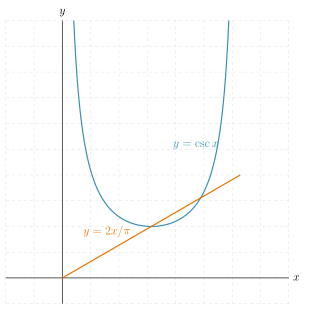
- Sketch on the same axes the functions \({\rm cosec}\, x\) and \(2x/ \pi\), for \(0 < x < \pi\,\). Deduce that the equation \(x\sin x = \pi/2 \) has exactly two roots in the interval \(0 < x < \pi\,\). Show that \[ \displaystyle \int_{\pi/2}^{\pi} \left \vert x\sin x - \frac{\pi} { 2} \right \vert \; \mathrm{d}x = 2\sin\alpha +\frac{3\pi^2} 4 - \alpha \pi -\pi -2\alpha \cos\alpha -1 \] where \(\alpha\) is the larger of the roots referred to above.
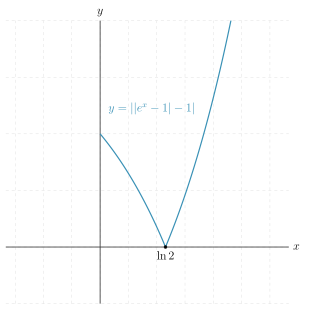
- Show that the region bounded by the positive \(x\)-axis, the \(y\)-axis and the curve \[y = \Bigl| \vert \e^x - 1 \vert - 1 \Bigr|\] has area \(\ln 4-1\).
- \(\,\)
Notice that they are equal at \(1\) when \(x = \pi/2\), but this is a local minimum for \(\csc x\) whereas \(2x/\pi\) is increasing so there is a second intersection. Notice that \(\csc x = \frac{2x}{\pi} \Leftrightarrow x \sin x = \frac{\pi}{2}\) therefore our intersections are also the roots of \(x \sin x = \frac{\pi}{2}\) and the larger one is greater than \(\pi/2\) \begin{align*} && I &= \int_{\pi/2}^{\pi} \Bigl| x \sin x - \frac{\pi}{2} \Bigr| \d x \\ &&&= \int_{\pi/2}^{\alpha} \left ( x \sin x - \frac{\pi}{2} \right )\d x +\int_{\alpha}^{\pi} \left ( \frac{\pi}{2} -x \sin x \right) \d x \\ &&&= \left ( \pi - 2\alpha + \frac{\pi}{2}\right) \frac{\pi}{2} + \int_{\pi/2}^{\alpha} x \sin x\d x -\int_{\alpha}^{\pi} x \sin x \d x \\ &&&= \frac{3\pi^2}{4} - \alpha \pi + \left [-x \cos x \right]_{\pi/2}^{\alpha}+\left[x \cos x \right]_{\alpha}^{\pi} + \int_{\pi/2}^{\alpha} \cos x \d x - \int_{\alpha}^{\pi} \cos x \d x \\ &&&= \frac{3\pi^2}{4} - \alpha \pi -\alpha \cos \alpha -\pi -\alpha \cos \alpha+ \sin \alpha - 1+\sin \alpha \\ &&&= 2\sin \alpha + \frac{3\pi^2}{4} - \alpha \pi - 2\alpha \cos \alpha - 1 \end{align*}
- \(\,\)
\begin{align*} && A &= \int_0^{\ln 2} ||e^x-1|-1| \d x \\ &&&= \int_0^{\ln 2} |e^x-2| \d x \\ &&&=\int_0^{\ln 2} (2-e^x) \d x \\ &&&= 2 \ln 2 - \left [e^x \right]_0^{\ln 2} \\ &&&= \ln 4 - (2-1) = \ln 4 - 1 \end{align*}
By making the substitution \(x=\pi-t\,\), show that \[ \! \int_0^\pi x\f(\sin x) \d x = \tfrac12 \pi \! \int_0^\pi \f(\sin x) \d x\,, \] where \(\f(\sin x)\) is a given function of \(\sin x\). Evaluate the following integrals:
- \(\displaystyle \int_0^\pi \frac {x \sin x}{3+\sin^2 x}\,\d x\,\);
- $\displaystyle \int_0^{2\pi} \frac {x \sin x}{3+\sin^2 x}\,\d x\,\(;
- \)\displaystyle \int_{0}^{\pi} \frac {x \big\vert\sin 2x\big\vert}{3+\sin^2 x}\,\d x\,$.
Let \[ I = \int_{-\frac12 \pi}^{\frac12\pi} \frac {\cos^2\theta}{1-\sin\theta\sin2\alpha} \, \d\theta \text{ and } J = \int_{-\frac12 \pi}^{\frac12\pi} \frac {\sec^2\theta}{1+\tan^2\theta\cos^22\alpha} \, \d\theta \] where \(0 < \alpha < \frac14\pi\,\).
- Show that \[ I = \int_{-\frac12 \pi}^{\frac12\pi} \frac {\cos^2\theta}{1+\sin\theta\sin2\alpha} \d\theta \] and hence that \[ \displaystyle 2I = \int_{-\frac12 \pi}^{\frac12\pi} \frac {2}{1+\tan^2\theta\cos^22\alpha} \, \d\theta \]
- Find \(J\).
- By considering \(I\sin^2 2\alpha +J\cos^2 2\alpha \), or otherwise, show that \(I =\frac12 \pi \sec^2\alpha\).
- Evaluate \(I\) in the case \(\frac14\pi < \alpha < \frac12\pi\).
- \(\,\) \begin{align*} && I &= \int_{-\frac12 \pi}^{\frac12\pi} \frac {\cos^2\theta}{1-\sin\theta\sin2\alpha} \, \d\theta \\ \phi = -\theta, \d \phi = - \d \theta: &&&= \int_{\phi=\frac12\pi}^{\phi=-\frac12\pi} \frac{\cos^2(-\phi)}{1-\sin(-\phi)\sin 2 \alpha} (-1) \d \phi \\ &&&= \int_{-\frac12 \pi}^{\frac12\pi} \frac {\cos^2\phi}{1+\sin\phi\sin2\alpha} \d\phi \\ \\ && 2I &= \int_{-\frac12 \pi}^{\frac12\pi} \frac {\cos^2\theta}{1-\sin\theta\sin2\alpha} \, \d\theta +\int_{-\frac12 \pi}^{\frac12\pi} \frac {\cos^2\theta}{1+\sin\theta\sin2\alpha} \, \d\theta \\ &&&= \int_{-\frac12 \pi}^{\frac12\pi} \left ( \frac {\cos^2\theta}{1-\sin\theta\sin2\alpha} +\frac {\cos^2\theta}{1+\sin\theta\sin2\alpha} \right) \, \d\theta \\ &&&= \int_{-\frac12 \pi}^{\frac12\pi} \left ( \frac {2\cos^2\theta}{1-\sin^2\theta\sin^22\alpha} \right) \, \d\theta \\ &&&= \int_{-\frac12 \pi}^{\frac12\pi} \left ( \frac {2\cos^2\theta}{1-(1-\cos^2\theta)(1-\cos^22\alpha)} \right) \, \d\theta \\ &&&= \int_{-\frac12 \pi}^{\frac12\pi} \left ( \frac {2\cos^2\theta}{\cos^2\theta+\cos^22\alpha-\cos^2 \theta \cos^2 2 \alpha)} \right) \, \d\theta \\ &&&= \int_{-\frac12 \pi}^{\frac12\pi} \left ( \frac {2}{1+\cos^22\alpha(\sec^2 \theta - 1))} \right) \, \d\theta \\ &&&= \int_{-\frac12 \pi}^{\frac12\pi} \left ( \frac {2}{1+\tan^2 \theta \cos^22\alpha} \right) \, \d\theta \\ \end{align*}
- \(\,\) \begin{align*} && J &= \int_{-\frac12 \pi}^{\frac12\pi} \frac {\sec^2\theta}{1+\tan^2\theta\cos^22\alpha} \, \d\theta \\ &&&= \left [\sec 2 \alpha \tan^{-1} \left ( \cos 2 \alpha \tan \theta \right) \right]_{-\frac12 \pi}^{\frac12\pi} \\ &&&= \sec(2\alpha)\pi = \frac{\pi}{\cos 2 \alpha} \end{align*}
- \(\,\) \begin{align*} && I\sin^2 2\alpha +J\cos^2 2\alpha &= \int_{-\frac12\pi}^{\frac12 \pi} \frac{\sin^2 2 \alpha+\cos^2 2 \alpha \sec^2 \theta}{1+\tan^2 \theta \cos^2 2\alpha} \d \theta \\ &&&= \int_{-\frac12\pi}^{\frac12 \pi} \frac{\sin^2 2 \alpha+\cos^2 2 \alpha (1 + \tan^2 \theta)}{1+\tan^2 \theta \cos^2 2\alpha} \d \theta \\ &&&= \pi \\ \\ \Rightarrow && I &= \frac{\pi - \pi \cos 2 \alpha}{\sin^2 2 \alpha} \\ &&&= \pi \frac{2\sin^2 \alpha}{4 \sin^2 \alpha \cos^2 \alpha} \\ &&&= \frac12 \pi \sec^2 \alpha \end{align*}
- If \(\frac14 \pi < \alpha < \frac12 \pi\) then our calculation for \(J\) is not correct. \begin{align*} && J &= \int_{-\frac12 \pi}^{\frac12\pi} \frac {\sec^2\theta}{1+\tan^2\theta\cos^22\alpha} \, \d\theta \\ &&&= \left [\sec 2 \alpha \tan^{-1} \left ( \cos 2 \alpha \tan \theta \right) \right]_{-\frac12 \pi}^{\frac12\pi} \\ &&&= \sec(2\alpha) \left ( \lim_{\theta \to \frac{\pi}{2}} \tan^{-1} \left ( \cos 2 \alpha \tan \theta \right) - \lim_{\theta \to -\frac{\pi}{2}} \tan^{-1} \left ( \cos 2 \alpha \tan \theta \right) \right) \\ &&&= \sec(2\alpha) \left ( \tan^{-1} \left ( \lim_{x\to -\infty} x \right) - \tan^{-1} \left ( \lim_{x\to \infty} x \right) \right) \\ &&&= -\pi \sec 2 \alpha \end{align*} Still using the same logic, we can say \begin{align*} && I &= \frac{\pi+\pi\cos 2 \alpha}{\sin^2 2 \alpha} \\ &&&= \pi \frac{2 \cos^2 \alpha}{4 \sin^2 \alpha \cos^2 \alpha}\\ &&&= \frac12 \pi \cosec^2 \alpha \end{align*}
- Evaluate the integral \[ \int_0^1 \l x + 1 \r ^{k-1} \; \mathrm{d}x \] in the cases \(k\ne0\) and \(k = 0\,\). Deduce that \(\displaystyle \frac{2^k - 1}{k} \approx \ln 2\) when \(k \approx 0\,\).
- Evaluate the integral \[ \int_0^1 x \l x + 1 \r ^m \; \mathrm{d}x \; \] in the different cases that arise according to the value of \(m\).
- Case \(k \neq 0\): \begin{align*} && \int_0^1 (x+1)^{k-1} \d x &= \left [\frac{1}{k}(x+1)^k \right]_0^1 \\ &&&= \frac{2^k-1}{k} \\ \end{align*} Case \(k = 0\): \begin{align*} && \int_0^1 (x+1)^{k-1} \d x &= \int_0^1 (x+1)^{-1} \d x \\ &&&= \left [\ln(x+1) \right]_0^1 \\ &&&= \ln 2 \end{align*} Therefore for \(k \approx 0\), we must have both integrals being close to each other, since the function is nice on this interval, ie \(\frac{2^k-1}{k} \approx \ln 2\)
- Case \(m = 0\). \(I = \frac12\) Case \(m \neq 0, -1, -2\) \begin{align*} u = x+1, \d u = \d x && \int_0^1 x(x+1)^m \d x &= \int_{u=1}^{u=2} (u-1)u^m \d u \\ &&&=\left[ \frac{u^{m+2}}{m+2} - \frac{u^{m+1}}{m+1} \right]_1^2 \\ &&&= 2^{m+1}\left ( \frac{2}{m+2} - \frac1{m+1} \right) - \frac{1}{m+2} + \frac{1}{m+1} \\ &&&= 2^{m+1} \frac{m}{(m+1)(m+2)} + \frac{1}{(m+1)(m+2)} \\ &&&= \frac{m2^{m+1}+1}{(m+1)(m+2)} \\ \end{align*} Case \(m = -1\). \begin{align*} && \int_0^1 \frac{x}{x+1} \d x &= \int_0^1 1 - \frac{1}{x+1} \d x \\ &&&= 1 - \ln2 \\ \end{align*} Case \(m = -2\): \begin{align*} && \int_0^1 \frac{x}{(x+1)^2} \d x &= \int_0^1\frac{x+1-1}{(x+1)^2} \d x \\ &&&= \left [ \ln (x+1) +(1+x)^{-1} \right]_0^1 \\ &&&= \ln 2 + \frac12 - 1 \\ &&&= \ln 2 - \frac12 \end{align*}
Give a sketch, for \(0 \le x \le \frac{1}{2}\pi\), of the curve $$ y = (\sin x - x\cos x)\;, $$ and show that \(0\le y \le 1\,\). Show that:
- \(\displaystyle \int_0^{\frac{1}{2}\pi}\,y\;\d x = 2 -\frac \pi 2 \)
- \(\displaystyle \int_0^{\frac{1}{2}\pi}\,y^2\,\d x = \frac{\pi^3}{48}-\frac \pi 8 \)
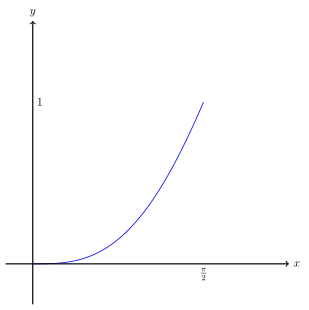
- \(\,\) \begin{align*} \int_0^{\frac{1}{2}\pi}\,y\;\d x &= \int_0^{\frac{1}{2}\pi} (\sin x - x \cos x) \d x \\ &= \left [-\cos x \right]_0^{\frac{1}{2}\pi} +\left [ -x \sin x \right]_0^{\frac{1}{2}\pi} + \int_0^{\frac{1}{2}\pi} \sin x \d x \\ &= 1-\frac{\pi}{2} + 1 = 2 - \frac{\pi}{2} \end{align*}
- \(\,\) \begin{align*} \int_0^{\frac{1}{2}\pi}y^2\d x &= \int_0^{\frac{1}{2}\pi} (\sin x - x \cos x)^2 \d x \\ &= \int_0^{\frac{1}{2}\pi} (\sin^2x - 2x\sin x \cos x+x^2\cos^2 x) \d x\\ &= \int_0^{\frac{1}{2}\pi} (\sin^2x -x \sin 2x+\tfrac12x^2(\cos 2 x + 1)) \d x\\ &= \frac{\pi}{4} + \frac{\pi^3}{48} + \int_0^{\frac{1}{2}\pi} (-x \sin 2x+\tfrac12x^2\cos 2 x) \d x \\ &= \frac{\pi}{4} + \frac{\pi^3}{48} + \left [\frac12 x \cos 2x +\frac14 x^2 \sin2x\right]_0^{\frac{1}{2}\pi}-\int_0^{\frac{1}{2}\pi}(\tfrac12 \cos 2x +\tfrac12 x \sin 2x) \d x\\ &= \frac{\pi}{4} + \frac{\pi^3}{48} - \frac{\pi}{4} - \left [ \frac14 \sin 2x \right]_0^{\frac{1}{2}\pi} - \int_0^{\frac{1}{2}\pi} \tfrac12 x \sin 2x \d x\\ &= \frac{\pi^3}{48} - \left( \left[ -\frac14 x \cos 2x \right]_0^{\frac{1}{2}\pi} - \int_0^{\frac{1}{2}\pi} -\frac14 \cos 2x \d x \right)\\ &= \frac{\pi^3}{48} - \left( \frac{\pi}{8} + \left[ \frac18 \sin 2x \right]_0^{\frac{1}{2}\pi} \right)\\ &= \frac{\pi^3}{48} - \frac{\pi}{8} \end{align*}
The square bracket notation \(\boldsymbol{[} x\boldsymbol{]}\) means the greatest integer less than or equal to \(x\,\). For example, \(\boldsymbol{[}\pi\boldsymbol{]} = 3\,\), \(\boldsymbol{[}\sqrt{24}\,\boldsymbol{]} = 4\,\) and \(\boldsymbol{[}5\boldsymbol{]}=5\,\).
- Sketch the graph of \(y = \sqrt{\boldsymbol{[}x\boldsymbol{]}}\) and show that \[ \displaystyle \int^a_0 \sqrt{\boldsymbol{[}x\boldsymbol{]}} \; \mathrm{d}x = \sum^{a-1}_{r=0} \sqrt{r} \] when \(a\) is a positive integer.
- Show that $\displaystyle \int^{a}_0 2_{\vphantom{A}}^{\pmb{\boldsymbol {[} } x \pmb{ \boldsymbol{]}} }\; \mathrm{d}x = 2^{a}-1\( when \)a\( is a positive integer.
- Determine an expression for \)\displaystyle \int^{a}_0 2_{\vphantom{\dot A}}^{\pmb{\boldsymbol{[} }x \pmb{ \boldsymbol{]}} } \; \mathrm{d}x\( when \)a$ is positive but not an integer.
- \(\,\) \begin{align*} && \int_0^a \sqrt{\boldsymbol{[}x\boldsymbol{]}} \d x &= \sum_{r=0}^{a-1} \int_{x=r}^{x=r+1} \sqrt{\boldsymbol{[}x\boldsymbol{]}} \d x \\ &&&= \sum_{r=0}^{a-1} \int_r^{r+1} \sqrt{r} \d x \\ &&&= \sum_{r=0}^{a-1} \sqrt{r} \\ \end{align*}
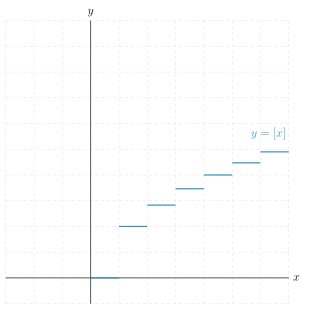
- \(\,\) \begin{align*} && \int^{a}_0 2^{\boldsymbol {[} x \boldsymbol{]}} \d x &= \sum_{r=0}^{a-1} \int_{x=r}^{x=r+1} 2^{\boldsymbol {[} x \boldsymbol{]}} \d x \\ &&&= \sum_{r=0}^{a-1} \int_{x=r}^{x=r+1} 2^{r} \d x \\ &&&= \sum_{r=0}^{a-1} 2^{r}\\ &&&= 2^{a}-1 \end{align*}
- \(\,\) \begin{align*} && \int^{a}_0 2^{\boldsymbol {[} x \boldsymbol{]}} \d x &= \int_0^{\boldsymbol {[} a \boldsymbol{]}} 2^{\boldsymbol {[} x \boldsymbol{]}} \d x + \int_{\boldsymbol {[} a \boldsymbol{]}}^a 2^{\boldsymbol {[} x \boldsymbol{]}} \d x \\ &&&= 2^{ \boldsymbol {[} a \boldsymbol{]}}-1 + (a-\boldsymbol {[} a \boldsymbol{]})2^{\boldsymbol {[} a \boldsymbol{]}} \\ &&&= (a-\boldsymbol {[} a \boldsymbol{]}+1)2^{\boldsymbol {[} a \boldsymbol{]}} -1 \end{align*}
Differentiate \(\sec {t}\) with respect to \(t\).
- Use the substitution \(x=\sec t\) to show that $\displaystyle \int^2_{\sqrt 2} \frac{1}{ x^3\sqrt {x^2-1} } \; \mathrm{d}x =\frac{\sqrt 3 - 2}{8} + \frac {\pi}{24} \;.$
- Determine $\displaystyle \int \frac{1} {( x+2) \sqrt {(x+1)(x+3)} } \; \mathrm{d}x \;$.
- Determine $\displaystyle \int \frac {1} {(x+2) \sqrt {x^2+4x-5} } \; \mathrm{d}x \;$.
- \(\,\) \begin{align*} && I_1 &= \int_{\sqrt{2}}^2 \frac{1}{x^3 \sqrt{x^2-1}} \\ x = \sec t, \d x = \sec t \tan t:&&&= \int_{t=\pi/4}^{t=\pi/3} \frac{1}{\sec^3 t \tan t} \sec t \tan t \d t \\ &&&= \int_{t=\pi/4}^{t=\pi/3} \cos^2 t \d t \\ &&&= \int_{t=\pi/4}^{t=\pi/3} \frac{1+\cos 2t}{2} \d t \\ &&&= \frac12 \frac{\pi}{12} + \frac12 \left (\sin \frac{\pi}{3} - \sin \frac{\pi}{4} \right) \\ &&&= \frac{\pi}{24} + \frac{\sqrt{3}-2}{8} \\ \end{align*}
- \(\,\) \begin{align*} && I_2 &= \int \frac{1}{(x+2)\sqrt{(x+1)(x+3)}} \d x \\ &&&= \int \frac{1}{(x+2)\sqrt{(x+2)^2-1}} \d x \\ &&&= \int \frac{1}{u\sqrt{u^2-1}} \d u \\ &&&= \sec^{-1} u + C \\ &&&= \sec^{1} (x+2) + C \end{align*}
- \(\,\) \begin{align*} && I_3 &= \int \frac{1}{(x+2)\sqrt{(x+2)^2 - 9}} \d x \\ &&&= \int\frac{1}{9(\frac{x+2}{3})\sqrt{(\frac{x+2}3)^2 - 1}} \d x \\ u = \frac{x+2}{3}, 3\d u =\d x &&&= \frac19 \int \frac{1}{u\sqrt{u^2-1}} 3 \d u \\ &&&= \frac13 \sec^{-1} u + C \\ &&&= \frac13 \sec^{-1} \frac{x+2}{3} + C \end{align*}
Evaluate the following integrals, in the different cases that arise according to the value of the positive constant \(a\,\):
- \[ \displaystyle \int_0^1 \frac 1 {x^2 + (a+2)x +2a} \; \d x \]
- \[\displaystyle \int _{1}^2\frac 1 {u^2 +au +a-1} \; \d u\]
- \(\,\) \begin{align*} && I &= \int_0^1 \frac 1 {x^2 + (a+2)x +2a} \; \d x \\ &&&= \int_0^1 \frac{1}{(x+a)(x+2)} \d x\\ \end{align*} Case 1: \(a = 2\) \begin{align*} && I &= \int_0^1 \frac{1}{(x+2)^2} \d x \\ &&&= \left [ -(x+2)^{-1}\right]_0^1 = \frac12 - \frac13 = \frac16 \end{align*} Case 2: \(a \neq 2, a \not \in [0,1]\) \begin{align*} && I &=\frac{1}{a-2} \int_0^1 \left ( \frac{1}{x+2} - \frac{1}{x+a} \right) \d x \\ &&&= \frac{1}{a-2} \left [ \ln |x+2| - \ln |x + a|\right]_0^1 \\ &&&= \frac{1}{a-2} \left ( \ln \frac{3}{|1+a|} - \ln \frac{2}{|a|} \right) \\ &&&= \frac{1}{a-2} \ln \frac{3|a|}{2|a+1|} \end{align*} Case 3: \(a \in [0, 1]\), \(I\) does not converge
- \(\,\) \begin{align*} && J &= \int _{1}^2\frac 1 {u^2 +au +a-1} \; \d u \\ &&&= \int_1^2 \frac{1}{(u+a-1)(u+1)} \d u \\ x = u-1:&&&= \int_0^1 \frac{1}{(x+a)(x+2)} \d x \end{align*} So it's the same as the previous integral
The function \(\f\) is defined by $$ \f(x)= \vert x-1 \vert\;, $$ where the domain is \({\bf R}\,\), the set of all real numbers. The function \(\g_n =\f^n\), with domain \({\bf R}\,\), so for example \(\g_3(x) = \f(\f(\f(x)))\,\). In separate diagrams, sketch graphs of \(\g_1\,\), \(\g_2\,\), \(\g_3\,\) and \(\g_4\,\). The function \(\h\) is defined by \[ \h(x) = |\sin {{{\pi}x} \over 2}|, \] where the domain is \({\bf R}\,\). Show that if \(n\) is even, \[ \int_0^n\,\big( \h(x)-\g_n(x)\big)\,\d x = \frac{2n}{\pi} -\frac{n}2\;. \]
Show Solution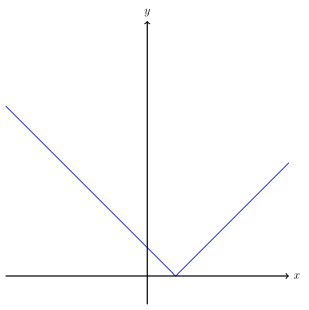
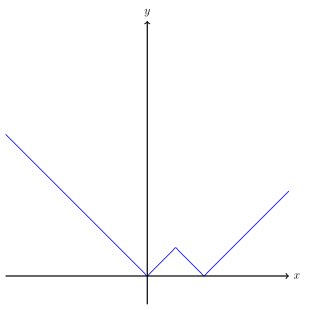
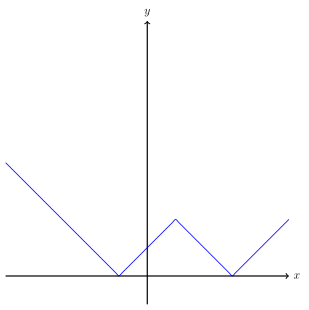
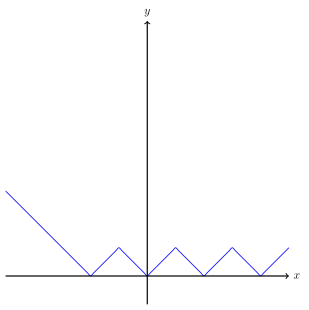
If \(m\) is a positive integer, show that \(\l 1+x \r^m + \l 1-x \r^m \ne 0\) for any real \(x\,\). The function \(\f\) is defined by \[ \f (x) = \frac{ (1+x )^m - ( 1-x )^m}{ (1+x )^m + (1-x )^m} \;. \] Find and simplify an expression for \(\f'(x)\). In the case \(m=5\,\), sketch the curves \(y = \f (x)\) and \(\displaystyle y = \frac1 { \f (x )}\;\).
Show Solution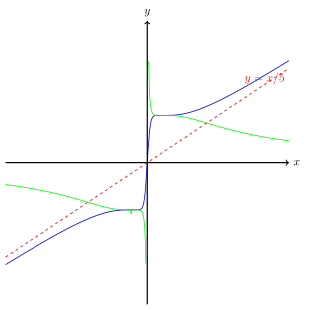
Give a sketch of the curve \( \;\displaystyle y= \frac1 {1+x^2}\;\), for \(x\ge0\). Find the equation of the line that intersects the curve at \(x=0\) and is tangent to the curve at some point with \(x>0\,\). Prove that there are no further intersections between the line and the curve. Draw the line on your sketch. By considering the area under the curve for \(0\le x\le1\), show that \(\pi>3\,\). Show also, by considering the volume formed by rotating the curve about the \(y\) axis, that \(\ln 2 >2/3\,\). [Note: \(\displaystyle \int_0^ 1 \frac1 {1+x^2}\, \d x = \frac\pi 4\,.\;\)]
Show Solution
Let \[ I= \int_0^a \frac {\cos x}{\sin x + \cos x} \; \d x \, \quad \mbox{ and } \quad J= \int_0^a \frac {\sin x}{\sin x + \cos x} \; \d x \;, \] where \(0\le a < \frac{3}{4}\pi\,\). By considering \(I+J\) and \(I-J\), show that $ 2I= a + \ln (\sin a +\cos a)\;. $ Find also:
- \(\displaystyle \int_0^{\frac{1}{2}\pi} \frac {\cos x}{p\sin x + q\cos x} \; \d x \,\), where \(p\) and \(q\) are positive numbers; %
- [(ii)] %\(\displaystyle \int_0^{\frac{1}{2}\pi/2} \frac {\cos x}{\sin (x+k)} \; \d x \,\), where \(0 < k < \pi/2\,\);
- \(\displaystyle \int_0^{\frac{1}{2}\pi} \frac {\cos x+4}{3\sin x + 4\cos x+ 25} \; \d x \,\).
- Let \(\displaystyle I = \int_0^{\frac12 \pi} \frac{\cos x}{p \sin x + q \cos x} \d x, J = \int_0^{\frac12 \pi} \frac{\sin x}{p \sin x + q \cos x} \d x\) so \begin{align*} && qI + pJ &= \frac{\pi}{2} \\ && pI - qJ &= \int_0^{\frac12 \pi} \frac{p \cos x - q \sin x}{p \sin x + q \cos x } \d x \\ &&&= \left [\ln (p \sin x + q \cos x) \right]_0^{\pi/2} \\ &&&= \ln(p) - \ln(q) = \ln \frac{p}{q} \end{align*}
- \(\,\) \begin{align*} && \int_0^{\frac{\pi}{2}} \frac{\cos x}{\sin(x + k)} \d x &= \int_0^{\frac{\pi}{2}} \frac{\cos x}{\sin(x) \cos(k) + \cos(x) \sin (k)} \d x \\ &&&= \ln \tan k \end{align*}
- Let \(\displaystyle I = \int_0^{\pi/2} \frac{\cos x + 4}{3 \sin x + 4 \cos x + 25} \d x, J = \int_0^{\pi/2} \frac{\sin x + 3}{3 \sin x + 4 \cos x + 25} \d x\), so \begin{align*} && 4I + 3J &= \int_0^{\pi/2} \frac{3 \sin x + 4 \cos x + 25}{3 \sin x + 4 \cos x + 25} \d x \\ &&&= \frac{\pi}{2} \\ && 3I - 4J &= \int_0^{\pi/2} \frac{3\cos x - 4 \sin x}{3 \sin x + 4 \cos x + 25} \d x \\ &&&= \left [\ln(3 \sin x + 4 \cos x + 25) \right]_0^{\pi/2} \\ &&&= \ln (28) - \ln (29) = \ln \frac{28}{29} \\ \Rightarrow && 25I &= 2\pi + 3 \ln \frac{28}{29} \\ \Rightarrow && I &= \frac{2}{25} \pi + \frac{3}{25} \ln \frac{28}{29} \end{align*}
Show that \[ \int_{\frac{1}{6}\pi}^{\frac{1}{4}\pi} \frac 1{1-\cos2\theta} \;\d\theta = \frac{\sqrt3}2 - \frac12\;. \] By using the substitution \(x=\sin2\theta\), or otherwise, show that \[ \int_{\sqrt3/2}^1 \frac 1 {1-\sqrt{1-x^2}} \, \d x = \sqrt 3 -1 -\frac\pi 6 \;. \] Hence evaluate the integral \[ \int_1^{2/\sqrt3} \frac 1{y ( y - \sqrt{y^2-1^2})} \, \d y \;. \]
Show SolutionGive a sketch to show that, if \(\f(x) > 0\) for \(p < x < q\,\), then \(\displaystyle \int_p^{q} \f(x) \d x > 0\,\).
- By considering \(\f(x) = ax^2-bx+c\,\) show that, if \(a > 0\) and \(b^2 < 4ac\), then \(3b < 2a+6c\,\).
- By considering \(\f(x)= a\sin^2x - b\sin x + c\,\) show that, if \(a > 0\) and \(b^2< 4ac\), then \(4b < (a+2c)\pi\)
- Show that, if \(a > 0\), \(b^2 < 4ac\) and \(q > p > 0\,\), then $$ b\ln(q/p) < a\left(\frac1p -\frac1q\right) +c(q-p)\;. $$
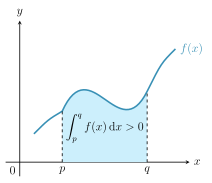
- If \(a > 0\) and \(b^2 < 4ac \Rightarrow \Delta < 0\) then \(f(x) = ax^2-bx+c > 0\) for all \(x\). Therefore \begin{align*} && 0 & < \int_0^1 (ax^2-bx+c) \d x\\ &&&= \frac13 a-\frac12b+c \\ \Rightarrow && 3b &< 2a+6c \end{align*}
- Similar logic tells us this must also be always positive, therefore \begin{align*} && 0 &< \int_0^{\pi} (a \sin^2 x - b \sin x +c ) \d x\\ &&&= \frac{\pi}{2}a - 2b+\pi c \\ \Rightarrow && 4b &< (a+2c)\pi \end{align*}
- Similar logic shows that \(f(x) = \frac{a}{x^2}-\frac{b}{x} +c>0\), therefore \begin{align*} && 0 &< \int_p^q \left (\frac{a}{x^2} - \frac{b}{x} + c\right) \d x \\ &&&=a\left (\frac{1}{p} - \frac{1}{q} \right) - b(\ln q - \ln p)+c(q-p) \\ \Rightarrow && b \ln (q/p) &,< a\left (\frac{1}{p} - \frac{1}{q} \right) +c(q-p) \end{align*}
Find the area of the region between the curve \(\displaystyle y = {\ln x \over x}\,\) and the \(x\)-axis, for \(1 \le x \le a\). What happens to this area as \(a\) tends to infinity? Find the volume of the solid obtained when the region between the curve \(\displaystyle y = {\ln x \over x}\,\) and the \(x\)-axis, for \(1 \le x\le a\), is rotated through \(2 \pi\) radians about the \(x\)-axis. What happens to this volume as \(a\) tends to infinity?
Show SolutionShow that (for \(t>0\))
- \[ \int_0^1 \frac1{(1+tx)^2} \d x = \frac1{(1+t)} \]
- \[ \int_0^1 \frac{-2x}{(1+tx)^3} \d x = -\frac1{(1+t)^2} \]
- For the first one, consider \begin{align*} && \int_0^1 \frac{1}{(1+tx)^2} \d x &= \left [ -\frac{1}{t}(1+tx)^{-1} \right]_0^1 \\ &&&= \frac{1}{t} - \frac{1}{t(1+t)} \\ &&&= \frac{t+1-1}{t(t+1)} = \frac{1}{t+1} \end{align*}
- Consider \begin{align*} && \int_0^1 \frac{-2x}{(1+tx)^3} \d x &= \int_0^1 \frac{\frac{2}{t}(1+tx) -\frac{2}{t}}{(1+tx)^3} \d x \\ &&&= -\frac{2}{t} \int_0^1 \left (\frac{1}{(1+tx)^2}- \frac{1}{(1+tx)^3} \right) \d x \\ &&&= -\frac{2}{t} \frac{1}{t+1} + \frac{2}{t} \left [ \frac{1}{-2t}(1+tx)^{-2}\right]_0^1 \\ &&&= -\frac{2}{t(t+1)} + \frac2t\left (\frac{1}{2t} - \frac{1}{2t(1+t)^2} \right) \\ &&&= -\frac{2}{t} \left ( \frac{1}{t+1} + \frac{1}{2t(1+t)^2} - \frac{1}{2t}\right) \\ &&&= -\frac{2}{t} \frac{2t(1+t)+1-(1+t)^2}{2t(1+t)^2} \\ &&&= -\frac{2}{t} \frac{2t^2+2t+1-1-2t-t^2}{2t(1+t)^2} \\ &&&= -\frac{1}{(1+t)^2} \end{align*}
Show that \[ \int_0^1 \frac{x^4}{1+x^2} \, \d x = \frac \pi {4} - \frac 23 \;. \] Determine the values of
- \(\displaystyle \int_0^1 x^3 \; \tan ^{-1} \left(\frac {1-x} {1+x} \right) \,\d x \)
- \(\displaystyle \int_0^1 \frac {(1-y)^3} {(1+y)^5} \; {{\tan}^{-1} y}\, \d y\)
- \(\,\) \begin{align*} && I &= \int_0^1 x^3 \; \tan ^{-1} \left(\frac {1-x} {1+x} \right) \,\d x \\ &&&= \left [ \frac{x^4}{4}\tan ^{-1} \left(\frac {1-x} {1+x} \right) \right]_0^1 -\int_0^1 \frac{x^4}{4} \frac{1}{1 +\left(\frac {1-x} {1+x} \right) ^2 } \cdot \frac{-2}{(1+x)^2} \d x \\ &&&= \frac{1}{2} \int_0^1 \frac{x^4}{(1+x)^2+(1-x)^2} \d x \\ &&&= \frac{1}{4} \int_0^1 \frac{x^4}{1+x^2} \d x \\ &&&= \frac{\pi}{16} - \frac{1}{6} \end{align*}
- \(\,\) \begin{align*} && J &= \int_0^1 \frac {(1-y)^3} {(1+y)^5} \; {{\tan}^{-1} y}\, \d y \\ &&&= \left [ \frac {(y(1+y^2)} {(1+y)^4} \tan^{-1}y \right]_0^1 - \int_0^1 \frac {(y(1+y^2)} {(1+y)^4} \frac{1}{1+y^2} \d y \\ &&&= \frac{\pi}{32} - \int_0^1 \frac{y}{(1+y)^4} \d y \\ &&&= \frac{\pi}{32} - \left[ - \frac{3y+1}{6(1+y)^3} \right]_0^1 \\ &&&= \frac{\pi}{32} +\frac{4}{6 \cdot 8} - \frac{1}{6} \\ &&&= \frac{\pi}{32} - \frac{1}{12} \end{align*}
- Show that, for \(0\le x\le 1\), the largest value of \(\displaystyle \frac{x^6}{(x^2+1)^4}\) is \(\frac1{16}\).
- Find constants \(A\), \(B\), \(C\) and \(D\) such that, for all \(x\), \[ \frac{1}{(x^2+1)^4}= \frac{\d \ }{\d x} \left( \frac{Ax^5+Bx^3+Cx}{(x^2+1)^3}\right) +\frac{Dx^6}{(x^2+1)^4}. \]
- Hence, or otherwise, prove that \[ \frac{11}{24} \le \int_{0}^{1}\frac{1}{(x^{2}+1)^{4}}\, \d x \le \frac{11}{24} + \frac 1{16} \; . \]
- \(x^2 + 1 \geq 2x \Rightarrow \frac{1}{x^2+1} \leq \frac1{2x} \Rightarrow \frac{x^6}{(x^2+1)^4}\leq \frac{x^6}{16x^2} = \frac1{16}x^2 \leq \frac1{16}\) with equality when \(x = 1\)
- \(\,\) \begin{align*} && RHS &= \frac{\d \ }{\d x} \left( \frac{Ax^5+Bx^3+Cx}{(x^2+1)^3}\right) +\frac{Dx^6}{(x^2+1)^4} \\ &&&= \frac{(5Ax^4+3Bx^2+C)(x^2+1)^3-6x(x^2+1)^2(Ax^5+Bx^3+Cx)}{(x^2+1)^6}+\frac{Dx^6}{(x^2+1)^4} \\ &&&= \frac{(5Ax^4+3Bx^2+C)(x^2+1)-6x(Ax^5+Bx^3+Cx)+Dx^6}{(x^2+1)^4} \\ &&&= \frac{(D-A) x^6 + (5A-3B) x^4 + (3B-5C)x^2 + C}{(x^2+1)^4} \\ \Rightarrow && C &= 1 \\ && 3B &= 5 \quad\quad\quad\Rightarrow B = \frac53 \\ && 5A &= 3B = 5\Rightarrow A = 1 \\ && D &= A \quad\quad \Rightarrow D = 1 \end{align*}
- So \begin{align*} && I &= \int_{0}^{1}\frac{1}{(x^{2}+1)^{4}}\, \d x \\ &&&= \int_{0}^{1}\frac{\d \ }{\d x} \left( \frac{Ax^5+Bx^3+Cx}{(x^2+1)^3}\right) +\frac{Dx^6}{(x^2+1)^4} \, \d x \\ &&&= \left [ \frac{Ax^5+Bx^3+Cx}{(x^2+1)^3} \right]_0^1 + \int_{0}^{1}\frac{Dx^6}{(x^2+1)^4} \, \d x \\ &&& \leq \frac{A+B+C}{8} + \frac1{16} \\ &&&= \frac{2+\frac53}{8} + \frac1{16} = \frac{11}{24} + \frac{1}{16} \\ && I &\geq \left [ \frac{Ax^5+Bx^3+Cx}{(x^2+1)^3} \right]_0^1 = \frac{11}{24} \end{align*}
Show that \[ \int_{-1}^1 \vert \, x\e^x \,\vert \d x =- \int_{-1}^0 x\e^x \d x + \int_0^1 x\e^x \d x \] and hence evaluate the integral. Evaluate the following integrals:
- \(\displaystyle \int_0^4 \vert\, x^3-2x^2-x+2 \,\vert \, \d x\,;\)
- \(\displaystyle \int_{-\pi}^\pi \vert\, \sin x +\cos x \,\vert \; \d x\,.\)
- \(\,\) \begin{align*} && I &= \int_0^4 | x^3-2x^2-x+2| \d x \\ &&&= \int_0^4 |(x-2)(x-1)(x+1)| \d x\\ &&&= \int_0^1( x^3-2x^2-x+2) \d x- \int_1^2 ( x^3-2x^2-x+2) \d x + \int_2^4 ( x^3-2x^2-x+2) \d x \\ &&&= \left [\frac14 x^4-\frac23 x^3- \frac12 x^2 +2x \right]_0^1 - \left [\frac14 x^4-\frac23 x^3- \frac12 x^2 +2x \right]_1^2 + \left [\frac14 x^4-\frac23 x^3- \frac12 x^2 +2x \right]_2^4 \\ &&&= 2 \left ( \frac14 - \frac23 -\frac12 + 2\right) - 2 \left ( \frac14 2^4 - \frac23 2^3 -\frac12 2^2 + 2 \cdot 2\right)+ \left ( \frac14 4^4 - \frac23 4^3 -\frac12 4^2 + 2 \cdot 4\right) \\ &&&= \frac{133}{6} \end{align*}
- \(\,\) \begin{align*} && J &= \int_{-\pi}^\pi | \sin x + \cos x | \d x \\ &&&= \int_{-\pi}^{\pi} | \sqrt{2} \sin(x + \tfrac{\pi}{4})| \d x \\ &&&= 2\sqrt{2}\int_0^\pi \sin x \d x \\ &&&= 4\sqrt{2} \end{align*}
It is required to approximate a given function \(\f(x)\), over the interval \(0 \le x \le 1\), by the linear function \(\lambda x\), where \(\lambda\) is chosen to minimise \[ \int_0^1 \big(\f(x)-\lambda x \big)^{\!2} \,\d x . \] Show that \[ \lambda = 3 \int_0^1 x\f(x)\,\d x. \] The residual error, \(R\), of this approximation process is such that \[ R^2 = \int_0^1 \big(\f(x)-\lambda x \big)^{\!2}\,\d x. \] Show that \[ R^2 = \int_0^1 \big(\f(x)\big)^{\!2}\,\d x -\tfrac{1}{3} \lambda ^2. \] Given now that \(\f(x)= \sin (\pi x/n)\), show that (i) for large \(n\), \(\lambda \approx \pi/n\) and (ii) \(\lim_{n \to \infty}R = 0.\) Explain why, prior to any calculation, these results are to be expected. [You may assume that, when \(\theta\) is small, $\sin \theta \approx \theta-\frac{1}{6}\theta^3$ and \(\cos \theta \approx 1 - \frac{1}{2}\theta^2.\)]
Show SolutionShow that \[ \sin\theta = \frac {2t}{1+t^2}, \ \ \ \cos\theta = \frac{1-t^2}{1+t^2}, \ \ \ \frac{1+\cos\theta}{\sin\theta} = \tan (\tfrac{1}{2}\pi-\tfrac{1}{2}\theta), \] where \(t =\tan\frac{1}{2}\theta\). Use the substitution \(t =\tan\frac{1}{2}\theta\) to show that, for \(0<\alpha<\frac{1}{2}\pi\), \[ \int_0^{\frac{1}{2}\pi} {1 \over {1 + \cos\alpha \sin \theta}} \,\d\theta =\frac{\alpha}{\sin\alpha}\,, \] and deduce a similar result for \[ \int_0^{\frac{1}{2}\pi} {1 \over {1 + \sin\alpha \cos \theta}} \,\d\theta \,. \]
Show Solution