2004 Paper 1 Q2
Year: 2004
Paper: 1
Question Number: 2
Course: LFM Pure
Section: Integration
Difficulty: 1484.0
Banger: 1499.3
integration
floor function
greatest integer function
curve sketching
summation
geometric series
piecewise function
Problem
The square bracket notation \(\boldsymbol{[} x\boldsymbol{]}\) means the greatest integer less than or equal to \(x\,\).
For example, \(\boldsymbol{[}\pi\boldsymbol{]} = 3\,\), \(\boldsymbol{[}\sqrt{24}\,\boldsymbol{]} = 4\,\) and \(\boldsymbol{[}5\boldsymbol{]}=5\,\).
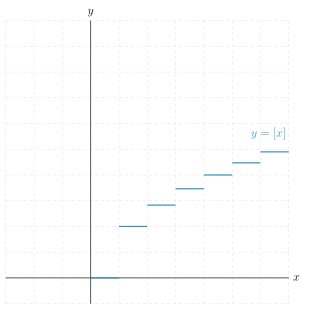
- Sketch the graph of \(y = \sqrt{\boldsymbol{[}x\boldsymbol{]}}\) and show that \[ \displaystyle \int^a_0 \sqrt{\boldsymbol{[}x\boldsymbol{]}} \; \mathrm{d}x = \sum^{a-1}_{r=0} \sqrt{r} \] when \(a\) is a positive integer.
- Show that $\displaystyle \int^{a}_0 2_{\vphantom{A}}^{\pmb{\boldsymbol {[} } x \pmb{ \boldsymbol{]}} }\; \mathrm{d}x = 2^{a}-1\( when \)a\( is a positive integer.
- Determine an expression for \)\displaystyle \int^{a}_0 2_{\vphantom{\dot A}}^{\pmb{\boldsymbol{[} }x \pmb{ \boldsymbol{]}} } \; \mathrm{d}x\( when \)a$ is positive but not an integer.
Solution
- \(\,\) \begin{align*} && \int_0^a \sqrt{\boldsymbol{[}x\boldsymbol{]}} \d x &= \sum_{r=0}^{a-1} \int_{x=r}^{x=r+1} \sqrt{\boldsymbol{[}x\boldsymbol{]}} \d x \\ &&&= \sum_{r=0}^{a-1} \int_r^{r+1} \sqrt{r} \d x \\ &&&= \sum_{r=0}^{a-1} \sqrt{r} \\ \end{align*}
- \(\,\) \begin{align*} && \int^{a}_0 2^{\boldsymbol {[} x \boldsymbol{]}} \d x &= \sum_{r=0}^{a-1} \int_{x=r}^{x=r+1} 2^{\boldsymbol {[} x \boldsymbol{]}} \d x \\ &&&= \sum_{r=0}^{a-1} \int_{x=r}^{x=r+1} 2^{r} \d x \\ &&&= \sum_{r=0}^{a-1} 2^{r}\\ &&&= 2^{a}-1 \end{align*}
- \(\,\) \begin{align*} && \int^{a}_0 2^{\boldsymbol {[} x \boldsymbol{]}} \d x &= \int_0^{\boldsymbol {[} a \boldsymbol{]}} 2^{\boldsymbol {[} x \boldsymbol{]}} \d x + \int_{\boldsymbol {[} a \boldsymbol{]}}^a 2^{\boldsymbol {[} x \boldsymbol{]}} \d x \\ &&&= 2^{ \boldsymbol {[} a \boldsymbol{]}}-1 + (a-\boldsymbol {[} a \boldsymbol{]})2^{\boldsymbol {[} a \boldsymbol{]}} \\ &&&= (a-\boldsymbol {[} a \boldsymbol{]}+1)2^{\boldsymbol {[} a \boldsymbol{]}} -1 \end{align*}
Rating Information
Difficulty Rating: 1484.0
Difficulty Comparisons: 1
Banger Rating: 1499.3
Banger Comparisons: 2
Show LaTeX source
Problem source
The square bracket notation $\boldsymbol{[}  x\boldsymbol{]}$ means the greatest integer less than or equal to $x\,$.
For example, $\boldsymbol{[}\pi\boldsymbol{]} = 3\,$,  $\boldsymbol{[}\sqrt{24}\,\boldsymbol{]} = 4\,$  and $\boldsymbol{[}5\boldsymbol{]}=5\,$.
\begin{questionparts}
\item Sketch the graph of $y = \sqrt{\boldsymbol{[}x\boldsymbol{]}}$ and show that
\[
\displaystyle \int^a_0 \sqrt{\boldsymbol{[}x\boldsymbol{]}} \;
\mathrm{d}x = \sum^{a-1}_{r=0} \sqrt{r}
\] when $a$ is a positive integer.
\item Show that
$\displaystyle \int^{a}_0
2_{\vphantom{A}}^{\pmb{\boldsymbol {[} } x \pmb{  \boldsymbol{]}} }\;
\mathrm{d}x = 2^{a}-1$ when $a$ is a positive integer.
\item Determine an expression for  $\displaystyle \int^{a}_0 2_{\vphantom{\dot A}}^{\pmb{\boldsymbol{[} }x \pmb{ \boldsymbol{]}} } \;
\mathrm{d}x$ when $a$ is positive but not an  integer.
\end{questionparts}
Solution source
\begin{questionparts}
\item $\,$ \begin{center}
    \begin{tikzpicture}
    \def\functionf(#1){(#1)*exp(-#1)};
    \def\xl{-3};
    \def\xu{7};
    \def\yl{-.5}; \def\yu{5};

    % Calculate scaling factors to make the plot square
    \pgfmathsetmacro{\xrange}{\xu-\xl}
    \pgfmathsetmacro{\yrange}{\yu-\yl}
    \pgfmathsetmacro{\xscale}{10/\xrange}
    \pgfmathsetmacro{\yscale}{10/\yrange}

    % Define the reusable styles to keep code clean
    \tikzset{
        x=\xscale cm, y=\yscale cm,
        axis/.style={thick, draw=black!80, -{Stealth[scale=1.2]}},
        grid/.style={thin, dashed, gray!30},
        curveA/.style={very thick, color=cyan!70!black, smooth},
        curveB/.style={very thick, color=orange!90!black, smooth},
        dot/.style={circle, fill=black, inner sep=1.2pt},
        labelbox/.style={fill=white, inner sep=2pt, rounded corners=2pt} % Protects text from lines
    }

    % Draw background grid
    \draw[grid] (\xl,\yl) grid[ystep=0.5] (\xu,\yu);

    % Set up axes
    \draw[axis] (\xl,0) -- (\xu,0) node[right, black] {$x$};
    \draw[axis] (0,\yl) -- (0,\yu) node[above, black] {$y$};

    % Define the bounding region with clip
    \begin{scope}
        \clip (\xl,\yl) rectangle (\xu,\yu);
        \draw[curveA] (0,0) -- (1,0);
        \draw[curveA] (1,1) -- (2,1);
        \draw[curveA] (2,{sqrt(2)}) -- (3,{sqrt(2)});
        \draw[curveA] (3,{sqrt(3)}) -- (4,{sqrt(3)});
        \draw[curveA] (4,{sqrt(4)}) -- (4+1,{sqrt(4)});
        \draw[curveA] (5,{sqrt(5)}) -- (5+1,{sqrt(5)});
        \draw[curveA] (6,{sqrt(6)}) -- (6+1,{sqrt(6)});
    \end{scope}

        \node[curveA, above] at ({2*pi}, {2.6}) {$y =[x]$};

    \end{tikzpicture}
\end{center}

\begin{align*}
&& \int_0^a \sqrt{\boldsymbol{[}x\boldsymbol{]}} \d x &= \sum_{r=0}^{a-1} \int_{x=r}^{x=r+1}  \sqrt{\boldsymbol{[}x\boldsymbol{]}} \d x \\
&&&= \sum_{r=0}^{a-1} \int_r^{r+1} \sqrt{r} \d x \\
&&&= \sum_{r=0}^{a-1}  \sqrt{r} \\
\end{align*}

\item $\,$ \begin{align*}
&& \int^{a}_0  2^{\boldsymbol {[} x   \boldsymbol{]}}  \d x &= \sum_{r=0}^{a-1} \int_{x=r}^{x=r+1}  2^{\boldsymbol {[} x   \boldsymbol{]}}  \d x \\
&&&= \sum_{r=0}^{a-1} \int_{x=r}^{x=r+1}  2^{r}  \d x \\
&&&= \sum_{r=0}^{a-1}   2^{r}\\
&&&= 2^{a}-1
\end{align*}

\item $\,$
\begin{align*}
&& \int^{a}_0  2^{\boldsymbol {[} x   \boldsymbol{]}}  \d x &= \int_0^{\boldsymbol {[} a   \boldsymbol{]}} 2^{\boldsymbol {[} x   \boldsymbol{]}}  \d x  + \int_{\boldsymbol {[} a   \boldsymbol{]}}^a 2^{\boldsymbol {[} x   \boldsymbol{]}}  \d x  \\
&&&= 2^{  \boldsymbol {[} a   \boldsymbol{]}}-1 + (a-\boldsymbol {[} a   \boldsymbol{]})2^{\boldsymbol {[} a   \boldsymbol{]}} \\
&&&= (a-\boldsymbol {[} a   \boldsymbol{]}+1)2^{\boldsymbol {[} a   \boldsymbol{]}} -1
\end{align*}
\end{questionparts}