2006 Paper 1 Q7
Year: 2006
Paper: 1
Question Number: 7
Course: LFM Pure
Section: Integration
Difficulty: 1516.0
Banger: 1503.2
integration
curve sketching
absolute value
trigonometric
exponential
area between curves
cosec
roots of equations
modulus function
Problem
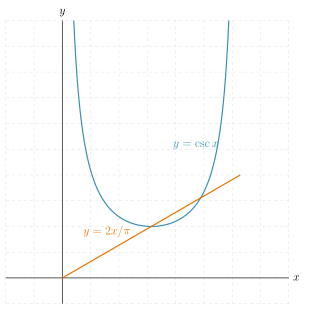
- Sketch on the same axes the functions \({\rm cosec}\, x\) and \(2x/ \pi\), for \(0 < x < \pi\,\). Deduce that the equation \(x\sin x = \pi/2 \) has exactly two roots in the interval \(0 < x < \pi\,\). Show that \[ \displaystyle \int_{\pi/2}^{\pi} \left \vert x\sin x - \frac{\pi} { 2} \right \vert \; \mathrm{d}x = 2\sin\alpha +\frac{3\pi^2} 4 - \alpha \pi -\pi -2\alpha \cos\alpha -1 \] where \(\alpha\) is the larger of the roots referred to above.
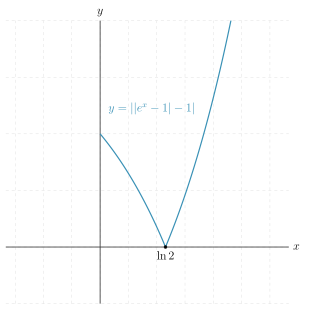
- Show that the region bounded by the positive \(x\)-axis, the \(y\)-axis and the curve \[y = \Bigl| \vert \e^x - 1 \vert - 1 \Bigr|\] has area \(\ln 4-1\).
Solution
- \(\,\)
Notice that they are equal at \(1\) when \(x = \pi/2\), but this is a local minimum for \(\csc x\) whereas \(2x/\pi\) is increasing so there is a second intersection. Notice that \(\csc x = \frac{2x}{\pi} \Leftrightarrow x \sin x = \frac{\pi}{2}\) therefore our intersections are also the roots of \(x \sin x = \frac{\pi}{2}\) and the larger one is greater than \(\pi/2\) \begin{align*} && I &= \int_{\pi/2}^{\pi} \Bigl| x \sin x - \frac{\pi}{2} \Bigr| \d x \\ &&&= \int_{\pi/2}^{\alpha} \left ( x \sin x - \frac{\pi}{2} \right )\d x +\int_{\alpha}^{\pi} \left ( \frac{\pi}{2} -x \sin x \right) \d x \\ &&&= \left ( \pi - 2\alpha + \frac{\pi}{2}\right) \frac{\pi}{2} + \int_{\pi/2}^{\alpha} x \sin x\d x -\int_{\alpha}^{\pi} x \sin x \d x \\ &&&= \frac{3\pi^2}{4} - \alpha \pi + \left [-x \cos x \right]_{\pi/2}^{\alpha}+\left[x \cos x \right]_{\alpha}^{\pi} + \int_{\pi/2}^{\alpha} \cos x \d x - \int_{\alpha}^{\pi} \cos x \d x \\ &&&= \frac{3\pi^2}{4} - \alpha \pi -\alpha \cos \alpha -\pi -\alpha \cos \alpha+ \sin \alpha - 1+\sin \alpha \\ &&&= 2\sin \alpha + \frac{3\pi^2}{4} - \alpha \pi - 2\alpha \cos \alpha - 1 \end{align*}
- \(\,\)
\begin{align*} && A &= \int_0^{\ln 2} ||e^x-1|-1| \d x \\ &&&= \int_0^{\ln 2} |e^x-2| \d x \\ &&&=\int_0^{\ln 2} (2-e^x) \d x \\ &&&= 2 \ln 2 - \left [e^x \right]_0^{\ln 2} \\ &&&= \ln 4 - (2-1) = \ln 4 - 1 \end{align*}
Rating Information
Difficulty Rating: 1516.0
Difficulty Comparisons: 1
Banger Rating: 1503.2
Banger Comparisons: 2
Show LaTeX source
Problem source
\begin{questionparts}
\item Sketch on the same axes the functions  ${\rm cosec}\, x$ and $2x/ \pi$, for  $0 < x < \pi\,$. Deduce that the equation $x\sin x = \pi/2 $ has exactly two roots in the interval  $0 < x < \pi\,$.
Show that
\[
\displaystyle \int_{\pi/2}^{\pi} \left \vert x\sin x  -
\frac{\pi} { 2} \right \vert \; \mathrm{d}x
=
2\sin\alpha   +\frac{3\pi^2} 4 - \alpha \pi -\pi -2\alpha
\cos\alpha -1
\]
where $\alpha$ is the larger of the roots referred to above.
\item Show that the  region bounded by the positive $x$-axis, the $y$-axis  and the curve
\[y = \Bigl| \vert \e^x - 1 \vert - 1 \Bigr|\]
has area $\ln 4-1$.
\end{questionparts}
Solution source
\begin{questionparts}
\item $\,$

\begin{center}
    \begin{tikzpicture}
    \def\functionf(#1){1/sin(deg(#1))};
    \def\xl{-1};
    \def\xu{4};
    \def\yl{-0.5};
    \def\yu{5};

    % Calculate scaling factors to make the plot square
    \pgfmathsetmacro{\xrange}{\xu-\xl}
    \pgfmathsetmacro{\yrange}{\yu-\yl}
    \pgfmathsetmacro{\xscale}{10/\xrange}
    \pgfmathsetmacro{\yscale}{10/\yrange}

    % Define the reusable styles to keep code clean
    \tikzset{
        x=\xscale cm, y=\yscale cm,
        axis/.style={thick, draw=black!80, -{Stealth[scale=1.2]}},
        grid/.style={thin, dashed, gray!30},
        curveA/.style={very thick, color=cyan!70!black, smooth},
        curveB/.style={very thick, color=orange!90!black, smooth},
        dot/.style={circle, fill=black, inner sep=1.2pt},
        labelbox/.style={fill=white, inner sep=2pt, rounded corners=2pt} % Protects text from lines
    }

    % Draw background grid
    \draw[grid] (\xl,\yl) grid[ystep=0.5] (\xu,\yu);

    % Set up axes
    \draw[axis] (\xl,0) -- (\xu,0) node[right, black] {$x$};
    \draw[axis] (0,\yl) -- (0,\yu) node[above, black] {$y$};

    % Define the bounding region with clip
    \begin{scope}
        \clip (\xl,\yl) rectangle (\xu,\yu);
        \draw[curveA, domain=0.1:{pi-.1}, samples=150] plot(\x, {\functionf(\x)});
        \draw[curveB] (0,0) -- (pi, 2);
    \end{scope}

        \node[curveA, above] at ({.75*pi}, {\functionf(.75*pi)+1}) {$y =\csc x$};
        \node[curveB, above] at ({.25*pi}, {.7}) {$y = 2x/\pi$};

    \end{tikzpicture}
\end{center}


Notice that they are equal at $1$ when $x = \pi/2$, but this is a local minimum for $\csc x$ whereas $2x/\pi$ is increasing so there is a second intersection.

Notice that $\csc x = \frac{2x}{\pi} \Leftrightarrow x \sin x = \frac{\pi}{2}$ therefore our intersections are also the roots of $x \sin x = \frac{\pi}{2}$ and the larger one is greater than $\pi/2$

\begin{align*}
&& I &= \int_{\pi/2}^{\pi} \Bigl| x \sin x - \frac{\pi}{2} \Bigr| \d x \\
&&&=  \int_{\pi/2}^{\alpha} \left ( x \sin x - \frac{\pi}{2} \right )\d x +\int_{\alpha}^{\pi} \left (  \frac{\pi}{2} -x \sin x \right) \d x \\
&&&= \left ( \pi - 2\alpha + \frac{\pi}{2}\right) \frac{\pi}{2} + \int_{\pi/2}^{\alpha} x \sin x\d x -\int_{\alpha}^{\pi} x \sin x \d x \\
&&&= \frac{3\pi^2}{4} - \alpha \pi + \left [-x \cos x  \right]_{\pi/2}^{\alpha}+\left[x \cos x \right]_{\alpha}^{\pi} + \int_{\pi/2}^{\alpha} \cos x \d x - \int_{\alpha}^{\pi} \cos x \d x \\
&&&= \frac{3\pi^2}{4} - \alpha \pi -\alpha \cos \alpha -\pi -\alpha \cos \alpha+ \sin \alpha - 1+\sin \alpha \\
&&&= 2\sin \alpha + \frac{3\pi^2}{4} - \alpha \pi - 2\alpha \cos \alpha - 1
\end{align*}

\item $\,$
\begin{center}
    \begin{tikzpicture}
    \def\functionf(#1){abs(abs(exp(#1)-1)-1)};
    \def\xl{-1};
    \def\xu{2};
    \def\yl{-0.5};
    \def\yu{2};

    % Calculate scaling factors to make the plot square
    \pgfmathsetmacro{\xrange}{\xu-\xl}
    \pgfmathsetmacro{\yrange}{\yu-\yl}
    \pgfmathsetmacro{\xscale}{10/\xrange}
    \pgfmathsetmacro{\yscale}{10/\yrange}

    % Define the reusable styles to keep code clean
    \tikzset{
        x=\xscale cm, y=\yscale cm,
        axis/.style={thick, draw=black!80, -{Stealth[scale=1.2]}},
        grid/.style={thin, dashed, gray!30},
        curveA/.style={very thick, color=cyan!70!black, smooth},
        curveB/.style={very thick, color=orange!90!black, smooth},
        dot/.style={circle, fill=black, inner sep=1.2pt},
        labelbox/.style={fill=white, inner sep=2pt, rounded corners=2pt} % Protects text from lines
    }

    % Draw background grid
    \draw[grid] (\xl,\yl) grid[ystep=0.5] (\xu,\yu);

    % Set up axes
    \draw[axis] (\xl,0) -- (\xu,0) node[right, black] {$x$};
    \draw[axis] (0,\yl) -- (0,\yu) node[above, black] {$y$};

    % Define the bounding region with clip
    \begin{scope}
        \clip (\xl,\yl) rectangle (\xu,\yu);
        \draw[curveA, domain=0:{ln(2)+1}, samples=150] plot(\x, {\functionf(\x)});
        \filldraw ({ln(2)}, 0) circle (1.5pt) node[below] {$\ln 2$};
    \end{scope}

        \node[curveA, above] at ({ln(2)/2+.2}, {\functionf(ln(2)/2)+1}) {$y=||e^x-1|-1|$};

    \end{tikzpicture}
\end{center}


\begin{align*}
&& A &= \int_0^{\ln 2} ||e^x-1|-1| \d x \\
&&&= \int_0^{\ln 2} |e^x-2| \d x \\
&&&=\int_0^{\ln 2} (2-e^x) \d x \\
&&&= 2 \ln 2 - \left [e^x \right]_0^{\ln 2} \\
&&&= \ln 4 -  (2-1) = \ln 4 - 1
\end{align*}

\end{questionparts}