2003 Paper 2 Q6
Year: 2003
Paper: 2
Question Number: 6
Course: LFM Pure
Section: Integration
Difficulty: 1600.0
Banger: 1500.0
integration
absolute value
iterated functions
curve sketching
piecewise functions
comparison of areas
trigonometric
function composition
Problem
The function \(\f\) is defined by
$$
\f(x)= \vert x-1 \vert\;,
$$
where the domain is \({\bf R}\,\), the set of all real numbers.
The function \(\g_n =\f^n\), with domain \({\bf R}\,\),
so for example \(\g_3(x) = \f(\f(\f(x)))\,\).
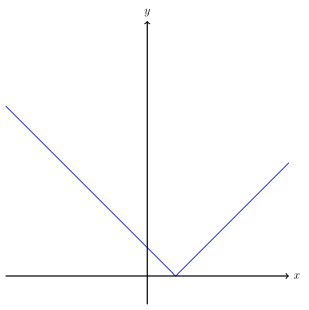
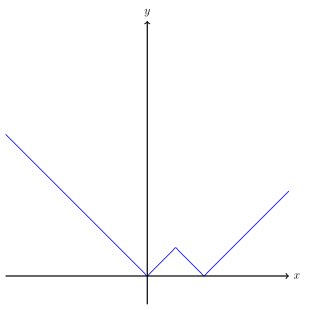
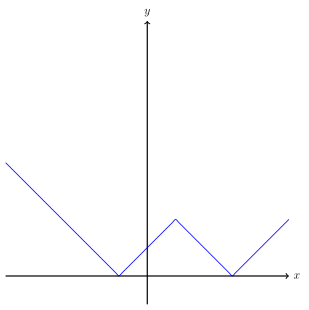
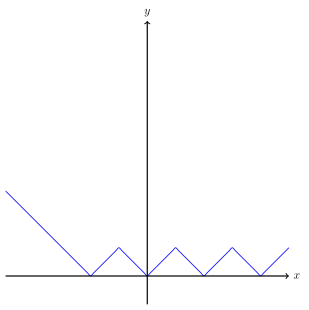
In separate diagrams, sketch graphs of \(\g_1\,\), \(\g_2\,\), \(\g_3\,\) and \(\g_4\,\).
The function \(\h\) is defined by
\[
\h(x) = |\sin {{{\pi}x} \over 2}|,
\]
where the domain is \({\bf R}\,\). Show that if \(n\) is even,
\[
\int_0^n\,\big( \h(x)-\g_n(x)\big)\,\d x = \frac{2n}{\pi} -\frac{n}2\;.
\]
Solution
Rating Information
Difficulty Rating: 1600.0
Difficulty Comparisons: 0
Banger Rating: 1500.0
Banger Comparisons: 0
Show LaTeX source
Problem source
The function $\f$  is defined by
$$
\f(x)=  \vert x-1 \vert\;,
$$
where the domain is ${\bf R}\,$, the set of all real numbers.
The function $\g_n =\f^n$, with domain ${\bf R}\,$,
so for example $\g_3(x) = \f(\f(\f(x)))\,$.
In separate diagrams, sketch graphs of $\g_1\,$, $\g_2\,$, $\g_3\,$ and $\g_4\,$.
The function $\h$ is defined by
\[
\h(x) = |\sin {{{\pi}x} \over 2}|,
\]
where  the domain is ${\bf R}\,$. Show that if $n$ is even,
\[
\int_0^n\,\big( \h(x)-\g_n(x)\big)\,\d x = \frac{2n}{\pi} -\frac{n}2\;.
\]
Solution source
\begin{center}
    \begin{tikzpicture}
    \def\functionf(#1){abs((#1)-1)};
    \def\xl{-5};
    \def\xu{5};
    \def\yl{-1};
    \def\yu{9};

    % Calculate scaling factors to make the plot square
    \pgfmathsetmacro{\xrange}{\xu-\xl}
    \pgfmathsetmacro{\yrange}{\yu-\yl}
    \pgfmathsetmacro{\xscale}{10/\xrange}
    \pgfmathsetmacro{\yscale}{10/\yrange}

    % Define the styles for the axes and grid
    \tikzset{
        axis/.style={very thick, ->},
        grid/.style={thin, gray!30},
        x=\xscale cm,
        y=\yscale cm
    }

    % Define the bounding region with clip
    \begin{scope}
        % You can modify these values to change your plotting region
        \clip (\xl,\yl) rectangle (\xu,\yu);

        % Draw a grid (optional)
        % \draw[grid] (-5,-3) grid (5,3);

        \draw[thick, blue, smooth, domain=\xl:\xu, samples=101]
            plot ({\x}, {\functionf(\x)});

        % \draw[thick, blue, smooth, domain=\xl:\xu, samples=101]
        %     plot ({\x}, {\functionf(\functionf(\x))});

        % \draw[thick, blue, smooth, domain=\xl:\xu, samples=101]
        %     plot ({\x}, {\functionf(\functionf(\functionf(\x)))});

        % \draw[thick, blue, smooth, domain=\xl:\xu, samples=101]
        %     plot ({\x}, {\functionf(\functionf(\functionf(\functionf(\x))))});

        % \draw[thick, blue, smooth, domain=\yl:-1, samples=100]
        %     plot ({sqrt(\x*\x-1)-0.25}, {\x});
        % \draw[thick, blue, smooth, domain=\yl:-1, samples=100]
        %     plot ({-(sqrt(\x*\x-1)-0.25)}, {\x});

    \end{scope}


    % Set up axes
    \draw[axis] (\xl,0) -- (\xu,0) node[right] {$x$};
    \draw[axis] (0,\yl) -- (0,\yu) node[above] {$y$};

    \end{tikzpicture}
\end{center}

\begin{center}
    \begin{tikzpicture}
    \def\functionf(#1){abs((#1)-1)};
    \def\xl{-5};
    \def\xu{5};
    \def\yl{-1};
    \def\yu{9};

    % Calculate scaling factors to make the plot square
    \pgfmathsetmacro{\xrange}{\xu-\xl}
    \pgfmathsetmacro{\yrange}{\yu-\yl}
    \pgfmathsetmacro{\xscale}{10/\xrange}
    \pgfmathsetmacro{\yscale}{10/\yrange}

    % Define the styles for the axes and grid
    \tikzset{
        axis/.style={very thick, ->},
        grid/.style={thin, gray!30},
        x=\xscale cm,
        y=\yscale cm
    }

    % Define the bounding region with clip
    \begin{scope}
        % You can modify these values to change your plotting region
        \clip (\xl,\yl) rectangle (\xu,\yu);

        % Draw a grid (optional)
        % \draw[grid] (-5,-3) grid (5,3);

        % \draw[thick, blue, smooth, domain=\xl:\xu, samples=101]
        %     plot ({\x}, {\functionf(\x)});

        \draw[thick, blue, smooth, domain=\xl:\xu, samples=101]
            plot ({\x}, {\functionf(\functionf(\x))});

        % \draw[thick, blue, smooth, domain=\xl:\xu, samples=101]
        %     plot ({\x}, {\functionf(\functionf(\functionf(\x)))});

        % \draw[thick, blue, smooth, domain=\xl:\xu, samples=101]
        %     plot ({\x}, {\functionf(\functionf(\functionf(\functionf(\x))))});

        % \draw[thick, blue, smooth, domain=\yl:-1, samples=100]
        %     plot ({sqrt(\x*\x-1)-0.25}, {\x});
        % \draw[thick, blue, smooth, domain=\yl:-1, samples=100]
        %     plot ({-(sqrt(\x*\x-1)-0.25)}, {\x});

    \end{scope}


    % Set up axes
    \draw[axis] (\xl,0) -- (\xu,0) node[right] {$x$};
    \draw[axis] (0,\yl) -- (0,\yu) node[above] {$y$};

    \end{tikzpicture}
\end{center}


\begin{center}
    \begin{tikzpicture}
    \def\functionf(#1){abs((#1)-1)};
    \def\xl{-5};
    \def\xu{5};
    \def\yl{-1};
    \def\yu{9};

    % Calculate scaling factors to make the plot square
    \pgfmathsetmacro{\xrange}{\xu-\xl}
    \pgfmathsetmacro{\yrange}{\yu-\yl}
    \pgfmathsetmacro{\xscale}{10/\xrange}
    \pgfmathsetmacro{\yscale}{10/\yrange}

    % Define the styles for the axes and grid
    \tikzset{
        axis/.style={very thick, ->},
        grid/.style={thin, gray!30},
        x=\xscale cm,
        y=\yscale cm
    }

    % Define the bounding region with clip
    \begin{scope}
        % You can modify these values to change your plotting region
        \clip (\xl,\yl) rectangle (\xu,\yu);

        % Draw a grid (optional)
        % \draw[grid] (-5,-3) grid (5,3);

        % \draw[thick, blue, smooth, domain=\xl:\xu, samples=101]
        %     plot ({\x}, {\functionf(\x)});

        % \draw[thick, blue, smooth, domain=\xl:\xu, samples=101]
        %     plot ({\x}, {\functionf(\functionf(\x))});

        \draw[thick, blue, smooth, domain=\xl:\xu, samples=101]
            plot ({\x}, {\functionf(\functionf(\functionf(\x)))});

        % \draw[thick, blue, smooth, domain=\xl:\xu, samples=101]
        %     plot ({\x}, {\functionf(\functionf(\functionf(\functionf(\x))))});

        % \draw[thick, blue, smooth, domain=\yl:-1, samples=100]
        %     plot ({sqrt(\x*\x-1)-0.25}, {\x});
        % \draw[thick, blue, smooth, domain=\yl:-1, samples=100]
        %     plot ({-(sqrt(\x*\x-1)-0.25)}, {\x});

    \end{scope}


    % Set up axes
    \draw[axis] (\xl,0) -- (\xu,0) node[right] {$x$};
    \draw[axis] (0,\yl) -- (0,\yu) node[above] {$y$};

    \end{tikzpicture}
\end{center}

\begin{center}
    \begin{tikzpicture}
    \def\functionf(#1){abs((#1)-1)};
    \def\xl{-5};
    \def\xu{5};
    \def\yl{-1};
    \def\yu{9};

    % Calculate scaling factors to make the plot square
    \pgfmathsetmacro{\xrange}{\xu-\xl}
    \pgfmathsetmacro{\yrange}{\yu-\yl}
    \pgfmathsetmacro{\xscale}{10/\xrange}
    \pgfmathsetmacro{\yscale}{10/\yrange}

    % Define the styles for the axes and grid
    \tikzset{
        axis/.style={very thick, ->},
        grid/.style={thin, gray!30},
        x=\xscale cm,
        y=\yscale cm
    }

    % Define the bounding region with clip
    \begin{scope}
        % You can modify these values to change your plotting region
        \clip (\xl,\yl) rectangle (\xu,\yu);

        % Draw a grid (optional)
        % \draw[grid] (-5,-3) grid (5,3);

        % \draw[thick, blue, smooth, domain=\xl:\xu, samples=101]
        %     plot ({\x}, {\functionf(\x)});

        % \draw[thick, blue, smooth, domain=\xl:\xu, samples=101]
        %     plot ({\x}, {\functionf(\functionf(\x))});

        % \draw[thick, blue, smooth, domain=\xl:\xu, samples=101]
        %     plot ({\x}, {\functionf(\functionf(\functionf(\x)))});

        \draw[thick, blue, smooth, domain=\xl:\xu, samples=101]
            plot ({\x}, {\functionf(\functionf(\functionf(\functionf(\x))))});

        % \draw[thick, blue, smooth, domain=\yl:-1, samples=100]
        %     plot ({sqrt(\x*\x-1)-0.25}, {\x});
        % \draw[thick, blue, smooth, domain=\yl:-1, samples=100]
        %     plot ({-(sqrt(\x*\x-1)-0.25)}, {\x});

    \end{scope}


    % Set up axes
    \draw[axis] (\xl,0) -- (\xu,0) node[right] {$x$};
    \draw[axis] (0,\yl) -- (0,\yu) node[above] {$y$};

    \end{tikzpicture}
\end{center}

If $n$ is even, and $0 < x < n$ then $g_n(x) = \begin{cases} \{x \} & \text{if }\lfloor x \rfloor\text{ is even} \\ 1-\{x \} & \text{if }\lfloor x \rfloor\text{ is odd} \\\end{cases}$, in other words, there are $\frac{n}{2}$ triangles, with height $1$ and base $2$, giving total area of $\frac{n}{2}$.

Each section of $|\sin (\frac{n \pi}{2})|$ will have area $\frac{2}{\pi}$ and there will be $n$ of them, therefore $\frac{2n}{\pi} - \frac{n}{2}$