2003 Paper 3 Q3
Year: 2003
Paper: 3
Question Number: 3
Course: LFM Pure
Section: Integration
Difficulty: 1700.0
Banger: 1484.0
differentiation
quotient rule
binomial expansion
curve sketching
rational function
asymptotes
inequality
odd function
Problem
If \(m\) is a positive integer, show that \(\l 1+x \r^m + \l 1-x \r^m \ne 0\) for any real \(x\,\).
The function \(\f\) is defined by
\[
\f (x) = \frac{ (1+x )^m - ( 1-x )^m}{ (1+x )^m + (1-x )^m}
\;.
\]
Find and simplify an expression for \(\f'(x)\).
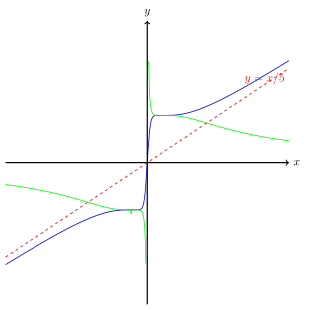
In the case \(m=5\,\), sketch the curves \(y = \f (x)\) and \(\displaystyle y = \frac1 { \f (x )}\;\).
Solution
If \(m\) is even, clearly that expression is positive since it's the sum of two (different) squares.
If \(m\) is odd, then we can expand it as a sum of powers of \(x^2\) with a leading coefficient of \(1\) so it is also positive.
\begin{align*}
&& f (x) = \frac{ (1+x )^m - ( 1-x )^m}{ (1+x )^m + (1-x )^m} \\
&& f'(x) &= \frac{(m(1+x )^{m-1} + m( 1-x )^{m-1})((1+x)^m + (1-x)^m ) - ((1+x )^m - ( 1-x )^m)(m(1+x)^{m-1} - m(1-x)^{m-1} )}{\l (1+x)^m + (1-x)^m \r^2} \\
&&&= \frac{2m(1+x)^m(1-x)^{m-1}+2m(1+x)^{m-1}(1-x)^m}{\l (1+x)^m + (1-x)^m \r^2} \\
&&&= \frac{2m(1+x)^{m-1}(1-x)^{m-1}(1+x+1-x)}{\l (1+x)^m + (1-x)^m \r^2} \\
&&&= \frac{4m(1+x)^{m-1}(1-x)^{m-1}}{\l (1+x)^m + (1-x)^m \r^2} \\
\end{align*}
Rating Information
Difficulty Rating: 1700.0
Difficulty Comparisons: 0
Banger Rating: 1484.0
Banger Comparisons: 1
Show LaTeX source
Problem source
If $m$ is a positive integer, show that $\l 1+x \r^m + \l 1-x \r^m \ne 0$ for any real $x\,$.

The function $\f$ is defined by
\[
\f (x) = \frac{ (1+x )^m - ( 1-x )^m}{ (1+x )^m + (1-x )^m}
\;.
\]
Find and simplify an expression for $\f'(x)$.

In the case $m=5\,$, sketch the curves $y = \f (x)$ and $\displaystyle y = \frac1 { \f (x )}\;$.
Solution source
If $m$ is even, clearly that expression is positive since it's the sum of two (different) squares.

If $m$ is odd, then we can expand it as a sum of powers of $x^2$ with a leading coefficient of $1$ so it is also positive.

\begin{align*}
&& f (x) = \frac{ (1+x )^m - ( 1-x )^m}{ (1+x )^m + (1-x )^m} \\
&& f'(x) &= \frac{(m(1+x )^{m-1} + m( 1-x )^{m-1})((1+x)^m + (1-x)^m ) - ((1+x )^m - ( 1-x )^m)(m(1+x)^{m-1} - m(1-x)^{m-1} )}{\l (1+x)^m + (1-x)^m \r^2} \\
&&&= \frac{2m(1+x)^m(1-x)^{m-1}+2m(1+x)^{m-1}(1-x)^m}{\l (1+x)^m + (1-x)^m \r^2} \\
&&&= \frac{2m(1+x)^{m-1}(1-x)^{m-1}(1+x+1-x)}{\l (1+x)^m + (1-x)^m \r^2} \\
&&&= \frac{4m(1+x)^{m-1}(1-x)^{m-1}}{\l (1+x)^m + (1-x)^m \r^2} \\
\end{align*}

\begin{center}
    \begin{tikzpicture}
    \def\functionf(#1){((1+(#1))^5-(1-(#1))^5)/((1+(#1))^5+(1-(#1))^5)};
    \def\functiong(#1){((1+(#1))^5+(1-(#1))^5)/((1+(#1))^5-(1-(#1))^5)};
    \def\xl{-10};
    \def\xu{10};
    \def\yl{-3};
    \def\yu{3};

    % Calculate scaling factors to make the plot square
    \pgfmathsetmacro{\xrange}{\xu-\xl}
    \pgfmathsetmacro{\yrange}{\yu-\yl}
    \pgfmathsetmacro{\xscale}{10/\xrange}
    \pgfmathsetmacro{\yscale}{10/\yrange}

    % Define the styles for the axes and grid
    \tikzset{
        axis/.style={very thick, ->},
        grid/.style={thin, gray!30},
        x=\xscale cm,
        y=\yscale cm
    }
    % 3 - 9/x + 27/x^2 - 147/(2 x^3) + 198/x^4 - 4275/(8 x^5) + 1443/x^6 - 62343/(16 x^7) + 10521/x^8 - 3636267/(128 x^9) + O((1/x)^10)
% (Laurent series)
    % Define the bounding region with clip
    \begin{scope}
        % You can modify these values to change your plotting region
        \clip (\xl,\yl) rectangle (\xu,\yu);

        % Draw a grid (optional)
        % \draw[grid] (-5,-3) grid (5,3);

        \draw[thick, blue, smooth, domain=-5:5, samples=100]
            plot ({\x}, {\functionf(\x)});
        \draw[thick, green, smooth, domain=0.1:5, samples=100]
            plot ({\x}, {\functiong(\x)});
        \draw[thick, green, smooth, domain=-5:-0.1, samples=100]
            plot ({\x}, {\functiong(\x)});
        \draw[thick, blue, smooth, domain=-8:-5, samples=100]
            plot ({\x}, {\x/5 +8/(5*\x) -56/(25 * \x^3) });
        \draw[thick, blue, smooth, domain=-10:-8, samples=100]
            plot ({\x}, {\x/5 +8/(5*\x) });
        \draw[thick, green, smooth, domain=-8:-5, samples=100]
            plot ({\x}, {1/(\x/5 +8/(5*\x) -56/(25 * \x^3)) });
        \draw[thick, green, smooth, domain=-10:-8, samples=100]
            plot ({\x}, {1/(\x/5 +8/(5*\x)) });
        \draw[thick, blue, smooth, domain=5:8, samples=100]
            plot ({\x}, {\x/5 +8/(5*\x) -56/(25 * \x^3) });
        \draw[thick, blue, smooth, domain=8:10, samples=100]
            plot ({\x}, {\x/5 +8/(5*\x) });
        \draw[thick, green, smooth, domain=5:8, samples=100]
            plot ({\x}, {1/(\x/5 +8/(5*\x) -56/(25 * \x^3)) });
        \draw[thick, green, smooth, domain=8:10, samples=100]
            plot ({\x}, {1/(\x/5 +8/(5*\x)) });
        % \draw[thick, blue, smooth, domain=-1:1, samples=100]
            % plot ({5*(\x+1)}, {\functiong(\x)});

        % \draw[thick, blue, smooth, domain=0.01:0.1, samples=100]
            % plot(1/\x, {3 - 9*\x + 27*\x^2 - 147/2 *\x^3 + 198*\x^4-4275/8 * \x^5 });
        \draw[thick, red, dashed] (-10, -2) -- (10, 2) node [below left] {$y = x/5$};
        % \draw[thick, red, dashed] (2, \yl) -- (2, \yu) node [below] {$x = 2$};
        \draw[red] (25,3.25) node [below left] {$y = 3-\frac9x$};
    \end{scope}

    % Set up axes
    \draw[axis] (\xl,0) -- (\xu,0) node[right] {$x$};
    \draw[axis] (0,\yl) -- (0,\yu) node[above] {$y$};

    \end{tikzpicture}
\end{center}