2005 Paper 2 Q3
Year: 2005
Paper: 2
Question Number: 3
Course: LFM Pure
Section: Integration
Difficulty: 1600.0
Banger: 1469.5
integration
integration by parts
curve sketching
trigonometric
inequality
product of trig and polynomial
definite integral
bounds
Problem
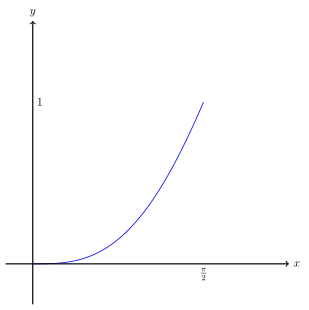
Give a sketch, for
\(0 \le x \le \frac{1}{2}\pi\), of the curve
$$
y = (\sin x - x\cos x)\;,
$$
and show that \(0\le y \le 1\,\).
Show that:
- \(\displaystyle \int_0^{\frac{1}{2}\pi}\,y\;\d x = 2 -\frac \pi 2 \)
- \(\displaystyle \int_0^{\frac{1}{2}\pi}\,y^2\,\d x = \frac{\pi^3}{48}-\frac \pi 8 \)
Solution
- \(\,\) \begin{align*} \int_0^{\frac{1}{2}\pi}\,y\;\d x &= \int_0^{\frac{1}{2}\pi} (\sin x - x \cos x) \d x \\ &= \left [-\cos x \right]_0^{\frac{1}{2}\pi} +\left [ -x \sin x \right]_0^{\frac{1}{2}\pi} + \int_0^{\frac{1}{2}\pi} \sin x \d x \\ &= 1-\frac{\pi}{2} + 1 = 2 - \frac{\pi}{2} \end{align*}
- \(\,\) \begin{align*} \int_0^{\frac{1}{2}\pi}y^2\d x &= \int_0^{\frac{1}{2}\pi} (\sin x - x \cos x)^2 \d x \\ &= \int_0^{\frac{1}{2}\pi} (\sin^2x - 2x\sin x \cos x+x^2\cos^2 x) \d x\\ &= \int_0^{\frac{1}{2}\pi} (\sin^2x -x \sin 2x+\tfrac12x^2(\cos 2 x + 1)) \d x\\ &= \frac{\pi}{4} + \frac{\pi^3}{48} + \int_0^{\frac{1}{2}\pi} (-x \sin 2x+\tfrac12x^2\cos 2 x) \d x \\ &= \frac{\pi}{4} + \frac{\pi^3}{48} + \left [\frac12 x \cos 2x +\frac14 x^2 \sin2x\right]_0^{\frac{1}{2}\pi}-\int_0^{\frac{1}{2}\pi}(\tfrac12 \cos 2x +\tfrac12 x \sin 2x) \d x\\ &= \frac{\pi}{4} + \frac{\pi^3}{48} - \frac{\pi}{4} - \left [ \frac14 \sin 2x \right]_0^{\frac{1}{2}\pi} - \int_0^{\frac{1}{2}\pi} \tfrac12 x \sin 2x \d x\\ &= \frac{\pi^3}{48} - \left( \left[ -\frac14 x \cos 2x \right]_0^{\frac{1}{2}\pi} - \int_0^{\frac{1}{2}\pi} -\frac14 \cos 2x \d x \right)\\ &= \frac{\pi^3}{48} - \left( \frac{\pi}{8} + \left[ \frac18 \sin 2x \right]_0^{\frac{1}{2}\pi} \right)\\ &= \frac{\pi^3}{48} - \frac{\pi}{8} \end{align*}
Rating Information
Difficulty Rating: 1600.0
Difficulty Comparisons: 0
Banger Rating: 1469.5
Banger Comparisons: 2
Show LaTeX source
Problem source
Give a sketch, for
$0 \le x \le \frac{1}{2}\pi$, of the curve
$$
y = (\sin x - x\cos x)\;,
$$
and show that $0\le y \le 1\,$.
Show that:
\begin{questionparts}
\item $\displaystyle \int_0^{\frac{1}{2}\pi}\,y\;\d x = 2 -\frac \pi 2 $
\item $\displaystyle \int_0^{\frac{1}{2}\pi}\,y^2\,\d x = \frac{\pi^3}{48}-\frac \pi 8 $
\end{questionparts}
Deduce that
$\pi^3 +18 \pi< 96\,$.
Solution source
\begin{center}
    \begin{tikzpicture}
    \def\functionf(#1){sin(180*(#1)/pi)-(#1)*cos(180*(#1)/pi))};
    \def\xl{-.25};
    \def\xu{3*pi/4};
    \def\yl{-.25};
    \def\yu{1.5};

    % Calculate scaling factors to make the plot square
    \pgfmathsetmacro{\xrange}{\xu-\xl}
    \pgfmathsetmacro{\yrange}{\yu-\yl}
    \pgfmathsetmacro{\xscale}{10/\xrange}
    \pgfmathsetmacro{\yscale}{10/\yrange}

    % Define the styles for the axes and grid
    \tikzset{
        axis/.style={very thick, ->},
        grid/.style={thin, gray!30},
        x=\xscale cm,
        y=\yscale cm
    }

    % Define the bounding region with clip
    \begin{scope}
        % You can modify these values to change your plotting region
        \clip (\xl,\yl) rectangle (\xu,\yu);

        % Draw a grid (optional)
        % \draw[grid] (-5,-3) grid (5,3);

        \draw[thick, blue, smooth, domain=0:{pi/2}, samples=101]
            plot ({\x}, {\functionf(\x)});


        % \draw[thick, blue, smooth, domain=\yl:-1, samples=100]
        %     plot ({sqrt(\x*\x-1)-0.25}, {\x});
        % \draw[thick, blue, smooth, domain=\yl:-1, samples=100]
        %     plot ({-(sqrt(\x*\x-1)-0.25)}, {\x});

    \end{scope}

    \node[below] at ({pi/2}, 0) {$\frac{\pi}2$};
    \node[right] at (0, 1) {$1$};

    % Set up axes
    \draw[axis] (\xl,0) -- (\xu,0) node[right] {$x$};
    \draw[axis] (0,\yl) -- (0,\yu) node[above] {$y$};

    \end{tikzpicture}
\end{center}

Since $y' = \cos x - \cos x + x \sin x = x \sin x > 0$ which is positive on $(0, \frac{\pi}{2})$, so $y$ is increasing, and therefore will achieve it's highest value at $\frac{\pi}{2}$ which is $y(\frac{\pi}{2}) = 1$ and it's smallest value at $y(0) = 0$. Therefore $0 \leq y \leq 1$

\begin{questionparts}
\item $\,$ \begin{align*}
 \int_0^{\frac{1}{2}\pi}\,y\;\d x  &=  \int_0^{\frac{1}{2}\pi} (\sin x - x \cos x) \d x \\
&= \left [-\cos x \right]_0^{\frac{1}{2}\pi} +\left [ -x \sin x \right]_0^{\frac{1}{2}\pi} + \int_0^{\frac{1}{2}\pi}  \sin x \d x  \\
&= 1-\frac{\pi}{2} + 1 = 2 - \frac{\pi}{2}
\end{align*}

\item $\,$ \begin{align*}
\int_0^{\frac{1}{2}\pi}y^2\d x &= \int_0^{\frac{1}{2}\pi} (\sin x - x \cos x)^2 \d x \\
&= \int_0^{\frac{1}{2}\pi} (\sin^2x - 2x\sin x \cos x+x^2\cos^2 x) \d x\\
&= \int_0^{\frac{1}{2}\pi} (\sin^2x -x \sin 2x+\tfrac12x^2(\cos 2 x + 1)) \d x\\
&= \frac{\pi}{4} + \frac{\pi^3}{48} + \int_0^{\frac{1}{2}\pi} (-x \sin 2x+\tfrac12x^2\cos 2 x) \d x \\
&= \frac{\pi}{4} + \frac{\pi^3}{48} + \left [\frac12 x \cos 2x +\frac14 x^2 \sin2x\right]_0^{\frac{1}{2}\pi}-\int_0^{\frac{1}{2}\pi}(\tfrac12 \cos 2x +\tfrac12 x \sin 2x) \d x\\
&= \frac{\pi}{4} + \frac{\pi^3}{48} - \frac{\pi}{4} - \left [ \frac14 \sin 2x \right]_0^{\frac{1}{2}\pi} - \int_0^{\frac{1}{2}\pi} \tfrac12 x \sin 2x \d x\\
&= \frac{\pi^3}{48} - \left( \left[ -\frac14 x \cos 2x \right]_0^{\frac{1}{2}\pi} - \int_0^{\frac{1}{2}\pi} -\frac14 \cos 2x \d x \right)\\
&= \frac{\pi^3}{48} - \left( \frac{\pi}{8} + \left[ \frac18 \sin 2x \right]_0^{\frac{1}{2}\pi} \right)\\
&= \frac{\pi^3}{48} - \frac{\pi}{8}
\end{align*}
\end{questionparts}

Since $y^2 < y$ on this interval, we must have $ \frac{\pi^3}{48} - \frac{\pi}{8} < 2 - \frac{\pi}{2} \Rightarrow \pi^3 +18\pi < 96$ as required.