2002 Paper 2 Q4
Year: 2002
Paper: 2
Question Number: 4
Course: LFM Pure
Section: Integration
Difficulty: 1600.0
Banger: 1484.0
integration
inequality
quadratic
definite integral
positivity
trigonometric
logarithm
substitution
discriminant
Problem
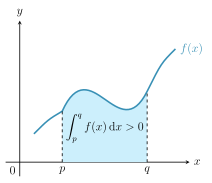
Give a sketch to show that, if \(\f(x) > 0\) for \(p < x < q\,\), then \(\displaystyle \int_p^{q} \f(x) \d x > 0\,\).
- By considering \(\f(x) = ax^2-bx+c\,\) show that, if \(a > 0\) and \(b^2 < 4ac\), then \(3b < 2a+6c\,\).
- By considering \(\f(x)= a\sin^2x - b\sin x + c\,\) show that, if \(a > 0\) and \(b^2< 4ac\), then \(4b < (a+2c)\pi\)
- Show that, if \(a > 0\), \(b^2 < 4ac\) and \(q > p > 0\,\), then $$ b\ln(q/p) < a\left(\frac1p -\frac1q\right) +c(q-p)\;. $$
Solution
- If \(a > 0\) and \(b^2 < 4ac \Rightarrow \Delta < 0\) then \(f(x) = ax^2-bx+c > 0\) for all \(x\). Therefore \begin{align*} && 0 & < \int_0^1 (ax^2-bx+c) \d x\\ &&&= \frac13 a-\frac12b+c \\ \Rightarrow && 3b &< 2a+6c \end{align*}
- Similar logic tells us this must also be always positive, therefore \begin{align*} && 0 &< \int_0^{\pi} (a \sin^2 x - b \sin x +c ) \d x\\ &&&= \frac{\pi}{2}a - 2b+\pi c \\ \Rightarrow && 4b &< (a+2c)\pi \end{align*}
- Similar logic shows that \(f(x) = \frac{a}{x^2}-\frac{b}{x} +c>0\), therefore \begin{align*} && 0 &< \int_p^q \left (\frac{a}{x^2} - \frac{b}{x} + c\right) \d x \\ &&&=a\left (\frac{1}{p} - \frac{1}{q} \right) - b(\ln q - \ln p)+c(q-p) \\ \Rightarrow && b \ln (q/p) &,< a\left (\frac{1}{p} - \frac{1}{q} \right) +c(q-p) \end{align*}
Rating Information
Difficulty Rating: 1600.0
Difficulty Comparisons: 0
Banger Rating: 1484.0
Banger Comparisons: 1
Show LaTeX source
Problem source
Give a sketch to show that, if $\f(x) > 0$ for $p < x <  q\,$, then $\displaystyle \int_p^{q} \f(x) \d x > 0\,$.
\begin{questionparts}
\item By considering $\f(x) = ax^2-bx+c\,$ show that,
if $a > 0$ and $b^2 < 4ac$, then $3b < 2a+6c\,$.
\item By considering $\f(x)= a\sin^2x - b\sin x + c\,$
show that, if $a > 0$ and $b^2< 4ac$, then
$4b < (a+2c)\pi$
\item Show that,  if $a > 0$, $b^2 < 4ac$ and $q > p > 0\,$, then
$$
 b\ln(q/p) < a\left(\frac1p -\frac1q\right) +c(q-p)\;.
$$
\end{questionparts}
Solution source
\begin{center}

\begin{tikzpicture}[>=stealth, thick]

    % 1. Define Coordinates representing the 'key' points
    % P_bot is (p, 0), P_top is (p, f(p))
    \coordinate (P_bot) at (1.5, 0);
    \coordinate (P_top) at (1.5, 1.8);

    % Q_bot is (q, 0), Q_top is (q, f(q))
    \coordinate (Q_bot) at (4.5, 0);
    \coordinate (Q_top) at (4.5, 2.5);

    % 2. Draw the Axes
    \draw[->] (-0.5, 0) -- (6, 0) node[right] {$x$};
    \draw[->] (0, -0.5) -- (0, 5) node[above] {$y$};
    \node[below left] at (0,0) {$0$};

    % 3. Draw the Shaded Area
    % We explicitly define the path: Up from p -> curve to q -> down to axis -> close
    \fill[cyan!20]
        (P_bot)
        -- (P_top)
        .. controls (2.5, 4) and (3.5, 0.5) .. (Q_top)
        -- (Q_bot)
        -- cycle;

    % 4. Draw the Function Curve
    % We draw a Left Tail + The Middle Part (same controls as fill) + Right Tail
    \draw[ultra thick, cyan!70!black]
        (0.5, 1.0) .. controls (1.0, 1.5) .. (P_top)           % Left tail
        .. controls (2.5, 4) and (3.5, 0.5) .. (Q_top)         % The part between p and q
        .. controls (5.0, 3.5) .. (5.5, 4) node[right] {$f(x)$}; % Right tail

    % 5. Draw dashed vertical lines and labels
    \draw[dashed] (P_bot) node[below] {$p$} -- (P_top);
    \draw[dashed] (Q_bot) node[below] {$q$} -- (Q_top);

    % 6. Annotation
    \node at (3, 1.2) {$\displaystyle \int_p^q f(x)\,\mathrm{d}x > 0$};

\end{tikzpicture}
\end{center}

\begin{questionparts}
\item If $a > 0$ and $b^2 < 4ac \Rightarrow \Delta < 0$ then $f(x) = ax^2-bx+c > 0$ for all $x$. Therefore

\begin{align*}
&& 0 & < \int_0^1 (ax^2-bx+c) \d x\\
&&&= \frac13 a-\frac12b+c \\
\Rightarrow && 3b &< 2a+6c
\end{align*}

\item Similar logic tells us this must also be always positive, therefore

\begin{align*}
&& 0 &< \int_0^{\pi} (a \sin^2 x - b \sin x +c ) \d x\\
&&&=  \frac{\pi}{2}a - 2b+\pi c \\
\Rightarrow && 4b &< (a+2c)\pi
\end{align*}

\item Similar logic shows that $f(x) = \frac{a}{x^2}-\frac{b}{x} +c>0$, therefore

\begin{align*}
&& 0 &< \int_p^q \left  (\frac{a}{x^2} - \frac{b}{x} + c\right) \d x \\
&&&=a\left (\frac{1}{p} - \frac{1}{q} \right) - b(\ln q - \ln p)+c(q-p) \\
\Rightarrow && b \ln (q/p) &,< a\left (\frac{1}{p} - \frac{1}{q} \right) +c(q-p)
\end{align*}

\end{questionparts}