Problems
Filters
298 problems found
2014 Paper 3 Q6
Starting from the result that \[ \.h(t) >0\ \mathrm{for}\ 0< t < x \Longrightarrow \int_0^x \.h(t)\ud t > 0 \,, \] show that, if \(\.f''(t) > 0\) for \(0 < t < x_0\) and \(\.f(0)=\.f'(0) =0\), then \(\.f(t)>0\) for \(0 < t < x_0\).
- Show that, for \(0 < x < \frac12\pi\), \[ \cos x \cosh x <1 \,. \]
- Show that, for \(0 < x < \frac12\pi\), \[ \frac 1 {\cosh x} < \frac {\sin x} x < \frac x {\sinh x} \,. \] %
- Show that, for \(0 < x < \frac12\pi\), \(\tanh x < \tan x\).
2014 Paper 3 Q8
The numbers \(f(r)\) satisfy \(f(r)>f(r+1)\) for $r=1, 2, \dots\(. Show that, for any non-negative integer \)n$, \[ k^n(k-1) \, f(k^{n+1}) \le \sum_{r=k^n}^{k^{n+1}-1}f(r) \le k^n(k-1)\, f(k^n)\, \] where \(k\) is an integer greater than 1.
- By taking \(f(r) = 1/r\), show that \[ \frac{N+1}2 \le \sum_{r=1}^{2^{N+1}-1} \frac1r \le N+1 \,. \] Deduce that the sum \(\displaystyle \sum_{r=1}^\infty \frac1r\) does not converge.
- By taking \(f(r)= 1/r^3\), show that \[ \sum_{r=1}^\infty \frac1 {r^3} \le 1 \tfrac 13 \,. \]
- Let \(S(n)\) be the set of positive integers less than \(n\) which do not have a \(2\) in their decimal representation and let \(\sigma(n)\) be the sum of the reciprocals of the numbers in \(S(n)\), so for example \(\sigma(5) = 1+\frac13+\frac14\). Show that \(S(1000)\) contains \(9^3-1\) distinct numbers. Show that \(\sigma (n) < 80\) for all \(n\).
Solution: \begin{align*} && \sum_{r=k^n}^{k^{n+1}-1} f(r) &\leq \sum_{r=k^n}^{k^{n+1}-1} f(k^{n}) \\ &&&= (k^{n+1}-k^n)f(k^n) \\ &&&= k^n(k-1)f(k^n) \\ \\ && \sum_{r=k^n}^{k^{n+1}-1} f(r) &\geq \sum_{r=k^n}^{k^{n+1}-1} f(k^{n+1}) \\ &&&= (k^{n+1}-k^n)f(k^{n+1}) \\ &&&= k^n(k-1)f(k^{n+1}) \\ \end{align*}
- Notice that if \(f(r) = 1/r\) then \(f(r) > f(r+1)\) so we can apply our lemma, ie \begin{align*} &&&2^N(2-1) \frac{1}{2^{N+1}} &\leq & \sum_{r=2^N}^{2^{N+1}-1} \frac1r &\leq&\quad 2^N(2-1) \frac{1}{2^{N}} \\ \Leftrightarrow &&& \frac12 &\leq & \sum_{r=2^N}^{2^{N+1}-1} \frac1r &\leq&\quad 1 \\ \Rightarrow &&& \frac12+\frac12+\cdots+\frac12 &\leq & \underbrace{\sum_{r=2^0}^{2^{0+1}-1} \frac1r+\sum_{r=2^1}^{2^{1+1}-1} \frac1r+\cdots+\sum_{r=2^N}^{2^{N+1}-1} \frac1r}_{N+1 \text{ terms}} &\leq&\quad 1 +1+\cdots+1\\ \Rightarrow &&& \frac{N+1}{2} &\leq & \underbrace{\sum_{r=1}^{2^{N+1}-1} \frac1r}_{N+1 \text{ terms}} &\leq&\quad N+1 \end{align*} Therefore the sum \(\displaystyle \sum_{r=1}^{2^{N+1}-1} \frac1r\) is always greater than \(N+1\) and in particular we can find an upper limit such that it is always bigger than any value, ie it diverges.
- If \(f(r) = 1/r^3\) then we have \begin{align*} && \sum_{r=2^N}^{2^{N+1}-1} \frac1{r^3} &\leq 2^N(2-1) \frac{1}{2^{3N}} \\ &&&= \frac{1}{4^N} \\ \Rightarrow && \sum_{r=2^0}^{2^{0+1}-1} \frac1{r^3} +\sum_{r=2^1}^{2^{1+1}-1} \frac1{r^3} +\sum_{r=2^N}^{2^{N+1}-1} \frac1{r^3} &\leq 1 + \frac14 + \cdots + \frac1{4^N} \\ \Rightarrow && \sum_{r=1}^{\infty} \frac1{r^3} &\leq 1 + \frac14 + \cdots \\ &&&= \frac{1}{1-\frac14} = \frac43 = 1\tfrac13 \end{align*}
- To count the number of numbers less than \(1000\) without a \(2\) in their decimal representation we can count the number of \(3\) digit numbers (where \(0\) is an acceptable leading digit) which don't contain a \(2\) and remove \(0\). There are \(9\) choices for each digit, so \(9^3-1\). Notice this is true for \(10^N\) for any \(N\), ie \(S(10^N) = 9^N-1\). Notice also that we can now write: \begin{align*} && \sum_{r=10^N }^{10^{N+1}-1} \frac{1}{r} \mathbb{1}_{r \in S} & < \frac{1}{10^{N+1}}\#\{\text{number not containing a }2\} \\ &&&= \frac{1}{10^{N+1}}((9^{N+1}-1)-(9^N-1)) \\ &&&= \frac{9^N}{10^N}(9-1) \\ &&&= 8 \cdot \left (\frac9{10} \right)^N \\ \\ \Rightarrow && \sum_{r=1}^{\infty} \frac{1}{r} \mathbb{1}_{r \in S} &< 8\left ( 1 + \frac9{10} + \cdots \right) \\ &&&= 8 \frac{1}{1-\frac{9}{10}} = 80 \end{align*}
2014 Paper 3 Q11
A particle \(P\) of mass \(m\) is connected by two light inextensible strings to two fixed points \(A\) and \(B\), with \(A\) vertically above \(B\). The string \(AP\) has length \(x\). The particle is rotating about the vertical through \(A\) and \(B\) with angular velocity \(\omega\), and both strings are taut. Angles \(PAB\) and \(PBA\) are \(\alpha\) and \(\beta\), respectively. Find the tensions \(T_A\) and \(T_B\) in the strings \(AP\) and \(BP\) (respectively), and hence show that \(\omega^2 x\cos\alpha \ge g\). Consider now the case that \(\omega^2 x\cos\alpha = g\). Given that \(AB=h\) and \(BP=d\), where \(h>d\), show that \(h\cos\alpha \ge \sqrt{h^2-d^2}\). Show further that \[ mg < T_A \le \frac{mgh}{\sqrt{h^2-d^2}\,}\,. \] Describe the geometry of the strings when \(T_A\) attains its upper bound.
Solution:


2014 Paper 3 Q12
The random variable \(X\) has probability density function \(f(x)\) (which you may assume is differentiable) and cumulative distribution function \(F(x)\) where \(-\infty < x < \infty \). The random variable \(Y\) is defined by \(Y= \e^X\). You may assume throughout this question that \(X\) and \(Y\) have unique modes.
- Find the median value \(y_m\) of \(Y\) in terms of the median value \(x_m\) of \(X\).
- Show that the probability density function of \(Y\) is \(f(\ln y)/y\), and deduce that the mode \(\lambda\) of \(Y\) satisfies \(\f'(\ln \lambda) = \f(\ln \lambda)\).
- Suppose now that \(X \sim {\rm N} (\mu,\sigma^2)\), so that \[ f(x) = \frac{1}{\sigma \sqrt{2\pi}\,} \e^{-(x-\mu)^2/(2\sigma^2)} \,. \] Explain why \[\frac{1}{\sigma \sqrt{2\pi}\,} \int_{-\infty}^{\infty}\e^{-(x-\mu-\sigma^2)^2/(2\sigma^2)} \d x = 1 \] and hence show that \( \E(Y) = \e ^{\mu+\frac12\sigma^2}\).
- Show that, when \(X \sim {\rm N} (\mu,\sigma^2)\), \[ \lambda < y_m < \E(Y)\,. \]
Solution:
- \begin{align*} && \frac12 &= \mathbb{P}(X \leq x_m) \\ \Leftrightarrow && \frac12 &= \mathbb{P}(e^X \leq e^{x_m} = y_m) \end{align*} Therefore the median is \(y_m = e^{x_m}\)
- \begin{align*} && \mathbb{P}(Y \leq y) &= \mathbb{P}(e^X \leq y) \\ &&&= \mathbb{P}(X \leq \ln y) \\ &&&= F(\ln y) \\ \Rightarrow && f_Y(y) &= f(\ln y)/y \\ \\ && f'_Y(y) &= \frac{f'(\ln y) - f(\ln y)}{y^2} \end{align*} Therefore since the mode satisfies \(f'_Y = 0\) we must have \(f'(\ln \lambda ) = f(\ln \lambda)\)
- This is the integral of the pdf of \(N(\mu + \sigma^2, \sigma^2)\) and therefore is clearly \(1\). \begin{align*} && \E[Y] &= \int_{-\infty}^{\infty} e^x \cdot \frac{1}{\sqrt{2\pi \sigma^2}} e^{-(x-\mu)^2/(2\sigma^2)} \d x \\ &&&= \frac{1}{\sqrt{2\pi \sigma^2}} \int_{-\infty}^{\infty} \exp (x - (x-\mu)^2/(2\sigma^2)) \d x\\ &&&= \frac{1}{\sqrt{2\pi \sigma^2}} \int_{-\infty}^{\infty} \exp ((2x \sigma^2- (x-\mu)^2)/(2\sigma^2)) \d x\\ &&&= \frac{1}{\sqrt{2\pi \sigma^2}} \int_{-\infty}^{\infty} \exp (-(x-\mu-\sigma^2)^2+2\mu \sigma^2-\sigma^4)/(2\sigma^2)) \d x\\ &&&= \frac{1}{\sqrt{2\pi \sigma^2}} \int_{-\infty}^{\infty} \exp (-(x-\mu+\sigma^2)^2)/(2\sigma^2)+\mu +\frac12\sigma^2) \d x\\ &&&= \e^{\mu +\frac12\sigma^2}\frac{1}{\sqrt{2\pi \sigma^2}} \int_{-\infty}^{\infty} \exp (-(x-\mu-\sigma^2)^2)/(2\sigma^2)) \d x\\ &&&= \e^{\mu +\frac12\sigma^2} \end{align*}
- Notice that \(y_m = e^\mu < e^{\mu + \tfrac12 \sigma^2} = \E[Y]\), so it suffices to prove that \(\lambda < e^{\mu}\) Notice that \(f'(x) - f(x) = f(x)[-(x-\mu)/\sigma^2 - 1]\) and therefore \(\ln y - \mu = -\sigma^2\) so \(\lambda = e^{\mu - \sigma^2}\) which is clearly less than \(e^{\mu}\) as required.
2013 Paper 1 Q1
- Use the substitution \(\sqrt x = y\) (where \(y\ge0\)) to find the real root of the equation \[ x + 3\, \sqrt x - \tfrac12 =0\,. \]
- Find all real roots of the following equations:
- \(x+10\,\sqrt{x+2\, }\, -22 =0\,\);
- \(x^2 -4x + \sqrt{2x^2 -8x-3 \,}\, -9 =0\,\).
Solution:
- \begin{align*} && 0 &= x + 3\sqrt{x} - \frac12 \\ \sqrt{x} = y: && 0&= y^2 + 3y - \frac12 \\ \Rightarrow && y &= \frac{-3\pm\sqrt{3^2+2}}{2} \\ &&&= \frac{-3 \pm \sqrt{11}}{2} \\ y > 0: && x &= \left ( \frac{\sqrt{11}-3}{2} \right)^2 \end{align*}
- \begin{align*} && 0 &= x + 10\sqrt{x+2} - 22 \\ y = \sqrt{x+2}: && 0 &= y^2 - 2 + 10y - 22 \\ &&&= y^2 + 10y - 24 \\ &&&= (y-2)(y+12) \\ \Rightarrow && y &= 2, -12 \\ y > 0: && x &= 2 \end{align*}
- Let \(y = \sqrt{2x^2-8x-3}\), so \begin{align*} && 0 &= x^2 - 4x +\sqrt{2x^2-8x-3} - 9 \\ && 0 &= \frac{y^2+3}{2} + y - 9 \\ &&&= \frac12 y^2 +y - \frac{15}{2} \\ &&&= \frac12 (y-3)(y+5) \\ \Rightarrow && y &= 3,-5 \\ y > 0: && 9 &= 2x^2-8x-3 \\ \Rightarrow && 0 &= 2x^2-8x-12 \\ &&&= 2(x^2-4x-6) \\ \Rightarrow && x &= 2 \pm \sqrt{10} \end{align*}
2013 Paper 1 Q11
\(\,\)
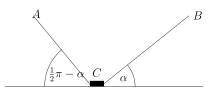
- In the case \(W> T\sin(\alpha+\beta)\), show that the block will remain at rest provided \[ W\sin\lambda \ge T\cos(\alpha+\beta- \lambda)\,, \] where \(\lambda\) is the acute angle such that \(\tan\lambda = \mu\).
- In the case \(W=T\tan\phi\), where \(2\phi =\alpha+\beta\), show that the block will start to move in a direction that makes an angle \(\phi\) with the horizontal.
Solution:
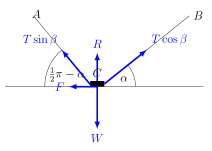
- Assuming the block is at rest we must have: \begin{align*} \text{N2}(\uparrow): && 0 &= T \sin \beta\cos \alpha + T \cos \beta \sin \alpha +R -W \\ \Rightarrow && W &> T \sin \beta\cos \alpha + T \cos \beta \sin \alpha \\ &&&= T\sin(\alpha+\beta) \\ \Rightarrow && R &= W-T\sin(\alpha+\beta)\\ \\ \text{N2}(\rightarrow): && 0 &= T \cos \beta \cos \alpha - T \sin \beta \sin \alpha - F \\ \Rightarrow && T \cos(\alpha+\beta) &= F \\ &&&\leq \mu (W-T\sin(\alpha+\beta)) \\ \Rightarrow && W \sin \lambda &\geq T \cos (\alpha+\beta)\cos \lambda +T \sin (\alpha+\beta) \sin \lambda \\ &&&= T\cos(\alpha+\beta-\lambda) \end{align*}
- If \(W = T\tan \phi\) where \(2\phi = \alpha + \beta\) then \begin{align*} \text{N2}(\uparrow): && ma_y &= T\sin(\alpha+\beta) - W \\ &&&= T \sin(\alpha+\beta) - T \tan \left ( \frac{\alpha+\beta}{2} \right ) \\ &&&= T \tan \left ( \frac{\alpha+\beta}{2} \right ) \left ( 2 \cos^2 \left ( \frac{\alpha+\beta}{2} \right ) -1\right) \\ &&&= T \tan \phi \cos \left ( \alpha+\beta\right ) \tag{notice this is positive so \(R=F=0\)} \\ \text{N2}(\rightarrow): && ma_x &= T \cos(\alpha+\beta) \\ \Rightarrow && \frac{a_y}{a_x} &= \tan \phi \end{align*} Therefore we are accelerating at an angle \(\phi\) to the horizontal
2013 Paper 2 Q1
- Find the value of \(m\) for which the line \(y = mx\) touches the curve \(y = \ln x\,\). If instead the line intersects the curve when \(x = a\) and \(x = b\), where \(a < b\), show that \(a^b = b^a\). Show by means of a sketch that \(a < \e < b\).
- The line \(y=mx+c\), where \(c>0\), intersects the curve \(y=\ln x\) when \(x=p\) and \(x=q\), where \(p < q\). Show by means of a sketch, or otherwise, that \(p^q > q^p\).
- Show by means of a sketch that the straight line through the points \((p, \ln p)\) and \((q, \ln q)\), where \(\e\le p < q\,\), intersects the \(y\)-axis at a positive value of \(y\). Which is greater, \(\pi^\e\) or \(\e^\pi\)?
- Show, using a sketch or otherwise, that if \(0 < p < q\) and \(\dfrac{\ln q - \ln p}{q-p} = \e^{-1}\), then \(q^p > p^q\).
Solution: \begin{questionparts} \item The tangent to \(y = \ln x\) is \begin{align*} && \frac{y - \ln x_1}{x - x_1} &= \frac{1}{x_1} \\ \Rightarrow && \frac{x_1y -x_1 \ln x_1}{ x- x_1} &= 1 \\ \Rightarrow && x_1 y - x_1 \ln x_1 &= x - x_1 \end{align*} So to run through the origin, we need \(\ln x_1 = 1 \Rightarrow x_1 = e\) so the line will be \(y = \frac1{e} x\) If \(ma = \ln a \Rightarrow m = \frac{\ln a}{a} = \frac{\ln b}{b} \Rightarrow b \ln a = a \ln b \Rightarrow a^b = b^a\). \item
2013 Paper 2 Q3
- Given that the cubic equation \(x^3+3ax^2 + 3bx +c=0\) has three distinct real roots and \(c<0\), show with the help of sketches that either exactly one of the roots is positive or all three of the roots are positive.
- Given that the equation \(x^3 +3ax^2+3bx+c=0\) has three distinct real positive roots show that \begin{equation*} a^2>b>0, \ \ \ \ a<0, \ \ \ \ c<0\,. \tag{\(*\)} \end{equation*} [Hint: Consider the turning points.]
- Given that the equation \(x^3 +3ax^2+3bx+c=0\) has three distinct real roots and that \begin{equation*} ab<0, \ \ \ \ c>0\,, \end{equation*} determine, with the help of sketches, the signs of the roots.
- Show by means of an explicit example (giving values for \(a\), \(b\) and \(c\)) that it is possible for the conditions (\(*\)) to be satisfied even though the corresponding cubic equation has only one real root.
Solution:
- First notice that this cubic has leading first term \(1\) and three real roots, so it must have the shape:
With the \(x\)-axis running somewhere between the dashed lines. Since \(c < 0\), the \(y\)-axis must meet the curve below the \(x\)-axis, ie somewhere on the blue section of this curve:
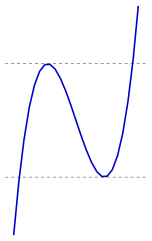 Therefore there will be either \(1\) (if it meets it in the \(\cup\) area) or \(3\) (if it meets it on the far left) positive roots.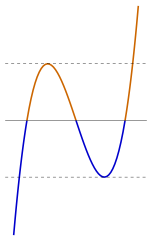
- First notice that if \(c > 0\) we cannot have three positive real roots since the function would need to pass \(0\) between \(0\) and \(-\infty\). Secondly, notice both turning points must be larger than zero, ie \begin{align*} && 0 &= 3x^2 + 6ax + 3b \\ \Leftrightarrow && 0 &= (x+a)^2 + b - a^2 \end{align*} has both roots larger than zero, (and it needs to have two roots, so \(a^2 > b\) and \(-a > 0\), ie \(a < 0\). If \(b < 0\), then just looking at \(x^2+2ax+b\) we can see that it is \(<0\) at \(0\) and one of the roots will be negative, therefore \(c < 0\), \(a^2 > b > 0\) and \(a < 0\)
- Since \(c > 0\) we can see that at least one root is negative.
ie the \(y\)-axis passes through an orange section of this curve. What now matters is where the larger turning point is. Considering \(x^2 + 2ax + b\), we notice that \(ab < 0\) means that \((x-\alpha)(x-\beta)\) we must have \((\alpha + \beta)\alpha \beta > 0\) which isn't possible if both roots are negative. Therefore the \(y\)-axis passes through the orange \(\cap\) and there are \(2\) positive real roots.
- If we take \(a = 1, b = -1, c = 1\) then we have \(x^3 + 3x^2-3x+1\). This has turning points when \(x^2+2x-1 = 0\), ie \(x = -1 \pm \sqrt{2}\) Notice that \begin{align*} && y(-1\pm \sqrt2) &= (-1 \pm \sqrt{2})^3 + 3(-1 \pm \sqrt{2})^2-3(-1 \pm \sqrt{2}) + 1 \\ &&&= (-1\pm \sqrt{2}) \cdot (3 \mp 2\sqrt2) + 3(3 \mp \sqrt2) -3(-1\pm \sqrt2) + 1 \\ &&&= (-7 \pm 5 \sqrt2) + (9 \mp 3\sqrt2) +(3 \mp 3\sqrt2) + 1 \\ &&&= 24 \mp 16\sqrt2 = 8(3 \mp 2 \sqrt2) >0 \end{align*} ie both turning points are above zero and hence only one real root
2013 Paper 2 Q5
- A function \(\f(x)\) satisfies \(\f(x) = \f(1-x)\) for all \(x\). Show, by differentiating with respect to \(x\), that \(\f'(\frac12) =0\,\). If, in addition, \(\f(x) = \f(\frac1x)\) for all (non-zero) \(x\), show that \(\f'(-1)=0\) and that \(\f'(2)=0\).
- The function \(\f\) is defined, for \(x\ne0\) and \(x\ne1\), by \[ \f(x) = \frac {(x^2-x+1)^3}{(x^2-x)^2} \,. \] Show that \(\f(x)= \f(\frac 1 x)\) and \(\f(x) = \f(1-x)\). Given that it has exactly three stationary points, sketch the curve \(y=\f(x)\).
- Hence, or otherwise, find all the roots of the equation \(\f(x) = \dfrac {27} 4\,\) and state the ranges of values of \(x\) for which \(\f(x) > \dfrac{27} 4\,\). Find also all the roots of the equation \(\f(x) = \dfrac{343}{36}\,\) and state the ranges of values of \(x\) for which \(\f(x) > \dfrac{343}{36}\).
Solution:
- \(\,\) \begin{align*} && f(x) &= f(1-x) \\ \Rightarrow && f'(x) &= -f'(1-x) \\ \Rightarrow && f'(\tfrac12) &= -f'(\tfrac12) \\ \Rightarrow && f'(\tfrac12) &= 0 \\ \\ && f(x) &= f(\tfrac1x) \\ \Rightarrow && f'(x) &= f'(\tfrac1x) \cdot \frac{-1}{x^2} \\ \Rightarrow && f'(-1) &= -f'(-1) \\ \Rightarrow && f'(-1) &= 0 \\ \\ && f'(2) &= -\frac{1}{4}f'(\tfrac12) \\ &&&= 0 \end{align*}
- Suppose \begin{align*}
&& f(x) &= \frac{(x^2-x+1)^3}{(x^2-x)^2} \\
&& f(1/x) &= \frac{(x^{-2}-x^{-1}+1)^3}{(x^{-2}-x^{-1})^2} \\
&&&= \frac{(1-x+x^2)^3/x^6}{((x-x^2)^2/x^6} \\
&&&= f(x) \\
\\
&& f(1-x) &= \frac{((1-x)^2-(1-x)+1)^3}{((1-x)^2-(1-x))^2} \\
&&&= \frac{(1-x+x^2)^3}{(x^2-x)^2} = f(x)
\end{align*}
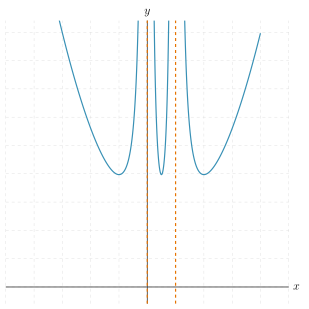
- Clearly \(x = -1\) is a root of \(f(x) = \frac{27}{4}\), so we must also have \(x=2\) and \(x = \frac12\), therefore \(f(x) > \frac{27}{4}\) if \(x \in \mathbb{R} \setminus \{-1, 2, \tfrac12, 0, 1 \}\). Clearly \(x = 3\) and \(x = -2\) are solutions so we also have: \(\frac13, -\frac12, \frac32, \frac23\) and these must be all solutions so we must have: \(f(x) > \frac{343}{36} \Leftrightarrow x \in (-\infty, -2) \cup (-\frac12, 0) \cup (0, \frac13) \cup (\frac23, 1) \cup (1, \frac32) \cup (3, \infty)\)
2013 Paper 2 Q8
The function \(\f\) satisfies \(\f(x)>0\) for \(x\ge0\) and is strictly decreasing (which means that \(\f(b)<\f(a)\) for \(b>a\)).
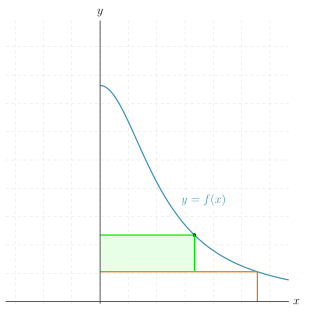
- For \(t\ge0\), let \(A_0(t)\) be the area of the largest rectangle with sides parallel to the coordinate axes that can fit in the region bounded by the curve \(y=\f(x)\), the \(y\)-axis and the line \(y=\f(t)\). Show that \(A_0(t)\) can be written in the form \[ A_0(t) =x_0\left( \f(x_0) -\f(t)\right), \] where \(x_0\) satisfies \(x_0 \f'(x_0) +\f(x_0) = \f(t)\,\).
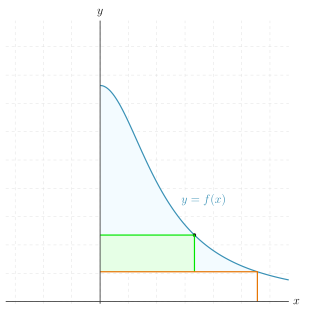
- The function g is defined, for \(t> 0\), by \[ \g(t) =\frac 1t \int_0^t \f(x) \d x\,. \] Show that \(t \g'(t) = \f(t) -\g(t)\,\). Making use of a sketch show that, for \(t>0\), \[ \int_0^t \left( \f(x) - \f(t)\right) \d x > A_0(t) \] and deduce that \(-t^2 \g'(t)> A_0(t)\).
- In the case \(\f(x)= \dfrac 1 {1+x}\,\), use the above to establish the inequality \[ \ln \sqrt{1+t} > 1 - \frac 1 {\sqrt{1+t}} \,, \] for \(t>0\).
Solution:
- First, not that the point must be ony the curve:
Since otherwise it's pretty clear we could make the area of the rectangle larger by moving the point onto the curve. Therefore \(A = x(f(x)-f(t))\). To maximise this we need \(xf'(x) + f(x)-f(t) = 0\), ie \(x_0f'(x_0) + f(x_0) = f(t)\)
- Suppose \(\displaystyle \g(t) =\frac 1t \int_0^t \f(x) \d x\) then
\begin{align*}
&& \g(t) &=\frac 1t \int_0^t \f(x) \d x\\
\Rightarrow && tg(t) &= \int_0^t \f(x) \d x \\
\Rightarrow && tg'(t) +g(t) &= f(t) \\
\Rightarrow && tg'(t) &= f(t) - g(t)
\end{align*}
Clearly the blue area + green area is larger than the green area. So \(\displaystyle \int_0^t (f(x) - f(t))\d x > A_0(t)\). Notice that \(f(t) = \frac1{t} \int_0^t f(t) \d x \) so \(-t^2g'(t) = \int_0^t f(x) \d x > A_0(t)\)
- Not that if \(f(x) = \dfrac{1}{1+x}\), the \(f'(x) = -\frac{1}{(1+x)^2}\) and so \begin{align*} && -\frac{x_0}{(1+x_0)^2} + \frac{1}{1+x_0} &= \frac{1}{1+t} \\ && \frac{1}{(1+x_0)^2} &= \frac{1}{1+t} \\ \Rightarrow && x_0 &= \sqrt{1+t} - 1 \\ && A_0(t) &= (\sqrt{1+t} - 1) \left ( \frac{1}{\sqrt{1+t}} - \frac{1}{t+1} \right) \\ &&&= 1 - \frac{1}{\sqrt{1+t}} - \frac{1}{\sqrt{1+t}} + \frac{1}{1+t} \\ &&&= \frac{2+t}{1+t} - \frac{2}{\sqrt{1+t}} \\ && g(t) &= \frac{1}{t} \int_0^t \frac{1}{1+x} \d x \\ &&&= \frac{\ln(1+t)}{t} \\ \Rightarrow && g'(t) &= \frac{\frac{t}{1+t} - \ln(1+t)}{t^2} \\ \Rightarrow && -t^2g(t) &= \ln(1+t) - \frac{t}{1+t} \\ \Rightarrow && \ln(1+t) - \frac{t}{1+t} &> \frac{2+t}{1+t} - \frac{2}{\sqrt{1+t}} \\ \Rightarrow && \ln \sqrt{1+t} & > 1 - \frac{1}{\sqrt{1+t}} \end{align*}
2013 Paper 2 Q10
A particle is projected at an angle of elevation \(\alpha\) (where \(\alpha>0\)) from a point \(A\) on horizontal ground. At a general point in its trajectory the angle of elevation of the particle from \(A\) is \(\theta\) and its direction of motion is at an angle \(\phi\) above the horizontal (with \(\phi\ge0\) for the first half of the trajectory and \(\phi\le0\) for the second half). Let \(B\) denote the point on the trajectory at which \(\theta = \frac12 \alpha\) and let \(C\) denote the point on the trajectory at which \(\phi = -\frac12\alpha\).
- Show that, at a general point on the trajectory, \(2\tan\theta = \tan \alpha + \tan\phi\,\).
- Show that, if \(B\) and \(C\) are the same point, then \( \alpha = 60^\circ\,\).
- Given that \(\alpha < 60^\circ\,\), determine whether the particle reaches the point \(B\) first or the point \(C\) first.
2013 Paper 2 Q11
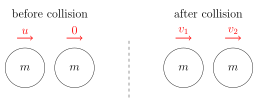
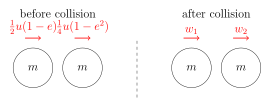
Three identical particles lie, not touching one another, in a straight line on a smooth horizontal surface. One particle is projected with speed \(u\) directly towards the other two which are at rest. The coefficient of restitution in all collisions is \(e\), where \(0 < e < 1\,\).
- Show that, after the second collision, the speeds of the particles are \(\frac12u(1-e)\), \(\frac14u (1-e^2)\) and \(\frac14u(1+e)^2\). Deduce that there will be a third collision whatever the value of \(e\).
- Show that there will be a fourth collision if and only if \(e\) is less than a particular value which you should determine.
Solution:
- First Collision:
By NEL, \(v_2 = v_1 + eu\), so \begin{align*} \text{COM}: && mu &= mv_1 + m(v_1 + eu) \\ \Rightarrow && 2mv_1 &= mu(1-e) \\ \Rightarrow && v_1 &= \frac12 u(1-e) \\ && v_2 &= \frac12 u(1-e) + eu \\ &&&= \frac12 u(1+e) \end{align*} The second collision is identical to the first except replacing \(u\) with \(\frac12u(1+e)\), therefore after that collision: \begin{align*} && \text{first particle} &= \frac12 u(1-e) \\ && \text{second particle} &= \frac12 \left (\frac12 u(1+e) \right)(1-e) \\ &&&= \frac14 u(1-e^2) \\ && \text{third particle} &= \frac12 \left (\frac12 u(1+e) \right)(1+e) \\ &&&= \frac14 u(1+e)^2 \end{align*} After all these collisions, all particles are moving in the same direction (since they all have positive velocity), but the first particle is now travelling faster than the second particle (as \(\frac12(1-e) < 1\)). Therefore they will collide again.
- The third collision:
The speed of approach will be \(\frac12u(1-e) - \frac14u(1-e^2) = \frac14u(1-e)(2 - (1+e)) = \frac14 u(1-e)^2\), therefore by NEL, \(w_2 = w_1 + \frac14ue(1-e)^2\) \begin{align*} \text{COM}: && m\frac12u(1-e) + m \frac14u(1-e^2) &= mw_1 + m\left (w_1 + \frac14ue(1-e)^2 \right) \\ \Rightarrow && \frac14u(1-e)(2+(1+e)) &= 2w_1 + \frac14ue(1-e)^2 \\ \Rightarrow && 2w_1 &= \frac14u(1-e)(3+e)-\frac14ue(1-e)^2 \\ &&&= \frac14u(1-e)(3+e-e(1-e)) \\ &&&= \frac14u(1-e)(3+e^2) \\ \Rightarrow && w_1 &= \frac18 u(1-e)(3+e^2) \\ && w_2 &= \frac18 u(1-e)(3+e^2) + \frac14ue(1-e)^2 \\ &&&= \frac18u(1-e)(3+e^2+2e(1-e)) \\ &&&= \frac18u(1-e)(3+2e-e^2) \\ &&&= \frac18u(1-e)(1+e)(3-e) \\ \end{align*} A fourth collision is possible, iff \begin{align*} && \frac18u(1-e)(1+e)(3-e)&> \frac14 u(1+e)^2 \\ \Leftrightarrow && (1-e)(3-e)&> 2 (1+e) \\ \Leftrightarrow &&3-4e-e^2&> 2+2e \\ \Leftrightarrow &&1-5e-e^2&>0 \\ \Leftrightarrow && e &< 3-\sqrt{2} \end{align*}
2013 Paper 2 Q13
A biased coin has probability \(p\) of showing a head and probability \(q\) of showing a tail, where \(p\ne0\), \(q\ne0\) and \(p\ne q\). When the coin is tossed repeatedly, runs occur. A straight run of length \(n\) is a sequence of \(n\) consecutive heads or \(n\) consecutive tails. An alternating run of length \(n\) is a sequence of length \(n\) alternating between heads and tails. An alternating run can start with either a head or a tail. Let \(S\) be the length of the longest straight run beginning with the first toss and let \(A\) be the length of the longest alternating run beginning with the first toss.
- Explain why \(\P(A=1)=p^2+q^2\) and find \(\P(S=1)\). Show that \(\P(S=1)<\P(A=1)\).
- Show that \(\P(S=2)= \P(A=2)\) and determine the relationship between \(\P(S=3)\) and \( \P(A=3)\).
- Show that, for \(n>1\), \(\P(S=2n)>\P(A=2n)\) and determine the corresponding relationship between \(\P(S=2n+1)\) and \(\P(A=2n+1)\). [You are advised not to use \(p+q=1\) in this part.]
Solution:
- The only way \(A = 1\) is if we get \(HH\) or \(TT\) which has probability \(p^2+q^2\). The only way we get \(S=1\) is if we have \(HT\) to \(TH\), ie \(2pq\). Since \((p-q)^2 = p^2 + q^2 - 2pq >0\) we must have \(\mathbb{P}(A=1) > \mathbb{P}(S=1)\).
- \(\,\) \begin{align*} \mathbb{P}(S=2) &= p^2q + q^2p \\ \mathbb{P}(A=2) &= pq^2 + qp^2 = \mathbb{P}(S=2) \\ \\ \mathbb{P}(S=3) &= p^3q + q^3p = pq(p^2+q^2) \\ \mathbb{P}(A=3) &= pqp^2 + qpq^2 = pq(p^2+q^2) = \mathbb{P}(S=3) \end{align*}
- For \(n > 1\) we must have \begin{align*} && \mathbb{P}(S = 2n) &= p^{2n}q + q^{2n}p \\ && \mathbb{P}(A=2n) &= (pq)^{n}q + (qp)^{n}p \\ &&&= p^nq^{n+1} + q^np^{n+1} \\ && \mathbb{P}(S = 2n) &> \mathbb{P}(A = 2n) \\ \Leftrightarrow && p^{2n}q + q^{2n}p & > p^nq^{n+1} + q^np^{n+1}\\ \Leftrightarrow && 0 & < p^{2n}q+q^{2n}p - p^nq^{n+1} -q^np^{n+1}\\ &&&= (p^n-q^n)(qp^n - pq^n) \end{align*} which is clearly true. \begin{align*} && \mathbb{P}(S=2n+1) &= p^{2n+1}q + q^{2n+1}p \\ && \mathbb{P}(A=2n+1) &= (pq)^{n}p^2 + (qp)^{n}q^2 \\ &&&= p^{n+2}q^n + q^{n+2}p^n \end{align*} The same factoring logic shows that \(\mathbb{P}(S = 2n+1) > \mathbb{P}(A=2n+1)\)
2013 Paper 3 Q6
Let \(z\) and \(w\) be complex numbers. Use a diagram to show that \(\vert z-w \vert \le \vert z\vert + \vert w \vert\,.\) For any complex numbers \(z\) and \(w\), \(E\) is defined by \[ E = zw^* + z^*w +2 \vert zw \vert\,. \]
- Show that \(\vert z-w\vert^2 = \left( \vert z \vert + \vert w\vert\right)^2 -E\,\), and deduce that \(E\) is real and non-negative.
- Show that \(\vert 1-zw^*\vert^2 = \left ( 1 +\vert zw \vert \right)^2 -E\,\).
Solution:
- \(\,\) \begin{align*} && |z-w|^2 &= (z-w)(z^*-w^*) \\ &&&= zz^* - wz^*-zw^* + ww^* \\ &&&= |z|^2+|w|^2 - E + 2|zw| \\ &&&= (|z|+|w|)^2 - E \\ \Rightarrow && E &= (|z|+|w|)^2 - |z-w|^2 &\in \mathbb{R} \end{align*} and by the triangle inequality \(|z|+|w| \geq |z-w|\), so \(E \geq 0\)
- \(\,\) \begin{align*} && |1-zw^*|^2 &= (1-zw^*)(1-z^*w) \\ &&&= 1 - zw^*-z^*w + |zw|^2 \\ &&&= 1 - E + 2|zw| + |zw|^2 \\ &&&= (1+|zw|)^2 - E \end{align*} \begin{align*} && \frac{|z-w|^2}{|1-zw^*|^2} &= \frac{(|z|+|w|)^2-E}{(1+|zw|)^2-E} \\ \Leftrightarrow && (1+|zw|^2)|z-w|^2 -E|z-w|^2 &= (|z|+|w|)^2|1-zw^*|^2-E|1-zw^*|^2\\ \Leftrightarrow && (1+|zw|^2)|z-w|^2-(|z|+|w|)^2|1-zw^*|^2 &= E(|z-w|^2-|1-zw^*|^2)\\ &&&= E(|z|^2-zw^*-z^*w+|w|^2-1+zw^*+z^*w-|z|^2|w|^2) \\ &&&= E(|z|^2+|w|^2-1-|z|^2|w|^2) \\ &&&= -E(1-|z|^2)(1-|w|^2) \\ &&&\leq 0 \\ \Leftrightarrow&& (1+|zw|^2)|z-w|^2& \leq (|z|+|w|)^2|1-zw^*|^2\\ \Leftrightarrow&& \frac{|z-w|^2}{|1-zw^*|^2} &\leq \frac{(|z|+|w|)^2}{(1+|zw|)^2}\\ \Leftrightarrow && \frac{|z-w|}{|1-zw^*|} &\leq \frac{(|z|+|w|)}{(1+|zw|)}\\ \end{align*} Yes, this inequality holds if \(|z|, |w|\) are the same side of \(1\) and is reversed otherwise.
2013 Paper 3 Q7
- Let \(y(x)\) be a solution of the differential equation \( \dfrac {\d^2 y}{\d x^2}+y^3=0\) with \(y = 1\) and \(\dfrac{\d y}{\d x} =0\) at \(x=0\), and let \[ {\rm E} (x)= \left ( \frac {\d y}{\d x}\right)^{\!\!2} + \tfrac 12 y^4\,. \] Show by differentiation that \({\rm E}\) is constant and deduce that \( \vert y(x) \vert \le 1\) for all \(x\).
- Let \(v(x)\) be a solution of the differential equation \( \dfrac{\d^2 v}{\d x^2} + x \dfrac {\d v}{\d x} +\sinh v =0\) with \(v = \ln 3\) and \(\dfrac{\d v}{\d x} =0\) at \(x=0\), and let \[ {\rm E} (x)= \left ( \frac {\d v}{\d x}\right)^{\!\!2} + 2 \cosh v\,. \] Show that \(\dfrac{\d{\rm E}}{\d x}\le 0\) for \(x\ge0\) and deduce that \(\cosh v(x) \le \frac53\) for \(x\ge0\).
- Let \(w(x)\) be a solution of the differential equation \[ \frac{\d^2 w}{\d x^2} + (5\cosh x - 4 \sinh x -3) \frac{\d w}{\d x} + (w\cosh w + 2 \sinh w) =0 \] with \(\dfrac{\d w }{\d x}=\dfrac 1 { \sqrt 2 }\) and \(w=0\) at \(x=0\). Show that \(\cosh w(x) \le \frac54\) for \(x\ge0\).
Solution:
- \(\,\) \begin{align*} && E(x) &= \left ( \frac{\d y}{\d x} \right)^2 + \frac12 y^4 \\ \Rightarrow && E'(x) &= 2 \frac{\d y}{\d x} \frac{\d^2 y}{\d x^2} + 2y^3 \frac{\d y}{\d x} \\ &&&= 2\frac{\d y}{\d x} \left ( \frac{\d^2 y}{\d x^2} + y^3 \right) \\ &&&= 0 \end{align*} Therefore \(E\) is constant. \(E(0) = \frac12\) and \begin{align*} &&\frac12 &= \left ( \frac{\d y}{\d x} \right)^2 + \frac12 y^4 \\ &&&\geq \frac12 y^4 \\ \Rightarrow && |y| &\leq 1 \end{align*}
- \(\,\) \begin{align*} && E(x) &= \left ( \frac{\d v}{\d x} \right)^2 + 2 \cosh v \\ \Rightarrow && E'(x) &= 2 \frac{\d v}{\d x}\frac{\d^2 v}{\d^2 x} + 2 \sinh v \frac{\d v}{\d x} \\ &&&= 2 \frac{\d v}{\d x} \left ( \frac{\d^2 v}{\d^2 x} + \sinh v\right) \\ &&&= 2 \frac{\d v}{\d x} \left ( -x \frac{\d v}{\d x}\right) \\ &&&= -2x \left ( \frac{\d v}{\d x} \right)^2 \leq 0 \tag{\(x \geq 0\)} \\ \\ && E(0) &= 0^2 + 2 \cosh \ln 3 \\ &&&= 3 + \frac13 = \frac{10}{3} \\ \Rightarrow && \frac{10}{3} &\geq E(x) \\ &&&= \left ( \frac{\d v}{\d x} \right)^2 + 2 \cosh v \\ &&&\geq 2 \cosh v \\ \Rightarrow && \cosh v &\leq \frac53 \end{align*}
- \(\,\) \begin{align*} && E(x) &= \left ( \frac{\d w}{\d x} \right)^2 + 2(w \sinh w + \cosh w) \\ && E'(x) &= 2 \frac{\d w}{\d x}\frac{\d^2 w}{\d^2 x} + 2(w \cosh w + 2 \sinh w) \frac{\d w}{\d x} \\ &&&= 2 \frac{\d w}{\d x} \left ( \frac{\d^2 w}{\d^2 x}+(w \cosh w + 2 \sinh w)\right) \\ &&&= -2 \left ( \frac{\d w}{\d x} \right)^2 \left (\underbrace{5\cosh x - 4 \sinh x -3}_{\geq0} \right) \\ &&&\leq 0 \\ && E(0) &= \frac12 + 2 = \frac52 \\ \Rightarrow && \frac52 &\geq E(x) \\ &&&=\underbrace{ \left ( \frac{\d w}{\d x} \right)^2}_{\geq0} + 2(\underbrace{w \sinh w}_{\geq 0} + \cosh w) \\ &&&\geq2\cosh w \\ \Rightarrow && \cosh w &\leq \frac54 \end{align*}