Problems
Filters
83 problems found
2001 Paper 3 Q9
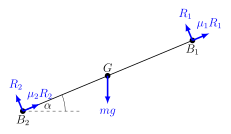
\(B_1\) and \(B_2\) are parallel, thin, horizontal fixed beams. \(B_1\) is a vertical distance \(d \sin \alpha \) above \(B_2\), and a horizontal distance \(d\cos\alpha \) from \(B_2\,\), where \(0<\alpha<\pi/2\,\). A long heavy plank is held so that it rests on the two beams, perpendicular to each, with its centre of gravity at \(B_1\,\). The coefficients of friction between the plank and \(B_1\) and \(B_2\) are \(\mu_1\) and \(\mu_2\,\), respectively, where \(\mu_1<\mu_2\) and \(\mu_1+\mu_2=2\tan\alpha\,\). The plank is released and slips over the beams experiencing a force of resistance from each beam equal to the limiting frictional force (i.e. the product of the appropriate coefficient of friction and the normal reaction). Show that it will come to rest with its centre of gravity over \(B_2\) in a time \[ \pi \left(\frac{d}{g(\mu_2-\mu_1)\cos\alpha }\right)^{\!\frac12}\;. \]
Solution:
2000 Paper 1 Q11
A rod \(AB\) of length 0.81 m and mass 5 kg is in equilibrium with the end \(A\) on a rough floor and the end \(B\) against a very rough vertical wall. The rod is in a vertical plane perpendicular to the wall and is inclined at \(45^{\circ}\) to the horizontal. The centre of gravity of the rod is at \(G\), where \(AG = 0.21\) m. The coefficient of friction between the rod and the floor is 0.2, and the coefficient of friction between the rod and the wall is 1.0. Show that the friction cannot be limiting at both \(A\) and \(B\). A mass of 5 kg is attached to the rod at the point \(P\) such that now the friction is limiting at both \(A\) and \(B\). Determine the length of \(AP\).
2000 Paper 3 Q10
A sphere of radius \(a\) and weight \(W\) rests on horizontal ground. A thin uniform beam of weight \(3\sqrt3\,W\) and length \(2a\) is freely hinged to the ground at \(X\), which is a distance \({\sqrt 3} \, a\) from the point of contact of the sphere with the ground. The beam rests on the sphere, lying in the same vertical plane as the centre of the sphere. The coefficients of friction between the beam and the sphere and between the sphere and the ground are \(\mu_1\) and \(\mu_2\) respectively. Given that the sphere is on the point of slipping at its contacts with both the ground and the beam, find the values of \(\mu_1\) and \(\mu_2\).
Solution:

1998 Paper 2 Q9
A light smoothly jointed planar framework in the form of a regular hexagon \(ABCDEF\) is suspended smoothly from \(A\) and a weight 1kg is suspended from \(C\). The framework is kept rigid by three light rods \(BD\), \(BE\) and \(BF\). What is the direction and magnitude of the supporting force which must be exerted on the framework at \(A\)? Indicate on a labelled diagram which rods are in thrust (compression) and which are in tension. Find the magnitude of the force in \(BE\).
1997 Paper 2 Q9
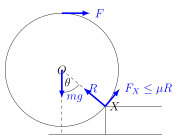
A uniform solid sphere of diameter \(d\) and mass \(m\) is drawn very slowly and without slipping from horizontal ground onto a step of height \(d/4\) by a horizontal force which is always applied to the highest point of the sphere and is always perpendicular to the vertical plane which forms the face of the step. Find the maximum horizontal force throughout the movement, and prove that the coefficient of friction between the sphere and the edge of the step must exceed \(1/\sqrt{3}\).
Solution:
1997 Paper 3 Q9
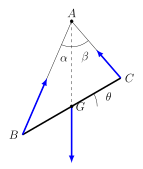
A uniform rigid rod \(BC\) is suspended from a fixed point \(A\) by light stretched springs \(AB,AC\). The springs are of different natural lengths but the ratio of tension to extension is the same constant \(\kappa\) for each. The rod is not hanging vertically. Show that the ratio of the lengths of the stretched springs is equal to the ratio of the natural lengths of the unstretched springs.
Solution:
1996 Paper 2 Q9
A child's toy consists of a solid cone of height \(\lambda a\) and a solid hemisphere of radius \(a\), made out of the same uniform material and fastened together so that their plane faces coincide. (Thus the diameter of the hemisphere is equal to that of the base of the cone.) Show that if \(\lambda < \sqrt{3}\) the toy will always move to an upright position if placed with the surface of the hemisphere on a horizontal table, but that if \(\lambda > \sqrt{3}\) the toy may overbalance. Show, however, that if the toy is placed with the surface of the cone touching the table it will remain there whatever the value of \(\lambda\). [The centre of gravity of a uniform solid cone of height \(h\) is a height \(h/4\) above its base. The centre of gravity of a uniform solid hemisphere of radius \(a\) is at distance \(3a/8\) from the centre of its base.]
Solution:


1996 Paper 3 Q10
Two rough solid circular cylinders, of equal radius and length and of uniform density, lie side by side on a rough plane inclined at an angle \(\alpha\) to the horizontal, where \(0<\alpha<\pi/2\). Their axes are horizontal and they touch along their entire length. The weight of the upper cylinder is \(W_1\) and the coefficient of friction between it and the plane is \(\mu_1\). The corresponding quantities for the lower cylinder are \(W_2\) and \(\mu_2\) respectively and the coefficient of friction between the two cylinders is \(\mu\). Show that for equilibrium to be possible:
- \(W_1\ge W_2\);
- \(\mu\geqslant\dfrac{W_1+W_2}{W_1-W_2}\);
- \(\mu_{1}\geqslant\left(\dfrac{2W_{1}\cot\alpha}{W_{1}+W_{2}}-1\right)^{-1}\,.\)
Solution:
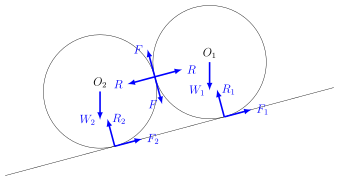
- \begin{align*} \overset{\curvearrowright}{O_2}: && 0 &= F_2 - F \\ \Rightarrow && F_2 &= F \\ \overset{\curvearrowright}{O_1}: && 0 &= F_1- F \\ \Rightarrow && F_1 &= F \\ \text{N2}(\swarrow, 2): && 0 &= R+W_2\sin\alpha -F \tag{1}\\ \text{N2}(\swarrow, 1): && 0 &= W_1\sin\alpha -F-R\tag{2}\\ \Rightarrow && W_1 \sin \alpha-R &= W_2 \sin \alpha+R \\ \Rightarrow && W_1 &\geq W_2 \end{align*}
- \begin{align*} (1)+(2)\Rightarrow && F &= \frac12 \sin \alpha (W_1 + W_2) \\ (1)-(2) \Rightarrow && R &= \frac12 \sin \alpha (W_1-W_2) \\ \Rightarrow && \frac{F}{R} &= \frac{W_1+W_2}{W_1-W_2} \\ \underbrace{\Rightarrow}_{F \leq \mu R} && \mu &\geq \frac{W_1+W_2}{W_1-W_2}\\ \end{align*}
- \begin{align*} \text{N2}(\nwarrow, 1): && 0 &= F+R_1-W_1\cos \alpha \\ \Rightarrow && R_1 &= W_1\cos \alpha - F \\ &&&= W_1 \cos \alpha - \frac12 \sin \alpha (W_1 + W_2) \\ \Rightarrow && \frac{R_1}{F_1} &= \frac{R_1}{F} \\ &&&= \frac{W_1 \cos \alpha - \frac12 \sin \alpha (W_1 + W_2)}{\frac12 \sin \alpha (W_1 + W_2) } \\ &&&= \frac{2W_1 \cot \alpha}{W_1+W_2} - 1 \\ \Rightarrow && \mu_1 & \geq \left ( \frac{2W_1 \cot \alpha}{W_1+W_2} - 1 \right)^{-1} \end{align*}
1996 Paper 3 Q11
A smooth circular wire of radius \(a\) is held fixed in a vertical plane with light elastic strings of natural length \(a\) and modulus \(\lambda\) attached to the upper and lower extremities, \(A\) and \(C\) respectively, of the vertical diameter. The other ends of the two strings are attached to a small ring \(B\) which is free to slide on the wire. Show that, while both strings remain taut, the equation for the motion of the ring is $$2ma \ddot\theta=\lambda(\cos\theta-\sin\theta)-mg\sin\theta,$$ where \(\theta\) is the angle \( \angle{CAB}\). Initially the system is at rest in equilibrium with \(\sin\theta=\frac{3}{5}\). Deduce that \(5\lambda=24mg\). The ring is now displaced slightly. Show that, in the ensuing motion, it will oscillate with period approximately $$10\pi\sqrt{a\over91g}\,.$$
1995 Paper 1 Q10
A small ball of mass \(m\) is suspended in equilibrium by a light elastic string of natural length \(l\) and modulus of elasticity \(\lambda.\) Show that the total length of the string in equilibrium is \(l(1+mg/\lambda).\) If the ball is now projected downwards from the equilibrium position with speed \(u_{0},\) show that the speed \(v\) of the ball at distance \(x\) below the equilibrium position is given by \[ v^{2}+\frac{\lambda}{lm}x^{2}=u_{0}^{2}. \] At distance \(h\), where \(\lambda h^{2} < lmu_{0}^{2},\) below the equilibrium position is a horizontal surface on which the ball bounces with a coefficient of restitution \(e\). Show that after one bounce the velocity \(u_{1}\) at \(x=0\) is given by \[ u_{1}^{2}=e^{2}u_{0}^{2}+\frac{\lambda}{lm}h^{2}(1-e^{2}), \] and that after the second bounce the velocity \(u_{2}\) at \(x=0\) is given by \[ u_{2}^{2}=e^{4}u_{0}^{2}+\frac{\lambda}{lm}h^{2}(1-e^{4}). \]
1995 Paper 1 Q11
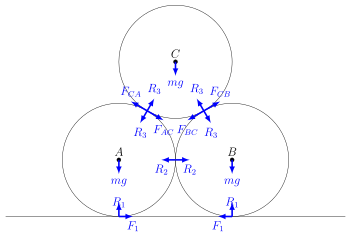
Two identical uniform cylinders, each of mass \(m,\) lie in contact with one another on a horizontal plane and a third identical cylinder rests symmetrically on them in such a way that the axes of the three cylinders are parallel. Assuming that all the surfaces in contact are equally rough, show that the minimum possible coefficient of friction is \(2-\sqrt{3}.\)
Solution:
1995 Paper 2 Q9
\noindent
1994 Paper 2 Q9
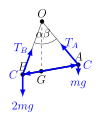
A light rod of length \(2a\) is hung from a point \(O\) by two light inextensible strings \(OA\) and \(OB\) each of length \(b\) and each fixed at \(O\). A particle of mass \(m\) is attached to the end \(A\) and a particle of mass \(2m\) is attached to the end \(B.\) Show that, in equilibrium, the angle \(\theta\) that the rod makes the horizontal satisfies the equation \[ \tan\theta=\frac{a}{3\sqrt{b^{2}-a^{2}}}. \] Express the tension in the string \(AO\) in terms of \(m,g,a\) and \(b\).
Solution:

1994 Paper 3 Q11
A step-ladder has two sections \(AB\) and \(AC,\) each of length \(4a,\) smoothly hinged at \(A\) and connected by a light elastic rope \(DE,\) of natural length \(a/4\) and modulus \(W\), where \(D\) is on \(AB,\) \(E\) is on \(AC\) and \(AD=AE=a.\) The section \(AB,\) which contains the steps, is uniform and of weight \(W\) and the weight of \(AC\) is negligible. The step-ladder rests on a smooth horizontal floor and a man of weight \(4W\) carefully ascends it to stand on a rung distant \(\beta a\) from the end of the ladder resting on the floor. Find the height above the floor of the rung on which the man is standing when \(\beta\) is the maximum value at which equilibrium is possible.
Solution:

1993 Paper 1 Q10
A small lamp of mass \(m\) is at the end \(A\) of a light rod \(AB\) of length \(2a\) attached at \(B\) to a vertical wall in such a way that the rod can rotate freely about \(B\) in a vertical plane perpendicular to the wall. A spring \(CD\) of natural length \(a\) and modulus of elasticity \(\lambda\) is joined to the rod at its mid-point \(C\) and to the wall at a point \(D\) a distance \(a\) vertically above \(B\). The arrangement is sketched below. \noindent