1997 Paper 2 Q9
Year: 1997
Paper: 2
Question Number: 9
Course: UFM Mechanics
Section: Moments
Difficulty: 1600.0
Banger: 1475.3
Problem
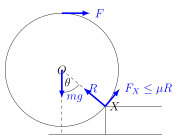
A uniform solid sphere of diameter \(d\) and mass \(m\) is drawn very slowly and without slipping from horizontal ground onto a step of height \(d/4\) by a horizontal force which is always applied to the highest point of the sphere and is always perpendicular to the vertical plane which forms the face of the step. Find the maximum horizontal force throughout the movement, and prove that the coefficient of friction between the sphere and the edge of the step must exceed \(1/\sqrt{3}\).
Solution
Rating Information
Difficulty Rating: 1600.0
Difficulty Comparisons: 0
Banger Rating: 1475.3
Banger Comparisons: 4
Show LaTeX source
Problem source
A uniform solid sphere of diameter $d$ and mass $m$ is drawn very slowly and without slipping from horizontal ground onto a step of height $d/4$ by a horizontal force which is always applied to the highest point of the sphere and is always perpendicular to the vertical plane which forms the face of the step. Find the maximum horizontal force throughout the movement, and prove that the coefficient of friction between the sphere and the edge of the step must exceed $1/\sqrt{3}$.Solution source
\begin{center}

\begin{tikzpicture}
    \draw (0,0) -- (4,0);
    \draw (2,0) -- (2, 1);
    \draw (2,1) -- (4, 1);

    \coordinate (R) at (2,1);
    \coordinate (O) at ({2 - 2*cos(40)},{1 + 2*sin(40)});
    \coordinate (B) at ({2 - 2*cos(40)}, 0);
    \draw (O) circle (2);

    \draw[dashed] (O) -- (R);
    \draw[dashed] (O) -- (B);

    \pic [draw, angle radius=0.8cm, "$\theta$"] {angle = B--O--R};

    \node[circle] at (O) {$O$};
    \node[right] at (R) {$X$};
    % \draw ({0.78-2*sin(4.5)},{2 + 2*(0.25 + cos(4.5)-1)}) circle (2);

    \draw[-latex, blue, ultra thick] ($(O) + (0,2)$) -- ++(1,0) node[right] {$F$};

    \draw[-latex, blue, ultra thick] (R) -- ++($0.5*(O)-0.5*(R)$) node[right] {$R$};
    \draw[-latex, blue, ultra thick] (R) -- ($(R)!0.4!-90:(O)$) node[right] {$F_X \leq \mu R$};
    \draw[-latex, blue, ultra thick] (O) -- ++(0,-1) node[right] {$mg$};
\end{tikzpicture}
\end{center}

The ball is on the ground when $\cos \theta = \frac12 \Rightarrow \theta = 60^\circ$ and ball will make it over the step when $\theta = 0^\circ$. It is also worth emphasising we are moving \emph{very slowly}, so we can treat the system as static at any given point.

\begin{align*}
    \overset{\curvearrowleft}{X}: && mg \frac{d}{2}\sin \theta - F \frac{d}{2} \l 1 + \cos \theta \r &= 0\\
    \Rightarrow && \frac{mg \sin \theta}{1 + \cos \theta} &= F& \\
    \Rightarrow && mg \tan \frac{\theta}{2} &= F& \\
\end{align*}

Therefore $F$ is maximised when $\theta = 60^\circ$, ie $F_{max} = \frac{mg}{\sqrt{3}}$

\begin{align*}
    \text{N2}(\parallel OX): && mg \cos \theta - R + F \sin \theta &= 0 \\
    \Rightarrow && mg \cos \theta - R + \frac{mg\sin \theta}{1 + \cos \theta} \sin \theta &= 0 \\
    \Rightarrow && mg &= R \\
    \\
    \text{N2}(\perp OX): && F_X - mg \sin \theta + F \cos \theta &= 0 \\
    \Rightarrow && mg \sin \theta -  \frac{mg\sin \theta}{1 + \cos \theta} \cos \theta &= F_X \\
    \Rightarrow && \frac{mg\sin \theta}{1 + \cos \theta} &= F_X \tag{We could also see this taking moments about $O$}\\
    % \text{N2}(\rightarrow): && F + \mu R \cos \theta - R \sin \theta &\geq 0 \\
    % \text{N2}(\uparrow): && -mg +\mu R \sin \theta + R \cos \theta &\geq 0 \\
    % \Rightarrow && R \l \sin \theta - \mu \cos \theta\r &\leq F \\
    % \Rightarrow && R \l \mu \sin \theta + \cos \theta\r &\geq mg  \\
    % \Rightarrow && \l \frac{\sin \theta - \mu \cos \theta}{\mu \sin \theta + \cos \theta} \r mg & \leq F \\
    % \Rightarrow && \l \frac{\tan \theta - \mu }{1+\mu \tan \theta} \r mg & \leq F \\
    % \Rightarrow && \tan \l \theta - \alpha \r  mg & \leq F \tag{where $\tan \alpha = \mu$}
\end{align*}

Therefore since $F_X \leq \mu R$, $\displaystyle \frac{mg\sin \theta}{1 + \cos \theta}  \leq \mu mg \Rightarrow \mu \geq \tan \frac{\theta}{2}$ which is maximised at $\theta = 60^\circ$ and implies $\mu \geq \frac{1}{\sqrt{3}}$