1997 Paper 3 Q9
Year: 1997
Paper: 3
Question Number: 9
Course: UFM Mechanics
Section: Work, energy and Power 2
Difficulty: 1700.0
Banger: 1500.0
Problem
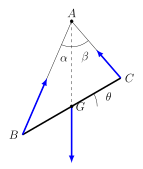
A uniform rigid rod \(BC\) is suspended from a fixed point \(A\) by light stretched springs \(AB,AC\). The springs are of different natural lengths but the ratio of tension to extension is the same constant \(\kappa\) for each. The rod is not hanging vertically. Show that the ratio of the lengths of the stretched springs is equal to the ratio of the natural lengths of the unstretched springs.
Solution
Rating Information
Difficulty Rating: 1700.0
Difficulty Comparisons: 0
Banger Rating: 1500.0
Banger Comparisons: 0
Show LaTeX source
Problem source
A uniform rigid rod $BC$ is suspended from a fixed point $A$ by light stretched springs $AB,AC$. The springs are of different natural lengths but the ratio of tension to extension is the same constant $\kappa$ for each. The rod is \textit{not} hanging vertically. Show that the ratio of the lengths of the stretched springs is equal to the ratio of the natural lengths of the unstretched springs.Solution source
\begin{center}
    \begin{tikzpicture}
        \def\t{30};
        \def\l{2};
        \coordinate (G) at (0,0);
        \coordinate (X) at (1,0);
        \coordinate (Y) at (-1,0);
        \coordinate (C) at ({\l*cos(\t)},{\l*sin(\t)});
        \coordinate (B) at ({-\l*cos(\t)},{-\l*sin(\t)});
        \coordinate (A) at ({0},{3});

        \draw[ultra thick] (B) -- (C);

        \draw (B) -- (A) -- (C);

        \draw[-latex, ultra thick, blue] (B) -- ($(B)!0.5!(A)$);
        \draw[-latex, ultra thick, blue] (C) -- ($(C)!0.5!(A)$);
        \draw[-latex, ultra thick, blue] (G) -- ++(0, -2);

        \filldraw (A) circle (1.5pt) node[above] {$A$};
        \filldraw (G) circle (1.5pt) node[right] {$G$};

        \draw[dashed] (A) -- (G);
        ]
        \pic [draw, angle radius=.9cm, angle eccentricity=1.5, "$\theta$"] {angle = X--G--C};
        \pic [draw, angle radius=.9cm, angle eccentricity=1.5, "$\alpha$"] {angle = B--A--G};
        \pic [draw, angle radius=.9cm, angle eccentricity=1.5, "$\beta$"] {angle = G--A--C};

        \node[right] at (C) {$C$};
        \node[left] at (B) {$B$};

    \end{tikzpicture}
\end{center}

By moments or "centre of mass" or whatever argument you choose, the centre of mass is directly below $A$.

\begin{align*}
N2:&& 0 &= \frac{1}{|AC|}\binom{-l\cos \theta}{h-l \sin \theta} T_{AC} + \frac{1}{|AB|} \binom{l \cos \theta}{h+l \sin \theta}T_{AB} + \binom{0}{-1}mg \\
\Rightarrow && \frac{T_{AC}}{AC} &= \frac{T_{AB}}{AB} \\
\Rightarrow && \frac{\kappa(AC-l_{AC})}{AC} &= \frac{\kappa(BC-l_{BC})}{BC} \\
\Rightarrow && \frac{l_{AC}}{AC} &= \frac{l_{BC}}{BC} \\
\Rightarrow && \frac{l_{AC}}{l_{BC}} &= \frac{AC}{BC}
\end{align*}