2001 Paper 3 Q9
Year: 2001
Paper: 3
Question Number: 9
Course: UFM Mechanics
Section: Simple Harmonic Motion
Difficulty: 1700.0
Banger: 1484.1
SHM
simple harmonic motion
friction
plank on beams
normal reaction
moments
equilibrium
trigonometric
period calculation
Problem
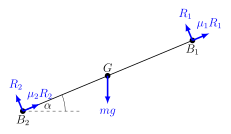
\(B_1\) and \(B_2\) are parallel, thin, horizontal fixed beams.
\(B_1\) is a vertical distance \(d \sin \alpha \) above \(B_2\), and a horizontal distance
\(d\cos\alpha \) from \(B_2\,\),
where \(0<\alpha<\pi/2\,\). A long heavy
plank is held so that it rests on the two beams, perpendicular to each,
with its centre of gravity at \(B_1\,\).
The coefficients of friction between
the plank and \(B_1\) and \(B_2\) are \(\mu_1\) and \(\mu_2\,\), respectively, where \(\mu_1<\mu_2\)
and \(\mu_1+\mu_2=2\tan\alpha\,\).
The plank is released and slips over the beams
experiencing a force of resistance from each beam equal to the limiting
frictional force (i.e. the product of the appropriate coefficient of friction and the
normal reaction). Show that it will come to rest with its centre of gravity over \(B_2\)
in a time
\[
\pi \left(\frac{d}{g(\mu_2-\mu_1)\cos\alpha }\right)^{\!\frac12}\;.
\]
Solution
Rating Information
Difficulty Rating: 1700.0
Difficulty Comparisons: 0
Banger Rating: 1484.1
Banger Comparisons: 1
Show LaTeX source
Problem source
$B_1$ and $B_2$ are  parallel, thin, horizontal fixed beams.
$B_1$ is a vertical distance $d \sin \alpha $ above $B_2$, and a horizontal distance
$d\cos\alpha $ from $B_2\,$,
where $0<\alpha<\pi/2\,$. A long heavy
plank  is held so that it rests on the two beams, perpendicular to each,
with its centre of gravity at  $B_1\,$.
The coefficients of friction between
the plank and $B_1$ and $B_2$ are $\mu_1$ and $\mu_2\,$, respectively, where $\mu_1<\mu_2$
and $\mu_1+\mu_2=2\tan\alpha\,$.
The plank is released and slips over the beams
experiencing a force of resistance from each beam equal to the limiting
frictional force (i.e. the product of the appropriate coefficient of friction and the
normal reaction). Show that it will come to rest with its centre of gravity over $B_2$
in a time
\[
\pi \left(\frac{d}{g(\mu_2-\mu_1)\cos\alpha }\right)^{\!\frac12}\;.
\]
Solution source
\begin{tikzpicture}[scale=.5]
    % Define points
    \coordinate (B2) at (0,0);
    \coordinate (B1) at (12,5);
    \coordinate (T) at (4, 0);
    \coordinate (M) at (6, 2.5);
    % \coordinate (H) at (2*12/13, 0);

    % Draw lines
    \draw[thick] (B1) -- (B2);
    \draw[dashed] (B2) -- (T);

    \fill (B1) circle (0.2cm);
    \fill (B2) circle (0.2cm);
    \fill (M) circle (0.2cm);
    % \draw[thick] (B2) circle (0.5cm);


    % Add points labels
    \node[below] at (B1) {$B_1$};
    \node[below] at (B2) {$B_2$};
    \node[above] at (M) {$G$};
    % \node[above] at (Q) {$Q$};
    % \node at (A)[circle,fill,inner sep=1.5pt]{};

    % % % Add angle φ at T
    \pic [draw, angle radius=1.5cm, "$\alpha$"] {angle = T--B2--B1};

    % % % Add an arrow for weight if needed
    \draw[-latex, blue, ultra thick] (M) -- ++(0,-2) node[below] {$mg$};
    \draw[-latex, blue, ultra thick] (B1) -- ++(-5/10,12/10) node[above] {$R_1$};
    \draw[-latex, blue, ultra thick] (B1) -- ++(12/10,5/10) node[above] {$\mu_1R_1$};
    \draw[-latex, blue, ultra thick] (B2) -- ++(-5/10,12/10) node[above] {$R_2$};
    \draw[-latex, blue, ultra thick] (B2) -- ++(12/10,5/10) node[above] {$\mu_2R_2$};

\end{tikzpicture}


\begin{align*}
 \overset{\curvearrowright}{B_2} : && mgx\cos \alpha - R_1d &= 0  \\
 && \frac{mgx \cos \alpha}{d} &= R_1 \\
 \overset{\curvearrowright}{B_1} : && -mg(d-x)\cos \alpha + R_2d &= 0 \\
 && \frac{mg(d-x) \cos \alpha}{d} &= R_2 \\
 % \text{N2}(\perp B_1B_2): && R_1 + R_2 - mg\cos \alpha &=0 \\
 \text{N2}(\parallel B_1B_2): && mg\sin \alpha - \mu_1R_1 - \mu_2R_2 &= m\ddot{x} \\
 && mg \sin \alpha - \mu_1 \frac{mgx \cos \alpha}{d} - \mu_2\frac{mg(d-x) \cos \alpha}{d}  &= m \ddot{x} \\
 && gd \sin \alpha - \mu_2 gd \cos \alpha - (\mu_1 - \mu_2) x g \cos \alpha &= d \ddot{x} \\
 && gd \frac12 \l \mu_1 + \mu_2 \r \cos \alpha - \mu_2 gd \cos \alpha - (\mu_1 - \mu_2) x g \cos \alpha &= d \ddot{x} \\
 && gd \frac12 \l \mu_1 - \mu_2 \r \cos \alpha - (\mu_1 - \mu_2) x g \cos \alpha &= d \ddot{x} \\
 && \frac12 d C &= d \ddot{x} + Cx \\
 && \Big ( C &=  g(\mu_1 - \mu_2) \cos \alpha \Big ) \\
\end{align*}

We can recognise this differential equation from SHM as having the solution:

\[x = A\sin \l \l \frac{d}{C} \r^{\frac12} t \r + B\cos \l \l \frac{d}{C} \r^{\frac12} t \r + \frac12 d\]

Since when $t = 0, x = d, \dot{x} = 0, A = 0, B = \frac{1}{2}d$.

We will reach $B_2, (x = 0)$ when $\cos \l \l \frac{d}{C} \r^{\frac12} T \r = -1$ (at which point the speed will be zero) and

\begin{align*}
    && \l \frac{d}{C} \r^{\frac12} T &= \pi \\
    \Rightarrow && T&= \pi \l \frac{d}{g(\mu_1 - \mu_2) \cos \alpha} \r^{\frac12}
\end{align*}