1994 Paper 2 Q9
Year: 1994
Paper: 2
Question Number: 9
Course: LFM Pure and Mechanics
Section: Moments
Difficulty: 1600.0
Banger: 1484.0
Problem
A light rod of length \(2a\) is hung from a point \(O\) by two light inextensible strings \(OA\) and \(OB\) each of length \(b\) and each fixed at \(O\). A particle of mass \(m\) is attached to the end \(A\) and a particle of mass \(2m\) is attached to the end \(B.\) Show that, in equilibrium, the angle \(\theta\) that the rod makes the horizontal satisfies the equation
\[
\tan\theta=\frac{a}{3\sqrt{b^{2}-a^{2}}}.
\]
Express the tension in the string \(AO\) in terms of \(m,g,a\) and \(b\).
Solution

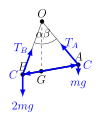
Rating Information
Difficulty Rating: 1600.0
Difficulty Comparisons: 0
Banger Rating: 1484.0
Banger Comparisons: 1
Show LaTeX source
Problem source
A light rod of length $2a$ is hung from a point $O$ by two light inextensible strings $OA$ and $OB$ each of length $b$ and each fixed at $O$. A particle of mass $m$ is attached to the end $A$ and a particle of mass $2m$ is attached to the end $B.$ Show that, in equilibrium, the angle $\theta$ that the rod makes the horizontal satisfies the equation
\[
\tan\theta=\frac{a}{3\sqrt{b^{2}-a^{2}}}.
\]
Express the tension in the string $AO$ in terms of $m,g,a$ and $b$.
Solution source
\begin{center}
    \begin{tikzpicture}[scale=2]
        \coordinate (O) at (0,3);
        \def\d{-50};
        \def\e{-110};
        \coordinate (A) at ({cos(\d)}, {sin(\d)+3)});
        \coordinate (B) at ({cos(\e)}, {sin(\e)+3)});
        \coordinate (G) at ($(A)!{2/3}!(B)$);
        \coordinate (M) at ($(A)!{1/2}!(B)$);

        \filldraw (O) circle (1pt) node [above] {$O$};
        \filldraw (A) circle (1pt) node [above] {$A$};
        \filldraw (B) circle (1pt) node [above] {$B$};
        \filldraw (G) circle (1pt) node [below] {$G$};
        \filldraw (M) circle (1pt) node [below] {$M$};

        \draw (B) -- (O) -- (A);
        \draw[ultra thick] (A) -- (B);
        \draw[dashed] (M) -- (O) -- (G);

        \pic [draw, angle radius=0.8cm, "$\theta$"] {angle = G--O--M};

    \end{tikzpicture}
\end{center}

The centre of mass of the rod will be at a point $G$ which divides the rod in a ratio $1:2$. Let $M$ be the midpoint of $AB$, so $|AM| = a$

To be in equilibrium $G$ must lie directly below $O$.

Note that $OM^2 +a^2 = b^2 \Rightarrow OM = \sqrt{b^2-a^2}$

Notice that $AG = \frac{4}{3}a$ and $AM = a$, so $|MG| = \frac13 a$.

Therefore $\displaystyle \tan \theta = \frac{\tfrac{a}{3}}{\sqrt{b^2-a^2}} \Rightarrow \tan \theta = \frac{a}{3\sqrt{b^2-a^2}}$.

\begin{center}
    \begin{tikzpicture}[scale=2]
        \coordinate (O) at (0,3);
        \def\d{-50};
        \def\e{-110};
        \coordinate (A) at ({cos(\d)}, {sin(\d)+3)});
        \coordinate (B) at ({cos(\e)}, {sin(\e)+3)});
        \coordinate (G) at ($(A)!{2/3}!(B)$);
        \coordinate (M) at ($(A)!{1/2}!(B)$);

        \filldraw (O) circle (1pt) node [above] {$O$};
        \filldraw (A) circle (1pt) node [above] {$A$};
        \filldraw (B) circle (1pt) node [above] {$B$};
        \filldraw (G) circle (1pt) node [below] {$G$};

        \draw (B) -- (O) -- (A);
        \draw[ultra thick] (A) -- (B);
        \draw[dashed] (O) -- (G);

        \draw[-latex, blue, ultra thick] (A) -- ++({0},{-0.2}) node[below] {$mg$};
        \draw[-latex, blue, ultra thick] (A) -- ($(A)!0.5!(O)$) node[right] {$T_A$};
        \draw[-latex, blue, ultra thick] (B) -- ($(B)!0.5!(O)$) node[left] {$T_B$};
        \draw[-latex, blue, ultra thick] (B) -- ++({0},{-0.4}) node[below] {$2mg$};
        \draw[-latex, blue, ultra thick] ($(B)!0.5!(A)$) -- (B) node[left] {$C$};
        \draw[-latex, blue, ultra thick] ($(B)!0.5!(A)$) -- (A) node[right] {$C$};


        \pic [draw, angle radius=0.8cm, "$\alpha$"] {angle = B--O--G};
        \pic [draw, angle radius=0.8cm, "$\beta$"] {angle = G--O--A};

    \end{tikzpicture}
\end{center}

Notice that $\frac{\sin \beta}{\frac43a} = \frac{\sin \angle OGA}{b} = \frac{\sin \alpha}{\frac23 a} \Rightarrow \sin \beta = 2 \sin \alpha$

\begin{align*}
\text{N2}(\rightarrow, A): && C\cos \theta - T_A \sin \beta&= 0 \\
\text{N2}(\rightarrow, B): && T_B \sin \alpha - C\cos \theta &= 0 \\
\Rightarrow && T_B \sin \alpha &= T_A\sin \beta \\
\Rightarrow && T_B &= 2T_A \\
\text{N2}(\uparrow, A): && T_A \cos \beta+C\sin \theta-mg &= 0 \\
\text{N2}(\uparrow, B): && T_B \cos \alpha- C\sin \theta-2mg &= 0 \\
\Rightarrow && T_A \cos \beta+2T_A \cos \alpha&=3mg \\
\end{align*}

Using the cosine rule: $(\frac23a)^2 = b^2 + OG^2 - 2b|OG|\cos \alpha$ and $(\frac43a)^2 = b^2 + OG^2-2b|OG|\cos \beta$.

$|OG|^2 = b^2 + (\frac43a)^2-\frac83ab \cos \angle A = b^2 +\frac{16}{9}a^2-\frac83a^2 = b^2-\frac89a^2$.

Therefore $\cos \alpha = \frac{2b^2-\frac43a^2}{2b |OG|}$, $\cos \beta = \frac{2b^2-\frac83a^2}{2b|OG|}$

Therefore $\cos \beta + 2 \cos \alpha = \frac{18b^2-16a^2}{6b|OG|} = \frac{9b^2-8a^2}{b\sqrt{9b^2-a^2}} = \frac{\sqrt{9b^2-a^2}}b$

Therefore $\displaystyle T_A = \frac{3bmg}{\sqrt{9b^2-8a^2}}$