1995 Paper 1 Q11
Year: 1995
Paper: 1
Question Number: 11
Course: LFM Pure and Mechanics
Section: Moments
Difficulty: 1500.0
Banger: 1500.0
Problem
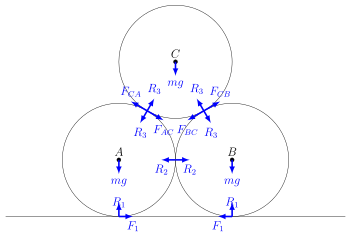
Two identical uniform cylinders, each of mass \(m,\) lie in contact with one another on a horizontal plane and a third identical cylinder rests symmetrically on them in such a way that the axes of the three cylinders are parallel. Assuming that all the surfaces in contact are equally rough, show that the minimum possible coefficient of friction is \(2-\sqrt{3}.\)
Solution
Rating Information
Difficulty Rating: 1500.0
Difficulty Comparisons: 0
Banger Rating: 1500.0
Banger Comparisons: 0
Show LaTeX source
Problem source
Two identical uniform cylinders, each of mass $m,$ lie in contact with one another on a horizontal plane and a third identical cylinder rests symmetrically on them in such a way that the axes of the three cylinders are parallel. Assuming that all the surfaces in contact are equally rough, show that the minimum possible coefficient of friction is $2-\sqrt{3}.$Solution source
\begin{center}
    \begin{tikzpicture}[scale=2]
        \coordinate (A) at (0,0);
        \coordinate (B) at (2,0);
        \coordinate (C) at (1, {sqrt(3)});

        \coordinate (AB) at ($(A)!0.5!(B)$);
        \coordinate (BC) at ($(B)!0.5!(C)$);
        \coordinate (CA) at ($(C)!0.5!(A)$);

        \draw (A) circle (1);
        \draw (B) circle (1);
        \draw (C) circle (1);


        \filldraw (A) circle (1pt) node[above] {$A$};
        \filldraw (B) circle (1pt) node[above] {$B$};
        \filldraw (C) circle (1pt) node[above] {$C$};


        \draw (-2,-1) -- (4, -1);

        \draw[-latex, blue, ultra thick] (A) -- ++ (0,-0.25) node[below] {$mg$};

        \draw[-latex, blue, ultra thick] (B) -- ++ (0,-0.25) node[below] {$mg$};
        \draw[-latex, blue, ultra thick] (C) -- ++ (0,-0.25) node[below] {$mg$};

        \draw[-latex, blue, ultra thick] (2,-1) -- ++ (0,0.25) node {$R_1$};
        \draw[-latex, blue, ultra thick] (2,-1) -- ++ (-0.25,0) node[below] {$F_1$};
        \draw[-latex, blue, ultra thick] (0,-1) -- ++ (0,0.25) node {$R_1$};
        \draw[-latex, blue, ultra thick] (0,-1) -- ++ (0.25,0) node[below] {$F_1$};

        \draw[-latex, blue, ultra thick] (AB) -- ($(AB)!0.25!(A)$) node[below] {$R_2$};
        \draw[-latex, blue, ultra thick] (AB) -- ($(AB)!0.25!(B)$) node[below] {$R_2$};
        % \draw[-latex, blue, ultra thick] (AB) -- ++(0,-0.5) node[below] {$F_2$};

        \draw[-latex, blue, ultra thick] (BC) -- ($(BC)!0.25!(B)$) node[below] {$R_3$};
        \draw[-latex, blue, ultra thick] (CA) -- ($(CA)!0.25!(A)$) node[below] {$R_3$};

        \draw[-latex, blue, ultra thick] (BC) -- ($(BC)!0.25!(C)$) node[above] {$R_3$};
        \draw[-latex, blue, ultra thick] (CA) -- ($(CA)!0.25!(C)$) node[above] {$R_3$};

        \draw[-latex, blue, ultra thick] (BC) -- ++({sqrt(3)/6},{1/6}) node[above] {$F_{CB}$};
        \draw[-latex, blue, ultra thick] (BC) -- ++({-sqrt(3)/6},{-1/6}) node[below] {$F_{BC}$};
        \draw[-latex, blue, ultra thick] (CA) -- ++({-sqrt(3)/6},{1/6}) node[above] {$F_{CA}$};
        \draw[-latex, blue, ultra thick] (CA) -- ++({sqrt(3)/6},{-1/6}) node[below] {$F_{AC}$};

    \end{tikzpicture}
\end{center}

First observe that many forces are equal by symmetry.

Also notice that $A$ and $B$ are trying to roll in opposite directions, therefore there is no friction between $A$ and $B$.

Considering the system as a whole $R_1 = \frac32 mg$.

\begin{align*}
\text{N2}(\uparrow,C): && 0 &= -mg +2R_3\cos 30^{\circ} + 2F_{CA} \cos 60^{\circ} \\
\Rightarrow && mg &= \sqrt{3}R_3 + F_{CA} \\
\\
\text{N2}(\uparrow, A): && 0 &= -mg + \frac32mg-R_3\cos 30^{\circ} -F_{AC} \cos 60^\circ \\
\Rightarrow && mg &= \sqrt{3}R_3+F_{AC} \\
\text{N2}(\rightarrow, A): && 0 &= F_{AC}\cos 30^{\circ}+F_1-R_3 \cos 60^\circ -R_2 \\
\Rightarrow && 0 &=F_{AC}\sqrt{3}+2F_1-R_3-2R_2 \\
\overset{\curvearrowleft}{A}: && 0 &= F_1 - F_{AC}
\end{align*}

Since $F_1 = F_{AC} = F_{CA}$ we can rewrite everything in terms of $F= F_1$ so.

\begin{align*}
&& mg &= \sqrt{3}R_3 + F \\
&& 0 &= (2+\sqrt{3})F -R_3-2R_2 \\
\Rightarrow && (2+\sqrt3)F &\geq R_3 \\
\Rightarrow && F &\geq (2-\sqrt{3})R_3 \\
\Rightarrow && \mu & \geq 2 - \sqrt{3}
\end{align*}