1996 Paper 3 Q10
Year: 1996
Paper: 3
Question Number: 10
Course: UFM Mechanics
Section: Moments
Difficulty: 1700.0
Banger: 1500.0
Problem
Two rough solid circular cylinders, of equal radius and length and of uniform density, lie side by side on a rough plane inclined at an angle \(\alpha\) to the horizontal, where \(0<\alpha<\pi/2\). Their axes are horizontal and they touch along their entire length. The weight of the upper cylinder is \(W_1\) and the coefficient of friction between it and the plane is \(\mu_1\). The corresponding quantities for the lower cylinder are \(W_2\) and \(\mu_2\) respectively and the coefficient of friction between the two cylinders is \(\mu\). Show that for equilibrium to be possible:
- \(W_1\ge W_2\);
- \(\mu\geqslant\dfrac{W_1+W_2}{W_1-W_2}\);
- \(\mu_{1}\geqslant\left(\dfrac{2W_{1}\cot\alpha}{W_{1}+W_{2}}-1\right)^{-1}\,.\)
Solution
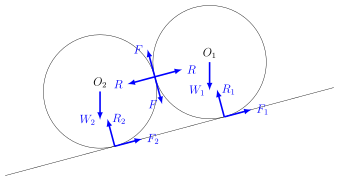
- \begin{align*} \overset{\curvearrowright}{O_2}: && 0 &= F_2 - F \\ \Rightarrow && F_2 &= F \\ \overset{\curvearrowright}{O_1}: && 0 &= F_1- F \\ \Rightarrow && F_1 &= F \\ \text{N2}(\swarrow, 2): && 0 &= R+W_2\sin\alpha -F \tag{1}\\ \text{N2}(\swarrow, 1): && 0 &= W_1\sin\alpha -F-R\tag{2}\\ \Rightarrow && W_1 \sin \alpha-R &= W_2 \sin \alpha+R \\ \Rightarrow && W_1 &\geq W_2 \end{align*}
- \begin{align*} (1)+(2)\Rightarrow && F &= \frac12 \sin \alpha (W_1 + W_2) \\ (1)-(2) \Rightarrow && R &= \frac12 \sin \alpha (W_1-W_2) \\ \Rightarrow && \frac{F}{R} &= \frac{W_1+W_2}{W_1-W_2} \\ \underbrace{\Rightarrow}_{F \leq \mu R} && \mu &\geq \frac{W_1+W_2}{W_1-W_2}\\ \end{align*}
- \begin{align*} \text{N2}(\nwarrow, 1): && 0 &= F+R_1-W_1\cos \alpha \\ \Rightarrow && R_1 &= W_1\cos \alpha - F \\ &&&= W_1 \cos \alpha - \frac12 \sin \alpha (W_1 + W_2) \\ \Rightarrow && \frac{R_1}{F_1} &= \frac{R_1}{F} \\ &&&= \frac{W_1 \cos \alpha - \frac12 \sin \alpha (W_1 + W_2)}{\frac12 \sin \alpha (W_1 + W_2) } \\ &&&= \frac{2W_1 \cot \alpha}{W_1+W_2} - 1 \\ \Rightarrow && \mu_1 & \geq \left ( \frac{2W_1 \cot \alpha}{W_1+W_2} - 1 \right)^{-1} \end{align*}
Rating Information
Difficulty Rating: 1700.0
Difficulty Comparisons: 0
Banger Rating: 1500.0
Banger Comparisons: 0
Show LaTeX source
Problem source
Two rough solid circular cylinders, of equal radius and length and of uniform density, lie side by side on a rough plane inclined at an angle $\alpha$ to the horizontal, where $0<\alpha<\pi/2$. Their axes are horizontal and they touch along their entire length. The weight of the upper cylinder is $W_1$ and the coefficient of friction between it and the plane is $\mu_1$. The corresponding quantities for the lower cylinder are $W_2$ and $\mu_2$ respectively and the coefficient of friction between the two cylinders is $\mu$. Show that for equilibrium to be possible:
\begin{questionparts}
\item $W_1\ge W_2$;
\item $\mu\geqslant\dfrac{W_1+W_2}{W_1-W_2}$;
\item $\mu_{1}\geqslant\left(\dfrac{2W_{1}\cot\alpha}{W_{1}+W_{2}}-1\right)^{-1}\,.$
\end{questionparts}
Find the similar inequality to \textbf{ (iii)} for $\mu_2$.
Solution source
\begin{center}
    \begin{tikzpicture}[scale=2]
        \def\a{15};

        \coordinate (O) at (0,0);
        \coordinate (X) at ({6*cos(\a)},{6*sin(\a)});

        \coordinate (A) at ({2*cos(\a)-sin(\a)},{2*sin(\a)+cos(\a)});
        \coordinate (Aa) at ({2*cos(\a)},{2*sin(\a)});
        \coordinate (B) at ({4*cos(\a)-sin(\a)},{4*sin(\a)+cos(\a)});
        \coordinate (Ba) at ({4*cos(\a)},{4*sin(\a)});
        \coordinate (C) at ($(A)!0.5!(B)$);

        \draw (O) -- (X);
        \draw (A) circle (1);
        \draw (B) circle (1);


        \draw[-latex, ultra thick, blue] (A) -- ++(0,-0.5) node[left] {$W_2$};
        \draw[-latex, ultra thick, blue] (B) -- ++(0,-0.5) node[left] {$W_1$};
        \draw[-latex, ultra thick, blue] (C) -- ($(A)!0.5!(C)$) node[left] {$R$};
        \draw[-latex, ultra thick, blue] (C) -- ++({-0.5*sin(\a)},{0.5*cos(\a)}) node[left] {$F$};
        \draw[-latex, ultra thick, blue] (C) -- ++({0.5*sin(\a)},{-0.5*cos(\a)}) node[left] {$F$};
        \draw[-latex, ultra thick, blue] (C) -- ($(B)!0.5!(C)$) node[right] {$R$};
        \draw[-latex, ultra thick, blue] (Aa) -- ($(A)!0.5!(Aa)$) node[right] {$R_2$};
        \draw[-latex, ultra thick, blue] (Aa) -- ($(Aa)!0.25!(Ba)$) node[right] {$F_2$};
        \draw[-latex, ultra thick, blue] (Ba) -- ($(B)!0.5!(Ba)$) node [right] {$R_1$};
        \draw[-latex, ultra thick, blue] (Ba) -- ($(Ba)!0.25!(X)$) node[right] {$F_1$};

    \node[above] at (A) {$O_2$};
    \node[above] at (B) {$O_1$};

    \end{tikzpicture}
\end{center}

\begin{questionparts}
\item

\begin{align*}
\overset{\curvearrowright}{O_2}: && 0 &= F_2 - F \\
\Rightarrow && F_2 &= F \\
\overset{\curvearrowright}{O_1}: && 0 &= F_1- F \\
\Rightarrow && F_1 &= F \\

\text{N2}(\swarrow, 2): && 0 &= R+W_2\sin\alpha -F \tag{1}\\
\text{N2}(\swarrow, 1): && 0 &= W_1\sin\alpha -F-R\tag{2}\\
\Rightarrow && W_1 \sin \alpha-R &= W_2 \sin \alpha+R \\
\Rightarrow && W_1 &\geq W_2
\end{align*}

\item \begin{align*}
(1)+(2)\Rightarrow && F &= \frac12 \sin \alpha (W_1 + W_2) \\
(1)-(2) \Rightarrow && R &= \frac12 \sin \alpha (W_1-W_2) \\
\Rightarrow && \frac{F}{R} &= \frac{W_1+W_2}{W_1-W_2} \\
\underbrace{\Rightarrow}_{F \leq \mu R} && \mu &\geq \frac{W_1+W_2}{W_1-W_2}\\
\end{align*}

\item \begin{align*}
\text{N2}(\nwarrow, 1): && 0 &= F+R_1-W_1\cos \alpha \\
\Rightarrow && R_1 &= W_1\cos \alpha - F \\
&&&= W_1 \cos \alpha - \frac12 \sin \alpha (W_1 + W_2) \\
\Rightarrow && \frac{R_1}{F_1} &= \frac{R_1}{F} \\
&&&= \frac{W_1 \cos \alpha - \frac12 \sin \alpha (W_1 + W_2)}{\frac12 \sin \alpha (W_1 + W_2) } \\
&&&= \frac{2W_1 \cot \alpha}{W_1+W_2} - 1 \\
\Rightarrow && \mu_1 & \geq \left ( \frac{2W_1 \cot \alpha}{W_1+W_2} - 1 \right)^{-1}
\end{align*}
\end{questionparts}
\begin{align*}
\text{N2}(\nwarrow, 2): && 0 &= -F+R_2-W_2\cos \alpha \\
\Rightarrow && R_2 &= W_2\cos \alpha + F \\
&&&= W_2 \cos \alpha + \frac12 \sin \alpha (W_1 + W_2) \\
\Rightarrow && \frac{R_2}{F_2} &= \frac{R_2}{F} \\
&&&= \frac{ W_2 \cos \alpha + \frac12 \sin \alpha (W_1 + W_2)}{\frac12 \sin \alpha (W_1 + W_2) } \\
&&&= \frac{2W_2 \cot \alpha}{W_1+W_2} + 1 \\
\Rightarrow && \mu_2 & \geq \left ( \frac{2W_1 \cot \alpha}{W_1+W_2} + 1 \right)^{-1}
\end{align*}