Problems
Filters
54 problems found
1989 Paper 2 Q14
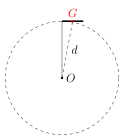
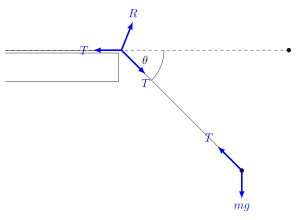
One end of a light inextrnsible string of length \(l\) is fixed to a point on the upper surface of a thin, smooth, horizontal table-top, at a distance \((l-a)\) from one edge of the table-top. A particle of mass \(m\) is fixed to the other end of the string, and held a distance \(a\) away from this edge of the table-top, so that the string is horizontal and taut. The particle is then released. Find the tension in the string after the string has rotated through an angle \(\theta,\) and show that the largest magnitude of the force on the edge of the table top is \(8mg/\sqrt{3}.\)
Solution:
1989 Paper 3 Q12
A smooth horizontal plane rotates with constant angular velocity \(\Omega\) about a fixed vertical axis through a fixed point \(O\) of the plane. The point \(A\) is fixed in the plane and \(OA=a.\) A particle \(P\) lies on the plane and is joined to \(A\) by a light rod of length \(b(>a)\) freely pivoted at \(A\). Initially \(OAP\) is a straight line and \(P\) is moving with speed \((a+2\sqrt{ab})\Omega\) perpendicular to \(OP\) in the same sense as \(\Omega.\) At time \(t,\) \(AP\) makes an angle \(\phi\) with \(OA\) produced. Obtain an expression for the component of the acceleration of \(P\) perpendicular to \(AP\) in terms of \(\dfrac{\mathrm{d}^{2}\phi}{\mathrm{d}t^{2}},\phi,a,b\) and \(\Omega.\) Hence find \(\dfrac{\mathrm{d}\phi}{\mathrm{d}t}\), in terms of \(\phi,a,b\) and \(\Omega,\) and show that \(P\) never crosses \(OA.\)
Solution: Set up coordinate axes so that at time \(t\) \(OA\) is the \(x\)-axis, and all rotations are counter-clockwise. Then if \(OA = \mathbf{a}\), \(AP = \mathbf{x}\) and \(OP = \mathbf{p}\) we have: \begin{align*} \mathbf{a} &= \binom{a}{0} \\ \dot{\mathbf{a}} &= \binom{0}{-a \Omega} \\ \ddot{\mathbf{a}} &= \binom{-a \Omega^2}{0} \\ \\ \mathbf{x} &= \binom{b \cos \phi }{b \sin \phi } \\ \dot{\mathbf{x}} &= b \dot{\phi} \binom{-\sin \phi}{\cos \phi} \\ \ddot{\mathbf{x}} &= \binom{-b \ddot{\phi} \sin \phi-b \dot{\phi}^2 \cos \phi }{b \ddot{\phi} \cos \phi-b \dot{\phi}^2 \sin \phi} \\ \\ \ddot{\mathbf{p}} &= \binom{-a \Omega^2 +-b \ddot{\phi} \sin \phi-b \dot{\phi}^2 \cos \phi }{b \ddot{\phi} \cos \phi-b \dot{\phi}^2 \sin \phi} \end{align*} We can take a dot product with \(\mathbf{n} = \binom{-\sin \phi}{\cos \phi}\) to obtain the component perpendicular to \(AP\), which is: \begin{align*} && \binom{-\sin \phi}{\cos \phi} \cdot \ddot{x} &= a \Omega^2 \sin \phi + b \ddot{\phi} \end{align*} Noticing that this component must be \(0\) (since the only force acting on \(P\) is the rod), this must be equal to zero. \begin{align*} && 0 &= a \Omega^2 \sin \phi + b \ddot{\phi} \\ \Rightarrow && 0 &= a \Omega^2 \dot{\phi} \sin \phi + b\dot{\phi} \ddot{\phi} \\ \Rightarrow && C &= -a \Omega^2 \cos \phi + \tfrac12 b \dot{\phi}^2 \end{align*} Noticing that the initial conditions are \(\phi = 0\) and \(\dot{\phi} = 2\sqrt{\frac{a}{b}} \Omega\), so \begin{align*} && C &= -a \Omega^2+ \tfrac12 b \left ( 2\sqrt{\frac{a}{b}} \Omega \right)^2 \\ &&&= -a \Omega^2 + 2a \Omega^2 \\ &&&= a \Omega^2\\ \Rightarrow && \dot{\phi} &=\sqrt{\frac{2}{b} \left ( a \Omega^2 + a \Omega^2 \cos \phi \right)} \\ &&&= \Omega \sqrt{\frac{2a}{b}} \sqrt{1+ \cos \phi} \\ &&& = \Omega \sqrt{\frac{2a}{b}}\sqrt{2} \cos \tfrac{\phi}{2} \\ \Rightarrow && \int \sec \tfrac{\phi}{2} \d \phi &= 2 \Omega \sqrt{\frac{a}{b}}t \\ \Rightarrow && \tfrac12 \ln | \sec \tfrac{\phi}{2}+\tan \tfrac{\phi}{2} | &= 2 \Omega \sqrt{\frac{a}{b}}t + C \\ t = 0, \phi = 0: && C = 0 \\ \Rightarrow && \sec \tfrac{\phi}{2}+\tan \tfrac{\phi}{2} &= e^{4 \Omega \sqrt{\frac{a}{b}}t} \end{align*} Since when \(t > 0\) this is positive and larger than \(1\) we cannot have \(\phi = 0\) and since it remains below infinite \(\phi\) cannot reach \(\pi\). Therefore it cannot cross \(OA\)
1988 Paper 1 Q12
A skater of mass \(M\) is skating inattentively on a smooth frozen canal. She suddenly realises that she is heading perpendicularly towards the straight canal bank at speed \(V\). She is at a distance \(d\) from the bank and can choose one of two methods of trying to avoid it; either she can apply a force of constant magnitude \(F\), acting at right-angles to her velocity, so that she travels in a circle; or she can apply a force of magnitude \(\frac{1}{2}F(V^{2}+v^{2})/V^{2}\) directly backwards, where \(v\) is her instantaneous speed. Treating the skater as a particle, find the set of values of \(d\) for which she can avoid hitting the bank. Comment briefly on the assumption that the skater is a particle.
Solution: Suppose she applies a force of magnitude \(\frac{1}{2}F(V^{2}+v^{2})/V^{2}\) backwards, then \begin{align*} && M v \frac{dv}{dx} &= -\frac{1}{2}F(V^{2}+v^{2})/V^{2} \\ \Rightarrow && M\int_{V}^0 \frac{2v}{V^2+ v^2} \d v &= - \frac{F}{V^2} x \\ \Rightarrow && M \left [ -\log(V^2+v^2) \right]_0^V &= -\frac{Fx}{V^2} \\ \Rightarrow && -M \ln 2&= -\frac{Fx}{V^2} \end{align*} Therefore she will stop quickly enough if \(d > \frac{V^2M \ln 2}{F}\) If she attempts to use the right-angled method, then she will travel a distance at most \(r\) where \(r\) is the radius of her circle: \begin{align*} && F &= M \frac{V^2}{r} \\ \Rightarrow && r &= \frac{MV^2}{F} \end{align*} Therefore she can always avoid the wall if \(d > \frac{MV^2}{F}\). There are two potential issues with being a particle. Firstly we would need to account for any variation in the distance to the wall (which could be accounted for by changing \(d\)). Secondly when she enters circular motion she will rotate and therefore we might need to consider her inertia as well as just her velocity when modelling.
1988 Paper 2 Q11
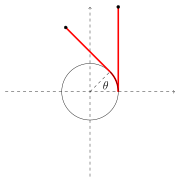
A heavy particle lies on a smooth horizontal table, and is attached to one end of a light inextensible string of length \(L\). The other end of the string is attached to a point \(P\) on the circumference of the base of a vertical post which is fixed into the table. The base of the post is a circle of radius \(a\) with its centre at a point \(O\) on the table. Initially, at time \(t=0\), the string is taut and perpendicular to the line \(OP.\) The particle is then struck in such a way that the string starts winding round the post and remains taut. At a later time \(t\), a length \(a\theta(t)\ (< L)\) of the string is in contact with the post. Using cartesian axes with origin \(O\), find the position and velocity vectors of the particle at time \(t\) in terms of \(a,L,\theta\) and \(\dot{\theta},\) and hence show that the speed of the particle is \((L-a\theta)\dot{\theta}.\) If the initial speed of the particle is \(v\), show that the particle hits the post at a time \(L^{2}/(2av).\)
Solution:
1988 Paper 2 Q14
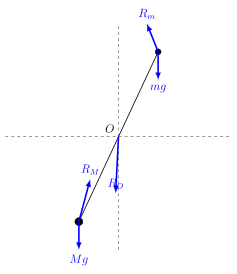
Two particles of mass \(M\) and \(m\) \((M>m)\) are attached to the ends of a light rod of length \(2l.\) The rod is fixed at its midpoint to a point \(O\) on a horizontal axle so that the rod can swing freely about \(O\) in a vertical plane normal to the axle. The axle rotates about a vertical axis through \(O\) at a constant angular speed \(\omega\) such that the rod makes a constant angle \(\alpha\) \((0<\alpha<\frac{1}{2}\pi)\) with the vertical. Show that \[ \omega^{2}=\left(\frac{M-m}{M+m}\right)\frac{g}{l\cos\alpha}. \] Show also that the force of reaction of the rod on the axle is inclined at an angle \[ \tan^{-1}\left[\left(\frac{M-m}{M+m}\right)^{2}\tan\alpha\right] \] with the downward vertical.
Solution:
1988 Paper 3 Q14
A small heavy bead can slide smoothly in a vertical plane on a fixed wire with equation \[ y=x-\frac{x^{2}}{4a}, \] where the \(y\)-axis points vertically upwards and \(a\) is a positive constant. The bead is projected from the origin with initial speed \(V\) along the wire.
- Show that for a suitable value of \(V\), to be determined, a motion is possible throughout which the bead exerts no pressure on the wire.
- Show that \(\theta,\) the angle between the particle's velocity at time \(t\) and the \(x\)-axis, satisfies \[ \frac{4a^{2}\dot{\theta}^{2}}{\cos^{6}\theta}+2ga(1-\tan^{2}\theta)=V^{2}. \]
Solution:
- The condition that the bead exerts no pressure on the wire is equivalent to the condition that the wire exerts no force on the bead. (Newton's Third Law). This is equivalent to the bead being projected under gravity. Notice that the initial projection is at \(45^{\circ}\) since \(\frac{dy}{dx}|_{x=0} = 1\). The position of the particle (under gravity) at time \(t\) is \(x = \frac{1}{\sqrt{2}}Vt\) and \(y = \frac{1}{\sqrt{2}}Vt - \frac12 gt^2 = x - \frac{1}{2}g \frac{2x^2}{V^2} = x - \frac{g}{V^2}x^2\). Therefore they follow the same trajectory if \(\frac{g}{V^2} = \frac{1}{4a} \Leftrightarrow V = 2\sqrt{ag}\)
- First note that the wire does no work as it is perpendicular to the velocity, so it is fine to use conservation of momentum. If we take our \(0\) GPE level to be be \(x = 0\), then we notice the initial energy is \(\frac12mV^2\). Secondly, notice that \(\tan \theta = \frac{\d y}{\d x} = 1- \frac{x}{2a} \Rightarrow x = 2a - 2a \tan \theta\) \begin{align*} y &= 2a(1-\tan \theta) - \frac{4a^2(1-\tan \theta)^2}{4a}\\ &= (1-\tan \theta)(2a-a(1-\tan \theta)) \\ &= a(1-\tan \theta)(1+\tan \theta) \\ &= a(1-\tan^2 \theta) \end{align*} GPE \(mga(1-\tan^2 \theta)\). To calculate the kinetic energy, notice that \(\dot{x} = v \cos \theta \dot{\theta}\) and \(\dot{x} = -2a\sec^2 \theta\dot{\theta} \Rightarrow v = -\frac{2a\dot{\theta} }{\cos^{3} \theta}\). Therefore, energy at time \(t\) is: \begin{align*} && \frac12 m V^2 &= \frac12 m \l - \frac{2a\dot{\theta}}{\cos^3 \theta} \r^2 + mga(1-\tan^2 \theta) \\ \Rightarrow && V^2 &= \frac{4a^2\dot{\theta}^2}{\cos^6 \theta} + 2ag(1-\tan^2 \theta) \end{align*}
1987 Paper 1 Q11
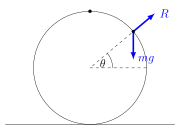
A smooth sphere of radius \(r\) stands fixed on a horizontal floor. A particle of mass \(m\) is displaced gently from equilibrium on top of the sphere. Find the angle its velocity makes with the horizontal when it loses contact with the sphere during the subsequent motion. By energy considerations, or otherwise, find the vertical component of the momentum of the particle as it strikes the floor.
Solution:
1987 Paper 2 Q14
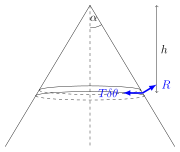
A thin uniform elastic band of mass \(m,\) length \(l\) and modulus of elasticity \(\lambda\) is pushed on to a smooth circular cone of vertex angle \(2\alpha,\) in such a way that all elements of the band are the same distance from the vertex. It is then released from rest. Let \(x(t)\) be the length of the band at time \(t\) after release, and let \(t_{0}\) be the time at which the band becomes slack. Assuming that a small element of the band which subtends an angle \(\delta\theta\) at the axis of the cone experiences a force, due to the tension \(T\) in the band, of magnitude \(T\delta\theta\) directed towards the axis, and ignoring the effects of gravity, show that \[ \frac{\mathrm{d}^{2}x}{\mathrm{d}t^{2}}+\frac{4\pi^{2}\lambda}{ml}(x-l)\sin^{2}\alpha=0,\qquad(0< t< t_{0}). \] Find the value of \(t_{0}.\)
Solution:
1987 Paper 3 Q12
A firework consists of a uniform rod of mass \(M\) and length \(2a\), pivoted smoothly at one end so that it can rotate in a fixed horizontal plane, and a rocket attached to the other end. The rocket is a uniform rod of mass \(m(t)\) and length \(2l(t)\), with \(m(t)=2\alpha l(t)\) and \(\alpha\) constant. It is attached to the rod by its front end and it lies at right angles to the rod in the rod's plane of rotation. The rocket burns fuel in such a way that \(\mathrm{d}m/\mathrm{d}t=-\alpha\beta,\) with \(\beta\) constant. The burnt fuel is ejected from the back of the rocket, with speed \(u\) and directly backwards relative to the rocket. Show that, until the fuel is exhausted, the firework's angular velocity \(\omega\) at time \(t\) satisfies \[ \frac{\mathrm{d}\omega}{\mathrm{d}t}=\frac{3\alpha\beta au}{2[Ma^{2}+2\alpha l(3a^{2}+l^{2})]}. \]
Solution: