1988 Paper 2 Q14
Year: 1988
Paper: 2
Question Number: 14
Course: UFM Mechanics
Section: Circular Motion 2
Difficulty: 1600.0
Banger: 1488.9
circular motion
conical motion
rotating rod
rigid body
angular velocity
reaction force
vertical axis rotation
equilibrium condition
Problem
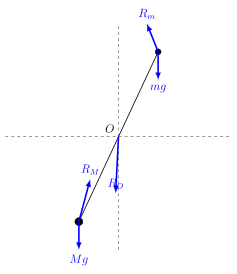
Two particles of mass \(M\) and \(m\) \((M>m)\) are attached to the ends of a light rod of length \(2l.\) The rod is fixed at its midpoint to a point \(O\) on a horizontal axle so that the rod can swing freely about \(O\) in a vertical plane normal to the axle. The axle rotates about a vertical axis through \(O\) at a constant angular speed \(\omega\) such that the rod makes a constant angle \(\alpha\) \((0<\alpha<\frac{1}{2}\pi)\) with the vertical. Show that
\[
\omega^{2}=\left(\frac{M-m}{M+m}\right)\frac{g}{l\cos\alpha}.
\]
Show also that the force of reaction of the rod on the axle is inclined at an angle
\[
\tan^{-1}\left[\left(\frac{M-m}{M+m}\right)^{2}\tan\alpha\right]
\]
with the downward vertical.
Solution
Rating Information
Difficulty Rating: 1600.0
Difficulty Comparisons: 0
Banger Rating: 1488.9
Banger Comparisons: 1
Show LaTeX source
Problem source
Two particles of mass $M$ and $m$ $(M>m)$ are attached to the ends of a light rod of length $2l.$ The rod is fixed at its midpoint to a point $O$ on a horizontal axle so that the rod can swing freely about $O$ in a vertical plane normal to the axle. The axle rotates about a \textit{vertical }axis through $O$ at a constant angular speed $\omega$ such that the rod makes a constant angle $\alpha$ $(0<\alpha<\frac{1}{2}\pi)$ with the vertical. Show that
\[
\omega^{2}=\left(\frac{M-m}{M+m}\right)\frac{g}{l\cos\alpha}.
\]
Show also that the force of reaction of the rod on the axle is inclined at an angle
\[
\tan^{-1}\left[\left(\frac{M-m}{M+m}\right)^{2}\tan\alpha\right]
\]
with the downward vertical.
Solution source
\begin{center}
    \begin{tikzpicture}[scale=2]
        \draw[dashed] (0, -2) -- (0, 2);
        \draw[dashed] (-2, 0) -- (2, 0);
        % \draw[dashed] (-1.5,-1) -- (1.5,1);

        \draw[thick] (-0.7, -1.5) -- (0.7, 1.5);

        \node[above left] at (0,0) {$O$};

        \filldraw (-0.7, -1.5) circle (2pt);
        \filldraw (0.7, 1.5) circle (1.5pt);

        \draw[-latex, blue, ultra thick](0.7, 1.5) -- ++(0, -0.5) node[below] {$mg$};
        \draw[-latex, blue, ultra thick](-0.7, -1.5) -- ++(0, -0.5) node[below] {$Mg$};
        \draw[-latex, blue, ultra thick](-0.7, -1.5) -- (-0.5, -0.75) node[above] {$R_M$};
        \draw[-latex, blue, ultra thick](0.7, 1.5) -- (0.5, 2) node[above] {$R_m$};
        \draw[-latex, blue, ultra thick](0,0) -- (-0.05, -1) node[above] {$R_O$};
    \end{tikzpicture}
\end{center}

The accelerations of $M$ and $m$ are $l \sin \alpha \omega^2$ and $-l \sin \alpha \omega^2$ so the forces $R_M$ and $R_m$ are $M\binom{l \sin \alpha \omega^2}{g}, \,m \binom{-l \sin \alpha \omega^2}{g}$.

Since the axle is rotating \textit{freely}, the moment about $O$ for the rod must be $O$.

The moment for $M$ will be $M\binom{l \sin \alpha\omega^2}{g} \cdot \binom{-l\cos \alpha}{l \sin \alpha} = lM\sin\alpha (g - l \cos \alpha\omega^2)$.

The moment for $m$ will be $m \binom{-l \sin \alpha\omega^2}{g} \cdot \binom{-l\cos \alpha\omega^2}{l \sin \alpha} = lm \sin \alpha(g+l \cos \alpha\omega^2)$

Therefore
\begin{align*}
&& lM\sin\alpha (g - l \cos \alpha\omega^2) &= lm \sin \alpha(g+l \cos \alpha\omega^2) \\
&& M(g - l \cos \alpha \omega^2) &= m(g + l \cos \alpha \omega^2 ) \\
\Rightarrow && g(M-m) &= l \cos \alpha (M+m) \omega^2 \\
\Rightarrow && \omega^2 &= \left (\frac{M-m}{M+m} \right) \frac{g}{l \cos \alpha}
\end{align*}

as required.

The total force on the rod is $\mathbf{0}$ so the reaction force must be $M\binom{l \sin \alpha \omega^2}{g}+ \,m \binom{-l \sin \alpha \omega^2}{g} = \binom{l \sin \alpha \omega^2 (M-m)}{(M+m)g}$

Therefore the angle this makes with downward vertical is:

\begin{align*}
\theta &= \tan^{-1} \left ( \frac{l \sin \alpha \omega^2 (M-m)}{(M+m)g} \right) \\
&= \tan^{-1} \left ( \frac{l \sin \alpha (M-m)}{(M+m)g}  \omega^2\right) \\
&= \tan^{-1} \left ( \frac{l \sin \alpha (M-m)}{(M+m)g}   \left (\frac{M-m}{M+m} \right) \frac{g}{l \cos \alpha}\right) \\
&= \tan^{-1}\left[\left(\frac{M-m}{M+m}\right)^{2}\tan\alpha\right]
\end{align*}

as required.