1987 Paper 2 Q14
Year: 1987
Paper: 2
Question Number: 14
Course: UFM Mechanics
Section: Simple Harmonic Motion
Difficulty: 1500.0
Banger: 1500.0
SHM
elastic band
cone
Hooke's law
tension
circular motion
differential equation
second order
modulus of elasticity
period
Problem
A thin uniform elastic band of mass \(m,\) length \(l\) and modulus of elasticity \(\lambda\) is pushed on to a smooth circular cone of vertex angle \(2\alpha,\) in such a way that all elements of the band are the same distance from the vertex. It is then released from rest. Let \(x(t)\) be the length of the band at time \(t\) after release, and let \(t_{0}\) be the time at which the band becomes slack.
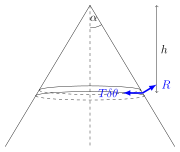
Assuming that a small element of the band which subtends an angle \(\delta\theta\) at the axis of the cone experiences a force, due to the tension \(T\) in the band, of magnitude \(T\delta\theta\) directed
towards the axis, and ignoring the effects of gravity, show that
\[
\frac{\mathrm{d}^{2}x}{\mathrm{d}t^{2}}+\frac{4\pi^{2}\lambda}{ml}(x-l)\sin^{2}\alpha=0,\qquad(0< t< t_{0}).
\]
Find the value of \(t_{0}.\)
Solution
Rating Information
Difficulty Rating: 1500.0
Difficulty Comparisons: 0
Banger Rating: 1500.0
Banger Comparisons: 0
Show LaTeX source
Problem source
A thin uniform elastic band of mass $m,$ length $l$ and modulus of elasticity $\lambda$ is pushed on to a smooth circular cone of vertex angle $2\alpha,$ in such a way that all elements of the band are the same distance from the vertex. It is then released from rest. Let $x(t)$ be the length of the band at time $t$ after release, and let $t_{0}$ be the time at which the band becomes slack.
Assuming that a small element of the band which subtends an angle $\delta\theta$ at the axis of the cone experiences a force, due to the tension $T$ in the band, of magnitude $T\delta\theta$ directed
towards the axis, and ignoring the effects of gravity, show that
\[
\frac{\mathrm{d}^{2}x}{\mathrm{d}t^{2}}+\frac{4\pi^{2}\lambda}{ml}(x-l)\sin^{2}\alpha=0,\qquad(0< t< t_{0}).
\]
Find the value of $t_{0}.$
Solution source
\begin{center}
    \begin{tikzpicture}

        \def\l{5};
        \def\h{3};
        \def\m{2};
        \def\d{0.2};

        \coordinate (O) at (0, \l);

        \coordinate (A) at ({\h}, 0);
        \coordinate (B) at ({-\h}, 0);
        \coordinate (D) at (0, 0);

        \coordinate (Ba) at ({(\l-\m+\d/2)/(\l)*\h}, {\m-\d/2});
        \coordinate (Bb) at ({-(\l-\m+\d/2)/(\l)*\h}, {\m-\d/2});

        \draw (A) -- (O) -- (B);

        \draw[<->] ({(\l-\m+\d/2)/(\l)*\h+0.5}, {\l}) --  ({(\l-\m+\d/2)/(\l)*\h+0.5}, {\m-\d/2});

        \node at ({(\l-\m+\d/2)/(\l)*\h+0.5}, {0.5*(\l+\m-\d/2)}) [right] {$h$};

        \pic [draw, angle radius=0.8cm, "$\alpha$"] {angle = D--O--A};

        \draw[dashed] (O) -- (D);

        \draw[domain = -90:90, samples=180, variable = \x]  plot ({sin(\x)*(\l-\m)/(\l)*\h}, {\m+cos(\x)*0.15} );
        \draw[domain = 270:90, samples=180, dashed, variable = \x]  plot ( {sin(\x)*(\l-\m)/(\l)*\h}, {\m+cos(\x)*0.15});

        \draw[domain = -90:90, samples=180, variable = \x]  plot ({sin(\x)*(\l-\m+\d)/(\l)*\h},{\m-\d+cos(\x)*0.15});
        \draw[domain = 270:90, samples=180, dashed, variable = \x]  plot ( {sin(\x)*(\l-\m+\d)/(\l)*\h},{\m-\d+cos(\x)*0.15});

        \draw[-latex, blue, ultra thick] (Ba) -- ++({\l/10}, {\h/10}) node[right] {$R$};
        \draw[-latex, blue, ultra thick] (Ba) -- ++({-0.7}, {0}) node[left] {$T\delta \theta$};

    \end{tikzpicture}
\end{center}

\begin{align*}
\text{N2}(\nwarrow): && T\delta \theta \sin \alpha &= -m\frac{\delta \theta}{2\pi} \ddot{d}
\end{align*}
Notice that $r = d \sin \alpha$ and $x = 2 \pi r$, so $x = 2\pi d \sin \alpha$ and $\ddot{x} = 2\pi \sin \alpha \ddot{d} \Rightarrow \ddot{d} = \ddot{x} \frac{1}{2 \pi \sin \alpha}$

Notice also that $T = \frac{\lambda}{l}(x-l)$ so.

\begin{align*}
&& \frac{m}{4 \pi^2 \sin\alpha} \ddot{x} &= -\frac{\lambda}{l}(x-l)  \sin\alpha \\
\Rightarrow && \frac{\mathrm{d}^{2}x}{\mathrm{d}t^{2}}+\frac{4\pi^{2}\lambda}{ml}(x-l)\sin^{2}\alpha&=0
\end{align*}

The solution to the differential equation we have is:

\begin{align*}
&& x(t) &= A \sin \left (\sqrt{\frac{4 \pi^2 \lambda}{ml}\sin^2 \alpha} \cdot t \right) + B \sin \left (\sqrt{\frac{4 \pi^2 \lambda}{ml}\sin^2 \alpha} \cdot t \right) + l \\
&&&= A \sin \left (2 \pi \sin \alpha\sqrt{\frac{ \lambda}{ml}} \cdot t \right) +B \sin \left (2 \pi \sin \alpha\sqrt{\frac{ \lambda}{ml}} \cdot t \right) + l\\
&& \dot{x}(0) =  0 \\
\Rightarrow && B &= 0 \\
&& x(t) &= (x(0)-l) \sin \left (2 \pi \sin \alpha\sqrt{\frac{ \lambda}{ml}} \cdot t \right)  + l \\
&& x(t_0) &= l \\
\Rightarrow && t_0 &= \frac{1}{4\sin \alpha} \sqrt{\frac{ml}{\lambda}}
\end{align*}