1987 Paper 3 Q12
Year: 1987
Paper: 3
Question Number: 12
Course: UFM Mechanics
Section: Circular Motion 2
Difficulty: 1500.0
Banger: 1482.0
circular motion
variable mass
rocket propulsion
moment of inertia
angular momentum
rigid body
differential equation
horizontal plane rotation
Problem
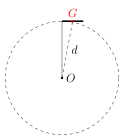
A firework consists of a uniform rod of mass \(M\) and length \(2a\), pivoted smoothly at one end so that it can rotate in a fixed horizontal plane, and a rocket attached to the other end. The rocket is a uniform rod of mass \(m(t)\) and length \(2l(t)\), with \(m(t)=2\alpha l(t)\) and \(\alpha\) constant. It is attached to the rod by its front end and it lies at right angles to the rod in the rod's plane of rotation.
The rocket burns fuel in such a way that \(\mathrm{d}m/\mathrm{d}t=-\alpha\beta,\) with \(\beta\) constant. The burnt fuel is ejected from the back of the rocket, with speed \(u\) and directly backwards relative to the rocket. Show that, until the fuel is exhausted, the firework's angular velocity \(\omega\) at time \(t\) satisfies
\[
\frac{\mathrm{d}\omega}{\mathrm{d}t}=\frac{3\alpha\beta au}{2[Ma^{2}+2\alpha l(3a^{2}+l^{2})]}.
\]
Solution
Rating Information
Difficulty Rating: 1500.0
Difficulty Comparisons: 0
Banger Rating: 1482.0
Banger Comparisons: 1
Show LaTeX source
Problem source
A firework consists of a uniform rod of mass $M$ and length $2a$, pivoted smoothly at one end so that it can rotate in a fixed horizontal plane, and a rocket attached to the other end. The rocket is a uniform rod of mass $m(t)$ and length $2l(t)$, with $m(t)=2\alpha l(t)$ and $\alpha$ constant. It is attached to the rod by its front end and it lies at right angles to the rod in the rod's plane of rotation.
The rocket burns fuel in such a way that $\mathrm{d}m/\mathrm{d}t=-\alpha\beta,$ with $\beta$ constant. The burnt fuel is ejected from the back of the rocket, with speed $u$ and directly backwards relative to the rocket. Show that, until the fuel is exhausted, the firework's angular velocity $\omega$ at time $t$ satisfies
\[
\frac{\mathrm{d}\omega}{\mathrm{d}t}=\frac{3\alpha\beta au}{2[Ma^{2}+2\alpha l(3a^{2}+l^{2})]}.
\]
Solution source
\begin{center}
    \begin{tikzpicture}
        \def\r{2};
        \def\l{0.75};
        \coordinate (O) at (0,0);
        \coordinate (A) at (0, \r);
        \coordinate (B) at (\l, \r);
        \coordinate (G) at ($(A)!0.5!(B)$);


        \filldraw (O) circle (1pt) node[right] {$O$};
        \draw[dashed] (O) circle (\r);
        \draw (O) -- (A);
        \draw[ultra thick] (A) -- (B);
        \filldraw[red] (G) circle (1pt) node[above] {$G$};

        \draw[dashed] (O) -- (G);
        \node[<->] at ($(O)!0.5!(G)$) [right] {$d$};

    \end{tikzpicture}
\end{center}

The rocket principle states that the thrust generated by the rocket is $-\frac{\d m}{\d t}u = \alpha \beta u$

This force is acting at a distance $2a$ from $O$ and therefore is generating a torque of $2a \alpha \beta u$ on the system.

Let's also consider the moments of inertia about $O$.

The fixed rod will have moment of inertia $\frac13 M (2a)^2 = \frac43 M a^2$.

The rocket will have moment of inertia $I_{G} + md^2 = \frac1{12}m(t)(2l(t))^2  + m(t) ((2a)^2 + l(t)^2)= \frac43 ml^2+ 4ma^2$. Since our final equation doesn't involve $m$, lets replace all the $m$ with $2al$ to obtain a total $\displaystyle I = \frac43 Ma^2 + \frac83 \alpha l^3 + 8\alpha la^2$.

Since $\tau$ is constant, we can note that $I\omega = 2a \alpha \beta u t$ (by integrating) and so

\begin{align*}
&& \dot{\omega} &= \frac{\d }{\d t} \left ( \frac{2a \alpha \beta u t}{ \frac43 Ma^2 + \frac83 \alpha l^3 + 8\alpha la^2} \right) \\
&&&= \frac{\d }{\d t} \left ( \frac{3a \alpha \beta u t}{ 2Ma^2 +4\alpha l^3 + 4 \cdot 3 \cdot \alpha la^2} \right) \\
&&&= \frac{\d }{\d t} \left ( \frac{3a \alpha \beta u t}{ 2[Ma^2 +2\alpha l(l^2 + 3 a^2)]} \right) \\
\end{align*}

This is, close, but not quite what they are after since the denominator also has a dependency on $t$ we wont get exactly what they've asked for