1987 Paper 1 Q11
Year: 1987
Paper: 1
Question Number: 11
Course: UFM Mechanics
Section: Circular Motion 2
Difficulty: 1500.0
Banger: 1486.7
circular motion
particle on hemisphere
energy conservation
normal reaction
loss of contact
projectile
momentum
smooth sphere
Problem
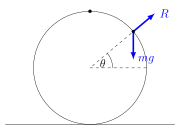
A smooth sphere of radius \(r\) stands fixed on a horizontal floor.
A particle of mass \(m\) is displaced gently from equilibrium on top of the sphere. Find the angle its velocity makes with the horizontal when it loses contact with the sphere during the subsequent motion.
By energy considerations, or otherwise, find the vertical component of the momentum of the particle as it strikes the floor.
Solution
Rating Information
Difficulty Rating: 1500.0
Difficulty Comparisons: 0
Banger Rating: 1486.7
Banger Comparisons: 1
Show LaTeX source
Problem source
A smooth sphere of radius $r$ stands fixed on a horizontal floor.
A particle of mass $m$ is displaced gently from equilibrium on top of the sphere. Find the angle its velocity makes with the horizontal when it loses contact with the sphere during the subsequent motion.
By energy considerations, or otherwise, find the vertical component of the momentum of the particle as it strikes the floor.
Solution source
\begin{center}
    \begin{tikzpicture}
        \coordinate (O) at (0,0);
        \coordinate (X) at (0,2);
        \coordinate (Y) at (2,0);
        \coordinate (Z) at ({2*cos(40)}, {2*sin(40)});

        \draw (-3, -2) -- (3, -2);

        \draw (O) circle (2);

        \draw[-latex, blue, ultra thick] (Z) -- ++($(Z)!0.5!(O)$) node[right] {$R$};
        \draw[-latex, blue, ultra thick] (Z) -- ++(0, -1) node[right] {$mg$};

        \draw[dashed] (Y)--(O)--(Z);
        \pic [draw, angle radius=0.8cm, "$\theta$"] {angle = Y--O--Z};

        \filldraw (X) circle (1.5pt);
        \filldraw (Z) circle (1.5pt);
    \end{tikzpicture}
\end{center}

Whilst the particle is on the surface of the sphere consider the energy.

Letting the height of centre of the sphere by our $0$ GPE level, the initial energy is $mgr$ (assuming that the initial speed is so close to $0$ as to make no difference).

When it makes an angle $\theta$ with the horizontal it's energy will be $mgr \sin \theta + \frac12 m v^2$.

By conservation of energy: $mgr \sin \theta + \frac12 m v^2 = mgr \Rightarrow v^2 = 2gr(1-\sin \theta)$

\begin{align*}
\text{N2}(\text{radially}): && mg \sin \theta - R &= m \frac{v^2}{r} \\
\Rightarrow && R &= mg\sin \theta - \frac{m}{r} 2gr(1-\sin \theta) \\
&&&=mg \l 3\sin \theta - 2 \r
\end{align*}

Since $R$ must be positive whilst the particle is in contact with the sphere, the angle $\theta$ makes with the horizontal when it leaves the sphere is $\sin^{-1} \frac{2}{3}$.

At this point $v^2 = 2gr(1-\sin \theta) = \frac{2}{3}gr$

Again, considering energy, the initial energy is $mgr$. The final energy is $-mgr + \frac12mu_x^2 + \frac12mu_y^2$

When the particle leaves the surface it has speed $v= \frac23 gr$, so the component $u_x = \sqrt{v}\sin \theta$.

By conservation of energy therefore:

\begin{align*}
&& mgr &= -mgr + \frac12mu_x^2 + \frac12mu_y^2 \\
\Rightarrow && \frac12 u_y^2 &= 2gr - \frac12 u_x^2 \\
&&&= 2gr - \frac12 (\sqrt{v} \sin \theta)^2 \\
&&&= 2gr  - \frac12 \frac23gr \sin^2 \theta \\
&&&= 2gr - \frac13gr \frac{4}{9} \\
&&&= \frac{50}{27}gr \\
\Rightarrow && u_y &= \frac{10}{3\sqrt{3}}\sqrt{gr}
\end{align*}

Therefore vertical component of momentum is $\displaystyle \frac{10}{3\sqrt{3}}\sqrt{gr}m$