Problems
Filters
39 problems found
2015 Paper 2 Q3
Three rods have lengths \(a\), \(b\) and \(c\), where \(a< b< c\). The three rods can be made into a triangle (possibly of zero area) if \(a+b\ge c\). Let \(T_{n}\) be the number of triangles that can be made with three rods chosen from \(n\) rods of lengths \(1\), \(2\), \(3\), \(\ldots\) , \(n\) (where \(n\ge3\)). Show that \(T_8-T_7 = 2+4+6\) and evaluate \(T_8 -T_6\). Write down expressions for \(T_{2m}-T_{2m-1}\) and \(T_{2m} - T_{2m-2}\). Prove by induction that \(T_{2m}=\frac 16 m (m-1)(4m+1)\,\), and find the corresponding result for an odd number of rods.
Solution: Every \(T_7\) triangle is valid, so we are interested in new triangles which have \(8\) has a longest side. We can have: \begin{array}{c|c|c} \text{longest} & \text{middle} & \text{shortest} \\ \hline 8 & 7 & 1-6 \\ 8 & 6 & 2-5 \\ 8 & 5 & 3-4 \end{array} which is \(6+4+2\) extra triangles. The new ones excluding all the sixes are: \begin{array}{c|c|c} \text{longest} & \text{middle} & \text{shortest} \\ \hline 8 & 7 & 1-6 \\ 8 & 6 & 2-5 \\ 8 & 5 & 3-4 \\ 7 & 6 & 1-5 \\ 7 & 5 & 2-4 \\ 7 & 4 & 3 \\ \end{array} Ie \(2+4+6 + 1 + 3+5\) \(T_{2m}-T_{2m-1} = 2 \frac{(m-1)m}{2} = m(m-1)\) and \(T_{2m}-T_{2m-2} = \frac{(2m-2)(2m-1)}{2}\) \(T_4 = 3\) (\(1,2,3\), \(1,3,4\), \(2,3,4\)) and \(\frac16 \cdot 2 \cdot 1 \cdot 9 = 3\) so the base case holds. Suppose it's true for some \(m = k\), then \begin{align*} && T_{2(k+1)} &= T_{2k} + \frac{2m(2m+1)}{2} \\ &&&= \frac{m(m-1)(4m+1)}{6} + \frac{6m(2m+1)}{6}\\ &&&= \frac{m(4m^2-3m-1+12m+6)}{6} \\ &&&= \frac{m(4m^2+9m+5)}{6}\\ &&&= \frac{m(4m+5)(m+1)}{6}\\ &&&= \frac{(m+1-1)(4(m+1)+5)(m+1)}{6}\\ \end{align*} as required, therefore it is true by induction. For odd numbers, we can see that \(T_{2m-1} = \frac{m(m-1)(4m+1)}{6} - m(m-1) = \frac{m(m-1)(4m-5)}{6}\)
2015 Paper 2 Q4
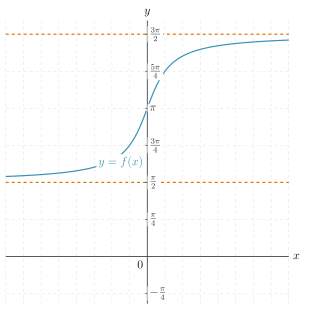
- The continuous function \(\f\) is defined by \[ \tan \f(x) = x \ \ \ \ \ (-\infty < x <\infty) \] and \(\f(0)=\pi\). Sketch the curve \(y=\f(x)\).
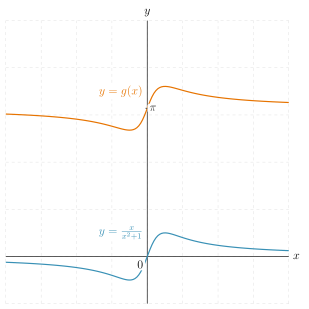
- The continuous function \(\g\) is defined by \[ \tan \g(x) = \frac x {1+x^2} \ \ \ \ \ \ (-\infty < x <\infty) \] and \(\g(0)=\pi\). Sketch the curves \(y= \dfrac x {1+x^2} \ \) and \(y=\g(x)\).
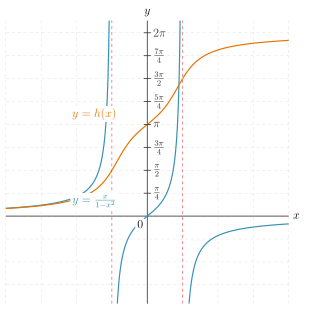
- The continuous function \(\h \) is defined by \(\h (0)=\pi\) and \[ \tan \h (x)= \frac x {1-x^2}\, \ \ \ \ \ (x \ne \pm 1) \,. \] (The values of \(\h (x)\) at \(x=\pm1\) are such that \(\h (x)\) is continuous at these points.) Sketch the curves \(y= \dfrac x {1-x^2} \ \) and \(y=\h (x)\).
- [Not on original exam] The continuous functions \(\h_1\) and \(\h_2\) are defined by: \(\h_1(0)=\h_2(0)=\pi \), \[ \tan \h_1(x) = \frac {x+x^4} {1+x^2+x^4} \ \ \ \ \ \text{and} \ \ \ \ \ \ \tan \h_2(x) = \frac {4x-x^3} {1-x^4} \,. \] for values of \(x\) at which the right hand sides are defined. Find \(\lim\limits_{x\to\infty}\h_1(x)\) and \(\lim\limits_{x\to\infty}\h_2(x)\,\).
Solution:
- \(\,\)
- \(\,\)
- \(\,\)
- Note that \(\frac{x+x^4}{1+x^2+x^4}\) is continuous, and nicely behaved on \((-\infty, \infty)\) so we can see that \(\lim_{x \to \infty} h_1(x) = \pi + \frac{\pi}{4} = \frac{5\pi}{4}\). \(\frac{4x-x^3}{1-x^4}\) on the other hand has asymptotes at \(\pm 1\). So as as \(x \to 1\), \(h_1(x) \to \pi + \frac{\pi}{2} = \frac{3\pi}{2}\). Then as \(x \to \infty\) we increase by another \(\frac{\pi}{2}\), so \(\lim_{x \to \infty} h_2(x) = 2\pi\)
2015 Paper 2 Q5
In this question, the \(\mathrm{arctan}\) function satisfies \(0\le \arctan x <\frac12 \pi\) for \(x\ge0\,\).
- Let \[ S_n= \sum_{m=1}^n \arctan \left(\frac1 {2m^2}\right) \,, \] for \(n=1, 2, 3, \ldots\) . Prove by induction that \[ \tan S_n = \frac n {n+1} \,. \] Prove also that \[ S_n = \arctan \frac n {n+1} \,. \]
- In a triangle \(ABC\), the lengths of the sides \(AB\) and \(BC\) are \(4n^2\) and \(4n^4-1\), respectively, and the angle at \(B\) is a right angle. Let \(\angle BCA = 2\alpha_n\). Show that \[ \sum_{n=1}^\infty \alpha_n = \tfrac14\pi \,. \]
Solution:
- Claim: \(\tan S_n = \frac n {n+1}\) Proof: (By Induction) Base case: (\(n=1\)): \begin{align*} && \tan \left ( \sum_{m=1}^1 \arctan \left ( \frac{1}{2m^2} \right) \right) &= \tan \left ( \arctan \left ( \frac{1}{2} \right) \right) \\ &&&= \frac12 = \frac{1}{1+1} \end{align*} Therefore the base case is true. Inductive step: Suppose our statement is true for some \(n = k\), ie \begin{align*} && \frac{k}{k+1} &= \tan \left ( \sum_{m=1}^k \arctan \left ( \frac{1}{2m^2} \right) \right) \\ \Rightarrow && \tan S_{k+1} &= \tan \left ( \sum_{m=1}^k \arctan \left ( \frac{1}{2m^2} \right) + \arctan \left ( \frac{1}{2 (k+1)^2} \right) \right) \\ &&&= \frac{\tan S_k + \tan \left ( \arctan \left ( \frac{1}{2 (k+1)^2} \right) \right)}{1-\tan S_k \tan \left ( \arctan \left ( \frac{1}{2 (k+1)^2} \right) \right)} \\ &&&= \frac{\frac{k}{k+1} + \frac{1}{2(k+1)^2}}{1-\frac{k}{k+1} \frac{1}{2(k+1)^2}} \\ &&&= \frac{2k(k+1)^2+(k+1)}{2(k+1)^3-k} \\ &&&= \frac{k+1}{(k+1)+1} \end{align*} Therefore it is true for \(n=k+1\). Conclusion: Therefore by the principle of mathematical induction since our statement is true for \(n=1\) and if it is true for \(n=k\) it is true for \(n=k+1\) it is true for all \(n\geq1\) Since \(S_n < \frac12 \pi\) for all \(n\), we must have \(\arctan \frac{n}{n+1} = S_n\)
- \(\tan (2\alpha_n) = \frac{4n^2}{4n^4-1} = \frac{2n^2+2n^2}{(2n^2)(2n^2)-1} = \frac{\frac{1}{2n^2}+\frac{1}{2n^2}}{1-\frac{1}{2n^2}\frac{1}{2n^2}} \Rightarrow \tan (\alpha_n) = \arctan \frac{1}{2n^2}\). In particular \(\displaystyle \sum_{n=1}^{N} \alpha_n = \arctan \frac{n}{n+1} \Rightarrow \sum_{n=1}^{\infty} \alpha_n \to \arctan 1 = \frac{\pi}{4} \)
2015 Paper 2 Q6
- Show that \[ \mathrm{sec}^2\left(\tfrac14\pi-\tfrac12 x\right)=\frac{2}{1+\sin x} \,. \] Hence integrate \(\dfrac{1}{1+\sin x}\) with respect to \(x\).
- By means of the substitution \(y=\pi -x\), show that \[ \int_0^\pi x \f (\sin x)\, \d x = \frac \pi 2 \int_0^\pi \f(\sin x) \, \d x ,\] where \(\mathrm{f}\) is any function for which these integrals exist. Hence evaluate \[ \int_0^\pi \frac x {1+\sin x} \, \d x \,. \]
- Evaluate \[ \int_0^\pi\frac{ 2x^3 -3\pi x^2}{(1+\sin x)^2}\, \d x .\]
Solution:
- \(\,\) \begin{align*} && \sec^2\left(\tfrac14\pi-\tfrac12 x\right) &= \frac{1}{\cos^2 \left(\tfrac14\pi-\tfrac12 x\right)} \\ &&&= \frac{1}{\frac{1+\cos 2\left(\tfrac14\pi-\tfrac12 x\right)}{2}} \\ &&&= \frac{2}{1 + \cos \left(\tfrac12\pi- x\right)} \\ &&&= \frac{2}{1+\sin x} \\ \\ && \int \frac{1}{1+\sin x} \d x &= \int \tfrac12\sec^2\left(\tfrac14\pi-\tfrac12 x\right) \d x\\ &&&= - \tan\left(\tfrac14\pi-\tfrac12 x\right) + C \end{align*}
- \(\,\) \begin{align*} && I &= \int_0^{\pi} x f(\sin x) \d x \\ y = \pi - x, \d y = - \d x: &&&= \int_{y=\pi}^{y = 0} (\pi - y) f(\sin(\pi - y))(-1) \d y \\ &&&= \int_0^\pi (\pi - y) f(\sin y) \d y \\ &&&= \pi \int_0^\pi f(\sin y) \d y - I \\ \Rightarrow && I &= \frac{\pi}{2} \int_0^\pi f(\sin x) \d x \\ \\ \Rightarrow && \int_0^{\pi} \frac{x}{1 + \sin x} \d x &= \frac{\pi}{2} \int_0^{\pi} \frac{1}{1 + \sin x} \d x\\ &&&=\frac{\pi}{2} \left [- \tan\left(\tfrac14\pi-\tfrac12 x\right) \right]_0^{\pi} \\ &&&= \frac{\pi}{2} \left (-\tan (-\tfrac{\pi}{4}) + \tan \tfrac{\pi}{4} \right) \\ &&&= \pi \end{align*}
- \(\,\) \begin{align*} && J &= \int_0^{\pi} \frac{2x^3-3\pi x^2}{(1+\sin x)^2} \d x \\ y = \pi - x: &&&= \int_0^{\pi} \frac{2(\pi-y)^3-3\pi (\pi - y)^2}{(1+\sin x)^2 } \d y \\ &&&= \int_0^{\pi} \frac{-2 y^3 + 3 \pi y^2 - \pi^3}{(1+ \sin x)^2}\\ &&&= -\pi^3 \int_0^{\pi} \frac{1}{(1 + \sin x)^2} \d x -J \\ \Rightarrow && J &= -\frac{\pi^3}{2} \int_0^{\pi} \frac{1}{(1 + \sin x)^2} \d x\\ &&&= -\frac{\pi^3}{2} \int_0^\pi \tfrac14 \sec^4\left(\tfrac14\pi-\tfrac12 x\right) \d x \\ &&&= -\frac{\pi^3}{8} \int_0^\pi \sec^2\left(\tfrac14\pi-\tfrac12 x\right)\left (1 + \tan^2\left(\tfrac14\pi-\tfrac12 x\right) \right) \d x \\ &&&= -\frac{\pi^3}{8} \left [-\frac23 \tan^3\left(\tfrac14\pi-\tfrac12 x\right) - 2 \tan\left(\tfrac14\pi-\tfrac12 x\right) \right]_0^{\pi} \\ &&&= -\frac{\pi^3}{8} \left (\frac43+4 \right) \\ &&&= -\frac{2\pi^3}{3} \end{align*}
2015 Paper 2 Q7
A circle \(C\) is said to be bisected by a curve \(X\) if \(X\) meets \(C\) in exactly two points and these points are diametrically opposite each other on \(C\).
- Let \(C\) be the circle of radius \(a\) in the \(x\)-\(y\) plane with centre at the origin. Show, by giving its equation, that it is possible to find a circle of given radius \(r\) that bisects \(C\) provided \(r > a\). Show that no circle of radius \(r\) bisects \(C\) if \(r\le a\,\).
- Let \(C_1\) and \(C_2\) be circles with centres at \((-d,0)\) and \((d,0)\) and radii \(a_1\) and \(a_2\), respectively, where \(d > a_1\) and \(d > a_2\). Let \(D\) be a circle of radius \(r\) that bisects both \(C_1\) and \(C_2\). Show that the \(x\)-coordinate of the centre of \(D\) is \(\dfrac{a_2^2 - a_1^2}{4d}\). Obtain an expression in terms of \(d\), \(r\), \(a_1\) and \(a_2\) for the \(y\)-coordinate of the centre of \(D\), and deduce that \(r\) must satisfy \[ 16r^2d^2 \ge \big (4d^2 +(a_2-a_1)^2\big) \, \big (4d^2 +(a_2+a_1)^2\big) \,. \]
Solution:
- \(C\) has the equation \(x^2 + y^2 = a^2\). One suitable circle would ideally pass through \((0,a)\) and \((0,-a)\) have a centre on the positive \(x\)-axis, so we would need \(a^2+c^2 = r^2\) so \(c = \sqrt{r^2-a^2}\) and the equation would be \((x-\sqrt{r^2-a^2})^2 + y^2 = r^2\). Clearly a circle with radius \(r < a\) cannot pass through two diametrically opposed points of a circle radius \(a\), since the furthest two points can be on a circle is \(2r\), and diametrically opposed points are \(2a\) apart. Similarly if they are exactly the same radii, then if they pass through diametrically opposed points they must be the same circle.
- Let the centre of \(D\) be at \((x,y)\), then it must be a distance of \(\sqrt{r^2-a_i}\) from each circle centre, ie \begin{align*} && (x-d)^2+y^2 &= r^2-a_2^2 \\ && (x+d)^2 + y^2 &= r^2-a_1^2 \\ \Rightarrow && 4dx &= a_2^2 - a_1^2 \\ \Rightarrow && x &= \frac{a_2^2-a_1^2}{4d} \\ \Rightarrow && y^2 &= r^2-a_1^2 - \left (\frac{a_2^2-a_1^2}{4d}+d \right)^2 \\ &&&= r^2 - a_1^2 - \frac{(a_2^2-a_1^2+4d^2)^2}{16d^2} \\ &&&= \frac{16d^2r^2-16d^2a_1^2 - a_2^4-a_1^4-16d^4+2a_1^2a_2^2+8a_1^2d^2-8a_2^2d^2}{16d^2} \\ &&&= \frac{16d^2r^2-8d^2a_1^2 - a_2^4-a_1^4-16d^4+2a_1^2a_2^2-8a_2^2d^2}{16d^2} \\ \Rightarrow && y &= \pm \sqrt{ \frac{16d^2r^2-8d^2a_1^2 - a_2^4-a_1^4-16d^4+2a_1^2a_2^2-8a_2^2d^2}{16d^2}} \end{align*} and we need \begin{align*} && 0 &\leq 16d^2r^2-8d^2a_1^2 - a_2^4-a_1^4-16d^4+2a_1^2a_2^2-8a_2^2d^2 \\ \Rightarrow && 16d^2 d^2 &\geq 8d^2a_1^2 + a_2^4+a_1^4+16d^4+2a_1^2a_2^2+8a_2^2d^2 \\ &&&= (4d^2+(a_2-a_1)^2)(4d^2+(a_2+a_1)^2) \end{align*}
2015 Paper 2 Q8
\noindent
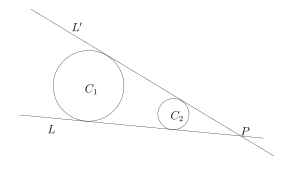
- Let \(\mathbf{x}_1\) and \(\mathbf{x}_2\) be the position vectors of the centres of \(C_1\) and \(C_2\), respectively. Show that the position vector of \(P\) is \[ \frac{r_1 \mathbf{x}_2- r_2 \mathbf{x}_1}{r_1-r_2} \,, \] where \(r_1\) and \(r_2\) are the radii of \(C_1\) and \(C_2\), respectively.
- The circle \(C_3\) does not overlap either \(C_1\) or \(C_2\) and its radius, \(r_3\), satisfies \(r_1 \ne r_3 \ne r_2\). The focus of \(C_1\) and \(C_3\) is \(Q\), and the focus of \(C_2\) and \(C_3\) is \(R\). Show that \(P\), \(Q\) and \(R\) lie on the same straight line.
- Find a condition on \(r_1\), \(r_2\) and \(r_3\) for \(Q\) to lie half-way between \(P\) and \(R\).
Solution:
- Notice that \(P\) lies on \(C_1C_2\), and that the triangles formed from \(C_iPT_i\) where \(T_i\) are the tangent points are similar, with ratios \(\frac{r_1}{r_2}\). Therefore \(\frac{C_1P}{r_1} = \frac{C_2P}{r_2}\), and hence \(\frac{C_1P}{C_1C_2} = \frac{C_1P}{C_1P-C_2P} = \frac{1}{1-\frac{r_2}{r_1}} = \frac{r_1}{r_1-r_2}\) So we have \(\mathbf{p} = \mathbf{x_1} + (\mathbf{x}_2 - \mathbf{x}_1)\cdot\frac{r_1}{r_1-r_2} = \frac{r_1\mathbf{x}_2 - r_2\mathbf{x}_1}{r_1-r_2}\)
- Suppose \(\mathbf{x}_3 = \binom{\alpha}{\beta}\) in the basis of \(\{ \mathbf{x}_1, \mathbf{x}_2 \}\), then we can see that \begin{align*} && \mathbf{p} &= \frac{1}{r_1-r_2}\binom{-r_2}{r_1} \\ && \mathbf{q} &= \frac{r_1(\alpha \mathbf{x}_1 +\beta \mathbf{x}_2) - r_3\mathbf{x}_1}{r_1-r_3} \\ &&&= \frac{1}{r_1-r_3} \binom{r_1\alpha -r_3}{r_1\beta} \\ && \mathbf{r} &=\frac{1}{r_2-r_3} \binom{r_2\alpha}{r_2\beta - r_3} \\ && \mathbf{p}-\mathbf{q} &= \frac{1}{r_1-r_2}\binom{-r_2}{r_1} - \frac{1}{r_1-r_3} \binom{r_1\alpha -r_3}{r_1\beta} \\ &&&= \frac{1}{(r_1-r_2)(r_1-r_3)} \binom{(r_1-r_3)(-r_2)-(r_1-r_2)(r_1\alpha-r_3)}{(r_1-r_3)r_1 - (r_1-r_2)r_1\beta} \\ &&&= \frac{r_1}{(r_1-r_2)(r_1-r_3)} \binom{(r_3-r_2)-\alpha(r_1-r_2)}{(r_1-r_3)-\beta(r_1-r_2)} \\ && \mathbf{q} - \mathbf{r} &= \frac{1}{r_1-r_3} \binom{r_1\alpha -r_3}{r_1\beta} - \frac{1}{r_2-r_3} \binom{r_2\alpha}{r_2\beta - r_3} \\ &&&= \frac{1}{(r_1-r_3)(r_2-r_3)}\binom{(r_2-r_3)(r_1\alpha-r_3) - (r_1-r_3)r_2\alpha)}{(r_2-r_3)r_1\beta - (r_1-r_3)(r_2\beta - r_3)} \\ &&&= \frac{1}{(r_1-r_3)(r_2-r_3)}\binom{(-r_2r_3+r_3^2) - \alpha(r_1r_3-r_3r_2)}{r_3(r_1-r_3)-\beta(r_1-r_2)} \\ &&&= \frac{r_3}{(r_1-r_3)(r_2-r_3)}\binom{(r_3-r_2)-\alpha(r_1-r_2)}{(r_1-r_3)-\beta(r_1-r_2)} \end{align*} Therefore they are clearly parallel, and hence lie on a line.
- \(Q\) is halfway between \(P\) and \(R\) if \begin{align*} && \frac{r_1}{(r_1-r_2)(r_1-r_3)} &= \frac{r_3}{(r_1-r_3)(r_2-r_3)} \\ \Leftrightarrow && r_1(r_2-r_3) &= r_3(r_1-r_2) \\ \Leftrightarrow && r_1r_2 - r_1r_3 &= r_1r_3 - r_2r_3 \\ \Leftrightarrow && r_2 &= \frac{2r_1r_3}{r_1+r_3} \end{align*}
2015 Paper 2 Q9
An equilateral triangle \(ABC\) is made of three light rods each of length \(a\). It is free to rotate in a vertical plane about a horizontal axis through \(A\). Particles of mass \(3m\) and \(5m\) are attached to \(B\) and \(C\) respectively. Initially, the system hangs in equilibrium with \(BC\) below \(A\).
- Show that, initially, the angle \(\theta\) that \(BC\) makes with the horizontal is given by \(\sin\theta = \frac17\).
- The triangle receives an impulse that imparts a speed \(v\) to the particle \(B\). Find the minimum speed \(v_0\) such that the system will perform complete rotations if \(v>v_0\).
Solution:
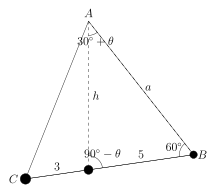
- The sine rule tells us: \begin{align*} && \frac{\frac58 a}{\sin(30^\circ + \theta)} &= \frac{a}{\sin(90^{\circ}-\theta)} \\ \Rightarrow &&\frac58 \cos \theta &= \frac12 \cos \theta+ \frac{\sqrt{3}}2 \sin \theta \\ \Rightarrow && \frac{1}{4\sqrt{3}} &= \tan \theta \\ \Rightarrow && \sin \theta &= \sqrt{\frac{1}{48+1}} = \frac17 \end{align*}
- \(\,\) \begin{align*} && \text{initial energy} &= \frac12(5m)v^2 + \frac12 (3m)v^2 - 3m \cdot g \cdot a \cos(30^{\circ}+\theta) -5m \cdot g \cdot a\cos(30^\circ - \theta) \\ &&&= 4m v^2 - amg(4\sqrt{3} \cos \theta + \sin \theta) \\ &&&= 4mv^2 - 7amg \\ && \text{energy at top} &= \frac12 m v_{top}^2 + 7amg \end{align*} We need this equation to be positive for all values of \(v_{top} \geq 0\), so \(4mv^2 \geq 14amg \Rightarrow v_0 = \sqrt{\frac{7ag}2}\)
2015 Paper 2 Q10
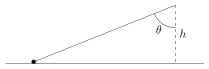
A particle of mass \(m\) is pulled along the floor of a room in a straight line by a light string which is pulled at constant speed \(V\) through a hole in the ceiling. The floor is smooth and horizontal, and the height of the room is \(h\). Find, in terms of \(V\) and \(\theta\), the speed of the particle when the string makes an angle of \(\theta\) with the vertical (and the particle is still in contact with the floor). Find also the acceleration, in terms of \(V\), \(h\) and \(\theta\). Find the tension in the string and hence show that the particle will leave the floor when \[ \tan^4\theta = \frac{V^2}{gh}\,. \]
Solution:
2015 Paper 2 Q11
Three particles, \(A\), \(B\) and \(C\), each of mass \(m\), lie on a smooth horizontal table. Particles \(A\) and \(C\) are attached to the two ends of a light inextensible string of length \(2a\) and particle \(B\) is attached to the midpoint of the string. Initially, \(A\), \(B\) and \(C\) are at rest at points \((0,a)\), \((0,0)\) and \((0,-a)\), respectively. An impulse is delivered to \(B\), imparting to it a speed \(u\) in the positive \(x\) direction. The string remains taut throughout the subsequent motion.
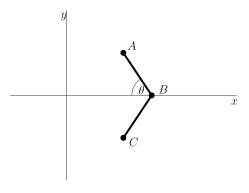
- At time \(t\), the angle between the \(x\)-axis and the string joining \(A\) and \(B\) is \(\theta\), as shown in the diagram, and \(B\) is at \((x,0)\). Write down the coordinates of \(A\) in terms of \(x,a\) and \(\theta\). Given that the velocity of \(B\) is \((v,0)\), show that the velocity of \(A\) is \((\dot x + a\sin\theta \,\dot \theta\,,\, a\cos\theta\, \dot\theta)\), where the dot denotes differentiation with respect to time.
- Show that, before particles \(A\) and \(C\) first collide, \[ 3\dot x + 2a \dot\theta \sin\theta =u \text{ and } \dot \theta^2 = \frac{u^2}{a^2(3-2\sin^2\theta)} \,. \]
- When \(A\) and \(C\) collide, the collision is elastic (no energy is lost). At what value of \(\theta\) does the second collision between particles \(A\) and \(C\) occur? (You should justify your answer.)
- When \(v=0\), what are the possible values of \(\theta\)? Is \(v =0\) whenever \(\theta\) takes these values?
Solution:
- \(A\) has coordinates \((x-a\cos \theta, a\sin \theta)\). Differentiating with respect to \(t\) the velocity of \(A\) is \((\dot{x}+a\sin \theta \cdot \dot{\theta}, a \cos \theta \cdot \dot{\theta})\)
- By considervation of momentum \(\rightarrow\) we must have \(mu = m(\dot{x}+a\dot{\theta}\sin \theta) + m\dot{x} + m(\dot{x}+a\dot{\theta}\sin \theta) = m(3\dot{x} + 2a \dot{\theta} \sin \theta)\) and the first equation follows. By conservation of energy, we must have \begin{align*} && \frac12 m u^2 &= \frac12 m \dot{x}^2 + \frac12m((\dot{x}+a\dot{\theta}\sin \theta)^2 + a^2 \dot{\theta}^2 \cos^2\theta ) + \frac12m((\dot{x}+a\dot{\theta}\sin \theta)^2 + a^2 \dot{\theta}^2 \cos^2\theta ) \\ &&&= \frac32m\dot{x}^2 + 2m a\dot{x}\dot{\theta}\sin \theta + ma^2\dot{\theta}^2(\sin^2\theta+\cos^2\theta) \\ \Rightarrow && u^2 &= \dot{x}(3\dot{x} + 4a \dot{\theta} \sin \theta) + 2a^2\dot{\theta}^2 \\ &&&= \left ( \frac{u-2a\dot{\theta}\sin \theta}{3}\right)\left ( 3\left ( \frac{u-2a\dot{\theta}\sin \theta}{3}\right)+ 4a \dot{x}\dot{\theta} \sin \theta \right) + 2a^2\dot{\theta}^2 \\ \Rightarrow && 3u^2 &= (u - 2a\dot{\theta} \sin \theta)^2 + 4a(u - 2 a \dot{\theta} \sin \theta) \dot{\theta}\sin \theta + 6a^2 \dot{\theta}^2 \\ &&&= u^2 + 4a^2\dot{\theta}^2 \sin^2 \theta - 8a^2\dot{\theta}^2\sin^2\theta + 6a^2 \dot{\theta}^2 \\ \Rightarrow && \dot{\theta}^2 &= \frac{u^2}{a^2(3-2\sin^2\theta)} \end{align*}
- Since \(\dot{\theta}^2 > 0\) \(\theta\) is strictly increasing or decreasing, therefore the first collision will be when \(\theta = 0\), the second when \(\theta = \pi\)
- If \(v = 0\), from our first equation we have \(2a \dot{\theta} \sin \theta = u \Rightarrow \dot{\theta}^2 = \frac{u^2}{4a^2 \sin^2 \theta} = \frac{u^2}{a^2(3-2\sin^2\theta)}\) so \(4\sin^2 \theta = 3 - 2\sin^2 \theta \Rightarrow \sin^2 \theta = \frac{1}{2}\) therefore the angles are all the multiples of \(\frac{\pi}{4}\).
2015 Paper 2 Q12
Four players \(A\), \(B\), \(C\) and \(D\) play a coin-tossing game with a fair coin. Each player chooses a sequence of heads and tails, as follows: Player A: HHT; Player B: THH; Player C: TTH; Player D: HTT. The coin is then tossed until one of these sequences occurs, in which case the corresponding player is the winner.
- Show that, if only \(A\) and \(B\) play, then \(A\) has a probability of \(\frac14\) of winning.
- If all four players play together, find the probabilities of each one winning.
- Only \(B\) and \(C\) play. What is the probability of \(C\) winning if the first two tosses are TT? Let the probabilities of \(C\) winning if the first two tosses are HT, TH and HH be \(p\), \(q\) and \(r\), respectively. Show that \(p=\frac12 +\frac12q\). Find the probability that \(C\) wins.
Solution:
- The only way \(A\) can win is if the sequence starts HH, if it does not start like this, then the only way HHT can appear is after a sequence of THH...H, but then THH has already appeared and \(B\) has won. Therefore the probability is \(\frac14\)
- If HH appears before TT then either \(A\) or \(B\) will win. If HH appears first, then \(A\) has a \(\frac14\) probability of winning. So \(A\): \(\frac18\), \(B:\), \(\frac38\), \(C:\), \(\frac18\), \(D: \frac38\)
- If the first two tosses are TT then \(C\) will win. If the first two tosses are HT, then either the next toss is T and \(C\) wins, or the next toss is H, and it's as if we started TH. ie \(p = \frac12 + \frac12 q\). If the first two tosses are TH, then either the next toss is H and \(C\) losses or the next toss is T and it's like starting HT. So \(q = \frac12 p\). Therefore \(p = \frac12 + \frac14p \Rightarrow p = \frac13\) If the first two tosses are HH, then eventually a T appears, and it's the same as starting HT. Therefore the probability \(C\) wins is: \(\frac14 + \frac14 \cdot \frac13 + \frac14 \cdot \frac16 + \frac14 \cdot \frac13 = \frac{11}{24}\)
2015 Paper 2 Q13
The maximum height \(X\) of flood water each year on a certain river is a random variable with probability density function \(\f\) given by \[ \f(x) = \begin{cases} \lambda \e^{-\lambda x} & \text{for \(x\ge0\)}\,, \\ 0 & \text{otherwise,} \end{cases} \] where \(\lambda\) is a positive constant. It costs \(ky\) pounds each year to prepare for flood water of height \(y\) or less, where \(k\) is a positive constant and \(y\ge0\). If \(X \le y\) no further costs are incurred but if \(X> y\) the additional cost of flood damage is \(a(X - y )\) pounds where \(a\) is a positive constant.
- Let \(C\) be the total cost of dealing with the floods in the year. Show that the expectation of \(C\) is given by \[\mathrm{E}(C)=ky+\frac{a}{\lambda}\mathrm{e}^{-\lambda y} \, . \] How should \(y\) be chosen in order to minimise \(\mathrm{E}(C)\), in the different cases that arise according to the value of \(a/k\)?
- Find the variance of \(C\), and show that the more that is spent on preparing for flood water in advance the smaller this variance.
Solution:
- \(\,\) \begin{align*} && \mathbb{E}(C) &= \int_0^\infty \text{cost}(x) f(x) \d x \\ &&&= ky + \int_y^{\infty} a(x-y) \lambda e^{-\lambda x} \d x\\ &&&= ky + \int_0^{\infty} a u \lambda e^{-\lambda u -\lambda y} \d x \\ &&&= ky + ae^{-\lambda y} \left( \left [ -ue^{-\lambda u} \right]_0^\infty -\int_0^\infty e^{-\lambda u} \d u\right) \\ &&&= ky + \frac{a}{\lambda}e^{-\lambda y} \\ \\ && \frac{\d \mathbb{E}(C)}{\d y} &= k - ae^{-\lambda y} \\ \Rightarrow && y &= \frac{1}{\lambda}\ln \left ( \frac{a}{k} \right) \end{align*} Since \(\mathbb{E}(C)\) is clearly increasing when \(y\) is very large, the optimal value will be \(\frac{1}{\lambda}\ln \left ( \frac{a}{k} \right)\), if \(\frac{a}{k} > 1\), otherwise you should spend nothing on flood defenses.
- \begin{align*} && \mathbb{E}(C^2) &= \int_0^{\infty} \text{cost}(x)^2 f(x) \d x \\ &&&= \int_0^{\infty}(ky + a(x-y)\mathbb{1}_{x > y})^2 f(x) \d x \\ &&&= k^2y^2 + \int_y^{\infty}2kya(x-y)f(x)\d x + \int_y^{\infty}a^2 (x-y)^2 f(x) \d x \\ &&&= k^2y^2 + \frac{2kya}{\lambda}e^{- \lambda y}+a^2e^{-\lambda y}\int_{u=0}^\infty u^2 \lambda e^{-\lambda u} \d u \\ &&&= k^2y^2 + \frac{2kya}{\lambda}e^{-\lambda y}+a^2e^{-\lambda y}(\textrm{Var}(Exp(\lambda)) + \mathbb{E}(Exp(\lambda))^2\\ &&&= k^2y^2 + \frac{2kya}{\lambda}e^{-\lambda y} + a^2e^{-\lambda y} \frac{2}{\lambda^2} \\ && \textrm{Var}(C) &= k^2y^2 + \frac{2kya}{\lambda}e^{-\lambda y} + a^2e^{-\lambda y} \frac{2}{\lambda^2} - \left ( ky + \frac{a}{\lambda} e^{-\lambda y}\right)^2 \\ &&&= a^2e^{-\lambda y} \frac{2}{\lambda^2} - a^2 e^{-2\lambda y}\frac{1}{\lambda^2} \\ &&&= \frac{a^2}{\lambda^2} e^{-\lambda y}\left (2 - e^{-\lambda y} \right) \\ \\ && \frac{\d \textrm{Var}(C)}{\d y} &= \frac{a^2}{\lambda^2} \left (-2\lambda e^{-\lambda y} +2\lambda e^{-2\lambda y} \right) \\ &&&= \frac{2a^2}{\lambda} e^{-\lambda y}\left (e^{-\lambda y}-1 \right) \leq 0 \end{align*} so \(\textrm{Var}(C)\) is decreasing in \(y\).
2015 Paper 3 Q1
- Let \[ I_n= \int_0^\infty \frac 1 {(1+u^2)^n}\, \d u \,, \] where \(n\) is a positive integer. Show that \[ I_n - I_{n+1} = \frac 1 {2n} I_n \] and deduce that \[ I_{n+1} = \frac{(2n)!\, \pi}{2^{2n+1}(n!)^2} \,. \]
- Let \[ J = \int_0^\infty \f\big( (x- x^{-1})^2\big ) \, \d x \,, \] where \(\f\) is any function for which the integral exists. Show that \[ J = \int_0^\infty x^{-2} \f\big( (x- x^{-1})^2\big) \, \d x \, = \frac12 \int_0^\infty (1 + x^{-2}) \f\big( (x- x^{-1})^2\big ) \, \d x \, = \int_0^\infty \f\big(u^2\big) \,\d u \,. \]
- Hence evaluate \[ \int_0^\infty \frac {x^{2n-2}}{(x^4-x^2+1)^n} \, \d x \,, \] where \(n\) is a positive integer.
Solution: \begin{align*} I_n - I_{n+1} &= \int_0^\infty \frac 1 {(1+u^2)^n}\, \d u - \int_0^\infty \frac 1 {(1+u^2)^{n+1}}\, \d u \\ &= \int_0^\infty \l \frac 1 {(1+u^2)^n}- \frac 1 {(1+u^2)^{n+1}} \r\, \d u \\ &= \int_0^\infty \frac {u^2} {(1+u^2)^{n+1}} \, \d u \\ &= \left [ u \frac{u}{(1+u^2)^{n+1}} \right]_0^{\infty} - \frac{-1}{2n}\int_0^{\infty} \frac{1}{(1+u^2)^n} \d u \tag{\(IBP: u = u, v' = \frac{u}{(1+u^2)^{n+1}}\)}\\ &= \frac{1}{2n} I_n \end{align*} \(\displaystyle I_1 = \int_0^{\infty} \frac{1}{1+u^2} \d u = \left [ \tan^{-1} u \right]_0^\infty = \frac{\pi}{2}\) as expected. We also have, \(I_{n+1} = \frac{2n(2n-1)}{2n \cdot 2n} I_n \), by rearranging the recurrence relation. Therefore, when we multiply out the top we will have \(2n!\) and the bottom we will have two factors of \(n!\) and two factors of \(2^n\) combined with the original \(\frac{\pi}{2}\) we get \[ I_{n+1} = \frac{(2n)! \pi}{2^{2n+1} (n!)^2} \] \begin{align*} J = \int_0^\infty f\big( (x- x^{-1})^2\big ) \, \d x &= \int_{u = \infty}^{u = 0} f((u^{-1}-u)^2)(-u^{-2} )\d u \tag{\(u = x^{-1}, \d u = -x^{-2} \d x\)} \\ &= \int^{u = \infty}_{u = 0} f((u^{-1}-u)^2)u^{-2} \d u \\ &= \int^{\infty}_{0} u^{-2}f((u-u^{-1})^2) \d u \\ \end{align*} Therefore adding the two forms for \(J\) we have \begin{align*} 2 J &= \int_0^\infty f\big( (x- x^{-1})^2\big ) \, \d x + \int_0^\infty x^{-2} f\big( (x- x^{-1})^2\big ) \, \d x \\ &= \int_0^\infty (1+x^{-2}) f\big( (x- x^{-1})^2\big ) \, \d x \end{align*} And letting \(u = x - x^{-1}\), we have \(\d u = (1 + x^{-2}) \d x\), and \(u\) runs from \(-\infty\) to \(\infty\) so we have: \begin{align*} \int_0^\infty (1+x^{-2}) f\big( (x- x^{-1})^2\big ) \, \d x &= \int_{-\infty}^\infty f(u^2) \, \d u \\ &=2 \int_{0}^\infty f(u^2) \, \d u \end{align*} Since both of these are \(2J\) we have the result we are after. Finally, \begin{align*} \int_0^\infty \frac {x^{2n-2}}{(x^4-x^2+1)^n} \, \d x &= \int_0^{\infty} \frac{x^{2n-2}}{x^{2n}(x^2-1+x^{-2})^n} \d x \\ &= \int_0^{\infty} \frac{x^{-2}}{((x-x^{-1})^2+1)^n} \d x \\ &= \int_0^{\infty} \frac{1}{(x^2+1)^n} \d x \tag{Where \(f(x) = (1+x^2)^{-n}\) in \(J\) integral} \\ &= I_n = \frac{(2n-2)! \pi}{2^{2n-1} ((n-1)!)^2} \end{align*}
2015 Paper 3 Q2
If \(s_1\), \(s_2\), \(s_3\), \(\ldots\) and \(t_1\), \(t_2\), \(t_3\), \(\ldots\) are sequences of positive numbers, we write \[ (s_n)\le (t_n) \] to mean
- \((1000n) \le (n^2)\,\).
- If it is not the case that \((s_n)\le (t_n)\), then it is the case that \((t_n)\le (s_n)\,\).
- If \((s_n)\le (t_n)\) and \((t_n) \le (u_n)\), then \((s_n)\le (u_n)\,\).
- \((n^2)\le (2^n)\,\).
Solution:
- If \(m = 1000\), then \(n \geq m \Rightarrow n^2 \geq 1000n \Rightarrow (1000n) \leq (n^2)\)
- This is false. Let \(s_i = 1,2,1,2,\cdots\) and \(t_i = 2,1,2,1,\cdots\).
- Suppose that for \(n \geq m_1, s_n \le t_n\) and for \(n \geq m_2, s_t \le u_n\), then for \(n \geq m = \max(m_1, m_2), s_n \leq t_n \leq u_n \Rightarrow s_n \leq u_n \Rightarrow (s_n) \leq (u_n)\)
- Let \(m = 6\), then if \(n \geq m, 2^n \geq 1 + n + \frac{n(n-1)}{2} + \frac{n(n-1)}{2} + n + 1 = n^2 + n + 2 \geq n^2\), so \((2^n) \geq (n^2)\)
2015 Paper 3 Q3
In this question, \(r\) and \(\theta\) are polar coordinates with \(r \ge0\) and \(- \pi < \theta\le \pi\), and \(a\) and \(b\) are positive constants. Let \(L\) be a fixed line and let \(A\) be a fixed point not lying on \(L\). Then the locus of points that are a fixed distance (call it \(d\)) from \(L\) measured along lines through \(A\) is called a conchoid of Nicomedes.
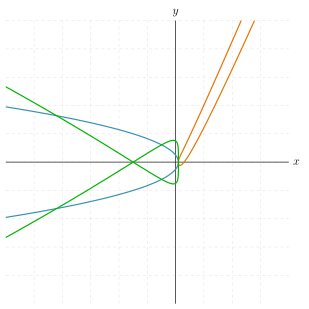
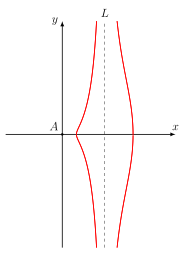
- Show that if \[ \vert r- a \sec\theta \vert = b\,, \tag{\(*\)} \] where \(a>b\), then \(\sec\theta >0\). Show that all points with coordinates satisfying (\(*\)) lie on a certain conchoid of Nicomedes (you should identify \(L\), \(d\) and \(A\)). Sketch the locus of these points.
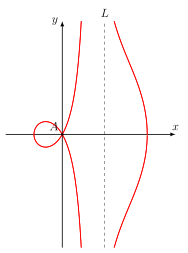
- In the case \(a < b\), sketch the curve (including the loop for which \(\sec\theta<0\)) given by \[ \vert r- a \sec\theta \vert = b\, . \] Find the area of the loop in the case \(a=1\) and \(b=2\). [Note: $ %\displaystyle \int \! \sec\theta \,\d \theta = \ln \vert \sec\theta + \tan\theta \vert + C \,. $]
Solution:
- \(r = a \sec \theta \pm b\). The points on \(r = a \sec \theta \Leftrightarrow r \cos \theta = a \Leftrightarrow x = a\) are points on the line \(x = a\). Therefore points on the curve \(r = a \sec \theta \pm b\) are points which are a distance \(b\) from the line \(x = a\) measured towards \(O\). So \(A\) is the origin and \(d = b\).
- The loop starts and ends when \(r = a \sec \theta - b = 0 \Rightarrow \cos \theta = \frac{a}{b}\), so when \(a = 1, b = 2\), this is \(-\frac{\pi}{3}\) to \(\frac{\pi}{3}\) \begin{align*} && A &= \frac12 \int r^2 \d \theta \\ &&&= \frac12 \int_{-\pi/3}^{\pi/3} \left ( \sec \theta - 2 \right)^2 \d \theta \\ &&&= \frac12 \int_{-\pi/3}^{\pi/3} \left (\sec^2 \theta - 4 \sec \theta + 4\right)\d \theta \\ &&&= \frac12 \left [ \tan \theta -4 \ln | \sec \theta + \tan \theta| + 4 \theta \right]_{-\pi/3}^{\pi/3} \\ &&&= \frac12 \left (\left (\tan \frac{\pi}3 - 4 \ln | \sec \frac{\pi}3 + \tan \frac{\pi}3 | + 4\left ( \frac{\pi}3 \right)\right) - \left (\tan \left (-\frac{\pi}3 \right) - 4 \ln | \sec \left (-\frac{\pi}3 \right)+ \tan\left ( -\frac{\pi}3 \right) | + 4\left ( -\frac{\pi}3 \right)\right) \right) \\ &&&= \frac12 \left ( 2\sqrt{3} - 4 \ln |2 + \sqrt{3}| + 4 \ln |2-\sqrt{3}| + \frac{8\pi}3 \right) \\ &&&= \sqrt{3} + 2\ln \frac{2-\sqrt{3}}{2+\sqrt{3}} + \frac{4\pi}3 \\ &&&= \sqrt{3} + 4 \ln (2 - \sqrt{3})+ \frac{4\pi}3 \end{align*}
2015 Paper 3 Q4
- If \(a\), \(b\) and \(c\) are all real, show that the equation \[ z^3+az^2+bz+c=0 \tag{\(*\)} \] has at least one real root.
- Let \[ S_1= z_1+z_2+z_3, \ \ \ \ S_2= z_1^2 + z_2^2 + z_3^2, \ \ \ \ S_3= z_1^3 + z_2^3 + z_3^3\,, \] where \(z_1\), \(z_2\) and \(z_3\) are the roots of the equation \((*)\). Express \(a\) and \(b\) in terms of \(S_1\) and \(S_2\), and show that \[ 6c =- S_1^3 + 3 S_1S_2 - 2S_3\,. \]
- The six real numbers \(r_k\) and \(\theta_k\) (\(k=1, \ 2, \ 3\)), where \(r_k>0\) and \(-\pi < \theta_k <\pi\), satisfy \[ \textstyle \sum\limits _{k=1}^3 r_k \sin (\theta_k) = 0\,, \ \ \ \ \textstyle \sum\limits _{k=1}^3 r_k^2 \sin (2\theta_k) = 0\,, \ \ \ \ \ \textstyle \sum\limits _{k=1}^3 r_k^3 \sin (3\theta_k) = 0\, . \] Show that \(\theta_k=0\) for at least one value of \(k\). Show further that if \(\theta_1=0\) then \(\theta_2 = - \theta_3\,\).
Solution:
- Let \(z \in \mathbb{R}\) and let \(z \to \pm \infty\) then \(z^3 + az^2 + bz + c\) changes sign, therefore somewhere it must have a real root.
- \begin{align*} &&z^3 + az^2 + bz + c &= (z-z_1)(z-z_2)(z-z_3) \\ && &= z^3 - (z_1+z_2+z_3)z^2 + (z_1z_2 + z_2z_3+z_3z_1)z - (z_1z_2z_3) \\ \\ \Rightarrow && S_1 &= z_1+z_2+z_3 \\ &&&= -a \\ \\ \Rightarrow && S_2 &= z_1^2+z_2^2+z_3^2 \\ &&&= (z_1+z_2+z_3)^2 - 2(z_1z_2 + z_2z_3+z_3z_1) \\ &&&= a^2 - 2b \\ \Rightarrow && a &= -S_1 \\ && b &= \frac12 \l S_1^2 - S_2\r \\ \\ && 0 &= z_i^3 + az_i^2+bz_i+c \\ \Rightarrow && 0 &= S_3 + aS_2+bS_1+3c \\ &&&= S_3 -S_1S_2 + \frac12 \l S_1^2 - S_2\r S_1 + 3c \\ \Rightarrow && 0 &= 2S_3 - 3S_1S_2 + S_1^3 + 6c \end{align*}
- Let \(z_k= r_ke^{i \theta_k}\), then we have \(\textrm{Im}(S_k) = 0\) and so the polynomial with roots \(z_k\) has real coefficients, and therefore at least one root is real. This root will have \(\theta_k = 0\). Moreover, since if \(w\) is a root of a real polynomial \(\overbar{w}\) is also a root, and therefore if \(\theta_1 = 0\), we must have that \(z_2\) and \(z_3\) are complex conjugate, ie \(\theta_2 = - \theta_3\)