2015 Paper 2 Q8
Year: 2015
Paper: 2
Question Number: 8
Course: UFM Pure
Section: Vectors
Problem
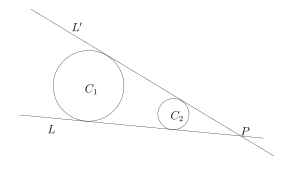
- Let \(\mathbf{x}_1\) and \(\mathbf{x}_2\) be the position vectors of the centres of \(C_1\) and \(C_2\), respectively. Show that the position vector of \(P\) is \[ \frac{r_1 \mathbf{x}_2- r_2 \mathbf{x}_1}{r_1-r_2} \,, \] where \(r_1\) and \(r_2\) are the radii of \(C_1\) and \(C_2\), respectively.
- The circle \(C_3\) does not overlap either \(C_1\) or \(C_2\) and its radius, \(r_3\), satisfies \(r_1 \ne r_3 \ne r_2\). The focus of \(C_1\) and \(C_3\) is \(Q\), and the focus of \(C_2\) and \(C_3\) is \(R\). Show that \(P\), \(Q\) and \(R\) lie on the same straight line.
- Find a condition on \(r_1\), \(r_2\) and \(r_3\) for \(Q\) to lie half-way between \(P\) and \(R\).
Solution
- Notice that \(P\) lies on \(C_1C_2\), and that the triangles formed from \(C_iPT_i\) where \(T_i\) are the tangent points are similar, with ratios \(\frac{r_1}{r_2}\). Therefore \(\frac{C_1P}{r_1} = \frac{C_2P}{r_2}\), and hence \(\frac{C_1P}{C_1C_2} = \frac{C_1P}{C_1P-C_2P} = \frac{1}{1-\frac{r_2}{r_1}} = \frac{r_1}{r_1-r_2}\) So we have \(\mathbf{p} = \mathbf{x_1} + (\mathbf{x}_2 - \mathbf{x}_1)\cdot\frac{r_1}{r_1-r_2} = \frac{r_1\mathbf{x}_2 - r_2\mathbf{x}_1}{r_1-r_2}\)
- Suppose \(\mathbf{x}_3 = \binom{\alpha}{\beta}\) in the basis of \(\{ \mathbf{x}_1, \mathbf{x}_2 \}\), then we can see that \begin{align*} && \mathbf{p} &= \frac{1}{r_1-r_2}\binom{-r_2}{r_1} \\ && \mathbf{q} &= \frac{r_1(\alpha \mathbf{x}_1 +\beta \mathbf{x}_2) - r_3\mathbf{x}_1}{r_1-r_3} \\ &&&= \frac{1}{r_1-r_3} \binom{r_1\alpha -r_3}{r_1\beta} \\ && \mathbf{r} &=\frac{1}{r_2-r_3} \binom{r_2\alpha}{r_2\beta - r_3} \\ && \mathbf{p}-\mathbf{q} &= \frac{1}{r_1-r_2}\binom{-r_2}{r_1} - \frac{1}{r_1-r_3} \binom{r_1\alpha -r_3}{r_1\beta} \\ &&&= \frac{1}{(r_1-r_2)(r_1-r_3)} \binom{(r_1-r_3)(-r_2)-(r_1-r_2)(r_1\alpha-r_3)}{(r_1-r_3)r_1 - (r_1-r_2)r_1\beta} \\ &&&= \frac{r_1}{(r_1-r_2)(r_1-r_3)} \binom{(r_3-r_2)-\alpha(r_1-r_2)}{(r_1-r_3)-\beta(r_1-r_2)} \\ && \mathbf{q} - \mathbf{r} &= \frac{1}{r_1-r_3} \binom{r_1\alpha -r_3}{r_1\beta} - \frac{1}{r_2-r_3} \binom{r_2\alpha}{r_2\beta - r_3} \\ &&&= \frac{1}{(r_1-r_3)(r_2-r_3)}\binom{(r_2-r_3)(r_1\alpha-r_3) - (r_1-r_3)r_2\alpha)}{(r_2-r_3)r_1\beta - (r_1-r_3)(r_2\beta - r_3)} \\ &&&= \frac{1}{(r_1-r_3)(r_2-r_3)}\binom{(-r_2r_3+r_3^2) - \alpha(r_1r_3-r_3r_2)}{r_3(r_1-r_3)-\beta(r_1-r_2)} \\ &&&= \frac{r_3}{(r_1-r_3)(r_2-r_3)}\binom{(r_3-r_2)-\alpha(r_1-r_2)}{(r_1-r_3)-\beta(r_1-r_2)} \end{align*} Therefore they are clearly parallel, and hence lie on a line.
- \(Q\) is halfway between \(P\) and \(R\) if \begin{align*} && \frac{r_1}{(r_1-r_2)(r_1-r_3)} &= \frac{r_3}{(r_1-r_3)(r_2-r_3)} \\ \Leftrightarrow && r_1(r_2-r_3) &= r_3(r_1-r_2) \\ \Leftrightarrow && r_1r_2 - r_1r_3 &= r_1r_3 - r_2r_3 \\ \Leftrightarrow && r_2 &= \frac{2r_1r_3}{r_1+r_3} \end{align*}
Examiner's report
— 2015 STEP 2, Question 8As in previous years the Pure questions were the most popular of the paper with questions 1, 2 and 6 the most popular. The least popular questions on the paper were questions 8, 11 and 13 with fewer than 250 attempts for each of them. There were many examples of solutions in this paper that were insufficiently well explained given that the answer to be reached had been provided in the question.
Rating Information
Difficulty Rating: 1600.0
Difficulty Comparisons: 0
Banger Rating: 1500.0
Banger Comparisons: 0
Show LaTeX source
Problem source
\noindent
\begin{center}
\begin{tikzpicture}[x=1.0cm, y=1.0cm, line width=0.3pt]
    % The asterisk in pspicture* means the drawing is clipped to the bounding box
    \clip (-2.94,-1.87) rectangle (7.07,3.86);
    % Circles
    \draw (0,1) circle (1.25);
    \draw (3,0) circle (0.55);
    % Lines
    \draw (-2.44,-0.03) -- (6.18,-0.85);
    \draw (-2.04,3.71) -- (6.55,-1.48);
    % Labels
    % \rput[tl] aligns the text to the Top-Left (North-West) of the node coordinate
    \node[anchor=north west, inner sep=0.1em] at (5.33,-0.41) {$P$};
    \node[anchor=north west, inner sep=0.1em] at (-0.18,1.1) {$C_1$};
    \node[anchor=north west, inner sep=0.1em] at (2.85,0.15) {$C_2$};
    \node[anchor=north west, inner sep=0.1em] at (-0.65,3.29) {$L'$};
    \node[anchor=north west, inner sep=0.1em] at (-1.5,-0.34) {$L$};
\end{tikzpicture}
\end{center}
The diagram above shows two non-overlapping circles $C_1$ and $C_2$ of different sizes. The lines $L$ and $L'$ are the two common tangents to $C_1$ and $C_2$ such that the two circles lie on the same side of each of the tangents. The lines $L$ and $L'$ intersect at the point $P$ which is called the \textit{focus} of $C_1$ and $C_2$.
\begin{questionparts}
\item Let $\mathbf{x}_1$ and $\mathbf{x}_2$ be the position vectors of the centres of $C_1$ and $C_2$, respectively. Show that the position vector of $P$ is
\[
\frac{r_1 \mathbf{x}_2- r_2 \mathbf{x}_1}{r_1-r_2} \,,
\]
where $r_1$ and $r_2$ are the radii of $C_1$ and $C_2$, respectively.
\item The circle $C_3$  does not overlap either $C_1$ or $C_2$ and its   radius, $r_3$, satisfies  $r_1 \ne r_3 \ne r_2$. The focus of $C_1$ and $C_3$ is $Q$, and the focus of $C_2$ and $C_3$ is $R$. Show that $P$, $Q$ and $R$ lie on the same straight line.
\item Find a condition on $r_1$, $r_2$ and $r_3$ for $Q$ to lie half-way between $P$ and $R$.
\end{questionparts}
Solution source
\begin{questionparts}
\item Notice that $P$ lies on $C_1C_2$, and that the triangles formed from $C_iPT_i$ where $T_i$ are the tangent points are similar, with ratios $\frac{r_1}{r_2}$. Therefore $\frac{C_1P}{r_1} = \frac{C_2P}{r_2}$, and hence $\frac{C_1P}{C_1C_2} = \frac{C_1P}{C_1P-C_2P} = \frac{1}{1-\frac{r_2}{r_1}} = \frac{r_1}{r_1-r_2}$

So we have $\mathbf{p}  = \mathbf{x_1} + (\mathbf{x}_2 - \mathbf{x}_1)\cdot\frac{r_1}{r_1-r_2} = \frac{r_1\mathbf{x}_2 - r_2\mathbf{x}_1}{r_1-r_2}$

\item Suppose $\mathbf{x}_3 = \binom{\alpha}{\beta}$ in the basis of $\{ \mathbf{x}_1, \mathbf{x}_2 \}$, then we can see that

\begin{align*}
&& \mathbf{p} &= \frac{1}{r_1-r_2}\binom{-r_2}{r_1} \\
&& \mathbf{q} &= \frac{r_1(\alpha \mathbf{x}_1 +\beta \mathbf{x}_2) - r_3\mathbf{x}_1}{r_1-r_3} \\
&&&= \frac{1}{r_1-r_3} \binom{r_1\alpha -r_3}{r_1\beta} \\
&& \mathbf{r} &=\frac{1}{r_2-r_3} \binom{r_2\alpha}{r_2\beta - r_3} \\
&& \mathbf{p}-\mathbf{q} &= \frac{1}{r_1-r_2}\binom{-r_2}{r_1}  - \frac{1}{r_1-r_3} \binom{r_1\alpha -r_3}{r_1\beta} \\
&&&= \frac{1}{(r_1-r_2)(r_1-r_3)} \binom{(r_1-r_3)(-r_2)-(r_1-r_2)(r_1\alpha-r_3)}{(r_1-r_3)r_1 - (r_1-r_2)r_1\beta} \\
&&&= \frac{r_1}{(r_1-r_2)(r_1-r_3)} \binom{(r_3-r_2)-\alpha(r_1-r_2)}{(r_1-r_3)-\beta(r_1-r_2)} \\
&& \mathbf{q} - \mathbf{r} &= \frac{1}{r_1-r_3} \binom{r_1\alpha -r_3}{r_1\beta}  - \frac{1}{r_2-r_3} \binom{r_2\alpha}{r_2\beta - r_3}  \\
&&&= \frac{1}{(r_1-r_3)(r_2-r_3)}\binom{(r_2-r_3)(r_1\alpha-r_3) - (r_1-r_3)r_2\alpha)}{(r_2-r_3)r_1\beta - (r_1-r_3)(r_2\beta - r_3)} \\
&&&= \frac{1}{(r_1-r_3)(r_2-r_3)}\binom{(-r_2r_3+r_3^2) - \alpha(r_1r_3-r_3r_2)}{r_3(r_1-r_3)-\beta(r_1-r_2)} \\
&&&= \frac{r_3}{(r_1-r_3)(r_2-r_3)}\binom{(r_3-r_2)-\alpha(r_1-r_2)}{(r_1-r_3)-\beta(r_1-r_2)}
\end{align*}

Therefore they are clearly parallel, and hence lie on a line.

\item $Q$ is halfway between $P$ and $R$ if \begin{align*}
&& \frac{r_1}{(r_1-r_2)(r_1-r_3)} &= \frac{r_3}{(r_1-r_3)(r_2-r_3)} \\
\Leftrightarrow && r_1(r_2-r_3) &= r_3(r_1-r_2) \\
\Leftrightarrow && r_1r_2 - r_1r_3 &= r_1r_3 - r_2r_3 \\
\Leftrightarrow && r_2 &= \frac{2r_1r_3}{r_1+r_3}
\end{align*}
\end{questionparts}
This was one of the least attempted questions on the paper and the average score for the question was quite low. However, there were a number of very good answers to the question. Part (i) was answered correctly by the majority of candidates, but part (ii) was approached in a much more complicated manner than necessary by many candidates, attempting to work out the equation of the line rather than comparing vectors in its direction. Where the vectors were considered, solutions could have been made clearer by better grouping of the terms. A number of solutions referred to division of vectors rather than comparing coefficients. In the final part some candidates did not identify the simplest relationship between the vectors to ensure that Q lies halfway between P and R. Generally, more complicated relationships did not lead to correct solutions to this part of the question.