Problems
Filters
54 problems found
2015 Paper 1 Q7
Let \[ \f(x) = 3ax^2 - 6x^3\, \] and, for each real number \(a\), let \({\rm M}(a)\) be the greatest value of \(\f(x)\) in the interval \(-\frac13 \le x \le 1\). Determine \({\rm M} (a)\) for \(a\ge0\). [The formula for \({\rm M} (a)\) is different in different ranges of \(a\); you will need to identify three ranges.]
Solution: \(f'(x) = 6ax-18x^2\), therefore \(f\) has turning points at \(0\) and \(\frac{a}3\) (ie decreasing for \(x \leq 0\) and \(x \geq \frac{a}{3}\) and increasing otherwise). Therefore possible maxima are \(f(-\tfrac13), f(\frac{a}{3}), f(1)\) where we consider \(\frac{a}{3}\) if \(a \leq 3\) and \(1\) otherwise. \(f(-\frac13) = \frac{a}{3} + \frac{2}{9} = \frac{3a+2}{9}\) \(f(\frac{a}{3}) = \frac{a^3}{3} - \frac{2a^3}{9} = \frac{a^3}{9}\) \(f(1) = 3(a-2)\) Comparing \(\frac{a^3}{9}\) to \(\frac{3a+2}{9}\) we have a double root at \(a = -1\) and a single root at \(a = 2\), therefore \(\frac{a^3}9\) is larger if \(a \geq 2\) Comparing \(3(a-2)\) to \(\frac{3a+2}9\) we have a cross-over at \(a = \frac{7}3\). Therefore we have: \begin{align*} M(a) &= \begin{cases} \frac{3a+2}{9} & 0 \leq a \leq 2 \\ \frac{a^3}{9} & 2 \leq a \leq 3 \\ 3(a-2) & 3 \leq a \end{cases} \end{align*}
2014 Paper 2 Q6
By simplifying \(\sin(r+\frac12)x - \sin(r-\frac12)x\) or otherwise show that, for \(\sin\frac12 x \ne0\), \[ \cos x + \cos 2x +\cdots + \cos nx = \frac{\sin(n+\frac12)x - \sin\frac12 x}{2\sin\frac12x}\,. \] The functions \(S_n\), for \(n=1, 2, \dots\), are defined by \[ S_n(x) = \sum_{r=1}^n \frac 1 r \sin rx \qquad (0\le x \le \pi). \]
- Find the stationary points of \(S_2(x)\) for \(0\le x\le\pi\), and sketch this function.
- Show that if \(S_n(x)\) has a stationary point at \(x=x_0\), where \(0< x_0 < \pi\), then \[ \sin nx_0 = (1-\cos nx_0) \tan\tfrac12 x_0 \] and hence that \(S_n(x_0) \ge S_{n-1}(x_0)\). Deduce that if \(S_{n-1}(x) > 0\) for all \(x\) in the interval \(0 < x < \pi\), then \(S_{n}(x) > 0\) for all \(x\) in this interval.
- Prove that \(S_n(x)\ge0\) for \(n\ge1\) and \(0\le x\le\pi\).
Solution: \begin{align*} && \sin(r + \tfrac12)x - \sin(r - \tfrac12) x &= \sin rx \cos \tfrac12x + \cos r x\sin\tfrac12x - \sin r x \cos \tfrac12 x + \cos rx \sin \tfrac12 x \\ &&&= 2\cos r x \sin\tfrac12 x \\ \\ && S &= \cos x + \cos 2x + \cdots + \cos n x \\ && 2\sin \tfrac12 x S &= \sin(1 + \tfrac12)x - \sin \tfrac12 x + \\ &&&\quad+ \sin(2+\tfrac12)x - \sin(2- \tfrac12)x + \\ &&&\quad+ \sin(3+\tfrac12)x - \sin(3 - \tfrac12)x + \\ &&& \quad + \cdots + \\ &&&\quad + \sin(n+\tfrac12)x - \sin(n-\tfrac12)x \\ &&&=\sin(n+\tfrac12)x - \sin\tfrac12 x \\ \Rightarrow && S &= \frac{\sin(n+\tfrac12)x - \sin\tfrac12 x}{2 \sin \tfrac12 x} \end{align*}
- \(\,\) \begin{align*}
&& S_2(x) &= \sin x + \tfrac12 \sin 2 x \\
&& S'_2(x) &= \cos x + \cos 2x \\
&&&= \cos x + 2\cos^2 x - 1 \\
&&&= (2\cos x -1)(\cos x + 1) \\
\end{align*}
Therefore the turning points are \(\cos x= \frac12 \Rightarrow x = \frac{\pi}{3}\) and \(\cos x = -1 \Rightarrow x = \pi\)
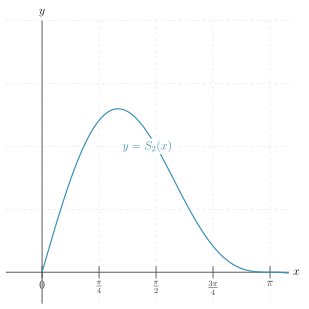
- Suppose \(S_n(x)\) has a stationary point at \(x_0\), then $$ therefore \begin{align*} &&0 &= S_n'(x_0) \\ &&&= \cos x_0 + \cos 2x_0 + \cdots + \cos n x_0 \\ &&&= \frac{\sin(n+\tfrac12)x_0 - \sin \tfrac12x_0}{2 \sin \tfrac12 x_0} \\ \Rightarrow &&\sin\tfrac12 x_0&= \sin nx_0 \cos \tfrac12 x_0 + \cos nx_0 \sin \tfrac12x_0 \\ \Rightarrow && \sin nx_0 &= (1-\cos nx_0)\tan \tfrac12 x_0 \end{align*} Therefore \(S_n(x_0) -S_{n-1}(x_0) = \tfrac1n \sin n x_0 = \tfrac1n \underbrace{(1-\cos nx_0)}_{\geq 0}\underbrace{\tan\tfrac12 x_0}_{\geq 0} \geq 0\). Therefore if \(S_{n-1}(x) > 0\) for all \(x\) on \(0 < x < \pi\) then since \(S_n(x) > S_{n-1}(x)\) at the turning points and since they agree at the end points, it must be larger at all points inbetween.
- Notice that \(S_1(x) = \sin x \geq 0\) for all \(x \in [0,1]\) and by our previous argument we can show \(S_n > S_{n-1}\) inside the interval and equal on the boundary we must have \(S_n(x) \geq 0\) for \(x \in [0, \pi]\)
2013 Paper 2 Q5
- A function \(\f(x)\) satisfies \(\f(x) = \f(1-x)\) for all \(x\). Show, by differentiating with respect to \(x\), that \(\f'(\frac12) =0\,\). If, in addition, \(\f(x) = \f(\frac1x)\) for all (non-zero) \(x\), show that \(\f'(-1)=0\) and that \(\f'(2)=0\).
- The function \(\f\) is defined, for \(x\ne0\) and \(x\ne1\), by \[ \f(x) = \frac {(x^2-x+1)^3}{(x^2-x)^2} \,. \] Show that \(\f(x)= \f(\frac 1 x)\) and \(\f(x) = \f(1-x)\). Given that it has exactly three stationary points, sketch the curve \(y=\f(x)\).
- Hence, or otherwise, find all the roots of the equation \(\f(x) = \dfrac {27} 4\,\) and state the ranges of values of \(x\) for which \(\f(x) > \dfrac{27} 4\,\). Find also all the roots of the equation \(\f(x) = \dfrac{343}{36}\,\) and state the ranges of values of \(x\) for which \(\f(x) > \dfrac{343}{36}\).
Solution:
- \(\,\) \begin{align*} && f(x) &= f(1-x) \\ \Rightarrow && f'(x) &= -f'(1-x) \\ \Rightarrow && f'(\tfrac12) &= -f'(\tfrac12) \\ \Rightarrow && f'(\tfrac12) &= 0 \\ \\ && f(x) &= f(\tfrac1x) \\ \Rightarrow && f'(x) &= f'(\tfrac1x) \cdot \frac{-1}{x^2} \\ \Rightarrow && f'(-1) &= -f'(-1) \\ \Rightarrow && f'(-1) &= 0 \\ \\ && f'(2) &= -\frac{1}{4}f'(\tfrac12) \\ &&&= 0 \end{align*}
- Suppose \begin{align*}
&& f(x) &= \frac{(x^2-x+1)^3}{(x^2-x)^2} \\
&& f(1/x) &= \frac{(x^{-2}-x^{-1}+1)^3}{(x^{-2}-x^{-1})^2} \\
&&&= \frac{(1-x+x^2)^3/x^6}{((x-x^2)^2/x^6} \\
&&&= f(x) \\
\\
&& f(1-x) &= \frac{((1-x)^2-(1-x)+1)^3}{((1-x)^2-(1-x))^2} \\
&&&= \frac{(1-x+x^2)^3}{(x^2-x)^2} = f(x)
\end{align*}
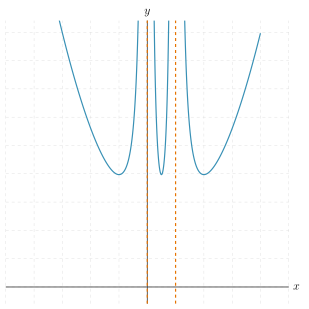
- Clearly \(x = -1\) is a root of \(f(x) = \frac{27}{4}\), so we must also have \(x=2\) and \(x = \frac12\), therefore \(f(x) > \frac{27}{4}\) if \(x \in \mathbb{R} \setminus \{-1, 2, \tfrac12, 0, 1 \}\). Clearly \(x = 3\) and \(x = -2\) are solutions so we also have: \(\frac13, -\frac12, \frac32, \frac23\) and these must be all solutions so we must have: \(f(x) > \frac{343}{36} \Leftrightarrow x \in (-\infty, -2) \cup (-\frac12, 0) \cup (0, \frac13) \cup (\frac23, 1) \cup (1, \frac32) \cup (3, \infty)\)
2012 Paper 1 Q1
The line \(L\) has equation \(y=c-mx\), with \(m>0\) and \(c>0\). It passes through the point \(R(a,b)\) and cuts the axes at the points \(P(p,0)\) and \(Q(0,q)\), where \(a\), \(b\), \(p\) and \(q\) are all positive. Find \(p\) and \(q\) in terms of \(a\), \(b\) and \(m\). As \(L\) varies with \(R\) remaining fixed, show that the minimum value of the sum of the distances of \(P\) and \(Q\) from the origin is \((a^{\frac12} + b^{\frac12})^2\), and find in a similar form the minimum distance between \(P\) and \(Q\). (You may assume that any stationary values of these distances are minima.)
Solution: \begin{align*} && b &= c - ma \\ \Rightarrow && c &= b+ma \\ \Rightarrow && y &= m(a-x)+b \\ \Rightarrow && q &= ma+b \\ && p &= \frac{ma+b}{m} \\ \\ && d &= p+q \\ &&&= a + \frac{b}{m} + ma + b \\ \Rightarrow && d' &= -bm^{-2}+a \\ \Rightarrow && m &= \sqrt{b/a} \\ \\ \Rightarrow &&d &= a + \sqrt{ba}+\sqrt{ba} + b \\ &&&= (\sqrt{a}+\sqrt{b})^2 \\ \\ && |PQ|^2 &= p^2 + q^2 \\ &&&= a^2 + \frac{2ab}{m} + \frac{b^2}{m^2} + m^2a^2 + 2mab + b^2 \\ &&&= a^2+b^2 + \frac{b^2}{m^2} + \frac{2ab}{m}+ 2abm + a^2m^2 \\ && \frac{\d}{\d m}&= -2b^2m^{-3}-2abm^{-2}+2ab + 2a^2m \\ && 0 &=2a^2m^4+2abm^3-2abm-2b^2 \\ &&&= 2(am^3-b)(am+b) \\ \Rightarrow && m &= \sqrt[3]{\frac{b}{a}} \\ \\ &&|PQ|^2 &= \left[ a^{1/3}(a^{2/3} + b^{2/3}) \right]^2 + \left[ b^{1/3}(a^{2/3} + b^{2/3}) \right]^2 \\ &&&= a^{2/3}(a^{2/3} + b^{2/3})^2 + b^{2/3}(a^{2/3} + b^{2/3})^2 \\ &&&= (a^{2/3} + b^{2/3})^2 \cdot (a^{2/3} + b^{2/3}) \\ &&&= (a^{2/3} + b^{2/3})^3 \\ \Rightarrow && |PQ| &= (a^{2/3} + b^{2/3})^{3/2} \end{align*} We can also do this with AM-GM instead: \begin{align*} && d &= a + b + \frac{b}{m} + am \\ &&&\geq a+b + 2 \sqrt{\frac{b}{m} \cdot am} \\ &&&= a+2\sqrt{ab}+b \\ \\ && |PQ|^2 &= a^2+b^2 + \frac{b^2}{m^2} + \frac{2ab}{m}+ 2abm + a^2m^2 \\ &&&= a^2+b^2 + \frac{b^2}{m} + abm + abm + a^2m^2 + \frac{ab}{m} + \frac{ab}{m} \\ &&&= a^2+b^2 + 3\sqrt[3]{ \frac{b^2}{m} \cdot abm \cdot abm} + 3 \sqrt[3]{ a^2m^2 \cdot \frac{ab}{m} \cdot \frac{ab}{m} } \\ &&&= a^2 + 3b^{4/3}a^{2/3}+3b^{2/3}a^{4/3}+b^2 \\ &&&= (a^{2/3}+b^{2/3})^3 \end{align*}
2012 Paper 1 Q2
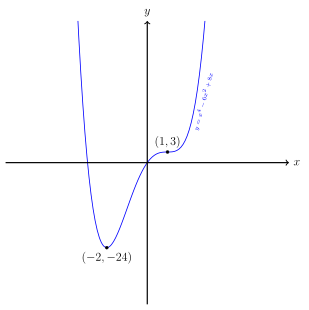
- Sketch the curve \(y= x^4-6x^2+9\) giving the coordinates of the stationary points. Let \(n\) be the number of distinct real values of \(x\) for which
\[
x^4-6x^2 +b=0.
\]
State the values of \(b\), if any, for which
- \(n=0\,\);
- \(n=1\,\);
- \(n=2\,\);
- \(n=3\,\);
- \(n=4\,\).
- For which values of \(a\) does the curve \(y= x^4-6x^2 +ax +b\) have a point at which both \(\dfrac{\d y}{\d x}=0\) and \(\dfrac{\d^2y}{\d x^2}=0\,\)? For these values of \(a\), find the number of distinct real values of \(x\) for which \(\vphantom{\dfrac{A}{B}}\) \[ x^4-6x^2 +ax +b=0\,, \] in the different cases that arise according to the value of \(b\).
- Sketch the curve \(y= x^4-6x^2 +ax\) in the case \(a>8\,\).
Solution:
- \(\,\)

- \(n = 0\) if \(b > 9\)
- \(n = 1\) is not possible, since by symmetry if \(x\) is a root, so is \(-x\), and \(0\) can never be the only root.
- \(n = 2\) if \(b < 0\) or \(b = 9\)
- \(n = 3\) if \(b = 0\)
- \(n = 4\) if \(0 < b < 9\)
- \(\,\) \begin{align*}
&& y' &= 4x^3-12x+a \\
&& y'' &= 12x^2-12 \\
\Rightarrow && x &= \pm 1 \\
\Rightarrow && 0 &= 4(\pm 1) - 12 (\pm 1) + a \\
&&&= a \mp 8 \\
\Rightarrow && a &= \pm 8
\end{align*}
When \(a = 8\), we have \(y = x^4-6x^2+8x\) and
\begin{align*}
&&y' &= 4x^3-12x+8 \\
&&&= 4(x^3-3x+2) \\
&&&= 4(x-1)^2(x+2) \\
\Rightarrow && y(1) &= 3\\
&& y(-2) &= -24
\end{align*}
Therefore there are no solutions if \(b > 24\), one solution if \(b = 24\) and two solutions otherwise. Similarly, if \(a = -8\), we have \(y = x^4 - 6x^2-8x\) \begin{align*} && y' &= 4x^3-12x-8 \\ &&&= 4(x^3-3x-2) \\ &&&= 4(x-2)(x+1)^2 \end{align*} So we have stationary points at \(x = 2\) and \(x = -1\) (which is also a inflection point) and at \(x = 2\) \(y = -24\), so we have the same story: there are no solutions if \(b > 24\), one solution if \(b = 24\) and two solutions otherwise.
- \(\,\)

2012 Paper 2 Q5
- Sketch the curve \(y=\f(x)\), where \[ \f(x) = \frac 1 {(x-a)^2 -1} \hspace{2cm}(x\ne a\pm1), \] and \(a\) is a constant.
- The function \(\g(x)\) is defined by \[ \g(x) = \frac 1 {\big( (x-a)^2-1 \big) \big( (x-b)^2 -1\big)} \hspace{1cm}(x\ne a\pm1, \ x\ne b\pm1), \] where \(a\) and \(b\) are constants, and \(b>a\). Sketch the curves \(y=\g(x)\) in the two cases \(b>a+2\) and \(b=a+2\), finding the values of \(x\) at the stationary points.
Solution:
- \(\,\)

- \(\,\) \begin{align*}
&& \frac{\d}{\d x} \left ( \frac{1}{g(x)} \right) &= \frac{\d }{\d x} \left ( \big( (x-a)^2-1 \big) \big( (x-b)^2 -1\big)\right) \\
&&&= ((x-a)^2-1)(2(x-b))+((x-b)^2-1)(2(x-a)) \\
&&&= 2(2x-a-b)(x^2-(a+b)x+ab-1) \\
\Rightarrow && x &= \frac{a+b}{2}, \frac{a+b \pm \sqrt{(a+b)^2-4ab+4}}{2} \\
&&&= \frac{a+b}{2}, \frac{a+b \pm \sqrt{(a-b)^2+4}}{2}
\end{align*}
If \(b > a+2\):
If \(b = a+2\):


2011 Paper 1 Q5
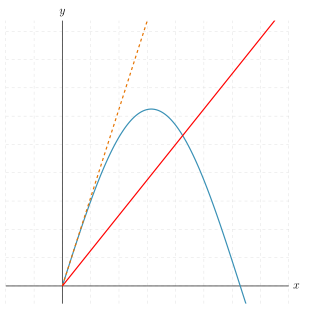
Given that \(0 < k < 1\), show with the help of a sketch that the equation \[ \sin x = k x \tag{\(*\)}\] has a unique solution in the range \(0 < x < \pi\). Let \[ I= \int_0^\pi \big\vert \sin x -kx\big\vert \, \d x\,. \] Show that \[ I= \frac{\pi^2 \sin\alpha }{2\alpha} -2\cos\alpha - \alpha \sin\alpha\,, \] where \(\alpha\) is the unique solution of \((*)\). Show that \(I\), regarded as a function of \(\alpha\), has a unique stationary value and that this stationary value is a minimum. Deduce that the smallest value of \(I\) is \[ -2 \cos \frac{\pi}{\sqrt2}\, .\]
Solution:
2010 Paper 1 Q2
The curve \(\displaystyle y=\Bigl(\frac{x-a}{x-b}\Bigr)\e^{x}\), where \(a\) and \(b\) are constants, has two stationary points. Show that \[ a-b<0 \ \ \ \text{or} \ \ \ a-b>4 \,. \]
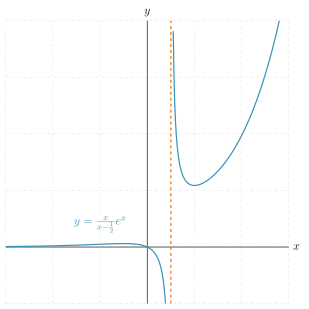
- Show that, in the case \(a=0\) and \(b= \frac12\), there is one stationary point on either side of the curve's vertical asymptote, and sketch the curve.
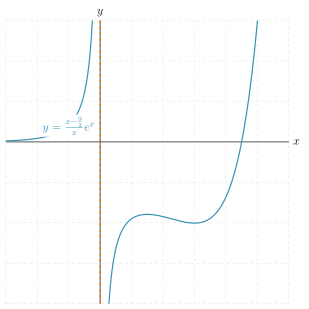
- Sketch the curve in the case \( a=\tfrac{9}{2}\) and \(b=0\,\).
Solution: \begin{align*} && y &= \left ( \frac{x-a}{x-b} \right )e^x \\ &&y'& = \left ( \frac{x-a}{x-b} \right )e^x + \left ( \frac{(x-b)-(x-a)}{(x-b)^2}\right )e^x \\ &&&= \left ( \frac{(x-b)(x-a) +a-b}{(x-b)^2} \right)e^x \\ &&&= \left ( \frac{x^2-(a+b)x+a-b+ab}{(x-b)^2} \right)e^x \\ && 0 &< \Delta = (a+b)^2 - 4 \cdot 1 \cdot (a-b+ab) \\ &&&= a^2+2ab+b^2-4a+4b-4ab \\ &&&= a^2-2ab+b^2-4a+4b\\ &&&= (a-b)^2-4(a-b) \\ &&&= (a-b)(a-b-4) \\ \end{align*} Considered as a quadratic in \(a-b\) we can see \(a-b < 0\) or \(a-b > 4\)
- If \(a = 0, b = \frac12\), we have \(x^2-\frac12x -\frac12 = 0 \Rightarrow (2x+1)(x-1) = 0 \Rightarrow x = -\frac12, x=1\). The asymptote is at \(x = \frac12\) so they are on either side.
- \(\,\)
2009 Paper 1 Q5
A right circular cone has base radius \(r\), height \(h\) and slant length \(\ell\). Its volume \(V\), and the area \(A\) of its curved surface, are given by \[ V= \tfrac13 \pi r^2 h \,, \ \ \ \ \ \ \ A = \pi r\ell\,. \]
- Given that \(A\) is fixed and \(r\) is chosen so that \(V\) is at its stationary value, show that \(A^2 = 3\pi^2r^4\) and that \(\ell =\sqrt3\,r\).
- Given, instead, that \(V\) is fixed and \(r\) is chosen so that \(A\) is at its stationary value, find \(h\) in terms of \(r\).
Solution:
- Given \(A\) is fixed, and \(h^2 + r^2 = \ell^2\), we can look at \begin{align*} && V^2 &= \frac19 \pi^2 r^4 h^2 \\ &&&= \frac19\pi^2r^4(\ell^2 - r^2) \\ &&&= \frac19\pi^2 r^4\left (\frac{A^2}{\pi^2r^2} - r^2 \right) \\ &&&= \frac{A^2r^2 - \pi^2r^6}{9} \end{align*} Differentiating wrt to \(r\) we find that \(2rA^2-6\pi^2 r^5 = 0\) or hence \(A^2 = 3\pi^2 r^4 \Rightarrow A = \sqrt{3}\pi r^2\). Therefore \(\sqrt{3}\pi r^2 = \pi r \ell \Rightarrow \ell = \sqrt{3}r\).
- Supposing \(V\) is fixed, then \begin{align*} && A^2 &= \pi^2 r^2\ell^2 \\ &&&= \pi^2 r^2 (h^2+r^2) \\ &&&= \pi^2 r^2 \left ( \frac{9V^2}{\pi^2r^4} + r^2 \right) \\ &&&= 9V^2r^{-2} + \pi^2r^4 \\ \end{align*} Differentiating wrt to \(r\) we find \(-18V^2r^{-3} + 4\pi^2 r^3 = 0\) so \(V^2 = \frac{2\pi^2}{9}r^6\) or \(V = \frac{\sqrt{2}\pi}{3}r^3\), from which it follows: \(\frac{\sqrt{2}\pi}{3}r^3 = \frac13\pi r^2 h \Rightarrow h = \sqrt{2}r\)
2009 Paper 2 Q2
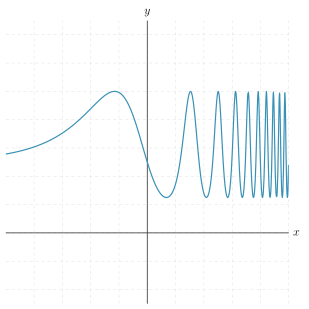
The curve \(C\) has equation \[ y= a^{\sin (\pi \e^ x)}\,, \] where \(a>1\).
- Find the coordinates of the stationary points on \(C\).
- Use the approximations \(\e^t \approx 1+t\) and \(\sin t \approx t\) (both valid for small values of \(t\)) to show that \[ y\approx 1-\pi x \ln a \; \] for small values of \(x\).
- Sketch \(C\).
- By approximating \(C\) by means of straight lines joining consecutive stationary points, show that the area between \(C\) and the \(x\)-axis between the \(k\)th and \((k+1)\)th maxima is approximately \[ \Big( \frac {a^2+1}{2a} \Big) \ln \Big ( 1+ \big( k-\tfrac34)^{-1} \Big)\,. \]
Solution:
- \(\,\) \begin{align*} && y & = a^{\sin(\pi e^x)} \\ \Rightarrow && \frac{\d y}{\d x} &= a^{\sin(\pi e^x)} \cdot ( \ln a) \cdot (\cos (\pi e^x)) \cdot \pi e^x \\ \frac{\d y}{\d x} = 0: && 0 &= \cos(\pi e^x) \\ \Rightarrow && \pi e^x &= \left ( \frac{2n+1}{2} \right) \pi \\ \Rightarrow && x &= \ln \left ( \frac{2n+1}{2} \right) \\ && y &= a^{(-1)^n} \\ &&(x,y) &= \left (\ln \left ( \frac{2n+1}{2} \right), a^{(-1)^n} \right) \end{align*}
- \(\,\) \begin{align*} && y &= a^{\sin(\pi e^x)} \\ &&&= e^{\ln a \cdot \sin(\pi e^x)} \\ &&&\approx e^{\ln a \cdot \sin(\pi (1+x))} \\ &&&\approx e^{-\ln a \cdot \sin(\pi x)} \\ &&&\approx e^{-\ln a \cdot \pi x} \\ &&&\approx 1-( \pi\ln a) x \end{align*}
- The \(k\)th maxima is at \(\ln \left ( \frac{4(k-1)+1}{2}\right)\) and \(a\) ,and the \((k+1)\)th is at \(\ln \left ( \frac{4k+1}{2}\right)\). They have a minima between at \(\ln \left ( \frac{4k-3}{2}\right)\). \begin{align*} && \text{Area} &\approx \frac12 \left (\ln \left ( \frac{4k-1}{2}\right)- \ln \left ( \frac{4k-3}{2}\right)\right) \left ( a + \frac1a \right) + \frac12 \left ( \ln \left ( \frac{4k+1}{2}\right)-\ln \left ( \frac{4k-1}{2}\right)\right) \left ( a + \frac1a \right) \\ &&&= \frac{a^2+1}{2a} \ln \left (\frac{4k+1}{4k-3} \right) \\ &&&= \frac{a^2+1}{2a} \ln \left (1 + \frac{4}{4k-3} \right) \\ &&&= \frac{a^2+1}{2a} \ln \left (1 + \frac{1}{k-\tfrac34} \right) \\ &&&= \frac{a^2+1}{2a} \ln \left (1 + (k-\tfrac34)^{-1} \right) \\ \end{align*}
2008 Paper 2 Q4
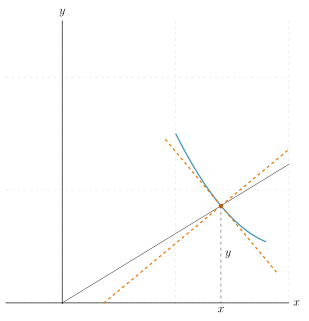
A curve is given by \[x^2+y^2 +2axy = 1,\] where \(a\) is a constant satisfying \(0 < a < 1\). Show that the gradient of the curve at the point \(P\) with coordinates \((x,y)\) is \[\displaystyle - \frac {x+ay}{ax+y}\,,\] provided \(ax+y \ne0\). Show that \(\theta\), the acute angle between \(OP\) and the normal to the curve at \(P\), satisfies \[ \tan\theta = a\vert y^2-x^2\vert\;. \] Show further that, if \(\ \displaystyle \frac{\d \theta}{\d x}=0\) at \(P\), then:
- \(a(x^2+y^2)+2xy=0\,\);
- \((1+a)(x^2+y^2+2xy)=1\,\);
- \(\displaystyle \tan\theta = \frac a{\sqrt{1-a^2}}\,\).
Solution: \begin{align*} && 1 &= x^2 + y^2 + 2axy \\ \frac{\d}{\d x}: && 0 &= 2x + 2y \frac{\d y}{\d x} + 2ay + 2ax \frac{\d y}{\d x} \\ &&&= (2x+2ay) + \frac{\d y}{\d x} \left (2ax + 2y \right) \\ \Rightarrow && \frac{\d y}{\d x} &= -\frac{x+ay}{ax+y} \end{align*}
- \(\,\) \begin{align*} && \sec^2 \theta \frac{\d \theta}{\d x} &= \pm a \left (2y \frac{\d y}{\d x} - 2 x\right) \\ \Rightarrow && 0 &= a \left (y \cdot \frac{x+ay}{ax+y} + x \right) \\ &&&=a \left ( \frac{xy+ay^2+ax^2+xy}{ax+y} \right) \\ \Rightarrow && 0 &= a(x^2+y^2)+2xy \end{align*}
- \(\,\) \begin{align*} && 0 &=a(x^2+y^2)+2xy \\ && 1 &= x^2+y^2 + 2axy \\ \Rightarrow && 1 &= (a+1)(x^2+y^2) + (a+1)(2xy) \\ &&&= (a+1)(x^2+y^2+2xy) \end{align*}
- \(\,\) \begin{align*} && 1 &= (a+1)(x+y)^2 \\ \Rightarrow && x +y &= \pm \frac{1}{\sqrt{1+a}} \\ && 0 &=a(x^2+y^2)+2xy \\ && 1 &= x^2+y^2 + 2axy \\ \Rightarrow && 1 &= (1-a)(x^2+y^2) + (a-1)(2xy) \\ &&&= (1-a)(x^2+y^2-2xy)\\ \Rightarrow && x-y &= \pm \frac{1}{\sqrt{1-a}} \\ \Rightarrow && \frac{\d \theta}{\d x} &= a|y^2-x^2| \\ &&&= a|(y-x)(x+y)| \\ &&&= \frac{a}{\sqrt{1-a^2}} \end{align*}
2007 Paper 1 Q14
The discrete random variable \(X\) has a Poisson distribution with mean \(\lambda\).
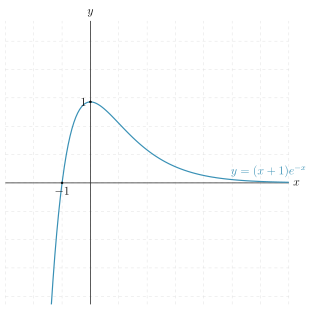
- Sketch the graph \(y=\l x+1 \r \e^{-x}\), stating the coordinates of the turning point and the points of intersection with the axes. It is known that \(\P(X \ge 2) = 1-p\), where \(p\) is a given number in the range \(0 < p <1\). Show that this information determines a unique value (which you should not attempt to find) of \(\lambda\).
- It is known (instead) that \(\P \l X = 1 \r = q\), where \(q\) is a given number in the range \(0 < q <1\). Show that this information determines a unique value of \(\lambda\) (which you should find) for exactly one value of \(q\) (which you should also find).
- It is known (instead) that \(\P \l X = 1 \, \vert \, X \le 2 \r = r\), where \(r\) is a given number in the range \(0 < r < 1\). Show that this information determines a unique value of \(\lambda\) (which you should find) for exactly one value of \(r\) (which you should also find).
Solution: Let \(X \sim Po(\lambda)\), then
- \(\,\)
Suppose \(\mathbb{P}(X \geq 2) = 1-p\) then \(\mathbb{P}(X=0) + \mathbb{P}(X=1) = p\), ie \(e^{-\lambda} +\lambda e^{-\lambda} = p\) If \(f(x) = (1+x)e^{-x}\) we have see it is strictly decreasing on \(x \geq 0\) and takes all values from \(1\) to \(0\), therefore we can find a unique value such that \(f(\lambda) = p\) which is our desired \(\lambda\).
- Note that \(\mathbb{P}(X = 1) = \lambda e^{-\lambda}\)
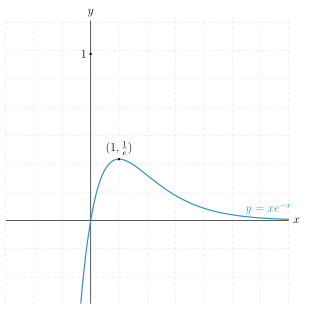
Sketching \(y = xe^{-x}\) and finding it's turning point we can see that there is a unique value of \(\lambda = 1\) when \(q = \frac{1}{e}\), otherwise there is either no solution (\(p > \frac1{e}\)) or two solutions (\(0 < q > \frac1{e}\)).
- Suppose \(\mathbb{P}(X = 1 | X \leq 2) = r\), ie \begin{align*} && r &= \frac{\lambda e^{-\lambda}}{e^{-\lambda} + \lambda e^{-\lambda} + \frac12 \lambda^2 e^{-\lambda}} \\ &&&= \frac{2\lambda}{2+2\lambda+\lambda^2} \\ \Rightarrow && 0 &= r\lambda^2 + 2(r-1) \lambda + 2r\\ \Rightarrow && \Delta &= 4(r-1)^2 - 4\cdot r \cdot 2 r \\ &&&= 4((r-1)^2-2r^2) \\ &&&= 4(r-1-\sqrt{2}r)(r-1+\sqrt{2}r) \\ &&&= -4((\sqrt{2}-1)r + 1)((1+\sqrt{2})r-1) \end{align*} Therefore our quadratic in \(r\) has a unique solution if \(r = \frac{1}{1+\sqrt{2}}\). If it has a positive solution then note since \(2r > 0\) both solutions are positive, so \(\lambda\) is not unique by excluding other solutions.
2007 Paper 2 Q2
A curve has equation \(y=2x^3-bx^2+cx\). It has a maximum point at \((p,m)\) and a minimum point at \((q,n)\) where \(p>0\) and \(n>0\). Let \(R\) be the region enclosed by the curve, the line \(x=p\) and the line \(y=n\).
- Express \(b\) and \(c\) in terms of \(p\) and \(q\).
- Sketch the curve. Mark on your sketch the point of inflection and shade the region \(R\). Describe the symmetry of the curve.
- Show that \(m-n=(q-p)^3\).
- Show that the area of \(R\) is \(\frac12 (q-p)^4\).
Solution:
- \(\,\) \begin{align*} && y &= 2x^3-bx^2+cx \\ \Rightarrow && y' &= 6x^2-2bx+c \end{align*} We must have \(p, q\) are the roots of this equation, ie \(\frac13b = p+q, \frac16c = pq\)
- The point of inflection will be at \(\frac{b}6\)
The graph will have rotational symmetry of \(180^{\circ}\) about the point of inflection.

- \begin{align*} && m-n &= 2(p^3-q^3)-b(p^2-q^2)+c(p-q) \\ &&&= (p-q)(2(p^2+qp+q^2)-b(p+q)+c) \\ &&&= (p-q)(2(p^2+qp+q^2)-3(p+q)^2+6pq) \\ &&&= (p-q)(-p^2-q^2+2pq) \\ &&&= (q-p)^3 \end{align*}
- The area of \(R\) is \begin{align*} A &= \frac12 bh \\ &= \frac12 (q-p)(m-n) = \frac12(q-p)^4 \end{align*} as required.
2006 Paper 2 Q2
Using the series \[ \e^x = 1 + x +\frac{x^2}{2!} + \frac{x^3}{3!} + \frac{x^4}{4!}+\cdots\,, \] show that \(\e>\frac83\). Show that \(n!>2^n\) for \(n\ge4\) and hence show that \(\e<\frac {67}{24}\). Show that the curve with equation \[ y= 3\e^{2x} +14 \ln (\tfrac43-x)\,, \qquad {x<\tfrac43} \] has a minimum turning point between \(x=\frac12\) and \(x=1\) and give a sketch to show the shape of the curve.
Solution: \begin{align*} && e &= 1 + 1 + \frac{1}{2!} + \frac{1}{3!} + \cdots \\ &&&> 1 + 1+ \frac12 + \frac16 \\ &&&= \frac{12+3+1}{6} = \frac83 \end{align*} \(4! = 24 > 16 = 2^4\), notice that \(n! = \underbrace{n \cdot (n-1) \cdots 5}_{>2^{n-4}} \cdot \underbrace{4!}_{>2^4} >2^n\). \begin{align*} && e &= 1 + 1 + \frac{1}{2!} + \frac{1}{3!} + \cdots \\ &&&< \frac83 + \frac{1}{2^4} + \frac{1}{2^5} + \cdots \\ &&&= \frac83 + \frac{1}{2^4} \frac{1}{1-\tfrac12} \\ &&&= \frac83 + \frac1{8} \\ &&&= \frac{67}{24} \end{align*} \begin{align*} && y &= 3e^{2x} +14 \ln(\tfrac43-x) \\ && y' &= 6e^{2x} - \frac{14}{\tfrac43-x} \\ && y'(\tfrac12) &= 6e - \frac{14}{\tfrac43-\tfrac12} \\ &&&= 6e -\tfrac{84}{5} = 6(e-\tfrac{14}5) < 0 \\ && y'(1) &= 6e^2 - \frac{14}{\tfrac43-1} \\ &&&= 6e^2 - 42 = 6(e^2-7) \\ &&&> 6(\tfrac{64}{9} - 7) > 0 \end{align*} Therefore \(y'\) changes from negative (decreasing) to positive (increasing) in our range, and therefore there is a minima in this range.

2005 Paper 2 Q1
Find the three values of \(x\) for which the derivative of \(x^2 \e^{-x^2}\) is zero. Given that \(a\) and \(b\) are distinct positive numbers, find a polynomial \(\P(x)\) such that the derivative of \(\P(x)\e^{-x^2}\) is zero for \(x=0\), \(x=\pm a\) and \(x=\pm b\,\), but for no other values of \(x\).
Solution: \begin{align*} && y &= x^2e^{-x^2} \\ \Rightarrow && y' &= 2xe^{-x^2} +x^2 \cdot (-2x)e^{-x^2} \\ &&&= e^{-x^2}(2x-2x^3) \\ &&&= 2e^{-x^2}x(1-x^2) \end{align*} Therefore the derivative is zero iff \(x = 0, \pm 1\) \begin{align*} && y &= \P(x) e^{-x^2} \\ \Rightarrow && y' &= e^{-x^2} (\P'(x)-2x\P(x)) \end{align*} Therefore we want \(\P'(x) - 2x\P(x) = Kx(x^2-a^2)(x^2-b^2)\) Since this has degree \(5\), we should look at polynomials degree \(4\) for \(\P\). We can also immediately see that \(0\) is a root of \(\P'(x)\), so \(\P(x) = a_4x^4+a_3x^3+a_2x^2+a_0\). WLOG \(a_4 = 1\) and \(K = -2\), so \begin{align*} && -2(x^5-(a^2+b^2)x^3+a^2b^2x) &= 4x^3+3a_3x^2+2a_2x- 2x(x^4+a_3x^3+a_2x^2+a_0) \\ &&&= -2x^5-2a_3 x^4+(4-2a_2)x^3+(2a_2-2a_0)x \\ \Rightarrow && a_3 &= 0 \\ && a^2+b^2 &= 2-a_2 \\ \Rightarrow && a_2 &= 2-a^2-b^2 \\ && a^2b^2 &= a_0-a_2 \\ \Rightarrow && a_0 &= a^2b^2 + 2-a^2-b^2 \\ \Rightarrow && \P(x) &= x^4+(2-a^2-b^2)x^2+(a^2-1)(b^2-1)x \end{align*}