2011 Paper 1 Q5
Year: 2011
Paper: 1
Question Number: 5
Course: LFM Pure
Section: Integration
Problem
Solution
Examiner's report
— 2011 STEP 1, Question 5There were again significantly more candidates attempting this paper than last year (just over 1100), but the scores were significantly lower than last year: fewer than 2% of candidates scored above 100 marks, and the median mark was only 44, compared to 61 last year. It is not clear why this was the case. One possibility is that Questions 2 and 3, which superficially looked straightforward, turned out to be both popular and far harder than candidates anticipated. The only popular and well-answered questions were 1 and 4. The pure questions were the most popular as usual, though there was noticeable variation: questions 1–4 were the most popular, while question 7 (on differential equations) was fairly unpopular. Just over half of all candidates attempted at least one mechanics question, which one-third attempted at least one probability question, an increase on last year. The marks were surprising, though: the two best-answered questions were the pure questions 1 and 4, but the next best were statistics question 12 and mechanics question 9. The remainder of the questions were fairly similar in their marks. A number of candidates ignored the advice on the front cover and attempted more than six questions, with a fifth of candidates trying eight or more questions. A good number of those extra attempts were little more than failed starts, but still suggest that some candidates are not very effective at question-picking. This is an important skill to develop during STEP preparation. Nevertheless, the good marks and the paucity of candidates who attempted the questions in numerical order does suggest that the majority are being wise in their choices. Because of the abortive starts, I have generally restricted my attention to those attempts which counted as one of the six highest-scoring answers in the detailed comments. On occasions, candidates spent far longer on some questions than was wise. Often, this was due to an algebraic slip early on, and they then used time which could have been far better spent tackling another question. It is important to balance the desire to finish a question with an appreciation of when it is better to stop and move on. Many candidates realised that for some questions, it was possible to attempt a later part without a complete (or any) solution to an earlier part. An awareness of this could have helped some of the weaker students to gain vital marks when they were stuck; it is generally better to do more of one question than to start another question, in particular if one has already attempted six questions. It is also fine to write "continued later" at the end of a partial attempt and then to continue the answer later in the answer booklet. As usual, though, some candidates ignored explicit instructions to use the previous work, such as "Hence", or "Deduce". They will get no credit if they do not do what they are asked to! (Of course, a question which has the phrase "or otherwise" gives them the freedom to use any method of their choosing; often the "hence" will be the easiest, though.) It is wise to remember that STEP questions do require a greater facility with mathematics and algebraic manipulation than the A-level examinations, as well as a depth of understanding which goes beyond that expected in a typical sixth-form classroom. There were a number of common errors and issues which appeared across the whole paper. The first was a lack of fluency in algebraic manipulations. STEP questions often use more variables than A-level questions (which tend to be more numerical), and therefore require candidates to be comfortable engaging in extended sequences of algebraic manipulations with determination and, crucially, accuracy. This is a skill which requires plenty of practice to master. Another area of weakness is logic. A lack of confidence in this area showed up several times. In particular, a candidate cannot possibly gain full marks on a question which reads "Show that X if and only if Y" unless they provide an argument which shows that Y follows from X and vice versa. Along with this comes the need for explanations in English: a sequence of formulæ or equations with no explicit connections between them can leave the reader (and writer) confused as to the meaning. Brief connectives or explanations would help, and sometimes longer sentences are necessary. Another related issue continues to be legibility. Many candidates at some point in the paper lost marks through misreading their own writing. One frequent error was dividing by zero. On several occasions, an equation of the form xy = xz appeared, and candidates blithely divided by x to reach the conclusion y = z. Again, I give a strong reminder that it is vital to draw appropriate, clear, accurate diagrams when attempting some questions, mechanics questions in particular.
Rating Information
Difficulty Rating: 1500.0
Difficulty Comparisons: 0
Banger Rating: 1516.7
Banger Comparisons: 1
Show LaTeX source
Problem source
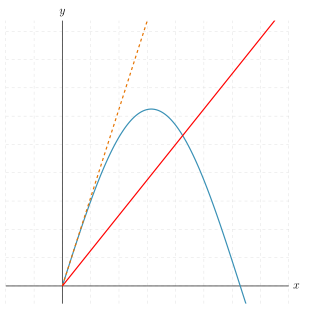
Given that $0 < k < 1$, show with the help of a sketch that the equation
\[
\sin x = k x
\tag{$*$}\]
has a unique solution in the range $0 < x <   \pi$.
Let
\[
I= \int_0^\pi \big\vert \sin x -kx\big\vert \, \d x\,.
\]
Show that
\[
I= \frac{\pi^2 \sin\alpha }{2\alpha} -2\cos\alpha - \alpha \sin\alpha\,,
\]
where
$\alpha$ is the unique solution of $(*)$.
Show that $I$, regarded as a function of $\alpha$, has
a unique stationary value and that this stationary value
 is a minimum. Deduce that
the smallest value of $I$ is
\[
 -2 \cos \frac{\pi}{\sqrt2}\,
.\]
Solution source
\begin{center}
    \begin{tikzpicture}
    \def\functionf(#1){sin(deg(#1))};
    \def\xl{-1};
    \def\xu{4};
    \def\yl{-0.1}; \def\yu{1.5};

    % Calculate scaling factors to make the plot square
    \pgfmathsetmacro{\xrange}{\xu-\xl}
    \pgfmathsetmacro{\yrange}{\yu-\yl}
    \pgfmathsetmacro{\xscale}{10/\xrange}
    \pgfmathsetmacro{\yscale}{10/\yrange}

    % Define the reusable styles to keep code clean
    \tikzset{
        x=\xscale cm, y=\yscale cm,
        axis/.style={thick, draw=black!80, -{Stealth[scale=1.2]}},
        grid/.style={thin, dashed, gray!30},
        curveA/.style={very thick, color=cyan!70!black, smooth},
        curveB/.style={very thick, color=orange!90!black, smooth},
        dot/.style={circle, fill=black, inner sep=1.2pt},
        labelbox/.style={fill=white, inner sep=2pt, rounded corners=2pt} % Protects text from lines
    }

    % Draw background grid
    \draw[grid] (\xl,\yl) grid (\xu,\yu);

    % Set up axes
    \draw[axis] (\xl,0) -- (\xu,0) node[right, black] {$x$};
    \draw[axis] (0,\yl) -- (0,\yu) node[above, black] {$y$};

    % Define the bounding region with clip
    \begin{scope}
        \clip (\xl,\yl) rectangle (\xu,\yu);
        \draw[curveA, domain=0:\xu, samples=150]
            plot ({\x},{\functionf(\x)});
        \draw[curveB, dashed] (0,0) -- (5,5);
        \draw[red, very thick] (0,0) -- (5,2);
    \end{scope}

    \end{tikzpicture}
\end{center}

Note that the line $y = x$ is the tangent $(0,0)$ and $y = \sin x $ is always below it. For any other line through the origin with gradient $0 < k < 1$ it must start below $y = \sin x$, but finish above it at $x = \pi$. It also can only cross once due the the convexity of $\sin$ in this interval.

\begin{align*}
&& I &= \int_0^\pi | \sin x -kx | \d x \\
&&&= \int_0^\alpha (\sin x -k x) \d x + \int_{\alpha}^\pi (kx - \sin x) \d x \\
&&&= \left [ -\cos x - \frac{kx^2}{2} \right]_0^{\alpha} + \left [ \cos x +\frac{kx^2}{2} \right]_{\alpha}^\pi \\
&&&= -\cos \alpha - \frac{k \alpha^2}{2} +1+(-1)+\frac{k\pi^2}{2} - \cos \alpha - \frac{k\alpha^2}{2} \\
&&&= -2\cos \alpha - k\left (\alpha^2 - \frac{\pi^2}{2} \right) \\
&&&= -2\cos \alpha - \frac{\sin \alpha}{\alpha}\left (\alpha^2 - \frac{\pi^2}{2} \right) \\
&&&= \frac{\pi^2 \sin \alpha}{\alpha} - \alpha \sin \alpha - 2\cos \alpha
\end{align*}


\begin{align*}
&& \frac{\d I}{\d \alpha} &= \frac{\pi^2(\alpha \cos \alpha - \sin \alpha)}{2\alpha^2} + 2 \sin \alpha - \sin \alpha - \alpha \cos \alpha \\
&&&= \frac{-2\alpha^3 \cos \alpha + 2\alpha \sin\alpha + \pi^2 \alpha \cos \alpha - \pi^2 \sin \alpha}{2\alpha^2} \\
\\
&&&= \left ( \alpha \cos \alpha - \sin \alpha\right) \left ( \frac{\pi^2}{2\alpha^2}-1 \right)\
\end{align*}

Therefore $I' = 0$ if $\tan \alpha = \alpha$ or $\alpha = \frac{\pi}{\sqrt{2}}$. Since $\tan \alpha = \alpha$ only at $\alpha = 0$ (between $0 \leq \alpha < \pi$ (by considering the tangent), we must have a unique turning point when $\alpha = \frac{\pi}{\sqrt{2}}$.

Note that $I(\frac{\pi}{\sqrt{2}}) = \frac{\pi^2 \sqrt{2} \sin \alpha}{2\pi} - \frac{\pi}{\sqrt{2}} \sin \alpha - 2\cos \frac{\pi}{\sqrt{2}}=- 2\cos \frac{\pi}{\sqrt{2}}$.

Notice that $I(0) = \frac{\pi^2}2 - 2 > 2$ and $I(\pi) = 2$, but $-2\cos \frac{\pi}{\sqrt{2}} < 2$ so we must be a at a minimum
This was a moderately popular question, attempted by half of the candidates. Most made a reasonably good start, but became stuck after deducing the value of I; only half of the candidates gained more than 7 marks. The first part was answered fairly poorly. Most were able to correctly sketch the graph of y = sin x (though there were a few who could not) and y = kx, but very few made any attempt to justify from their sketch the required result. The most common mark for this part was 1 out of 4. A handful of candidates decided to rewrite the equation as sin x/x = k and went on to draw a graph of y = sin x/x, a far more challenging task which was successfully performed by some of the candidates. The integration part (deducing the formula for I) was generally answered very well. There were some who did not understand how to split up the integral or the significance of x = α to this part, but the majority correctly handled the absolute value and the necessity to change the signs of the integrand in the integral from α to π. Quite a number used geometrical arguments, considering a triangle from x = 0 to x = α, a trapezium from x = α to x = π and two regions under the curve; most of these also reached the given result. Determining the stationary points of the function was found to be very challenging. While the differentiation was generally performed correctly, many struggled to factorise the resulting expression. Even among those who did, it was very common to divide by one of the factors, ignoring the possibility that it might be zero. Those who were lucky enough to divide by sin α − α cos α deduced the correct value for α at the minimum. Though they gained no immediate credit for this, they were able to continue attempting the rest of the question. Others, though, were less fortunate and asserted that the minimum occurred where sin α = α cos α; they were unable to make any further progress. It was very unusual to see any sort of decent justification that sin α = α cos α has no solutions in the required range. Most of the students who reached this point correctly evaluated I at the stationary point to reach the given value. Finally, students were required to show that the stationary point is a minimum, which few attempted. A significant amount of care was required for each of the approaches, and a small number did so successfully. A few only evaluated I or dI/dα on one side of the stationary point rather than on both. Students would do well to remember that there are at least three different general approaches to determining the nature of a stationary point, and that different methods might be more or less successful in different situations.