2008 Paper 2 Q4
Year: 2008
Paper: 2
Question Number: 4
Course: LFM Pure
Section: Implicit equations and differentiation
Problem
- \(a(x^2+y^2)+2xy=0\,\);
- \((1+a)(x^2+y^2+2xy)=1\,\);
- \(\displaystyle \tan\theta = \frac a{\sqrt{1-a^2}}\,\).
Solution
- \(\,\) \begin{align*} && \sec^2 \theta \frac{\d \theta}{\d x} &= \pm a \left (2y \frac{\d y}{\d x} - 2 x\right) \\ \Rightarrow && 0 &= a \left (y \cdot \frac{x+ay}{ax+y} + x \right) \\ &&&=a \left ( \frac{xy+ay^2+ax^2+xy}{ax+y} \right) \\ \Rightarrow && 0 &= a(x^2+y^2)+2xy \end{align*}
- \(\,\) \begin{align*} && 0 &=a(x^2+y^2)+2xy \\ && 1 &= x^2+y^2 + 2axy \\ \Rightarrow && 1 &= (a+1)(x^2+y^2) + (a+1)(2xy) \\ &&&= (a+1)(x^2+y^2+2xy) \end{align*}
- \(\,\) \begin{align*} && 1 &= (a+1)(x+y)^2 \\ \Rightarrow && x +y &= \pm \frac{1}{\sqrt{1+a}} \\ && 0 &=a(x^2+y^2)+2xy \\ && 1 &= x^2+y^2 + 2axy \\ \Rightarrow && 1 &= (1-a)(x^2+y^2) + (a-1)(2xy) \\ &&&= (1-a)(x^2+y^2-2xy)\\ \Rightarrow && x-y &= \pm \frac{1}{\sqrt{1-a}} \\ \Rightarrow && \frac{\d \theta}{\d x} &= a|y^2-x^2| \\ &&&= a|(y-x)(x+y)| \\ &&&= \frac{a}{\sqrt{1-a^2}} \end{align*}
Examiner's report
— 2008 STEP 2, Question 4There were around 850 candidates for this paper – a slight increase on the 800 of the past two years – and the scripts received covered the full range of marks (and beyond!). The questions on this paper in recent years have been designed to be a little more accessible to all top A-level students, and this has been reflected in the numbers of candidates making good attempts at more than just a couple of questions, in the numbers making decent stabs at the six questions required by the rubric, and in the total scores achieved by candidates. Most candidates made attempts at five or more questions, and most genuinely able mathematicians would have found the experience a positive one in some measure at least. With this greater emphasis on accessibility, it is more important than ever that candidates produce really strong, essentially-complete efforts to at least four questions. Around half marks are required in order to be competing for a grade 2, and around 70 for a grade 1. The range of abilities on show was still quite wide. Just over 100 candidates failed to score a total mark of at least 30, with a further 100 failing to reach a total of 40. At the other end of the scale, more than 70 candidates scored a mark in excess of 100, and there were several who produced completely (or nearly so) successful attempts at more than six questions; if more than six questions had been permitted to contribute towards their paper totals, they would have comfortably exceeded the maximum mark of 120. While on the issue of the "best-six question-scores count" rubric, almost a third of candidates produced efforts at more than six questions, and this is generally a policy not to be encouraged. In most such cases, the seventh, eighth, or even ninth, question-efforts were very low scoring and little more than a waste of time for the candidates concerned. Having said that, it was clear that, in many of these cases, these partial attempts represented an abandonment of a question after a brief start, with the candidates presumably having decided that they were unlikely to make much successful further progress on it, and this is a much better employment of resources. As in recent years, most candidates' contributing question-scores came exclusively from attempts at the pure maths questions in Section A. Attempts at the mechanics and statistics questions were very much more of a rarity, although more (and better) attempts were seen at these than in other recent papers.
Rating Information
Difficulty Rating: 1600.0
Difficulty Comparisons: 0
Banger Rating: 1532.0
Banger Comparisons: 4
Show LaTeX source
Problem source
A curve is given by
\[x^2+y^2 +2axy = 1,\] where $a$ is a constant satisfying  $0 < a < 1$.
Show that the gradient of the curve at the point $P$ with coordinates $(x,y)$  is
\[\displaystyle - \frac {x+ay}{ax+y}\,,\]
provided $ax+y \ne0$.
Show that $\theta$,  the acute angle between $OP$ and the normal to the curve at $P$, satisfies
\[
\tan\theta = a\vert y^2-x^2\vert\;.
\]
Show further that, if $\ \displaystyle \frac{\d \theta}{\d x}=0$ at $P$, then:
\begin{questionparts}
\item $a(x^2+y^2)+2xy=0\,$;
\item $(1+a)(x^2+y^2+2xy)=1\,$;
\item $\displaystyle \tan\theta = \frac a{\sqrt{1-a^2}}\,$.
\end{questionparts}
Solution source
\begin{align*}
&& 1 &= x^2 + y^2 + 2axy \\
\frac{\d}{\d x}: && 0 &= 2x + 2y \frac{\d y}{\d x} + 2ay + 2ax \frac{\d y}{\d x} \\
&&&= (2x+2ay) + \frac{\d y}{\d x} \left (2ax + 2y \right) \\
\Rightarrow && \frac{\d y}{\d x} &= -\frac{x+ay}{ax+y}
\end{align*}

\begin{center}
    \begin{tikzpicture}
    \def\functionf(#1){1/((#1)*(#1))};
    \def\xl{-0.5};
    \def\xu{2};
    \def\yl{-0.01}; \def\yu{2.5};

    % Calculate scaling factors to make the plot square
    \pgfmathsetmacro{\xrange}{\xu-\xl}
    \pgfmathsetmacro{\yrange}{\yu-\yl}
    \pgfmathsetmacro{\xscale}{10/\xrange}
    \pgfmathsetmacro{\yscale}{10/\yrange}

    % Define the reusable styles to keep code clean
    \tikzset{
        x=\xscale cm, y=\yscale cm,
        axis/.style={thick, draw=black!80, -{Stealth[scale=1.2]}},
        grid/.style={thin, dashed, gray!30},
        curveA/.style={very thick, color=cyan!70!black, smooth},
        curveB/.style={very thick, color=orange!90!black, smooth},
        dot/.style={circle, fill=black, inner sep=1.2pt},
        labelbox/.style={fill=white, inner sep=2pt, rounded corners=2pt} % Protects text from lines
    }

    % Draw background grid
    \draw[grid] (\xl,\yl) grid[step=1] (\xu,\yu);

    % Set up axes
    \draw[axis] (\xl,0) -- (\xu,0) node[right, black] {$x$};
    \draw[axis] (0,\yl) -- (0,\yu) node[above, black] {$y$};

    \def\t{1.4}
    \coordinate (O) at  (0, 0);
    \coordinate (A) at  ({\t},{(\t)^2-4*\t+4.5});


    % Define the bounding region with clip
    \begin{scope}
        \clip (\xl,\yl) rectangle (\xu,\yu);

        \draw[curveA, domain=1:1.8, samples=150]
            plot ({\x},{(\x)^2-4*\x+4.5});
        \filldraw (A) circle (1.5pt);
        \draw (O) -- ($(O)!1.5!(A)$);
        \draw[curveB, dashed] (A)-- ++(.5, {0.5*(2*\t-4)});
        \draw[curveB, dashed] (A)-- ++(-.5, -{0.5*(2*\t-4)});
        \draw[curveB, dashed] (A)-- ++(-{0.5*(2*\t-4)}, .5);
        \draw[curveB, dashed] (A)-- ++({(2*\t-4)}, -1);
    \end{scope}
    \draw[dashed] (A) -- (\t, 0) node[below] {$x$} node[pos=0.5, right] {$y$};

    \end{tikzpicture}
\end{center}

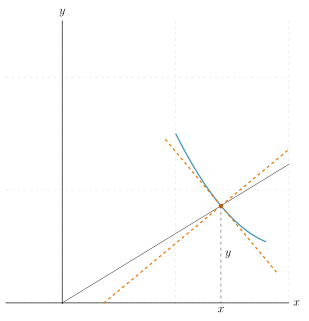
The gradient of $OP$ is $\frac{y}{x}$.
The gradient of the normal is $\frac{ax+y}{x+ay}$

Therefore (noting the absolute values in case they are on opposite sides to this diagram:

\begin{align*}
&& \tan \theta &= \Big |\tan \left ( \tan^{-1} \frac{ax+y}{x+ay} - \tan^{-1} \frac{y}{x} \right) \Big |  \\
&&&= \Big | \frac{\frac{ax+y}{x+ay} - \frac{y}{x}}{1+\frac{ax+y}{x+ay}\frac{y}{x} } \Big | \\
&&&= \Big | \frac{(ax+y)x - y(x+ay)}{x(x+ay)+y(ax+y)} \Big | \\
&&&= \Big | \frac{ax^2 - ay^2}{x^2+y^2+2ayx} \Big | \\
&&&= a \frac{|y^2-x^2|}{1} \\
&&&= a|y^2-x^2|
\end{align*}

\begin{questionparts}
\item $\,$ \begin{align*}
&& \sec^2 \theta \frac{\d \theta}{\d x} &= \pm a \left (2y \frac{\d y}{\d x} - 2 x\right) \\
\Rightarrow && 0 &= a \left (y \cdot \frac{x+ay}{ax+y} + x  \right) \\
&&&=a \left ( \frac{xy+ay^2+ax^2+xy}{ax+y} \right) \\
\Rightarrow && 0 &= a(x^2+y^2)+2xy
\end{align*}
\item $\,$ \begin{align*}
&& 0 &=a(x^2+y^2)+2xy \\
&& 1 &= x^2+y^2 + 2axy \\
\Rightarrow && 1 &= (a+1)(x^2+y^2) + (a+1)(2xy) \\
&&&= (a+1)(x^2+y^2+2xy)
\end{align*}
\item $\,$ \begin{align*}
&& 1 &= (a+1)(x+y)^2 \\
\Rightarrow && x +y &= \pm \frac{1}{\sqrt{1+a}} \\
&& 0 &=a(x^2+y^2)+2xy \\
&& 1 &= x^2+y^2 + 2axy \\
\Rightarrow && 1 &= (1-a)(x^2+y^2) + (a-1)(2xy) \\
&&&= (1-a)(x^2+y^2-2xy)\\
\Rightarrow && x-y &= \pm \frac{1}{\sqrt{1-a}} \\
\Rightarrow && \frac{\d \theta}{\d x} &= a|y^2-x^2| \\
&&&= a|(y-x)(x+y)| \\
&&&= \frac{a}{\sqrt{1-a^2}}
\end{align*}
\end{questionparts}
Another very popular question, poorly done (600 attempts, mean score below 7). Most efforts got little further than finding the gradient of the normal to the curve, and I strongly suspect that this question was frequently to be found amongst candidates' non-contributing scorers. Using the tan(A – B) formula is a sufficiently common occurrence on past papers that there is little excuse for well-prepared candidates not to recognise when and how to apply it. Once that has been done, the question's careful structuring guided able candidates over the hurdles one at a time, each result relying on the preceding result(s); yet most attempts had finished quite early on, and the majority of candidates failed to benefit from the setters' kindness.