2007 Paper 1 Q14
Year: 2007
Paper: 1
Question Number: 14
Course: UFM Statistics
Section: Poisson Distribution
Problem
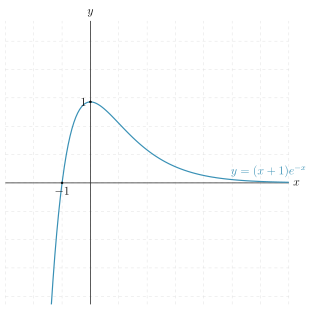
- Sketch the graph \(y=\l x+1 \r \e^{-x}\), stating the coordinates of the turning point and the points of intersection with the axes. It is known that \(\P(X \ge 2) = 1-p\), where \(p\) is a given number in the range \(0 < p <1\). Show that this information determines a unique value (which you should not attempt to find) of \(\lambda\).
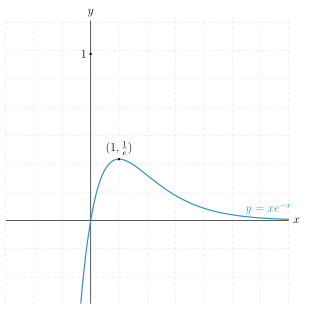
- It is known (instead) that \(\P \l X = 1 \r = q\), where \(q\) is a given number in the range \(0 < q <1\). Show that this information determines a unique value of \(\lambda\) (which you should find) for exactly one value of \(q\) (which you should also find).
- It is known (instead) that \(\P \l X = 1 \, \vert \, X \le 2 \r = r\), where \(r\) is a given number in the range \(0 < r < 1\). Show that this information determines a unique value of \(\lambda\) (which you should find) for exactly one value of \(r\) (which you should also find).
Solution
- \(\,\)
Suppose \(\mathbb{P}(X \geq 2) = 1-p\) then \(\mathbb{P}(X=0) + \mathbb{P}(X=1) = p\), ie \(e^{-\lambda} +\lambda e^{-\lambda} = p\) If \(f(x) = (1+x)e^{-x}\) we have see it is strictly decreasing on \(x \geq 0\) and takes all values from \(1\) to \(0\), therefore we can find a unique value such that \(f(\lambda) = p\) which is our desired \(\lambda\).
- Note that \(\mathbb{P}(X = 1) = \lambda e^{-\lambda}\)
Sketching \(y = xe^{-x}\) and finding it's turning point we can see that there is a unique value of \(\lambda = 1\) when \(q = \frac{1}{e}\), otherwise there is either no solution (\(p > \frac1{e}\)) or two solutions (\(0 < q > \frac1{e}\)).
- Suppose \(\mathbb{P}(X = 1 | X \leq 2) = r\), ie \begin{align*} && r &= \frac{\lambda e^{-\lambda}}{e^{-\lambda} + \lambda e^{-\lambda} + \frac12 \lambda^2 e^{-\lambda}} \\ &&&= \frac{2\lambda}{2+2\lambda+\lambda^2} \\ \Rightarrow && 0 &= r\lambda^2 + 2(r-1) \lambda + 2r\\ \Rightarrow && \Delta &= 4(r-1)^2 - 4\cdot r \cdot 2 r \\ &&&= 4((r-1)^2-2r^2) \\ &&&= 4(r-1-\sqrt{2}r)(r-1+\sqrt{2}r) \\ &&&= -4((\sqrt{2}-1)r + 1)((1+\sqrt{2})r-1) \end{align*} Therefore our quadratic in \(r\) has a unique solution if \(r = \frac{1}{1+\sqrt{2}}\). If it has a positive solution then note since \(2r > 0\) both solutions are positive, so \(\lambda\) is not unique by excluding other solutions.
Examiner's report
— 2007 STEP 1, Question 14There were significantly more candidates attempting this paper this year (an increase of nearly 50%), but many found it to be very difficult and only achieved low scores. In particular, the level of algebraic skill required by the questions was often lacking. The examiners' express their concern that this was the case despite a conscious effort to make the paper more accessible than last year's. At this level, the fluent, confident and correct handling of mathematical symbols (and numbers) is necessary and is expected; many good starts to questions soon became unstuck after a simple slip. Graph sketching was usually poor: if future candidates wanted to improve one particular skill, they would be well advised to develop this. There were of course some excellent scripts, full of logical clarity and perceptive insight. It was pleasing to note that the applied questions were more popular this year, and many candidates scored well on at least one of these. It was however surprising how rarely answers to questions such as 5, 9, 10, 11 and 12 began with a diagram. However, the examiners were left with the overall feeling that some candidates had not prepared themselves well for the examination. The use of past papers to ensure adequate preparation is strongly recommended. A student's first exposure to STEP questions can be a daunting, demanding experience; it is a shame if that takes place during a public examination on which so much rides. Further, and fuller, discussion of the solutions to these questions can be found in the Hints and Answers document.
Rating Information
Difficulty Rating: 1500.0
Difficulty Comparisons: 0
Banger Rating: 1484.0
Banger Comparisons: 1
Show LaTeX source
Problem source
The discrete random variable $X$ has a Poisson distribution with mean $\lambda$.
\begin{questionparts}
\item Sketch the graph $y=\l x+1 \r \e^{-x}$, stating the coordinates of the turning point and the points of intersection with the axes.
It is known that $\P(X \ge 2) = 1-p$, where $p$ is a given number in the range $0 < p <1$.
Show that this information determines a unique value (which you should not attempt to find) of $\lambda$.
\item  It is known (instead) that $\P \l X = 1 \r = q$, where $q$ is a given number in the range $0 < q <1$. Show that this information determines a unique value of $\lambda$ (which you should find) for exactly one value of $q$ (which you should also find).
\item It is known (instead) that $\P \l X = 1 \, \vert \, X \le 2 \r =  r$, where $r$ is a given number in the range $0 < r < 1$. Show that this information determines a unique value of $\lambda$ (which you should find) for exactly one value of $r$ (which you should also find).
\end{questionparts}
Solution source
Let $X \sim Po(\lambda)$, then
\begin{questionparts}
\item $\,$
\begin{center}
    \begin{tikzpicture}
    \def\functionf(#1){(#1+1)*exp(-#1)};
    \def\xl{-3};
    \def\xu{7};
    \def\yl{-1.5}; \def\yu{2};

    % Calculate scaling factors to make the plot square
    \pgfmathsetmacro{\xrange}{\xu-\xl}
    \pgfmathsetmacro{\yrange}{\yu-\yl}
    \pgfmathsetmacro{\xscale}{10/\xrange}
    \pgfmathsetmacro{\yscale}{10/\yrange}

    % Define the reusable styles to keep code clean
    \tikzset{
        x=\xscale cm, y=\yscale cm,
        axis/.style={thick, draw=black!80, -{Stealth[scale=1.2]}},
        grid/.style={thin, dashed, gray!30},
        curveA/.style={very thick, color=cyan!70!black, smooth},
        curveB/.style={very thick, color=orange!90!black, smooth},
        dot/.style={circle, fill=black, inner sep=1.2pt},
        labelbox/.style={fill=white, inner sep=2pt, rounded corners=2pt} % Protects text from lines
    }

    % Draw background grid
    \draw[grid] (\xl,\yl) grid (\xu,\yu);

    % Set up axes
    \draw[axis] (\xl,0) -- (\xu,0) node[right, black] {$x$};
    \draw[axis] (0,\yl) -- (0,\yu) node[above, black] {$y$};

    % Define the bounding region with clip
    \begin{scope}
        \clip (\xl,\yl) rectangle (\xu,\yu);
        \draw[curveA, domain=\xl:\xu, samples=150] plot(\x, {\functionf(\x)});
        \filldraw (-1,0) circle (1pt) node[below] {$-1$};
        \filldraw (0,1) circle (1pt) node[left] {$1$};
    \end{scope}

        \node[curveA, above] at ({2*pi}, {\functionf(2*pi)}) {$y = (x+1)e^{-x}$};

    \end{tikzpicture}
\end{center}

Suppose $\mathbb{P}(X \geq 2) = 1-p$ then $\mathbb{P}(X=0) + \mathbb{P}(X=1) = p$, ie $e^{-\lambda} +\lambda e^{-\lambda} = p$ If $f(x) = (1+x)e^{-x}$ we have see it is strictly decreasing on $x \geq 0$ and takes all values from $1$ to $0$, therefore we can find a unique value such that $f(\lambda) = p$ which is our desired $\lambda$.

\item Note that $\mathbb{P}(X = 1) = \lambda e^{-\lambda}$


\begin{center}
    \begin{tikzpicture}
    \def\functionf(#1){(#1)*exp(-#1)};
    \def\xl{-3};
    \def\xu{7};
    \def\yl{-.5}; \def\yu{1.2};

    % Calculate scaling factors to make the plot square
    \pgfmathsetmacro{\xrange}{\xu-\xl}
    \pgfmathsetmacro{\yrange}{\yu-\yl}
    \pgfmathsetmacro{\xscale}{10/\xrange}
    \pgfmathsetmacro{\yscale}{10/\yrange}

    % Define the reusable styles to keep code clean
    \tikzset{
        x=\xscale cm, y=\yscale cm,
        axis/.style={thick, draw=black!80, -{Stealth[scale=1.2]}},
        grid/.style={thin, dashed, gray!30},
        curveA/.style={very thick, color=cyan!70!black, smooth},
        curveB/.style={very thick, color=orange!90!black, smooth},
        dot/.style={circle, fill=black, inner sep=1.2pt},
        labelbox/.style={fill=white, inner sep=2pt, rounded corners=2pt} % Protects text from lines
    }

    % Draw background grid
    \draw[grid] (\xl,\yl) grid (\xu,\yu);

    % Set up axes
    \draw[axis] (\xl,0) -- (\xu,0) node[right, black] {$x$};
    \draw[axis] (0,\yl) -- (0,\yu) node[above, black] {$y$};

    % Define the bounding region with clip
    \begin{scope}
        \clip (\xl,\yl) rectangle (\xu,\yu);
        \draw[curveA, domain=\xl:\xu, samples=150] plot(\x, {\functionf(\x)});
        \filldraw (1,{exp(-1)}) circle (1pt) node[above] {$(1, \frac1{e})$};
        \filldraw (0,1) circle (1pt) node[left] {$1$};
    \end{scope}

        \node[curveA, above] at ({2*pi}, {\functionf(2*pi)}) {$y = xe^{-x}$};

    \end{tikzpicture}
\end{center}

Sketching $y = xe^{-x}$ and finding it's turning point we can see that there is a unique value of $\lambda = 1$ when $q = \frac{1}{e}$, otherwise there is either no solution ($p > \frac1{e}$) or two solutions ($0 < q > \frac1{e}$).

\item Suppose $\mathbb{P}(X = 1 | X \leq 2) = r$, ie

\begin{align*}
&& r &= \frac{\lambda e^{-\lambda}}{e^{-\lambda} + \lambda e^{-\lambda} + \frac12 \lambda^2 e^{-\lambda}} \\
&&&= \frac{2\lambda}{2+2\lambda+\lambda^2} \\
\Rightarrow && 0 &= r\lambda^2 + 2(r-1) \lambda  + 2r\\
\Rightarrow && \Delta &= 4(r-1)^2 - 4\cdot r \cdot 2 r \\
&&&= 4((r-1)^2-2r^2) \\
&&&= 4(r-1-\sqrt{2}r)(r-1+\sqrt{2}r) \\
&&&= -4((\sqrt{2}-1)r + 1)((1+\sqrt{2})r-1)
\end{align*}

Therefore our quadratic in $r$ has a unique solution if $r = \frac{1}{1+\sqrt{2}}$. If it has a positive solution then note since $2r > 0$ both solutions are positive, so $\lambda$ is not unique by excluding other solutions.

\end{questionparts}
Only a few attempts at this question were seen. Poor graph sketching limited many candidates' progress; the importance of the ability to sketch accurately standard graphs such as y = xe–x cannot be overstated.