Problems
Filters
91 problems found
2017 Paper 1 Q9
A particle is projected at speed \(u\) from a point \(O\) on a horizontal plane. It passes through a fixed point \(P\) which is at a horizontal distance \(d\) from \(O\) and at a height \(d \tan \beta\) above the plane, where \(d>0\) and \(\beta \) is an acute angle. The angle of projection \(\alpha\) is chosen so that \(u\) is as small as possible.
- Show that \(u^2 = gd \tan \alpha\) and \(2\alpha = \beta + 90^\circ\,\).
- At what angle to the horizontal is the particle travelling when it passes through \(P\)? Express your answer in terms of \(\alpha\) in its simplest form.
Solution:
- \(\,\) \begin{align*} && d &= u \cos \alpha t \\ && d \tan \beta &= u \sin \alpha t - \frac12 gt^2 \\ && &= d\tan \alpha - \frac1{2u^2} g d^2 \sec^2 \alpha \\ \Rightarrow && u^2 &= \frac{gd \sec^2 \alpha}{2(\tan \alpha + \tan \beta)} \\ &&&= \frac{gd t^2}{2(t+\tan \beta)} \\ && \frac{\d}{\d t} \left (u^2 \right) &= \frac{2gdt\cdot 2(t+\tan \beta) - gdt^2 \cdot 2}{4(t+\tan \beta)^2} \\ &&&= \frac{2gdt(2t-t+2\tan \beta)}{4(t+\tan \beta)^2} \\ &&&= \frac{gdt(t+2\tan \beta)}{2(t+\tan \beta)^2} \\ \end{align*} So either \(t = 0\) or \(t = -2 \tan \beta\) \begin{align*} && u^2 &= \frac{gd\cdot 4 \tan^2 \beta}{2(-2\tan \beta + \tan \beta)} \\ &&&= \frac{2gd \tan \beta}{-1} \\ &&&= gd (-2\tan \beta) \\ &&&= gd \tan \alpha \end{align*} \begin{align*} && d \tan \beta &= d \tan \alpha - \frac12 \frac{gd^2}{gd \tan \alpha \cdot \cos^2 \alpha } \\ \Rightarrow && \tan \beta&= \tan \alpha - \frac{1}{2\sin \alpha \cos \alpha} \\ &&&= \frac{2 \sin^2 \alpha - 1}{2 \sin \alpha \cos \alpha} \\ &&&= \frac{-\cos 2 \alpha}{\sin 2 \alpha} \\ &&&= -\cot 2 \alpha \\ &&&= \tan (2\alpha - 90^\circ) \\ \Rightarrow && \beta &= 2\alpha - 90^\circ \\ \Rightarrow && 2\alpha &= \beta + 90^\circ \end{align*}
- Suppose the angle to the horizontal is \(\theta\), then \(\tan \theta = \frac{v_y}{v_x}\) so \begin{align*} && \tan \theta &= \frac{u \sin \alpha - gt}{u \cos \alpha} \\ &&&= \frac{u \sin \alpha - \frac12 g \frac{d}{u \cos \alpha}}{u \cos \alpha} \\ &&&= \frac{u^2\sin \alpha \cos \alpha - gd}{u^2 \cos^2 \alpha} \\ &&&= \frac{gd \tan \alpha \sin \alpha \cos \alpha- gd}{ gd \tan \alpha \cdot \cos^2 \alpha} \\ &&&= \frac{\tan \alpha \sin \alpha \cos \alpha - 1}{ \sin \alpha \cos \alpha} \\ &&&= \frac{\sin^2 \alpha - 1}{\sin \alpha \cos \alpha} \\ &&&= -\frac{\cos \alpha}{\sin \alpha}\\ &&&= - \cot \alpha = \tan (\alpha - 90^\circ)\\ \Rightarrow && \theta &= \alpha - 90^\circ \end{align*}
2017 Paper 2 Q7
The functions \(\f\) and \(\g\) are defined, for \(x>0\), by \[ \f(x) = x^x\,, \ \ \ \ \ \g(x) = x^{\f(x)}\,. \]
- By taking logarithms, or otherwise, show that \(\f(x) > x\) for \(0 < x < 1\,\). Show further that \(x < \g(x) < \f(x)\) for \(0 < x < 1\,\). Write down the corresponding results for \(x > 1 \,\).
- Find the value of \(x\) for which \(\f'(x)=0\,\).
- Use the result \(x\ln x \to 0\) as \(x\to 0\) to find \(\lim\limits_{x\to0}\f(x)\), and write down \(\lim\limits_{x\to0}\g(x)\,\).
- Show that \( x^{-1}+\, \ln x \ge 1\,\) for \(x>0\). Using this result, or otherwise, show that \(\g'(x) > 0\,\).
Solution:
- \(\,\) \begin{align*} && \ln f(x) &= x \ln x \\ &&&> \ln x \quad (\text{if } 0 < x < 1)\\ \Rightarrow && f(x) &> x\quad\quad (\text{if } 0 < x < 1)\\ \Rightarrow && x^{f(x)} &< x^x \\ && g(x) &< f(x) \\ && 1&>f(x) \\ \Rightarrow && x &< x^{f(x)} = g(x) \end{align*}
- \(\,\) \begin{align*} && f(x) &= e^{x \ln x} \\ \Rightarrow && f'(x) &= (\ln x + 1)e^{x \ln x} \\ \Rightarrow && f'(x) = 0 &\Leftrightarrow x = \frac1e \end{align*}
- \(\,\) \begin{align*} && \lim_{x \to 0} f(x) &= \lim_{x \to 0} \exp \left ( x \ln x \right ) \\ &&&= \exp \left ( \lim_{x \to 0} \left ( x \ln x \right )\right) \\ &&&= \exp \left ( 0 \right) = 1\\ \\ && \lim_{x \to 0} g(x) &= \lim_{x \to 0} \exp \left ( f(x) \ln x\right) \\ &&&= \exp \left (\lim_{x \to 0} \ln x f(x)\right) \\ &&&= \exp \left (\lim_{x \to 0} \ln x \lim_{x \to 0}f(x)\right) \\ &&&= \exp \left (\lim_{x \to 0} \ln x\right) \\ &&&= 0 \end{align*}
- \(y = x^{-1} + \ln x \Rightarrow y' = -x^{-2} + x^{-1}\) which has roots at \(x =1\), therefore the minimum value is \(1\). (We can see it's a minimum by considering \(x \to 0, x \to \infty\). So \begin{align*} && g'(x) &= x^{f(x)} \cdot (f'(x) \ln x + f(x) x^{-1})\\ &&&= x^{f(x)} \cdot f(x) \cdot ((1+\ln x) \ln x + x^{-1}) \\ &&&= x^{f(x)} \cdot f(x) \cdot (\ln x + x^{-1} + (\ln x)^2) \\ &&&\geq x^{f(x)} \cdot f(x) > 0 \end{align*}
2017 Paper 3 Q5
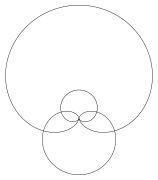
The point with cartesian coordinates \((x,y)\) lies on a curve with polar equation \(r=\f(\theta)\,\). Find an expression for \(\dfrac{\d y}{\d x}\) in terms of \(\f(\theta)\), \(\f'(\theta)\) and \(\tan\theta\,\). Two curves, with polar equations \(r=\f(\theta)\) and \(r=\g(\theta)\), meet at right angles. Show that where they meet \[ \f'(\theta) \g'(\theta) +\f(\theta)\g(\theta) = 0 \,. \] The curve \(C\) has polar equation \(r=\f(\theta)\) and passes through the point given by \(r=4\), \(\theta = - \frac12\pi\). For each positive value of \(a\), the curve with polar equation \(r= a(1+\sin\theta)\) meets~\(C\) at right angles. Find \(\f(\theta)\,\). Sketch on a single diagram the three curves with polar equations \(r= 1+\sin\theta\,\), \ \(r= 4(1+\sin\theta)\) and \(r=\f(\theta)\,\).
Solution: \((x, y) = (f(\theta)\cos(\theta), f(\theta)\sin(\theta))\) so \begin{align*} \frac{dy}{d\theta} &= -f(\theta)\sin(\theta) + f'(\theta)\cos(\theta) \\ \frac{dx}{d\theta} &= f(\theta)\cos(\theta) + f'(\theta)\sin(\theta) \\ \frac{dy}{dx} &= \frac{-f(\theta)\sin(\theta) + f'(\theta)\cos(\theta)}{f(\theta)\cos(\theta) + f'(\theta)\sin(\theta) } \\ &= \frac{-f(\theta)\tan(\theta) + f'(\theta)}{f(\theta) + f'(\theta)\tan(\theta) } \end{align*} If the curves meet at right angles then the product of their gradients is \(-1\), ie \begin{align*} \frac{-f(\theta)\tan(\theta) + f'(\theta)}{f(\theta) + f'(\theta)\tan(\theta) } \cdot \frac{-g(\theta)\tan(\theta) + g'(\theta)}{g(\theta) + g'(\theta)\tan(\theta) } &= -1 \\ f(\theta)g(\theta)\tan^2 \theta - f(\theta)g'(\theta)\tan \theta - f'(\theta)g(\theta)\tan \theta + f'(\theta)g'(\theta) &= \\ \quad - \l f(\theta)g(\theta) + f(\theta)g'(\theta)\tan(\theta) + f'(\theta)g(\theta)\tan(\theta) + f'(\theta)g'(\theta)\tan^2 \theta \r \\ \tan^2\theta \l f(\theta)g(\theta) + f'(\theta)g'(\theta) \r + f'(\theta)g'(\theta) + f(\theta)g(\theta) &= 0 \\ (\tan^2\theta + 1) \l f(\theta)g(\theta) + f'(\theta)g'(\theta) \r &= 0 \\ f(\theta)g(\theta) + f'(\theta)g'(\theta) &= 0 \end{align*} \(g(\theta) = a(1+\sin\theta), g'(\theta) = a\cos\theta\) Therefore \(f'(\theta)a\cos \theta+f(\theta)a(1+\sin(\theta)) = 0\) \begin{align*} && \frac{f'(\theta)}{f(\theta)} &= -\sec(\theta) - \tan(\theta) \\ \Rightarrow && \ln(f(\theta)) &= -\ln |\tan(\theta) + \sec(\theta)| + \ln |\cos(\theta)| + C \\ \Rightarrow && f(\theta) &= A \frac{\cos \theta}{\tan \theta + \sec \theta} \\ &&&= A \frac{\cos^2 \theta}{\sin \theta + 1} \\ &&&= A \frac{1-\sin^2 \theta}{\sin \theta + 1} \\ &&&= A (1-\sin \theta) \end{align*} When \(\theta = -\frac12 \pi, r = 4\), so \(A = 2\).
2016 Paper 1 Q2
Differentiate, with respect to \(x\), \[ (ax^2+bx+c)\,\ln \big( x+\sqrt{1+x^2}\big) +\big(dx+e\big)\sqrt{1+x^2} \,, \] where \(a\), \(b\), \(c\), \(d\) and \(e\) are constants. You should simplify your answer as far as possible. Hence integrate:
- \( \ln \big( x+\sqrt{1+x^2}\,\big) \,;\)
- \(\sqrt{1+x^2} \,; \)
- \( x\ln \big( x+\sqrt{1+x^2}\,\big) \,.\)
Solution: \begin{align*} && y &= (ax^2+bx+c)\,\ln \big( x+\sqrt{1+x^2}\big) +\big(dx+e\big)\sqrt{1+x^2} \\ && y' &= (2ax+b)\,\ln \big( x+\sqrt{1+x^2}\big) + (ax^2+bx+c) \frac{1}{x + \sqrt{1+x^2}} \cdot \left(1 + \frac{x}{\sqrt{1+x^2}} \right) + d\sqrt{1+x^2} + \frac{x(dx+e)}{\sqrt{1+x^2}} \\ &&&= (2ax+b)\,\ln \big( x+\sqrt{1+x^2}\big) + \frac{1}{\sqrt{1+x^2}} \left ( (ax^2+bx+c) + d(1+x^2) + x(dx+e) \right) \\ &&&= (2ax+b)\,\ln \big( x+\sqrt{1+x^2}\big) + \frac{1}{\sqrt{1+x^2}} \left ( (a+2d)x^2+(b+e)x+(d+c) \right) \\ \end{align*}
- We want \(a = 0, b = 1, d = 0, e = -1, c =0\), so \begin{align*} I &= \int \ln \big( x+\sqrt{1+x^2}\,\big) \,\d x \\ &= x\ln(x+\sqrt{1+x^2})-\sqrt{1+x^2}+C \end{align*}
- We want \(a = b =0, e = 0, d = \frac12, c = \frac12\), so \begin{align*} I &= \int \sqrt{1+x^2}\, \d x \\ &= \frac12\ln(x+\sqrt{1+x^2}) + \frac12x\sqrt{1+x^2}+C \end{align*}
- We want \(a = \frac12, b = 0, d = -\frac14, e = 0, c = \frac14\), so \begin{align*} I &= \int x \ln (x+\sqrt{1+x^2}) \, \d x \\ &= \left (\frac12 x^2+\frac14 \right)\ln(x+\sqrt{1+x^2}) -\frac14x\sqrt{1+x^2}+C \end{align*}
2016 Paper 1 Q4
- Differentiate $\displaystyle \; \frac z {(1+z^2)^{\frac12}} \;$ with respect to \(z\).
- The {\em signed curvature} \(\kappa\) of the curve \(y=\f(x)\) is defined by \[ \kappa = \frac {\f''(x)}{\big({1+ (\f'(x))^2\big)^{\frac32}}} \,.\] Use this definition to determine all curves for which the signed curvature is a non-zero constant. For these curves, what is the geometrical significance of \(\kappa\)?
Solution:
- Let \(\displaystyle y = \frac z {(1+z^2)^{\frac12}}\) then \(\frac{d y}{d x} = \frac{(1+z^2)^{\frac12} - z^2(1+z^2)^{-\frac12}}{1+z^2} = \frac{(1+z^2)-z^2}{(1+z^2)^\frac32} = \frac{1}{(1+z^2)^\frac32}\)
- \(\kappa = \frac {f''(x)}{\big({1+ (f'(x))^2\big)^{\frac32}}}\) then \begin{align*} && \int \kappa \, dx &= \int \frac{f''(x)}{( 1 + (f'(x))^2)^{\frac32}} \, dx \\ && \kappa x &= \frac{f'(x)}{(1 + (f'(x))^2)^\frac12} + C \\ \Rightarrow && (\kappa x-C)^2 &= \frac{f'(x)^2}{1 + (f'(x))^2} \\ \Rightarrow && f'(x)^2((\kappa x - C)^2 - 1) &= -(\kappa x-C)^2 \\ \Rightarrow && f'(x) &= \frac{\kappa x - C}{\sqrt{1-(\kappa x - C)^2 }} \\ \Rightarrow && f(x) &= \frac{1}{\kappa} \sqrt{1 - (\kappa x - C)^2} \\ \Rightarrow && (\kappa y)^2 + (\kappa x - C)^2 &= 1 \\ \Rightarrow && y^2 + (x - C')^2 &= \frac{1}{\kappa^2} \end{align*} Therefore all the curves are circles and \(\kappa\) is the reciprocal of the radius.
2016 Paper 2 Q3
For each non-negative integer \(n\), the polynomial \(\f_n\) is defined by \[ \f_n(x) = 1 + x + \frac{x^2}{2!} + \frac {x^3}{3!} + \cdots + \frac{x^n}{n!} \]
- Show that \(\f'_{n}(x) = \f_{n-1}(x)\,\) (for \(n\ge1\)).
- Show that, if \(a\) is a real root of the equation \[\f_n(x)=0\,,\tag{\(*\)}\] then \(a<0\).
- Let \(a\) and \(b\) be distinct real roots of \((*)\), for \(n\ge2\). Show that \(\f_n'(a)\, \f_n'(b)>0\,\) and use a sketch to deduce that \(\f_n(c)=0\) for some number \(c\) between \(a\) and \(b\). Deduce that \((*)\) has at most one real root. How many real roots does \((*)\) have if \(n\) is odd? How many real roots does \((*)\) have if \(n\) is even?
Solution:
- \(\,\) \begin{align*} && f'_n(x) &= 0 + 1 + \frac{2x}{2!} + \frac{3x^2}{3!} + \cdots + \frac{nx^{n-1}}{n!} \\ &&&= 1 + x + \frac{x^2}{2!} + \frac{x^3}{3!} + \cdots + \frac{x^{n-1}}{(n-1)!} \\ &&&= f_{n-1}(x) \end{align*}
- Claim: \(f_n(x) > 0\) for all \(x > 0\) Proof: (By induction) Base case: (\(n = 1\)) \(f_1(x) = 1 + x > 1\) therefore \(f_1(x) > 0\) Suppose it's true for \(n = k\), then consider \(f_{k+1}\), if we differentiate it, we find it is increasing on \((0, \infty)\) by our inductive hypothesis. But then \(f_{k+1}(0) = 1 > 0\). Therefore \(f_{k+1}(x) > 0\) as well. Therefore by the principle of mathematical induction we are done. Since \(f_n(x) > 0\) for non-negative \(x\), if \(a\) is a root it must be negative.
- Suppose \(f_n(a) = f_n(b) = 0\) then \(f'_n(a) = -\frac{a^n}{n!}\) and \(f'_n(b) = -\frac{b^n}{n!}\), but then \(f_n'(a) f_n'(b) = \frac{(-a)^n(-b)^n}{(n!)^2} > 0\) since \(a < 0, b < 0\). \(_n'(a) f_n'(b)\) is positive, the two gradients must have the same sign (and not be zero). Therefore if they are both increasing, at some point the curve must cross the axis in between. Therefore there is some root \(c\) between \(a\) and \(b\). But then there is also a root between \(c\) and \(a\) and \(c\) and \(b\), and very quickly we find more than \(n\) roots which is not possivel. Therefore there must be at most \(1\) root. If \(n\) is odd there must be exactly one root, since \(f_n\) changes sign as \(x \to -\infty\) vs \(x = 0\). If \(n\) is even then there can't be any roots, since if it crossed the \(x\)-axis there would be two roots (not possible) and it cannot touch the axis, since \(f'_n(a) \neq 0\) unless \(a = 0\), and we know \(a < 0\)
2016 Paper 3 Q3
- Given that \[ \int \frac {x^3-2}{(x+1)^2}\, \e ^x \d x = \frac{\P(x)}{Q(x)}\,\e^x + \text{constant} \,, \] where \(\P(x)\)and \(Q(x)\) are polynomials, show that \(Q(x)\) has a factor of \(x + 1\). Show also that the degree of \(\P(x)\) is exactly one more than the degree of \(Q(x)\), and find \(\P(x)\) in the case \(Q(x) =x+1\).
- Show that there are no polynomials \(\P(x)\) and \(Q(x)\) such that \[ \int \frac 1 {x+1} \, \, \e^x \d x = \frac{\P(x)}{Q(x)}\,\e^x +\text{constant} \,. \] You need consider only the case when \(\P(x)\) and \(Q(x)\) have no common factors.
Solution:
- \begin{align*} && \int \frac {x^3-2}{(x+1)^2}\, \e ^x \d x &= \frac{\P(x)}{Q(x)}\,\e^x + \text{constant} \\ \underbrace{\Rightarrow}_{\frac{\d}{\d x}} && \frac{x^3-2}{(x+1)^2}e^x &= \frac{P'(x)Q(x)-Q'(x)P(x)}{Q(x)^2}e^x + \frac{P(x)}{Q(x)}e^x \\ \Rightarrow && \frac{x^3-2}{(x+1)^2} &= \frac{(P(x)+P'(x))Q(x)-Q'(x)P(x)}{Q(x)^2} \\ \Rightarrow && Q(x)^2(x^3-2) &= ((P(x)+P'(x))Q(x)-Q'(x)P(x))(x+1)^2 \\ \Rightarrow && Q(-1) &= 0 \\ \Rightarrow && x+1 &\mid Q(x) \end{align*} We have \(\frac{x^3-2}{(x+1)^2}\) has degree \(1\) (plus some remainder term). Therefore \begin{align*} 1 &= \deg \l (P(x)+P'(x))Q(x)-Q'(x)P(x)\r - 2 \deg Q(x) \\ &= \deg P(x) + \deg Q(x) - 2 \deg Q(x) \\ &= \deg P(x) - \deg Q(x) \end{align*} as required. Suppose \(Q(x) = x+1, P(x) = ax^2+bx+c\) then \begin{align*} && \frac{x^3-2}{(x+1)^2} &= \frac{(P(x)+P'(x))(x+1)-P(x)}{(x+1)^2} \\ \Rightarrow && x^3-2 &= (P(x)+P'(x))(x+1) - P(x) \\ \Rightarrow && x^3-2 &= (ax^2+bx+c+2ax+b)(x+1) - (ax^2+bx+c) \\ &&&= a x^3+ x^2 (2 a + b) + x (2 a + b + c)+b \\ \Rightarrow && a &= 1 \\ && b &= -2 \\ && c &= 0 \end{align*} So \(P(x) = x^2-2x\)
- \begin{align*} && \int \frac1{x+1}e^x \d x &= \frac{P(x)}{Q(x)}e^x + c \\ \Rightarrow && \frac{1}{x+1} e^x &= \frac{P'(x)Q(x)-Q'(x)P(x)}{Q(x)^2}e^x + \frac{P(x)}{Q(x)}e^x \\ \Rightarrow && \frac{1}{x+1} &= \frac{(P(x)+P'(x))Q(x)-Q'(x)P(x)}{Q(x)^2} \end{align*} Therefore \(Q(-1) = 0\) and so \(x +1 \mid Q(x)\). Considering degrees, we must have that \(P(x)\) has degree \(1\) less than \(Q(x)\). Consider also the number of factors of \(x+1\) in the numerator and denominator. Since \(P(x)\) and \(Q(x)\) have no common factors, the \(Q(x)\) could have \(q\) factors and \(P(x)\) must have none. The denominator therefore has \(2q\) factors and the numerator must have \(q-1\) factors (coming from \(Q'(x)\)), we must have \(2q = (q-1) + 1\), but that implies \(q = 0\). Contradiction! \end{align*}
2014 Paper 1 Q4
An accurate clock has an hour hand of length \(a\) and a minute hand of length \(b\) (where \(b>a\)), both measured from the pivot at the centre of the clock face. Let \(x\) be the distance between the ends of the hands when the angle between the hands is \(\theta\), where \(0\le\theta < \pi\). Show that the rate of increase of \(x\) is greatest when \(x=(b^2-a^2)^\frac12\). In the case when \(b=2a\) and the clock starts at mid-day (with both hands pointing vertically upwards), show that this occurs for the first time a little less than 11 minutes later.
Solution: The position of the hands are \(\begin{pmatrix} a\sin(-t) \\ a \cos(-t) \end{pmatrix}\) and \(\begin{pmatrix} b\sin(-60t) \\ b \cos(-60t) \end{pmatrix}\), the distance between the hands is \begin{align*} x &= \sqrt{\left ( a \sin t - b \sin 60t\right)^2+\left ( a \cos t - b \cos 60t\right)^2} \\ &= \sqrt{a^2+b^2-2ab\left (\sin t \sin 60t+\cos t \cos 60t \right)} \\ &= \sqrt{a^2+b^2-2ab \cos(59t)} = \sqrt{a^2+b^2-2ab \cos \theta} \\ \\ \frac{\d x}{\d \theta} &= \frac{ab \sin \theta}{ \sqrt{a^2+b^2-2ab \cos \theta}} \\ \frac{\d^2 x}{\d \theta^2} &= \frac{ab \cos \theta\sqrt{a^2+b^2-2ab \cos \theta} - \frac{a^2b^2 \sin^2 \theta}{\sqrt{a^2+b^2-2ab \cos \theta}} }{a^2+b^2-2ab \cos \theta} \\ &= \frac{ab \cos \theta(a^2+b^2-2ab \cos \theta) - a^2b^2 \sin^2 \theta }{(a^2+b^2-2ab \cos \theta)^{3/2}} \\ &= \frac{ab \cos \theta(a^2+b^2-2ab \cos \theta) - a^2b^2(1-\cos^2 \theta)}{(a^2+b^2-2ab \cos \theta)^{3/2}} \\ &= \frac{ab(a^2+b^2) \cos \theta-a^2b^2 \cos \theta- a^2b^2}{(a^2+b^2-2ab \cos \theta)^{3/2}} \\ &= \frac{-ab(a\cos \theta -b)(b \cos \theta - a)}{(a^2+b^2-2ab \cos \theta)^{3/2}} \\ \end{align*} So the rate of increase is largest when \(\cos \theta = \frac{a}{b}\) (since \(\frac{b}{a}\) is impossible. Therefore when \(x = \sqrt{a^2+b^2-2ab \frac{a}{b}} = \sqrt{a^2+b^2-2a^2} = \sqrt{b^2-a^2}\) If \(b = 2a\) then \(\cos \theta = \frac{a}{2a} = \frac12 = \frac{\pi}{3} = 60^\circ\) The relative speed of the hands is \(5.5^\circ\) per minute, so \(\frac{60}{5.5} = \frac{120}{11} \approx 11\) but clearly also less than since \(121 = 11^2\).
2014 Paper 2 Q6
By simplifying \(\sin(r+\frac12)x - \sin(r-\frac12)x\) or otherwise show that, for \(\sin\frac12 x \ne0\), \[ \cos x + \cos 2x +\cdots + \cos nx = \frac{\sin(n+\frac12)x - \sin\frac12 x}{2\sin\frac12x}\,. \] The functions \(S_n\), for \(n=1, 2, \dots\), are defined by \[ S_n(x) = \sum_{r=1}^n \frac 1 r \sin rx \qquad (0\le x \le \pi). \]
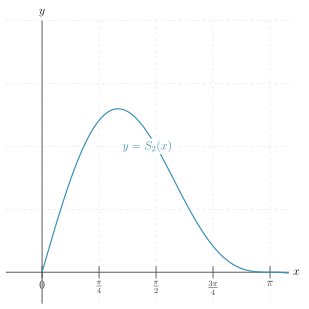
- Find the stationary points of \(S_2(x)\) for \(0\le x\le\pi\), and sketch this function.
- Show that if \(S_n(x)\) has a stationary point at \(x=x_0\), where \(0< x_0 < \pi\), then \[ \sin nx_0 = (1-\cos nx_0) \tan\tfrac12 x_0 \] and hence that \(S_n(x_0) \ge S_{n-1}(x_0)\). Deduce that if \(S_{n-1}(x) > 0\) for all \(x\) in the interval \(0 < x < \pi\), then \(S_{n}(x) > 0\) for all \(x\) in this interval.
- Prove that \(S_n(x)\ge0\) for \(n\ge1\) and \(0\le x\le\pi\).
Solution: \begin{align*} && \sin(r + \tfrac12)x - \sin(r - \tfrac12) x &= \sin rx \cos \tfrac12x + \cos r x\sin\tfrac12x - \sin r x \cos \tfrac12 x + \cos rx \sin \tfrac12 x \\ &&&= 2\cos r x \sin\tfrac12 x \\ \\ && S &= \cos x + \cos 2x + \cdots + \cos n x \\ && 2\sin \tfrac12 x S &= \sin(1 + \tfrac12)x - \sin \tfrac12 x + \\ &&&\quad+ \sin(2+\tfrac12)x - \sin(2- \tfrac12)x + \\ &&&\quad+ \sin(3+\tfrac12)x - \sin(3 - \tfrac12)x + \\ &&& \quad + \cdots + \\ &&&\quad + \sin(n+\tfrac12)x - \sin(n-\tfrac12)x \\ &&&=\sin(n+\tfrac12)x - \sin\tfrac12 x \\ \Rightarrow && S &= \frac{\sin(n+\tfrac12)x - \sin\tfrac12 x}{2 \sin \tfrac12 x} \end{align*}
- \(\,\) \begin{align*}
&& S_2(x) &= \sin x + \tfrac12 \sin 2 x \\
&& S'_2(x) &= \cos x + \cos 2x \\
&&&= \cos x + 2\cos^2 x - 1 \\
&&&= (2\cos x -1)(\cos x + 1) \\
\end{align*}
Therefore the turning points are \(\cos x= \frac12 \Rightarrow x = \frac{\pi}{3}\) and \(\cos x = -1 \Rightarrow x = \pi\)
- Suppose \(S_n(x)\) has a stationary point at \(x_0\), then $$ therefore \begin{align*} &&0 &= S_n'(x_0) \\ &&&= \cos x_0 + \cos 2x_0 + \cdots + \cos n x_0 \\ &&&= \frac{\sin(n+\tfrac12)x_0 - \sin \tfrac12x_0}{2 \sin \tfrac12 x_0} \\ \Rightarrow &&\sin\tfrac12 x_0&= \sin nx_0 \cos \tfrac12 x_0 + \cos nx_0 \sin \tfrac12x_0 \\ \Rightarrow && \sin nx_0 &= (1-\cos nx_0)\tan \tfrac12 x_0 \end{align*} Therefore \(S_n(x_0) -S_{n-1}(x_0) = \tfrac1n \sin n x_0 = \tfrac1n \underbrace{(1-\cos nx_0)}_{\geq 0}\underbrace{\tan\tfrac12 x_0}_{\geq 0} \geq 0\). Therefore if \(S_{n-1}(x) > 0\) for all \(x\) on \(0 < x < \pi\) then since \(S_n(x) > S_{n-1}(x)\) at the turning points and since they agree at the end points, it must be larger at all points inbetween.
- Notice that \(S_1(x) = \sin x \geq 0\) for all \(x \in [0,1]\) and by our previous argument we can show \(S_n > S_{n-1}\) inside the interval and equal on the boundary we must have \(S_n(x) \geq 0\) for \(x \in [0, \pi]\)
2013 Paper 2 Q1
- Find the value of \(m\) for which the line \(y = mx\) touches the curve \(y = \ln x\,\). If instead the line intersects the curve when \(x = a\) and \(x = b\), where \(a < b\), show that \(a^b = b^a\). Show by means of a sketch that \(a < \e < b\).
- The line \(y=mx+c\), where \(c>0\), intersects the curve \(y=\ln x\) when \(x=p\) and \(x=q\), where \(p < q\). Show by means of a sketch, or otherwise, that \(p^q > q^p\).
- Show by means of a sketch that the straight line through the points \((p, \ln p)\) and \((q, \ln q)\), where \(\e\le p < q\,\), intersects the \(y\)-axis at a positive value of \(y\). Which is greater, \(\pi^\e\) or \(\e^\pi\)?
- Show, using a sketch or otherwise, that if \(0 < p < q\) and \(\dfrac{\ln q - \ln p}{q-p} = \e^{-1}\), then \(q^p > p^q\).
Solution: \begin{questionparts} \item The tangent to \(y = \ln x\) is \begin{align*} && \frac{y - \ln x_1}{x - x_1} &= \frac{1}{x_1} \\ \Rightarrow && \frac{x_1y -x_1 \ln x_1}{ x- x_1} &= 1 \\ \Rightarrow && x_1 y - x_1 \ln x_1 &= x - x_1 \end{align*} So to run through the origin, we need \(\ln x_1 = 1 \Rightarrow x_1 = e\) so the line will be \(y = \frac1{e} x\) If \(ma = \ln a \Rightarrow m = \frac{\ln a}{a} = \frac{\ln b}{b} \Rightarrow b \ln a = a \ln b \Rightarrow a^b = b^a\). \item
2013 Paper 2 Q5
- A function \(\f(x)\) satisfies \(\f(x) = \f(1-x)\) for all \(x\). Show, by differentiating with respect to \(x\), that \(\f'(\frac12) =0\,\). If, in addition, \(\f(x) = \f(\frac1x)\) for all (non-zero) \(x\), show that \(\f'(-1)=0\) and that \(\f'(2)=0\).
- The function \(\f\) is defined, for \(x\ne0\) and \(x\ne1\), by \[ \f(x) = \frac {(x^2-x+1)^3}{(x^2-x)^2} \,. \] Show that \(\f(x)= \f(\frac 1 x)\) and \(\f(x) = \f(1-x)\). Given that it has exactly three stationary points, sketch the curve \(y=\f(x)\).
- Hence, or otherwise, find all the roots of the equation \(\f(x) = \dfrac {27} 4\,\) and state the ranges of values of \(x\) for which \(\f(x) > \dfrac{27} 4\,\). Find also all the roots of the equation \(\f(x) = \dfrac{343}{36}\,\) and state the ranges of values of \(x\) for which \(\f(x) > \dfrac{343}{36}\).
Solution:
- \(\,\) \begin{align*} && f(x) &= f(1-x) \\ \Rightarrow && f'(x) &= -f'(1-x) \\ \Rightarrow && f'(\tfrac12) &= -f'(\tfrac12) \\ \Rightarrow && f'(\tfrac12) &= 0 \\ \\ && f(x) &= f(\tfrac1x) \\ \Rightarrow && f'(x) &= f'(\tfrac1x) \cdot \frac{-1}{x^2} \\ \Rightarrow && f'(-1) &= -f'(-1) \\ \Rightarrow && f'(-1) &= 0 \\ \\ && f'(2) &= -\frac{1}{4}f'(\tfrac12) \\ &&&= 0 \end{align*}
- Suppose \begin{align*}
&& f(x) &= \frac{(x^2-x+1)^3}{(x^2-x)^2} \\
&& f(1/x) &= \frac{(x^{-2}-x^{-1}+1)^3}{(x^{-2}-x^{-1})^2} \\
&&&= \frac{(1-x+x^2)^3/x^6}{((x-x^2)^2/x^6} \\
&&&= f(x) \\
\\
&& f(1-x) &= \frac{((1-x)^2-(1-x)+1)^3}{((1-x)^2-(1-x))^2} \\
&&&= \frac{(1-x+x^2)^3}{(x^2-x)^2} = f(x)
\end{align*}
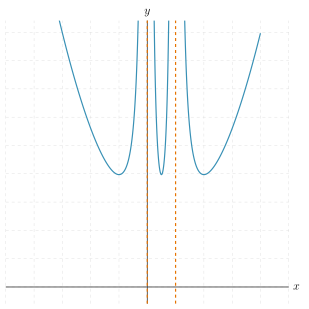
- Clearly \(x = -1\) is a root of \(f(x) = \frac{27}{4}\), so we must also have \(x=2\) and \(x = \frac12\), therefore \(f(x) > \frac{27}{4}\) if \(x \in \mathbb{R} \setminus \{-1, 2, \tfrac12, 0, 1 \}\). Clearly \(x = 3\) and \(x = -2\) are solutions so we also have: \(\frac13, -\frac12, \frac32, \frac23\) and these must be all solutions so we must have: \(f(x) > \frac{343}{36} \Leftrightarrow x \in (-\infty, -2) \cup (-\frac12, 0) \cup (0, \frac13) \cup (\frac23, 1) \cup (1, \frac32) \cup (3, \infty)\)
2013 Paper 2 Q8
The function \(\f\) satisfies \(\f(x)>0\) for \(x\ge0\) and is strictly decreasing (which means that \(\f(b)<\f(a)\) for \(b>a\)).
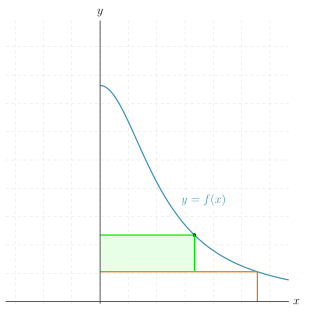
- For \(t\ge0\), let \(A_0(t)\) be the area of the largest rectangle with sides parallel to the coordinate axes that can fit in the region bounded by the curve \(y=\f(x)\), the \(y\)-axis and the line \(y=\f(t)\). Show that \(A_0(t)\) can be written in the form \[ A_0(t) =x_0\left( \f(x_0) -\f(t)\right), \] where \(x_0\) satisfies \(x_0 \f'(x_0) +\f(x_0) = \f(t)\,\).
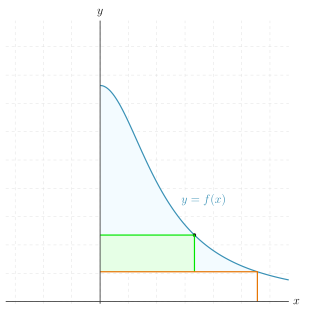
- The function g is defined, for \(t> 0\), by \[ \g(t) =\frac 1t \int_0^t \f(x) \d x\,. \] Show that \(t \g'(t) = \f(t) -\g(t)\,\). Making use of a sketch show that, for \(t>0\), \[ \int_0^t \left( \f(x) - \f(t)\right) \d x > A_0(t) \] and deduce that \(-t^2 \g'(t)> A_0(t)\).
- In the case \(\f(x)= \dfrac 1 {1+x}\,\), use the above to establish the inequality \[ \ln \sqrt{1+t} > 1 - \frac 1 {\sqrt{1+t}} \,, \] for \(t>0\).
Solution:
- First, not that the point must be ony the curve:
Since otherwise it's pretty clear we could make the area of the rectangle larger by moving the point onto the curve. Therefore \(A = x(f(x)-f(t))\). To maximise this we need \(xf'(x) + f(x)-f(t) = 0\), ie \(x_0f'(x_0) + f(x_0) = f(t)\)
- Suppose \(\displaystyle \g(t) =\frac 1t \int_0^t \f(x) \d x\) then
\begin{align*}
&& \g(t) &=\frac 1t \int_0^t \f(x) \d x\\
\Rightarrow && tg(t) &= \int_0^t \f(x) \d x \\
\Rightarrow && tg'(t) +g(t) &= f(t) \\
\Rightarrow && tg'(t) &= f(t) - g(t)
\end{align*}
Clearly the blue area + green area is larger than the green area. So \(\displaystyle \int_0^t (f(x) - f(t))\d x > A_0(t)\). Notice that \(f(t) = \frac1{t} \int_0^t f(t) \d x \) so \(-t^2g'(t) = \int_0^t f(x) \d x > A_0(t)\)
- Not that if \(f(x) = \dfrac{1}{1+x}\), the \(f'(x) = -\frac{1}{(1+x)^2}\) and so \begin{align*} && -\frac{x_0}{(1+x_0)^2} + \frac{1}{1+x_0} &= \frac{1}{1+t} \\ && \frac{1}{(1+x_0)^2} &= \frac{1}{1+t} \\ \Rightarrow && x_0 &= \sqrt{1+t} - 1 \\ && A_0(t) &= (\sqrt{1+t} - 1) \left ( \frac{1}{\sqrt{1+t}} - \frac{1}{t+1} \right) \\ &&&= 1 - \frac{1}{\sqrt{1+t}} - \frac{1}{\sqrt{1+t}} + \frac{1}{1+t} \\ &&&= \frac{2+t}{1+t} - \frac{2}{\sqrt{1+t}} \\ && g(t) &= \frac{1}{t} \int_0^t \frac{1}{1+x} \d x \\ &&&= \frac{\ln(1+t)}{t} \\ \Rightarrow && g'(t) &= \frac{\frac{t}{1+t} - \ln(1+t)}{t^2} \\ \Rightarrow && -t^2g(t) &= \ln(1+t) - \frac{t}{1+t} \\ \Rightarrow && \ln(1+t) - \frac{t}{1+t} &> \frac{2+t}{1+t} - \frac{2}{\sqrt{1+t}} \\ \Rightarrow && \ln \sqrt{1+t} & > 1 - \frac{1}{\sqrt{1+t}} \end{align*}
2013 Paper 3 Q7
- Let \(y(x)\) be a solution of the differential equation \( \dfrac {\d^2 y}{\d x^2}+y^3=0\) with \(y = 1\) and \(\dfrac{\d y}{\d x} =0\) at \(x=0\), and let \[ {\rm E} (x)= \left ( \frac {\d y}{\d x}\right)^{\!\!2} + \tfrac 12 y^4\,. \] Show by differentiation that \({\rm E}\) is constant and deduce that \( \vert y(x) \vert \le 1\) for all \(x\).
- Let \(v(x)\) be a solution of the differential equation \( \dfrac{\d^2 v}{\d x^2} + x \dfrac {\d v}{\d x} +\sinh v =0\) with \(v = \ln 3\) and \(\dfrac{\d v}{\d x} =0\) at \(x=0\), and let \[ {\rm E} (x)= \left ( \frac {\d v}{\d x}\right)^{\!\!2} + 2 \cosh v\,. \] Show that \(\dfrac{\d{\rm E}}{\d x}\le 0\) for \(x\ge0\) and deduce that \(\cosh v(x) \le \frac53\) for \(x\ge0\).
- Let \(w(x)\) be a solution of the differential equation \[ \frac{\d^2 w}{\d x^2} + (5\cosh x - 4 \sinh x -3) \frac{\d w}{\d x} + (w\cosh w + 2 \sinh w) =0 \] with \(\dfrac{\d w }{\d x}=\dfrac 1 { \sqrt 2 }\) and \(w=0\) at \(x=0\). Show that \(\cosh w(x) \le \frac54\) for \(x\ge0\).
Solution:
- \(\,\) \begin{align*} && E(x) &= \left ( \frac{\d y}{\d x} \right)^2 + \frac12 y^4 \\ \Rightarrow && E'(x) &= 2 \frac{\d y}{\d x} \frac{\d^2 y}{\d x^2} + 2y^3 \frac{\d y}{\d x} \\ &&&= 2\frac{\d y}{\d x} \left ( \frac{\d^2 y}{\d x^2} + y^3 \right) \\ &&&= 0 \end{align*} Therefore \(E\) is constant. \(E(0) = \frac12\) and \begin{align*} &&\frac12 &= \left ( \frac{\d y}{\d x} \right)^2 + \frac12 y^4 \\ &&&\geq \frac12 y^4 \\ \Rightarrow && |y| &\leq 1 \end{align*}
- \(\,\) \begin{align*} && E(x) &= \left ( \frac{\d v}{\d x} \right)^2 + 2 \cosh v \\ \Rightarrow && E'(x) &= 2 \frac{\d v}{\d x}\frac{\d^2 v}{\d^2 x} + 2 \sinh v \frac{\d v}{\d x} \\ &&&= 2 \frac{\d v}{\d x} \left ( \frac{\d^2 v}{\d^2 x} + \sinh v\right) \\ &&&= 2 \frac{\d v}{\d x} \left ( -x \frac{\d v}{\d x}\right) \\ &&&= -2x \left ( \frac{\d v}{\d x} \right)^2 \leq 0 \tag{\(x \geq 0\)} \\ \\ && E(0) &= 0^2 + 2 \cosh \ln 3 \\ &&&= 3 + \frac13 = \frac{10}{3} \\ \Rightarrow && \frac{10}{3} &\geq E(x) \\ &&&= \left ( \frac{\d v}{\d x} \right)^2 + 2 \cosh v \\ &&&\geq 2 \cosh v \\ \Rightarrow && \cosh v &\leq \frac53 \end{align*}
- \(\,\) \begin{align*} && E(x) &= \left ( \frac{\d w}{\d x} \right)^2 + 2(w \sinh w + \cosh w) \\ && E'(x) &= 2 \frac{\d w}{\d x}\frac{\d^2 w}{\d^2 x} + 2(w \cosh w + 2 \sinh w) \frac{\d w}{\d x} \\ &&&= 2 \frac{\d w}{\d x} \left ( \frac{\d^2 w}{\d^2 x}+(w \cosh w + 2 \sinh w)\right) \\ &&&= -2 \left ( \frac{\d w}{\d x} \right)^2 \left (\underbrace{5\cosh x - 4 \sinh x -3}_{\geq0} \right) \\ &&&\leq 0 \\ && E(0) &= \frac12 + 2 = \frac52 \\ \Rightarrow && \frac52 &\geq E(x) \\ &&&=\underbrace{ \left ( \frac{\d w}{\d x} \right)^2}_{\geq0} + 2(\underbrace{w \sinh w}_{\geq 0} + \cosh w) \\ &&&\geq2\cosh w \\ \Rightarrow && \cosh w &\leq \frac54 \end{align*}
2012 Paper 1 Q1
The line \(L\) has equation \(y=c-mx\), with \(m>0\) and \(c>0\). It passes through the point \(R(a,b)\) and cuts the axes at the points \(P(p,0)\) and \(Q(0,q)\), where \(a\), \(b\), \(p\) and \(q\) are all positive. Find \(p\) and \(q\) in terms of \(a\), \(b\) and \(m\). As \(L\) varies with \(R\) remaining fixed, show that the minimum value of the sum of the distances of \(P\) and \(Q\) from the origin is \((a^{\frac12} + b^{\frac12})^2\), and find in a similar form the minimum distance between \(P\) and \(Q\). (You may assume that any stationary values of these distances are minima.)
Solution: \begin{align*} && b &= c - ma \\ \Rightarrow && c &= b+ma \\ \Rightarrow && y &= m(a-x)+b \\ \Rightarrow && q &= ma+b \\ && p &= \frac{ma+b}{m} \\ \\ && d &= p+q \\ &&&= a + \frac{b}{m} + ma + b \\ \Rightarrow && d' &= -bm^{-2}+a \\ \Rightarrow && m &= \sqrt{b/a} \\ \\ \Rightarrow &&d &= a + \sqrt{ba}+\sqrt{ba} + b \\ &&&= (\sqrt{a}+\sqrt{b})^2 \\ \\ && |PQ|^2 &= p^2 + q^2 \\ &&&= a^2 + \frac{2ab}{m} + \frac{b^2}{m^2} + m^2a^2 + 2mab + b^2 \\ &&&= a^2+b^2 + \frac{b^2}{m^2} + \frac{2ab}{m}+ 2abm + a^2m^2 \\ && \frac{\d}{\d m}&= -2b^2m^{-3}-2abm^{-2}+2ab + 2a^2m \\ && 0 &=2a^2m^4+2abm^3-2abm-2b^2 \\ &&&= 2(am^3-b)(am+b) \\ \Rightarrow && m &= \sqrt[3]{\frac{b}{a}} \\ \\ &&|PQ|^2 &= \left[ a^{1/3}(a^{2/3} + b^{2/3}) \right]^2 + \left[ b^{1/3}(a^{2/3} + b^{2/3}) \right]^2 \\ &&&= a^{2/3}(a^{2/3} + b^{2/3})^2 + b^{2/3}(a^{2/3} + b^{2/3})^2 \\ &&&= (a^{2/3} + b^{2/3})^2 \cdot (a^{2/3} + b^{2/3}) \\ &&&= (a^{2/3} + b^{2/3})^3 \\ \Rightarrow && |PQ| &= (a^{2/3} + b^{2/3})^{3/2} \end{align*} We can also do this with AM-GM instead: \begin{align*} && d &= a + b + \frac{b}{m} + am \\ &&&\geq a+b + 2 \sqrt{\frac{b}{m} \cdot am} \\ &&&= a+2\sqrt{ab}+b \\ \\ && |PQ|^2 &= a^2+b^2 + \frac{b^2}{m^2} + \frac{2ab}{m}+ 2abm + a^2m^2 \\ &&&= a^2+b^2 + \frac{b^2}{m} + abm + abm + a^2m^2 + \frac{ab}{m} + \frac{ab}{m} \\ &&&= a^2+b^2 + 3\sqrt[3]{ \frac{b^2}{m} \cdot abm \cdot abm} + 3 \sqrt[3]{ a^2m^2 \cdot \frac{ab}{m} \cdot \frac{ab}{m} } \\ &&&= a^2 + 3b^{4/3}a^{2/3}+3b^{2/3}a^{4/3}+b^2 \\ &&&= (a^{2/3}+b^{2/3})^3 \end{align*}
2012 Paper 1 Q2
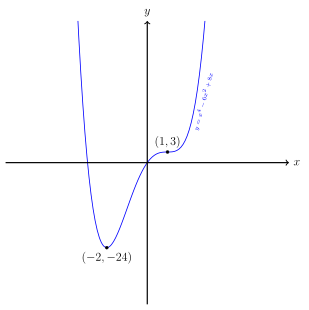
- Sketch the curve \(y= x^4-6x^2+9\) giving the coordinates of the stationary points. Let \(n\) be the number of distinct real values of \(x\) for which
\[
x^4-6x^2 +b=0.
\]
State the values of \(b\), if any, for which
- \(n=0\,\);
- \(n=1\,\);
- \(n=2\,\);
- \(n=3\,\);
- \(n=4\,\).
- For which values of \(a\) does the curve \(y= x^4-6x^2 +ax +b\) have a point at which both \(\dfrac{\d y}{\d x}=0\) and \(\dfrac{\d^2y}{\d x^2}=0\,\)? For these values of \(a\), find the number of distinct real values of \(x\) for which \(\vphantom{\dfrac{A}{B}}\) \[ x^4-6x^2 +ax +b=0\,, \] in the different cases that arise according to the value of \(b\).
- Sketch the curve \(y= x^4-6x^2 +ax\) in the case \(a>8\,\).
Solution:
- \(\,\)

- \(n = 0\) if \(b > 9\)
- \(n = 1\) is not possible, since by symmetry if \(x\) is a root, so is \(-x\), and \(0\) can never be the only root.
- \(n = 2\) if \(b < 0\) or \(b = 9\)
- \(n = 3\) if \(b = 0\)
- \(n = 4\) if \(0 < b < 9\)
- \(\,\) \begin{align*}
&& y' &= 4x^3-12x+a \\
&& y'' &= 12x^2-12 \\
\Rightarrow && x &= \pm 1 \\
\Rightarrow && 0 &= 4(\pm 1) - 12 (\pm 1) + a \\
&&&= a \mp 8 \\
\Rightarrow && a &= \pm 8
\end{align*}
When \(a = 8\), we have \(y = x^4-6x^2+8x\) and
\begin{align*}
&&y' &= 4x^3-12x+8 \\
&&&= 4(x^3-3x+2) \\
&&&= 4(x-1)^2(x+2) \\
\Rightarrow && y(1) &= 3\\
&& y(-2) &= -24
\end{align*}
Therefore there are no solutions if \(b > 24\), one solution if \(b = 24\) and two solutions otherwise. Similarly, if \(a = -8\), we have \(y = x^4 - 6x^2-8x\) \begin{align*} && y' &= 4x^3-12x-8 \\ &&&= 4(x^3-3x-2) \\ &&&= 4(x-2)(x+1)^2 \end{align*} So we have stationary points at \(x = 2\) and \(x = -1\) (which is also a inflection point) and at \(x = 2\) \(y = -24\), so we have the same story: there are no solutions if \(b > 24\), one solution if \(b = 24\) and two solutions otherwise.
- \(\,\)
