Problems
Filters
40 problems found
2019 Paper 3 Q10
Two identical smooth spheres \(P\) and \(Q\) can move on a smooth horizontal table. Initially, \(P\) moves with speed \(u\) and \(Q\) is at rest. Then \(P\) collides with \(Q\). The direction of travel of \(P\) before the collision makes an acute angle \(\alpha\) with the line joining the centres of \(P\) and \(Q\) at the moment of the collision. The coefficient of restitution between \(P\) and \(Q\) is \(e\) where \(e < 1\). As a result of the collision, \(P\) has speed \(v\) and \(Q\) has speed \(w\), and \(P\) is deflected through an angle \(\theta\).
- Show that $$u \sin \alpha = v \sin(\alpha + \theta)$$ and find an expression for \(w\) in terms of \(v\), \(\theta\) and \(\alpha\).
- Show further that $$\sin \theta = \cos(\theta + \alpha) \sin \alpha + e \sin(\theta + \alpha) \cos \alpha$$ and find an expression for \(\tan \theta\) in terms of \(\tan \alpha\) and \(e\). Find, in terms of \(e\), the maximum value of \(\tan \theta\) as \(\alpha\) varies.
Solution:
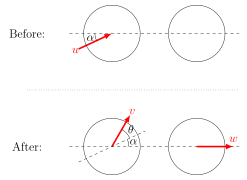
- Since the impulse is along the line of centres, the velocities are as show in the diagram. Additionally, vertical velocity is unchanged, so: \(v \sin (\theta + \alpha) = u \sin \alpha\) \begin{align*} \text{COM}(\rightarrow): && u \cos\alpha &= v \cos(\alpha + \theta) + w \\ \Rightarrow && w &= u \cos \alpha - v \cos (\alpha + \theta) \end{align*}
- Since the approach speed (horizontally) is \(u \cos \alpha\) the speed of separation is \(e u \cos \alpha\), in particular \(w - v \cos(\theta + \alpha) = e u \cos \alpha\) or \(w = v \cos (\theta + \alpha) + e u \cos \alpha\). \begin{align*} && w &= w \\ && v \cos (\theta + \alpha) + e u \cos \alpha &= u \cos \alpha - v \cos (\alpha + \theta) \\ \Rightarrow && \frac{u \sin \alpha}{\sin (\alpha + \theta)} \cos (\theta + \alpha) + e u \cos \alpha &= u \cos \alpha - \frac{u \sin \alpha}{\sin (\alpha + \theta)} \cos (\alpha + \theta) \\ \Rightarrow && \sin \alpha \cos(\theta + \alpha) + e \sin (\alpha+\theta)\cos \alpha &= \sin(\alpha+\theta) \cos \alpha - \cos(\alpha+\theta)\sin \alpha \\ &&&= \sin ((\alpha+\theta)-\alpha) \\ &&&= \sin \theta \end{align*} as required. \begin{align*} && \sin \theta &= \cos(\theta+ \alpha)\sin \alpha + e \sin (\theta + \alpha) \cos \alpha \\ &&&= \cos \theta \cos \alpha \sin \alpha - \sin \theta \sin^2 \alpha + e \sin \theta \cos ^2 \alpha + e \cos \theta \sin \alpha \cos \alpha \\ \Rightarrow && \tan \theta \sec^2 \alpha &= \tan \alpha - \tan \theta \tan^2 \alpha + e \tan \theta + e \tan \alpha \\ \Rightarrow && \tan \theta (1 + \tan^2 \alpha+\tan^2 \alpha-e) &= \tan \alpha + e \tan \alpha \\ \Rightarrow && \tan \theta &= \frac{(1+e)\tan \alpha}{1-e + 2\tan^2 \alpha} \end{align*} We seek to maximise \(y = \frac{x}{c+2x^2}\), \begin{align*} && \frac{\d y}{\d x} &= \frac{c+2x^2-4x^2}{(c+2x^2)^2} \\ &&&= \frac{c-2x^2}{(c+2x^2)^2} \end{align*} Therefore the maximum will occur at \(x = \sqrt{c/2}\), ie \(\tan \alpha = \sqrt{(1-e)/2}\) and theta will be \(\displaystyle \frac{(1+e)\sqrt{(1-e)/2}}{2(1-e)} =\frac{1}{2\sqrt{2}} \frac{1+e}{\sqrt{1-e}}\)
2018 Paper 3 Q11
A particle is attached to one end of a light inextensible string of length \(b\). The other end of the string is attached to a fixed point \(O\). Initially the particle hangs vertically below \(O\). The particle then receives a horizontal impulse. The particle moves in a circular arc with the string taut until the acute angle between the string and the upward vertical is \(\alpha\), at which time it becomes slack. Express \(V\), the speed of the particle when the string becomes slack, in terms of \( b\), \(g\) and \(\alpha\). Show that the string becomes taut again a time \(T\) later, where \[ gT = 4V \sin\alpha \,,\] and that just before this time the trajectory of the particle makes an angle \(\beta \) with the horizontal where \(\tan\beta = 3\tan \alpha \,\). When the string becomes taut, the momentum of the particle in the direction of the string is destroyed. Show that the particle comes instantaneously to rest at this time if and only if \[ \sin^2\alpha = \dfrac {1+\sqrt3}4 \,. \]
Solution:

2017 Paper 1 Q11
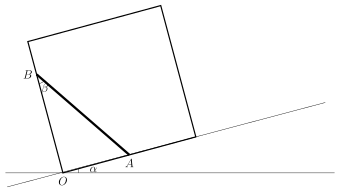
A plane makes an acute angle \(\alpha\) with the horizontal. A box in the shape of a cube is fixed onto the plane in such a way that four of its edges are horizontal and two of its sides are vertical. A uniform rod of length \(2L\) and weight \(W\) rests with its lower end at \(A\) on the bottom of the box and its upper end at \(B\) on a side of the box, as shown in the diagram below. The vertical plane containing the rod is parallel to the vertical sides of the box and cuts the lowest edge of the box at \(O\). The rod makes an acute angle~\(\beta\) with the side of the box at \(B\). The coefficients of friction between the rod and the box at the two points of contact are both \(\tan \gamma\), where \(0 < \gamma < \frac12\pi\). %The frictional force on the rod at \(A\) acts toward \(O\), %and the frictional force on the rod at~\(B\) %acts away from \(O\). The rod is in limiting equilibrium, with the end at \(A\) on the point of slipping in the direction away from \(O\) and the end at \(B\) on the point of slipping towards \(O\). Given that \(\alpha < \beta\), show that \(\beta = \alpha + 2\gamma\). [\(Hint\): You may find it helpful to take moments about the midpoint of the rod.]
Solution:

2016 Paper 2 Q11
- Two particles move on a smooth horizontal surface. The positions, in Cartesian coordinates, of the particles at time \(t\) are \((a+ut\cos\alpha \,,\, ut\sin\alpha)\) and \((vt\cos\beta\,,\, b+vt\sin\beta )\), where \(a\), \(b\), \(u\) and \(v\) are positive constants, \(\alpha\) and \(\beta\) are constant acute angles, and \(t\ge0\). Given that the two particles collide, show that \[ u \sin(\theta+\alpha) = v\sin(\theta +\beta)\,, \] where \(\theta \) is the acute angle satisfying \(\tan\theta = \dfrac b a\).
- A gun is placed on the top of a vertical tower of height \(b\) which stands on horizontal ground. The gun fires a bullet with speed \(v\) and (acute) angle of elevation \(\beta\). Simultaneously, a target is projected from a point on the ground a horizontal distance \(a\) from the foot of the tower. The target is projected with speed \(u\) and (acute) angle of elevation \(\alpha\), in a direction directly away from the tower. Given that the target is hit before it reaches the ground, show that \[ 2u\sin\alpha (u\sin\alpha - v\sin\beta) > bg\,. \] Explain, with reference to part (i), why the target can only be hit if \(\alpha > \beta\).
Solution:
- The particles collide if there exists a time when \begin{align*} && a + ut \cos \alpha &= vt \cos \beta \\ \Rightarrow && t (v \cos \beta-u \cos \alpha) &= a\\ && ut \sin \alpha &= b + vt \sin \beta \\ \Rightarrow && t(u \sin \alpha - v \sin \beta) &= b\\ \Rightarrow && a(u\sin \alpha - v \sin \beta) &= b(v \cos \beta - u \cos \alpha) \\ \Rightarrow && u(a \sin \alpha + b \cos \alpha) &= v (b \cos \beta + a \sin \beta) \\ \Rightarrow && u \sin (\alpha + \theta) &= v \sin (\beta + \theta) \end{align*}
- The path of the bullet is \((vt \cos \beta, b + vt \sin \beta -\frac12 g t^2)\). The path of the target is \((a+ut \cos \alpha, ut \sin \alpha - \frac12 g t^2)\). By comparing components as in part (i) and noting the acceleration doesn't change the story, we can see that \(t(u \sin \alpha - v \sin \beta) = b\) and we also need \(u t \sin \alpha - \frac12 gt^2 >0\) or \(u \sin \alpha - \frac12 gt > 0\) \begin{align*} && u \sin \alpha & > \frac12 gt \\ && 2u \sin \alpha & > g \frac{b}{(u \sin \alpha - v \sin \beta)} \\ \Rightarrow && 2u \sin \alpha( u \sin \alpha - v \sin \beta) & > gb \end{align*} Notice we must have \(u \sin \alpha > v \sin \beta\) and \(u \sin (\alpha + \theta) = v \sin (\beta + \theta)\) so \( \frac{\sin \alpha}{\sin (\alpha + \theta)} > \frac{\sin \beta}{\sin (\beta + \theta)}\), but if we consider \(f(t) = \frac{\sin t}{\sin(t+x)}\) we can see \(f'(t) = \frac{\cos t \sin(t + x) - \sin t \cos(t+x)}{\sin^2(t+x)} = \frac{\sin x}{\sin^2(t+x)} > 0\) is increasing, therefore \(\alpha > \beta\).
2015 Paper 2 Q6
- Show that \[ \mathrm{sec}^2\left(\tfrac14\pi-\tfrac12 x\right)=\frac{2}{1+\sin x} \,. \] Hence integrate \(\dfrac{1}{1+\sin x}\) with respect to \(x\).
- By means of the substitution \(y=\pi -x\), show that \[ \int_0^\pi x \f (\sin x)\, \d x = \frac \pi 2 \int_0^\pi \f(\sin x) \, \d x ,\] where \(\mathrm{f}\) is any function for which these integrals exist. Hence evaluate \[ \int_0^\pi \frac x {1+\sin x} \, \d x \,. \]
- Evaluate \[ \int_0^\pi\frac{ 2x^3 -3\pi x^2}{(1+\sin x)^2}\, \d x .\]
Solution:
- \(\,\) \begin{align*} && \sec^2\left(\tfrac14\pi-\tfrac12 x\right) &= \frac{1}{\cos^2 \left(\tfrac14\pi-\tfrac12 x\right)} \\ &&&= \frac{1}{\frac{1+\cos 2\left(\tfrac14\pi-\tfrac12 x\right)}{2}} \\ &&&= \frac{2}{1 + \cos \left(\tfrac12\pi- x\right)} \\ &&&= \frac{2}{1+\sin x} \\ \\ && \int \frac{1}{1+\sin x} \d x &= \int \tfrac12\sec^2\left(\tfrac14\pi-\tfrac12 x\right) \d x\\ &&&= - \tan\left(\tfrac14\pi-\tfrac12 x\right) + C \end{align*}
- \(\,\) \begin{align*} && I &= \int_0^{\pi} x f(\sin x) \d x \\ y = \pi - x, \d y = - \d x: &&&= \int_{y=\pi}^{y = 0} (\pi - y) f(\sin(\pi - y))(-1) \d y \\ &&&= \int_0^\pi (\pi - y) f(\sin y) \d y \\ &&&= \pi \int_0^\pi f(\sin y) \d y - I \\ \Rightarrow && I &= \frac{\pi}{2} \int_0^\pi f(\sin x) \d x \\ \\ \Rightarrow && \int_0^{\pi} \frac{x}{1 + \sin x} \d x &= \frac{\pi}{2} \int_0^{\pi} \frac{1}{1 + \sin x} \d x\\ &&&=\frac{\pi}{2} \left [- \tan\left(\tfrac14\pi-\tfrac12 x\right) \right]_0^{\pi} \\ &&&= \frac{\pi}{2} \left (-\tan (-\tfrac{\pi}{4}) + \tan \tfrac{\pi}{4} \right) \\ &&&= \pi \end{align*}
- \(\,\) \begin{align*} && J &= \int_0^{\pi} \frac{2x^3-3\pi x^2}{(1+\sin x)^2} \d x \\ y = \pi - x: &&&= \int_0^{\pi} \frac{2(\pi-y)^3-3\pi (\pi - y)^2}{(1+\sin x)^2 } \d y \\ &&&= \int_0^{\pi} \frac{-2 y^3 + 3 \pi y^2 - \pi^3}{(1+ \sin x)^2}\\ &&&= -\pi^3 \int_0^{\pi} \frac{1}{(1 + \sin x)^2} \d x -J \\ \Rightarrow && J &= -\frac{\pi^3}{2} \int_0^{\pi} \frac{1}{(1 + \sin x)^2} \d x\\ &&&= -\frac{\pi^3}{2} \int_0^\pi \tfrac14 \sec^4\left(\tfrac14\pi-\tfrac12 x\right) \d x \\ &&&= -\frac{\pi^3}{8} \int_0^\pi \sec^2\left(\tfrac14\pi-\tfrac12 x\right)\left (1 + \tan^2\left(\tfrac14\pi-\tfrac12 x\right) \right) \d x \\ &&&= -\frac{\pi^3}{8} \left [-\frac23 \tan^3\left(\tfrac14\pi-\tfrac12 x\right) - 2 \tan\left(\tfrac14\pi-\tfrac12 x\right) \right]_0^{\pi} \\ &&&= -\frac{\pi^3}{8} \left (\frac43+4 \right) \\ &&&= -\frac{2\pi^3}{3} \end{align*}
2014 Paper 2 Q9
A uniform rectangular lamina \(ABCD\) rests in equilibrium in a vertical plane with the \(A\) in contact with a rough vertical wall. The plane of the lamina is perpendicular to the wall. It is supported by a light inextensible string attached to the side \(AB\) at a distance \(d\) from \(A\). The other end of the string is attached to a point on the wall above \(A\) where it makes an acute angle \(\theta\) with the downwards vertical. The side \(AB\) makes an acute angle \(\phi\) with the upwards vertical at \(A\). The sides \(BC\) and \(AB\) have lengths \(2a\) and \(2b\) respectively. The coefficient of friction between the lamina and the wall is \(\mu\).
- Show that, when the lamina is in limiting equilibrium with the frictional force acting upwards, \begin{equation} d\sin(\theta +\phi) = (\cos\theta +\mu \sin\theta)(a\cos\phi +b\sin\phi)\,. \tag{\(*\)} \end{equation}
- How should \((*)\) be modified if the lamina is in limiting equilibrium with the frictional force acting downwards?
- Find a condition on \(d\), in terms of \(a\), \(b\), \(\tan\theta\) and \(\tan\phi\), which is necessary and sufficient for the frictional force to act upwards. Show that this condition cannot be satisfied if \(b(2\tan\theta+ \tan \phi) < a\).
Solution:
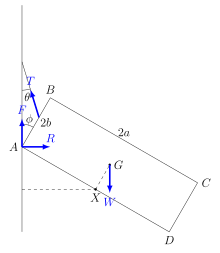
- \begin{align*} \text{N2}(\uparrow): && T \cos \theta + F -W &= 0 \\ && W &= T\cos \theta + \mu R \tag{1} \\ \text{N2}(\rightarrow): && R-T\sin \theta &= 0 \\ && R &= T \sin \theta \tag{2}\\ \\ (1)+(2): && W&=(\cos \theta + \mu \sin \theta)T \tag{3} \\ \overset{\curvearrowright}{A}: && 0 &= W(b\sin \phi + a \cos \phi) - Td\sin(\phi+\theta) \tag{4} \\ \\ (3)+(4): && 0 &= (\cos \theta + \mu \sin \theta)(b\sin \phi + a \cos \phi)-d\sin(\phi+\theta) \\ \Rightarrow && d\sin(\phi+\theta) &= (\cos \theta + \mu \sin \theta)(b\sin \phi + a \cos \phi) \end{align*} as required.
- If \(F\) is operating downwards, it's equivalent to \(-\mu\), ie: \[d\sin(\phi+\theta) = (\cos \theta - \mu \sin \theta)(b\sin \phi + a \cos \phi)\]
- For the frictional force to be acting upwards, we need \begin{align*} && d\sin(\phi+\theta) &\geq \cos \theta(b\sin \phi + a \cos \phi) \\ \Rightarrow && d &\geq \frac{\cos \theta(b\sin \phi + a \cos \phi)}{\sin(\phi + \theta)} \\ &&&= \frac{\cos \theta(b\sin \phi + a \cos \phi)}{\sin\phi \cos\theta+\cos\phi\sin \theta)}\\ &&&= \frac{(b\sin \phi + a \cos \phi)}{\sin\phi+\cos \phi \tan \theta)}\\ &&&= \frac{a+b\tan \phi}{\tan\theta+\tan\phi }\\ \end{align*} We know that \(d < 2b\), so \begin{align*} && 2b &>\frac{a+b\tan \phi}{\tan\theta+\tan\phi }\\ \Rightarrow && 2b \tan \theta + 2b \tan \phi &> a + b \tan \phi \\ \Rightarrow &&b(2 \tan \theta + \tan \phi) &> a\\ \end{align*} Therefore we will have problems if the inequality is reversed!
2013 Paper 1 Q11
\(\,\)
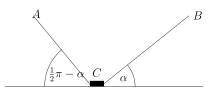
- In the case \(W> T\sin(\alpha+\beta)\), show that the block will remain at rest provided \[ W\sin\lambda \ge T\cos(\alpha+\beta- \lambda)\,, \] where \(\lambda\) is the acute angle such that \(\tan\lambda = \mu\).
- In the case \(W=T\tan\phi\), where \(2\phi =\alpha+\beta\), show that the block will start to move in a direction that makes an angle \(\phi\) with the horizontal.
Solution:
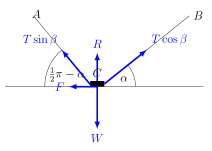
- Assuming the block is at rest we must have: \begin{align*} \text{N2}(\uparrow): && 0 &= T \sin \beta\cos \alpha + T \cos \beta \sin \alpha +R -W \\ \Rightarrow && W &> T \sin \beta\cos \alpha + T \cos \beta \sin \alpha \\ &&&= T\sin(\alpha+\beta) \\ \Rightarrow && R &= W-T\sin(\alpha+\beta)\\ \\ \text{N2}(\rightarrow): && 0 &= T \cos \beta \cos \alpha - T \sin \beta \sin \alpha - F \\ \Rightarrow && T \cos(\alpha+\beta) &= F \\ &&&\leq \mu (W-T\sin(\alpha+\beta)) \\ \Rightarrow && W \sin \lambda &\geq T \cos (\alpha+\beta)\cos \lambda +T \sin (\alpha+\beta) \sin \lambda \\ &&&= T\cos(\alpha+\beta-\lambda) \end{align*}
- If \(W = T\tan \phi\) where \(2\phi = \alpha + \beta\) then \begin{align*} \text{N2}(\uparrow): && ma_y &= T\sin(\alpha+\beta) - W \\ &&&= T \sin(\alpha+\beta) - T \tan \left ( \frac{\alpha+\beta}{2} \right ) \\ &&&= T \tan \left ( \frac{\alpha+\beta}{2} \right ) \left ( 2 \cos^2 \left ( \frac{\alpha+\beta}{2} \right ) -1\right) \\ &&&= T \tan \phi \cos \left ( \alpha+\beta\right ) \tag{notice this is positive so \(R=F=0\)} \\ \text{N2}(\rightarrow): && ma_x &= T \cos(\alpha+\beta) \\ \Rightarrow && \frac{a_y}{a_x} &= \tan \phi \end{align*} Therefore we are accelerating at an angle \(\phi\) to the horizontal
2013 Paper 2 Q10
A particle is projected at an angle of elevation \(\alpha\) (where \(\alpha>0\)) from a point \(A\) on horizontal ground. At a general point in its trajectory the angle of elevation of the particle from \(A\) is \(\theta\) and its direction of motion is at an angle \(\phi\) above the horizontal (with \(\phi\ge0\) for the first half of the trajectory and \(\phi\le0\) for the second half). Let \(B\) denote the point on the trajectory at which \(\theta = \frac12 \alpha\) and let \(C\) denote the point on the trajectory at which \(\phi = -\frac12\alpha\).
- Show that, at a general point on the trajectory, \(2\tan\theta = \tan \alpha + \tan\phi\,\).
- Show that, if \(B\) and \(C\) are the same point, then \( \alpha = 60^\circ\,\).
- Given that \(\alpha < 60^\circ\,\), determine whether the particle reaches the point \(B\) first or the point \(C\) first.
2013 Paper 3 Q4
Show that \((z-\e^{i\theta})(z-\e^{-i\theta})=z^2 -2z\cos\theta +1\,\). Write down the \((2n)\)th roots of \(-1\) in the form \(\e^{i\theta}\), where \(-\pi <\theta \le \pi\), and deduce that \[ z^{2n} +1 = \prod_{k=1}^n \left(z^2-2z \cos\left( \tfrac{(2k-1)\pi}{2n}\right) +1\right) \,. \] Here, \(n\) is a positive integer, and the \(\prod\) notation denotes the product.
- By substituting \(z=i\) show that, when \(n\) is even, \[ \cos \left(\tfrac \pi {2n}\right) \cos \left(\tfrac {3\pi} {2n}\right) \cos \left(\tfrac {5\pi} {2n}\right) \cdots \cos \left(\tfrac{(2n-1) \pi} {2n}\right) = {(-1\vphantom{\dot A})}^{\frac12 n} 2^{1-n} \,. \]
- Show that, when \(n\) is odd, \[ \cos^2 \left(\tfrac \pi {2n}\right) \cos ^2 \left(\tfrac {3\pi} {2n}\right) \cos ^2 \left(\tfrac {5\pi} {2n}\right) \cdots \cos ^2 \left(\tfrac{(n-2) \pi} {2n}\right) = n 2^{1-n} \,. \] You may use without proof the fact that \(1+z^{2n}= (1+z^2)(1-z^2+z^4 - \cdots + z^{2n-2})\,\) when \(n\) is odd.
Solution: \begin{align*} && (z-e^{i \theta})(z-e^{-i\theta}) &= z^2 - (e^{i\theta}+e^{-i\theta})z + 1 \\ &&&= z^2-2\cos \theta z + 1 \end{align*} The \(2n\)th roots of \(-1\) are \(e^{\frac{i (2k+1)\pi}{2n}}, k \in \{-n, \cdots, n-1 \}\) or \(e^{\frac{i k \pi}{2n}}, k \in \{-2n+1, -2n+3, \cdots, 2n-3, 2n-1 \}\) \begin{align*} && z^{2n}+1 &= (z-e^{-i(2n-1)/2n})\cdot (z-e^{-i(2n-3)/2n})\cdots (z-e^{i(2n-3)/2n})\cdot (z-e^{i(2n-1)/2n}) \\ &&&= \prod_{k=1}^n \left (z - e^{i \frac{2k-1}{2n}\pi} \right)\left (z - e^{-i \frac{2k-1}{2n}\pi} \right)\\ &&&= \prod_{k=1}^n \left (z^2 - 2z \cos \left ( \frac{(2k-1)\pi}{2n}\right) + 1 \right) \end{align*}
- \begin{align*} && i^{2n} + 1 &= \prod_{k=1}^n \left (i^2 - 2i \cos \left ( \frac{(2k-1)\pi}{2n}\right) + 1 \right) \\ \Rightarrow && (-1)^n + 1 &= (-1)^n2^ni^n\prod_{k=1}^n \cos \left ( \frac{(2k-1)\pi}{2n}\right) \\ \Rightarrow && \prod_{k=1}^n \cos \left ( \frac{(2k-1)\pi}{2n}\right) &= 2^{1-n}(-1)^{n/2} \tag{if \(n\equiv 0\pmod{2}\)} \end{align*}
- When \(n\) is odd, we notice that two of the roots are \(i\) and \(-i\), if we exclude those, (ie by factoring out \(z^2+1\), we see that \begin{align*} && 1-z^2+z^4-\cdots + z^{2n-2} &= \prod_{k=1, 2k-1\neq n}^n \left (z^2-2z \cos \left ( \frac{(2k-1)\pi}{2n} \right)+1 \right) \\ &&&= \prod_{k=1}^{(n-1)/2} \left (z^2-2z \cos \left ( \frac{(2k-1)\pi}{2n} \right)+1 \right) \prod_{k=(n+1)/2}^{n} \left (z^2-2z \cos \left ( \frac{(2k-1)\pi}{2n} \right)+1 \right)\\ &&&= \prod_{k=1}^{(n-1)/2} \left (z^2-2z \cos \left ( \frac{(2k-1)\pi}{2n} \right)+1 \right) \prod_{k=1}^{(n-1)/2} \left (z^2+2z \cos \left ( \frac{(2k-1)\pi}{2n} \right)+1 \right)\\ \Rightarrow && 1-i^2 + i^4 + \cdots + i^{2n-2} &= \prod_{k=1}^{(n-1)/2} \left (2 \cos \left ( \frac{(2k-1)\pi}{2n} \right) \right) \prod_{k=1}^{(n-1)/2} \left (2 \cos \left ( \frac{(2k-1)\pi}{2n} \right) \right)\\ \Rightarrow && n &= 2^{n-1} \prod_{k=1}^{(n-1)/2}\cos^2 \left ( \frac{(2k-1)\pi}{2n} \right) \\ \Rightarrow && \prod_{k=1}^{(n-1)/2}\cos^2 \left ( \frac{(2k-1)\pi}{2n} \right) &= n2^{1-n} \end{align*}
2012 Paper 1 Q6
A thin circular path with diameter \(AB\) is laid on horizontal ground. A vertical flagpole is erected with its base at a point \(D\) on the diameter \(AB\). The angles of elevation of the top of the flagpole from \(A\) and \(B\) are \(\alpha\) and \(\beta\) respectively (both are acute). The point \(C\) lies on the circular path with \(DC\) perpendicular to \(AB\) and the angle of elevation of the top of the flagpole from \(C\) is \(\phi\). Show that \(\cot\alpha\cot \beta = \cot^2\phi\). Show that, for any \(p\) and \(q\), \[ \cos p \cos q \sin^2\tfrac12(p+q) - \sin p\sin q \cos^2 \tfrac12 (p+q) = \tfrac12 \cos(p+q) -\tfrac12 \cos(p+q)\cos(p-q) .\] Deduce that, if \(p\) and \(q\) are positive and \( p+q \le \tfrac12 \pi\), then \[ \cot p\cot q\, \ge \cot^2 \tfrac12(p+q) \, \] and hence show that \(\phi \le \tfrac12(\alpha+\beta)\) when \( \alpha +\beta \le \tfrac12 \pi\,\).
Solution:

2012 Paper 3 Q5
- The point with coordinates \((a, b)\), where \(a\) and \(b\) are rational numbers,is called an integer rational point if both \(a\) and \(b\) are integers; a non-integer rational point if neither \(a\) nor \(b\) is an integer.
- \(\bf (a)\) Write down an integer rational point and a non-integer rational point on the circle \(x^2+y^2 =1\).
- [\bf (b)] Write down an integer rational point on the circle \(x^2+y^2=2\). Simplify \[ (\cos\theta + \sqrt m \sin\theta)^2 + (\sin\theta - \sqrt m \cos\theta)^2 \, \] and hence obtain a non-integer rational point on the circle \(x^2+y^2=2\,\).
- The point with coordinates \((p+\sqrt 2 \, q\,,\, r+\sqrt 2 \, s)\), where \(p\), \(q\), \(r\) and \(s\) are rational numbers, is called: an integer \(2\)-rational point if all of \(p\), \(q\), \(r\) and \(s\) are integers; a non-integer \(2\)-rational point if none of \(p\), \(q\), \(r\) and \(s\) is an integer.
- \(\bf (a)\) Write down an integer \(2\)-rational point, and obtain a non-integer \(2\)-rational point, on the circle \(x^2+y^2=3\,\).
- [\bf(b)] Obtain a non-integer \(2\)-rational point on the circle \(x^2+y^2=11\,\).
- [\bf(c)]Obtain a non-integer \(2\)-rational point on the hyperbola \(x^2-y^2 =7 \).
Solution:
- \(\bf (a)\) \((1, \sqrt2)\) is an integer \(2\)-rational point. \((\frac35 + \frac45\sqrt2, \frac45 - \frac{3}{5}\sqrt2)\) is a non-integer \(2\)-rational point.
- [\bf(b)] First notice that \((\sqrt2)^2 +3^2 = 11\) so then consider \((1 + \tfrac32\sqrt2, 1-\tfrac32\sqrt2)\) will work as \(\pi/4\) degree rotation.
- [\bf(c)] First notice \(3^2-(\sqrt2)^2 = 2\). Notice that \((k\sec \theta + \sqrt{m} \tan \theta)^2 - (k\tan \theta + \sqrt{m} \sec \theta)^2 = k^2-m\). Taking \(k= 3\) we have \((3 \cdot \frac{13}{5} + \frac{12}{5}\sqrt{2}, 3\cdot\frac{12}5+\frac{13}{5}\sqrt2)\)
2012 Paper 3 Q8
The sequence \(F_0\), \(F_1\), \(F_2\), \(\ldots\,\) is defined by \(F_0=0\), \(F_1=1\) and, for \(n\ge0\), \[ F_{n+2} = F_{n+1} + F_n \,. \]
- Show that \(F_0F_3-F_1F_2 = F_2F_5- F_3F_4\,\).
- Find the values of \(F_nF_{n+3} - F_{n+1}F_{n+2}\) in the two cases that arise.
- Prove that, for \(r=1\), \(2\), \(3\), \(\ldots\,\), \[ \arctan \left( \frac 1{F_{2r}}\right) =\arctan \left( \frac 1{F_{2r+1}}\right)+ \arctan \left( \frac 1{F_{2r+2}}\right) \] and hence evaluate the following sum (which you may assume converges): \[ \sum_{r=1}^\infty \arctan \left( \frac 1{F_{2r+1}}\right) \,. \]
2010 Paper 1 Q9

Solution:


2009 Paper 1 Q8
- The equation of the circle \(C\) is \[ (x-2t)^2 +(y-t)^2 =t^2, \] where \(t\) is a positive number. Show that \(C\) touches the line \(y=0\,\). Let \(\alpha\) be the acute angle between the \(x\)-axis and the line joining the origin to the centre of \(C\). Show that \(\tan2\alpha=\frac43\) and deduce that \(C\) touches the line \(3y=4x\,\).
- Find the equation of the incircle of the triangle formed by the lines \(y=0\), \(3y=4x\) and \(4y+3x=15\,\). Note: The incircle of a triangle is the circle, lying totally inside the triangle, that touches all three sides.
Solution:
- This is a circle centre \((2t,t)\) with radius \(t\). Therefore it is exactly \(t\) away from the line \(y = 0\) so just touches that line. Not that \(\tan \alpha = \frac{t}{2t} = \frac12\) so \(\tan 2\alpha = \frac{2\tan \alpha}{1-\tan^2\alpha} = \frac{1}{1-\frac14} = \frac43\). Therefore the line \(y = \frac43x\) or \(3y = 4x\) is tangent to \(C\).
- Note that \(3y=4x\) and \(4y+3x=15\) are perpendicular, so this is a right-angled triangle with incenter \((2t,t)\) for some \(t\) and hypotenuse \(15\) We can find the third coordinate when \(3y-4x = 0\) and \(4y+3x = 15\) meet, ie \((\frac{9}{5}, \frac{12}5)\) The incentre lies on the bisector of the right angle at this point, which is the line through \((\frac{9}{5}, \frac{12}5)\) and \((\frac{15}{2}, 0)\), so \begin{align*} && \frac{2t-\frac{12}{5}}{t - \frac{9}{5}} &= \frac{-\frac{12}{5}}{\frac{15}2-\frac95} \\ \Rightarrow && \frac{10t-12}{5t-9} &= \frac{-24}{57} = -\frac{8}{19} \\ \Rightarrow && 190t - 12 \cdot 19 &= -40t + 72 \\ \Rightarrow && t &= 2 \end{align*} Therefore the center is \((4, 2)\) and the equation is \((x-4)^2+(y-2)^2=2^2\)
2009 Paper 1 Q9
Two particles \(P\) and \(Q\) are projected simultaneously from points \(O\) and \(D\), respectively, where~\(D\) is a distance \(d\) directly above \(O\). The initial speed of \(P\) is \(V\) and its angle of projection {\em above} the horizontal is \(\alpha\). The initial speed of \(Q\) is \(kV\), where \(k>1\), and its angle of projection {\em below} the horizontal is \(\beta\). The particles collide at time \(T\) after projection. Show that \(\cos\alpha = k\cos\beta\) and that \(T\) satisfies the equation \[ (k^2-1)V^2T^2 +2dVT\sin\alpha -d^2 =0\,. \] Given that the particles collide when \(P\) reaches its maximum height, find an expression for~\(\sin^2\alpha\) in terms of \(g\), \(d\), \(k\) and \(V\), and deduce that \[ gd\le (1+k)V^2\,. \]