2017 Paper 1 Q11
Year: 2017
Paper: 1
Question Number: 11
Course: UFM Mechanics
Section: Moments
Problem
Solution

Examiner's report
— 2017 STEP 1, Question 11The pure questions were again the most popular of the paper with questions 1 and 3 being attempted by almost all candidates. The least popular questions on the paper were questions 10, 11, 12 and 13 and a significant proportion of attempts at these were brief, attracting few or no marks. Candidates generally demonstrated a high level of competence when completing the standard processes and there were many good attempts made when questions required explanations to be given, particularly within the pure questions. A common feature of the stronger responses to questions was the inclusion of diagrams.
Rating Information
Difficulty Rating: 1516.0
Difficulty Comparisons: 1
Banger Rating: 1500.0
Banger Comparisons: 0
Show LaTeX source
Problem source
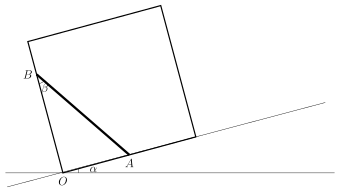
A plane makes an acute angle $\alpha$ with the horizontal.
A box in the shape of a cube is fixed  onto  the plane  in such a way that four of its edges are horizontal and two of its sides are vertical.
A uniform rod of length $2L$ and weight $W$ rests  with its lower end at $A$ on the bottom of the box and its upper end at $B$ on a side of the box, as shown in the diagram below.
The vertical plane containing the rod is parallel to the vertical sides of the box and cuts the lowest edge of the box at $O$. The rod makes an acute angle~$\beta$ with the side of the box at $B$.
The coefficients of friction between the rod and the box at the two points of contact are both $\tan \gamma$, where $0 <   \gamma < \frac12\pi$.
%The  frictional force on the rod at $A$ acts toward $O$,
%and the frictional force on the rod at~$B$
%acts away from $O$.
The rod is in limiting equilibrium, with the end at $A$ on the point of slipping in the direction away from $O$ and the end at $B$ on the point of slipping towards $O$. Given that $\alpha < \beta$, show that $\beta = \alpha + 2\gamma$.
[$\textbf{Hint}$: You may find it helpful to take moments about the midpoint of the rod.]
\begin{center}
\begin{tikzpicture}[scale=0.8]
    \coordinate (O) at (0,-3);
    \coordinate (B) at (-1.55,2.8);
    \coordinate (D) at (5.87,-1.41);
    \coordinate (C) at ($(D)+(B)-(O)$);
    \coordinate (A) at  ($(O)!0.5!(D)$);
    \coordinate (Bp) at ($(O)!0.75!(B)$);

    % Draw polygon
    \draw[line width=1.2pt] (O) -- (B) -- (C) -- (D) -- cycle;

    % Draw horizontal and sloped lines
    \draw (-2.54,-3) -- (12,-3);
    \draw (-2.46,-3.62) -- (11.59,0.11);

    % Draw thick line segment
    \draw[line width=2.3pt] (Bp) -- (A);

    % Add labels
    \node at (A) [anchor=north] {$A$};
    \node at (Bp) [anchor=east] {$B$};
    \node at (O) [anchor=north] {$O$};

    % Add angle marks
    \coordinate (angle1) at (1.4,-2.7);
    \node at (1,-2.85) [anchor=west] {$\alpha$};

    \coordinate (angle2) at (-0.8,0.8);
    \node at (-0.8,0.3) [anchor=south] {$\beta$};

    % Draw angle arcs
    \draw (0,-3) ++(0:0.7) arc (0:15:0.7);
    \draw (-1.21,1.52) ++(285:0.6) arc (285:315:0.6);
\end{tikzpicture}
\end{center}
Solution source
\begin{tikzpicture}[scale=0.8]
    % Coordinates
    \coordinate (O) at (0,-3);
    \coordinate (B) at (-1.55,2.8);
    \coordinate (D) at (5.87,-1.41);
    \coordinate (C) at ($(D)+(B)-(O)$);
    \coordinate (A) at  ($(O)!0.5!(D)$);
    \coordinate (Bp) at ($(O)!0.75!(B)$);

    % Draw polygon
    \draw[line width=1.2pt] (O) -- (B) -- (C) -- (D) -- cycle;

    % Draw horizontal and sloped lines
    \draw (-2.54,-3) -- (12,-3);
    \draw (-2.46,-3.62) -- (11.59,0.11);

    % Draw thick line segment
    \draw[line width=2.3pt] (Bp) -- (A);

    % Add labels
    \node at (A) [anchor=north] {$A$};
    \node at (Bp) [anchor=east] {$B$};
    \node at (O) [anchor=north] {$O$};

    % Add angle marks
    \coordinate (angle1) at (1.4,-2.7);
    \node at (1,-2.85) [anchor=west] {$\alpha$};

    \coordinate (angle2) at (-0.8,0.8);
    \node at (-0.8,0.3) [anchor=south] {$\beta$};

    % Draw angle arcs
    \draw (0,-3) ++(0:0.7) arc (0:15:0.7);
    \draw (-1.21,1.52) ++(285:0.6) arc (285:315:0.6);

    \draw[-latex, blue, ultra thick] (A) -- ++($0.4*(B)-0.4*(O)$) node[right] {$R_A$};
    \draw[-latex, blue, ultra thick] (A) -- ++($0.4*(O)-0.4*(A)$) node[above] {$Fr_A$};

    \draw[-latex, blue, ultra thick] (Bp) -- ++($0.4*(D)-0.4*(O)$) node[right] {$R_B$};
    \draw[-latex, blue, ultra thick] (Bp) -- ++($0.2*(B)-0.2*(O)$) node[above, left] {$Fr_B$};

    \draw[-latex, blue, ultra thick]  ($(A)!0.5!(Bp)$) -- ++(0,-0.8) node[below] {$W$};

\end{tikzpicture}

Since we're at limiting equilibrium and about to slip $Fr_B = \mu R_B$ and $Fr_A = \mu R_A$

\begin{align*}
    \text{N2}(\parallel OB): && \mu R_B + R_A - W \cos \alpha &= 0 \\
    \text{N2}(\parallel OA): && R_B - \mu R_A - W \sin \alpha &= 0 \\
    \\
    \Rightarrow && \sin\alpha \l \mu R_B + R_A \r - \cos \alpha \l R_B - \mu R_A \r &= 0 \\
    \Leftrightarrow && R_A(\sin \alpha + \mu \cos \alpha) - R_B(\cos \alpha - \mu \sin \alpha) &= 0 \\
    \Rightarrow && \frac{\tan \alpha + \mu}{1 - \mu \tan \alpha} R_A &=  R_B\\
    && \tan (\alpha + \gamma) R_A &= R_B \\
    \\
    \\
    \overset{\curvearrowleft}{\text{midpoint}}: && R_A \sin \beta - \mu R_A \cos \beta - R_B \cos \beta - \mu R_B \sin \beta &= 0\\
    \Rightarrow &&   \tan \beta - \mu   - \tan (\alpha + \gamma) - \mu \tan (\alpha + \gamma) \tan \beta &= 0\\
    \Rightarrow &&  \tan \beta \l 1 - \mu \tan (\alpha + \gamma) \r - \mu   - \tan (\alpha + \gamma)  &= 0\\
    \Rightarrow && \frac{\mu   + \tan (\alpha + \gamma)}{1 - \mu \tan (\alpha + \gamma)} &= \tan \beta \\
    \Rightarrow && \tan (\alpha + 2\gamma) &= \tan \beta
\end{align*}

Since $\alpha < \beta$ and $\gamma < \frac{\pi}{4}$ we must have $\alpha + 2\gamma = \beta$
While this question had the smallest number of attempts among the Mechanics questions, it did have the highest average mark. Many candidates were able to produce a diagram with the appropriate forces labelled and realised that the usual procedures of resolving in two directions and taking moments about a point would be a sensible approach. Despite the hint that taking moments about the midpoint of the rod might be helpful, a number of candidates chose to take moments about one of the ends of the rod, which led to more complicated sets of equations to solve. The manipulation of the trigonometric terms proved challenging for many candidates, but a number did manage to work through to a clear and full solution to the problem.