Problems
Filters
23 problems found
2023 Paper 2 Q9
A truck of mass \(M\) is connected by a light, rigid tow-bar, which is parallel to the ground, to a trailer of mass \(kM\). A constant driving force \(D\) which is parallel to the ground acts on the truck, and the only resistance to motion is a frictional force acting on the trailer, with coefficient of friction \(\mu\).
- When the truck pulls the trailer up a slope which makes an angle \(\alpha\) to the horizontal, the acceleration is \(a_1\) and there is a tension \(T_1\) in the tow-bar.
- When the truck pulls the trailer on horizontal ground, the acceleration is \(a_2\) and there is a tension \(T_2\) in the tow-bar.
- When the truck pulls the trailer down a slope which makes an angle \(\alpha\) to the horizontal, the acceleration is \(a_3\) and there is a tension \(T_3\) in the tow-bar.
- Show that \(T_1 = T_3\) and that \(M(a_1 + a_3 - 2a_2) = 2(T_2 - T_1)\).
- It is given that \(\mu < 1\).
- Show that \[a_2 < \tfrac{1}{2}(a_1 + a_3) < a_3\,.\]
- Show further that \[a_1 < a_2\,.\]
2021 Paper 2 Q9
Two particles, of masses \(m_1\) and \(m_2\) where \(m_1 > m_2\), are attached to the ends of a light, inextensible string. A particle of mass \(M\) is fixed to a point \(P\) on the string. The string passes over two small, smooth pulleys at \(Q\) and \(R\), where \(QR\) is horizontal, so that the particle of mass \(m_1\) hangs vertically below \(Q\) and the particle of mass \(m_2\) hangs vertically below~\(R\). The particle of mass \(M\) hangs between the two pulleys with the section of the string \(PQ\) making an acute angle of \(\theta_1\) with the upward vertical and the section of the string \(PR\) making an acute angle of \(\theta_2\) with the upward vertical. \(S\) is the point on \(QR\) vertically above~\(P\). The system is in equilibrium.
- Using a triangle of forces, or otherwise, show that:
- \(\sqrt{m_1^2 - m_2^2} < M < m_1 + m_2\)\,;
- \(S\) divides \(QR\) in the ratio \(r : 1\), where \[ r = \frac{M^2 - m_1^2 + m_2^2}{M^2 - m_2^2 + m_1^2}. \]
- You are now given that \(M^2 = m_1^2 + m_2^2\). Show that \(\theta_1 + \theta_2 = 90^\circ\) and determine the ratio of \(QR\) to \(SP\) in terms of the masses only.
2021 Paper 3 Q10
The origin \(O\) of coordinates lies on a smooth horizontal table and the \(x\)- and \(y\)-axes lie in the plane of the table. A cylinder of radius \(a\) is fixed to the table with its axis perpendicular to the \(x\)--\(y\) plane and passing through \(O\), and with its lower circular end lying on the table. One end, \(P\), of a light inextensible string \(PQ\) of length \(b\) is attached to the bottom edge of the cylinder at \((a, 0)\). The other end, \(Q\), is attached to a particle of mass \(m\), which rests on the table. Initially \(PQ\) is straight and perpendicular to the radius of the cylinder at \(P\), so that \(Q\) is at \((a, b)\). The particle is then given a horizontal impulse parallel to the \(x\)-axis so that the string immediately begins to wrap around the cylinder. At time \(t\), the part of the string that is still straight has rotated through an angle \(\theta\), where \(a\theta < b\).
- Obtain the Cartesian coordinates of the particle at this time. Find also an expression for the speed of the particle in terms of \(\theta\), \(\dot{\theta}\), \(a\) and \(b\).
- Show that \[ \dot{\theta}(b - a\theta) = u, \] where \(u\) is the initial speed of the particle.
- Show further that the tension in the string at time \(t\) is \[ \frac{mu^2}{\sqrt{b^2 - 2aut}}. \]
Solution:
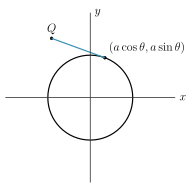
- The line to the circle is tangent, and the point it meets the circle is \((a \cos \theta, a \sin \theta)\) and it will be a distance \(b - a \theta\) away, therefore it is at \((a \cos \theta - (b-a \theta) \sin \theta, a \sin \theta + (b-a \theta) \cos \theta)\)
- The velocity will be \(\displaystyle \binom{-a \dot{\theta}\sin \theta-b \dot{\theta}\cos \theta + a \dot{\theta} \sin \theta + a \theta \dot{\theta} \cos \theta}{ a \dot{\theta} \cos \theta - b \dot{\theta} \sin \theta -a \dot{\theta} \cos \theta + a \theta \dot{\theta} \sin \theta}= \binom{-b \dot{\theta}\cos \theta + a \theta \dot{\theta} \cos \theta}{ - b \dot{\theta} \sin \theta + a \theta \dot{\theta} \sin \theta}\) Therefore the speed will be \(\dot{\theta}(b-a\theta)\)
- Conservation of energy and the fact that the tension is perpendicular to the velocity means no work is being done on the particle and hence it's speed is unchanged. So \(u = \dot{\theta}(b-a\theta)\).
- Note that the acceleration is \begin{align*} && \mathbf{a} &= \frac{\d}{\d t} \left (-\dot{\theta}(b-a\theta) \binom{\cos \theta}{\sin \theta} \right) \\ &&&=-u \dot{\theta}\binom{-\sin \theta}{\cos \theta} \\ \Rightarrow && T &= ma \\ &&&= \frac{mu^2}{b - a \theta} \end{align*} It would be valuable to have \(\theta\) in terms of \(t\), so we want to solve \begin{align*} &&\frac{\d \theta}{\d t} (b-a\theta) &= u \\ \Rightarrow && b \theta - a\frac{\theta^2}{2} + C &= ut \\ t = 0, \theta = 0: && C &= 0 \\ \Rightarrow && b\theta - \frac{a}{2} \theta^2 &= ut \\ \Rightarrow && \theta &= \frac{b \pm \sqrt{b^2-2aut}}{a} \end{align*} At \(t\) increases, \(\theta\) increases so \(a\theta = b -\sqrt{b^2-2aut}\) or \(b-a \theta = \sqrt{b^2-2aut}\) and the result follows
2018 Paper 1 Q10
A train is made up of two engines, each of mass \(M\), and \(n\) carriages, each of mass \(m\). One of the engines is at the front of the train, and the other is coupled between the \(k\)th and \((k+1)\)th carriages. When the train is accelerating along a straight, horizontal track, the resistance to the motion of each carriage is \(R\) and the driving force on each engine is \(D\), where \(2D >nR\,\). The tension in the coupling between the engine at the front and the first carriage is \(T\).
- Show that \[ T = \frac{n(mD+MR)}{nm+2M}\,. \]
- Show that \(T\) is greater than the tension in any other coupling provided that \(k> \frac12n\,\).
- Show also that, if \(k> \frac12n\,\), then at least one of the couplings is in compression (that is, there is a negative tension in the coupling).
Solution:
- \(\,\)
\begin{align*} \text{N2}(\leftarrow, \text{first engine}): && D-T &= Ma \\ \text{N2}(\leftarrow, \text{rest of train}): && T-nR+D &= (M+nm)a \\ \Rightarrow && \frac{D-T}{M} &= \frac{T+D-nR}{M+nm} \\ \Rightarrow && T \left ( \frac{1}{M+nm}+\frac{1}{M} \right) &= \frac{D}{M} + \frac{nR-D}{M+nm} \\ \Rightarrow && T \left ( 2M+nm\right) &= DM +Dnm + nRM - DM \\ &&&= n(mD+MR) \\ \Rightarrow && T &= \frac{n(mD+MR)}{2M+nm} \end{align*}
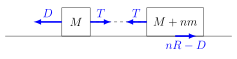
- The greatest coupling must occur behind an engine, because each carriage behind an engine acts as a drag.
Therefore we need only consider the couple between the second engine and the rest of the carriages:
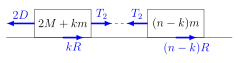
\begin{align*} \text{N2}(\leftarrow, \text{up to second engine}): && 2D - T_2 - kR &= (2M+km)a \\ \text{N2}(\leftarrow, \text{everything else}): && T_2 - (n-k)R &= (n-k)ma \\ \Rightarrow && \frac{2D-T_2-kR}{2M+km} &= \frac{T_2-(n-k)R}{(n-k)m} \\ \Rightarrow && T_2 \left (\frac{1}{(n-k)m} + \frac{1}{2M+km} \right) &= \frac{2D-kR}{2M+km} + \frac{R}{m} \\ \Rightarrow && T_2 \left (2M+ nm \right) &= (2D-kR)m(n-k) + R(2M+km)(n-k) \\ \Rightarrow && T_2 &= \frac{(n-k)\left (2Dm+2RM \right)}{2M+nm} \\ &&&= \frac{2(n-k)(mD + MR)}{2M+nm} \end{align*} Therefore \(T > T_2\) provided \(2(n-k) < n \Leftrightarrow k > \frac12n\)
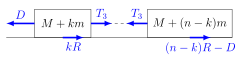
- If there is a coupling which is in negative tension, it must be between the two engines. In particular, if there is one, there must be one directly in front of the first engine.
\begin{align*} \text{N2}(\leftarrow, \text{before second engine}): && D - T_3 - kR &= (M+km)a \\ \text{N2}(\leftarrow, \text{everything else}): && T_3 +D- (n-k)R &= (M+(n-k)m)a \\ \Rightarrow && \frac{D-T_3-kR}{M+km} &= \frac{T_3+D-(n-k)R}{M+(n-k)m} \\ \Rightarrow && T_3 \left ( \frac{1}{M+(n-k)m} + \frac{1}{M+km} \right) &= \frac{D-(n-k)R}{M+(n-k)m}+\frac{kR-D}{M+km} \\ \Rightarrow && T_3 (2M+nm) &= (D-(n-k)R)(M+km)+(kR-D)(M+(n-k)m) \\ &&&= D(M+km-M-(n-k)m) + R(kM+k(n-k)m-(n-k)M-k(n-k)m) \\ &&&= D(n-2k)m+RM(2k-n)m \\ &&&= (n-2k)m(D-RM) \end{align*} Therefore \(T_3\) is negative if \(k > \frac12n\) so there are some connections in compression.
2018 Paper 3 Q11
A particle is attached to one end of a light inextensible string of length \(b\). The other end of the string is attached to a fixed point \(O\). Initially the particle hangs vertically below \(O\). The particle then receives a horizontal impulse. The particle moves in a circular arc with the string taut until the acute angle between the string and the upward vertical is \(\alpha\), at which time it becomes slack. Express \(V\), the speed of the particle when the string becomes slack, in terms of \( b\), \(g\) and \(\alpha\). Show that the string becomes taut again a time \(T\) later, where \[ gT = 4V \sin\alpha \,,\] and that just before this time the trajectory of the particle makes an angle \(\beta \) with the horizontal where \(\tan\beta = 3\tan \alpha \,\). When the string becomes taut, the momentum of the particle in the direction of the string is destroyed. Show that the particle comes instantaneously to rest at this time if and only if \[ \sin^2\alpha = \dfrac {1+\sqrt3}4 \,. \]
Solution:

2016 Paper 3 Q9
Three pegs \(P\), \(Q\) and \(R\) are fixed on a smooth horizontal table in such a way that they form the vertices of an equilateral triangle of side \(2a\). A particle \(X\) of mass \(m\) lies on the table. It is attached to the pegs by three springs, \(PX\), \(QX\) and \(RX\), each of modulus of elasticity \(\lambda\) and natural length \(l\), where \(l < \frac{ \ 2 }{\sqrt3}\, a\). Initially the particle is in equilibrium. Show that the extension in each spring is \(\frac{\ 2}{\sqrt3}\,a -l\,\). The particle is then pulled a small distance directly towards \(P\) and released. Show that the tension \(T\) in the spring \(RX\) is given by \[ T= \frac {\lambda} l \left( \sqrt{\frac {4a^2}3 + \frac{2ax}{\sqrt3} +x^2\; }\; -l\right) , \] where \(x\) is the displacement of \(X\) from its equilibrium position. Show further that the particle performs approximate simple harmonic motion with period \[ 2\pi \sqrt{ \frac{4mla}{3 (4a-\sqrt3 \, l)\lambda } \; }\,. \]
2015 Paper 2 Q10
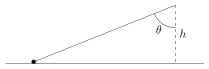
A particle of mass \(m\) is pulled along the floor of a room in a straight line by a light string which is pulled at constant speed \(V\) through a hole in the ceiling. The floor is smooth and horizontal, and the height of the room is \(h\). Find, in terms of \(V\) and \(\theta\), the speed of the particle when the string makes an angle of \(\theta\) with the vertical (and the particle is still in contact with the floor). Find also the acceleration, in terms of \(V\), \(h\) and \(\theta\). Find the tension in the string and hence show that the particle will leave the floor when \[ \tan^4\theta = \frac{V^2}{gh}\,. \]
Solution:
2014 Paper 1 Q11
The diagrams below show two separate systems of particles, strings and pulleys.In both systems, the pulleys are smooth and light, the strings are light and inextensible, the particles move vertically and the pulleys labelled with \(P\) are fixed. The masses of the particles are as indicated on the diagrams.
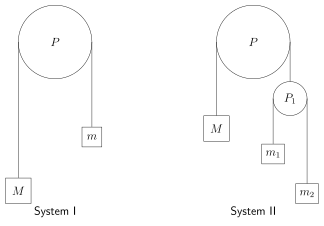
- For system I show that the acceleration, \(a_1\), of the particle of mass \(M\), measured in the downwards direction, is given by \[ a_1= \frac{M-m}{M+m} \, g \,, \] where \(g\) is the acceleration due to gravity. Give an expression for the force on the pulley due to the tension in the string.
- For system II show that the acceleration, \(a_2\), of the particle of mass \(M\), measured in the downwards direction, is given by \[ a_2= \frac{ M - 4\mu}{M+4\mu}\,g \,, \] where \(\mu = \dfrac{m_1m_2}{m_1+m_2}\). In the case \(m= m_1+m_2\), show that \(a_1= a_2\) if and only if \(m_1=m_2\).
Solution:
- \(\,\)
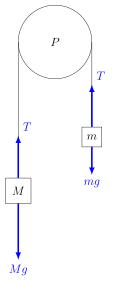
\begin{align*} \text{N2}(\uparrow, m): && T - mg &= ma_1 \\ \text{N2}(\uparrow, M): && T-Mg &= -Ma_1 \\ \Rightarrow && (M-m)g &= a_1(m+M) \\ \Rightarrow && a_1 &= \frac{M-m}{M+m}g \\ && T &= mg + ma_1 \\ &&&= \frac{2mM}{M+m}g \end{align*}
- System II is the same as system I, but with \(m\) replaced with \(2\frac{T}{g} = \frac{4mM}{M+m}\). In particular, this means that: \begin{align*} && a_2 &= \frac{M - \frac{4m_1m_2}{m_1+m_2}}{M + \frac{4m_1m_2}{m_1+m_2}} g \\ &&&= \frac{M-4\mu}{M+4\mu}g \end{align*} If \(m = m_1 + m_2\) then \begin{align*} && a_1 &= a_2 \\ \Leftrightarrow && \frac{M-m_1-m_2}{M+m_1+m_2} &= \frac{M - \frac{4m_1m_2}{m_1+m_2}}{M + \frac{4m_1m_2}{m_1+m_2}} \\ \Leftrightarrow && \frac{M-m_1-m_2}{M+m_1+m_2} &= \frac{M(m_1+m_2) -4m_1m_2}{M(m_1+m_2) + 4m_1m_2} \\ \Leftrightarrow && M^2(m_1+m_2)+4m_1m_2M &- M(m_1+m_2)^2 - 4m_1m_2(m_1+m_2) \\ &&\quad \quad = M^2(m_1+m_2) - 4m_1m_2M &+M(m_1+m_2)^2-4m_1m_2(m_1+m_2) \\ \Leftrightarrow && 8m_1m_2M&= 2M(m_1+m_2)^2 \\ \Leftrightarrow && 0 &= (m_1-m_2)^2 \\ \Leftrightarrow && m_1 &= m_2 \end{align*}
2014 Paper 2 Q11
A small smooth ring \(R\) of mass \(m\) is free to slide on a fixed smooth horizontal rail. A light inextensible string of length~\(L\) is attached to one end,~\(O\), of the rail. The string passes through the ring, and a particle~\(P\) of mass~\(km\) (where \(k>0\)) is attached to its other end; this part of the string hangs at an acute angle \(\alpha\) to the vertical and it is given that \(\alpha\) is constant in the motion. Let \(x\) be the distance between \(O\) and the ring. Taking the \(y\)-axis to be vertically upwards, write down the Cartesian coordinates of~\(P\) relative to~\(O\) in terms of \(x\), \(L\) and~\(\alpha\).
- By considering the vertical component of the equation of motion of \(P\), show that \[ km\ddot x \cos\alpha = T \cos\alpha - kmg\,, \] where \(T\) is the tension in the string. Obtain two similar equations relating to the horizontal components of the equations of motion of \(P\) and \(R\).
- Show that \(\dfrac {\sin\alpha}{(1-\sin\alpha)^2_{\vphantom|}} = k\), and deduce, by means of a sketch or otherwise, that motion with \(\alpha\) constant is possible for all values of~\(k\).
- Show that \(\ddot x = -g\tan\alpha\,\).
2014 Paper 3 Q11
A particle \(P\) of mass \(m\) is connected by two light inextensible strings to two fixed points \(A\) and \(B\), with \(A\) vertically above \(B\). The string \(AP\) has length \(x\). The particle is rotating about the vertical through \(A\) and \(B\) with angular velocity \(\omega\), and both strings are taut. Angles \(PAB\) and \(PBA\) are \(\alpha\) and \(\beta\), respectively. Find the tensions \(T_A\) and \(T_B\) in the strings \(AP\) and \(BP\) (respectively), and hence show that \(\omega^2 x\cos\alpha \ge g\). Consider now the case that \(\omega^2 x\cos\alpha = g\). Given that \(AB=h\) and \(BP=d\), where \(h>d\), show that \(h\cos\alpha \ge \sqrt{h^2-d^2}\). Show further that \[ mg < T_A \le \frac{mgh}{\sqrt{h^2-d^2}\,}\,. \] Describe the geometry of the strings when \(T_A\) attains its upper bound.
Solution:


2011 Paper 2 Q11
Three non-collinear points \(A\), \(B\) and \(C\) lie in a horizontal ceiling. A particle \(P\) of weight \(W\) is suspended from this ceiling by means of three light inextensible strings \(AP\), \(BP\) and \(CP\), as shown in the diagram. The point \(O\) lies vertically above \(P\) in the ceiling.
- Show that the unit vector in the direction \(PB\) can be written in the form \[ -\frac13\, {\bf i} - \frac{\sqrt2\,}3\, {\bf j} + \frac{\sqrt2\, }{\sqrt3 \,} \,{\bf k} \,,\] where \(\bf i\,\), \(\, \bf j\) and \(\bf k\) are the usual mutually perpendicular unit vectors with \(\bf j\) parallel to \(OA\) and \(\bf k\) vertically upwards.
- Find expressions in vector form for the forces acting on \(P\).
- Show that \(U=\sqrt6 V\) and find \(T\), \(U\) and \(V\) in terms of \(W\).
2008 Paper 3 Q10
A long string consists of \(n\) short light strings joined together, each of natural length \(\ell\) and modulus of elasticity \(\lambda\). It hangs vertically at rest, suspended from one end. Each of the short strings has a particle of mass \(m\) attached to its lower end. The short strings are numbered \(1\) to \(n\), the \(n\)th short string being at the top. By considering the tension in the \(r\)th short string, determine the length of the long string. Find also the elastic energy stored in the long string. A uniform heavy rope of mass \(M\) and natural length \(L_0\) has modulus of elasticity \(\lambda\). The rope hangs vertically at rest, suspended from one end. Show that the length, \(L\), of the rope is given by \[ L=L_0\biggl(1+ \frac{Mg}{2\lambda}\biggr), \] and find an expression in terms of \(L\), \(L_0\) and \(\lambda\) for the elastic energy stored in the rope.
2005 Paper 1 Q9
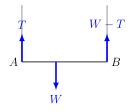
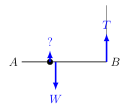
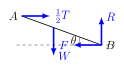
A non-uniform rod \(AB\) has weight \(W\) and length \(3l\). When the rod is suspended horizontally in equilibrium by vertical strings attached to the ends \(A\) and \(B\), the tension in the string attached to \(A\) is \(T\). When instead the rod is held in equilibrium in a horizontal position by means of a smooth pivot at a distance \(l\) from \(A\) and a vertical string attached to \(B\), the tension in the string is \(T\). Show that \(5T = 2W\). When instead the end \(B\) of the rod rests on rough horizontal ground and the rod is held in equilibrium at an angle \(\theta\) to the horizontal by means of a string that is perpendicular to the rod and attached to \(A\), the tension in the string is \(\frac12 T\). Calculate \(\theta\) and find the smallest value of the coefficient of friction between the rod and the ground that will prevent slipping.
Solution:
1994 Paper 1 Q10
One end \(A\) of a light elastic string of natural length \(l\) and modulus of elasticity \(\lambda\) is fixed and a particle of mass \(m\) is attached to the other end \(B\). The particle moves in a horizontal circle with centre on the vertical through \(A\) with angular velocity \(\omega.\) If \(\theta\) is the angle \(AB\) makes with the downward vertical, find an expression for \(\cos\theta\) in terms of \(m,g,l,\lambda\) and \(\omega.\) Show that the motion described is possible only if \[ \frac{g\lambda}{l(\lambda+mg)}<\omega^{2}<\frac{\lambda}{ml}. \]
1994 Paper 2 Q9
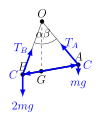
A light rod of length \(2a\) is hung from a point \(O\) by two light inextensible strings \(OA\) and \(OB\) each of length \(b\) and each fixed at \(O\). A particle of mass \(m\) is attached to the end \(A\) and a particle of mass \(2m\) is attached to the end \(B.\) Show that, in equilibrium, the angle \(\theta\) that the rod makes the horizontal satisfies the equation \[ \tan\theta=\frac{a}{3\sqrt{b^{2}-a^{2}}}. \] Express the tension in the string \(AO\) in terms of \(m,g,a\) and \(b\).
Solution: