2014 Paper 1 Q11
Year: 2014
Paper: 1
Question Number: 11
Course: LFM Pure and Mechanics
Section: Pulley systems
Problem
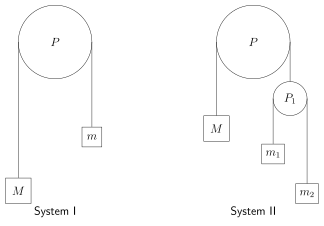
- For system I show that the acceleration, \(a_1\), of the particle of mass \(M\), measured in the downwards direction, is given by \[ a_1= \frac{M-m}{M+m} \, g \,, \] where \(g\) is the acceleration due to gravity. Give an expression for the force on the pulley due to the tension in the string.
- For system II show that the acceleration, \(a_2\), of the particle of mass \(M\), measured in the downwards direction, is given by \[ a_2= \frac{ M - 4\mu}{M+4\mu}\,g \,, \] where \(\mu = \dfrac{m_1m_2}{m_1+m_2}\). In the case \(m= m_1+m_2\), show that \(a_1= a_2\) if and only if \(m_1=m_2\).
Solution
- \(\,\)
\begin{align*} \text{N2}(\uparrow, m): && T - mg &= ma_1 \\ \text{N2}(\uparrow, M): && T-Mg &= -Ma_1 \\ \Rightarrow && (M-m)g &= a_1(m+M) \\ \Rightarrow && a_1 &= \frac{M-m}{M+m}g \\ && T &= mg + ma_1 \\ &&&= \frac{2mM}{M+m}g \end{align*}
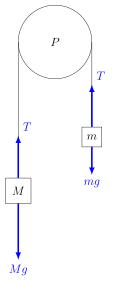
- System II is the same as system I, but with \(m\) replaced with \(2\frac{T}{g} = \frac{4mM}{M+m}\). In particular, this means that: \begin{align*} && a_2 &= \frac{M - \frac{4m_1m_2}{m_1+m_2}}{M + \frac{4m_1m_2}{m_1+m_2}} g \\ &&&= \frac{M-4\mu}{M+4\mu}g \end{align*} If \(m = m_1 + m_2\) then \begin{align*} && a_1 &= a_2 \\ \Leftrightarrow && \frac{M-m_1-m_2}{M+m_1+m_2} &= \frac{M - \frac{4m_1m_2}{m_1+m_2}}{M + \frac{4m_1m_2}{m_1+m_2}} \\ \Leftrightarrow && \frac{M-m_1-m_2}{M+m_1+m_2} &= \frac{M(m_1+m_2) -4m_1m_2}{M(m_1+m_2) + 4m_1m_2} \\ \Leftrightarrow && M^2(m_1+m_2)+4m_1m_2M &- M(m_1+m_2)^2 - 4m_1m_2(m_1+m_2) \\ &&\quad \quad = M^2(m_1+m_2) - 4m_1m_2M &+M(m_1+m_2)^2-4m_1m_2(m_1+m_2) \\ \Leftrightarrow && 8m_1m_2M&= 2M(m_1+m_2)^2 \\ \Leftrightarrow && 0 &= (m_1-m_2)^2 \\ \Leftrightarrow && m_1 &= m_2 \end{align*}
Examiner's report
— 2014 STEP 1, Question 11More than 1800 candidates sat this paper, which represents another increase in uptake for this STEP paper. The impression given, however, is that many of these extra candidates are just not sufficiently well prepared for questions which are not structured in the same way as are the A-level questions that they are, perhaps, more accustomed to seeing. Although STEP questions try to give all able candidates "a bit of an intro." into each question, they are not intended to be easy, and (at some point) imagination and real flair (as well as determination) are required if one is to score well on them. In general, it is simply not possible to get very far into a question without making some attempt to think about what is actually going on in the situation presented therein; and those students who expect to be told exactly what to do at each stage of a process are in for a shock. Too many candidates only attempt the first parts of many questions, restricting themselves to 3-6 marks on each, rather than trying to get to grips with substantial portions of work – the readiness to give up and try to find something else that is "easy pickings" seldom allows such candidates to acquire more than 40 marks (as was the case with almost half of this year's candidature, in fact). Poor preparation was strongly in evidence – curve-sketching skills were weak, inequalities very poorly handled, algebraic capabilities (especially in non-standard settings) were often pretty poor, and the ability to get to grips with extended bits of working lacking in the extreme; also, an unwillingness to be imaginative and creative, allied with a lack of thoroughness and attention to detail, made this a disappointing (and, possibly, very uncomfortable) experience for many of those students who took the paper. On the other side of the coin, there was a very pleasing number of candidates who produced exceptional pieces of work on 5 or 6 questions, and thus scored very highly indeed on the paper overall. Around 100 of them scored 90+ marks of the 120 available, and they should be very proud of their performance – it is a significant and noteworthy achievement.
Rating Information
Difficulty Rating: 1500.0
Difficulty Comparisons: 0
Banger Rating: 1500.0
Banger Comparisons: 0
Show LaTeX source
Problem source
The diagrams below show two separate systems of particles, strings and pulleys.In both systems, the pulleys  are smooth and light, the strings are light and inextensible, the particles  move vertically and the pulleys labelled  with $P$ are fixed.
The masses of the particles are as indicated on the diagrams.
  \begin{center}
\begin{tikzpicture}[
    % Define styles for the mass boxes to ensure they are consistent squares
    big mass/.style={draw, minimum size=0.9cm, anchor=north},
    small mass/.style={draw, minimum size=0.7cm, anchor=north}
]
    % ==========================================
    %                 System I
    % ==========================================
    \def\Px{0}       % X coordinate of the large pulley P
    \def\Py{6}       % Y coordinate of the large pulley P
    \def\PR{1.3}     % Radius of the large pulley P
    % Draw Pulley P
    \draw (\Px,\Py) circle (\PR) node {$P$};
    % Draw left rope and mass M
    \draw (\Px-\PR, \Py) -- (\Px-\PR, 1.2) node[big mass] {$M$};
    % Draw right rope and mass m
    \draw (\Px+\PR, \Py) -- (\Px+\PR, 3.0) node[small mass] {$m$};
    % Label for the system
    \node[font=\sffamily] at (\Px, 0) {System I};

    % ==========================================
    %                 System II
    % ==========================================
    \def\PxII{7}     % X coordinate of the large pulley P in System II (shifted right)
    \def\PyII{6}     % Y coordinate of the large pulley P in System II
    % Draw Pulley P
    \draw (\PxII,\PyII) circle (\PR) node {$P$};
    % Draw left rope and mass M
    \draw (\PxII-\PR, \PyII) -- (\PxII-\PR, 3.4) node[big mass] {$M$};
    % Setup coordinates for the smaller movable pulley P1
    \def\PoneR{0.6}       % Radius of small pulley P1
    \def\PoneX{\PxII+\PR} % X coordinate (aligned with right tangent of P)
    \def\PoneY{4.0}       % Y coordinate of P1's center
    % Draw right rope connecting P to P1
    \draw (\PoneX, \PyII) -- (\PoneX, \PoneY+\PoneR);
    % Draw Pulley P1
    \draw (\PoneX, \PoneY) circle (\PoneR) node {$P_1$};
    % Draw ropes and masses hanging from P1
    \draw (\PoneX-\PoneR, \PoneY) -- (\PoneX-\PoneR, 2.4) node[small mass] {$m_1$};
    \draw (\PoneX+\PoneR, \PoneY) -- (\PoneX+\PoneR, 1.0) node[small mass] {$m_2$};
    % Label for the system
    \node[font=\sffamily] at (\PxII, 0) {System II};
\end{tikzpicture}
  \end{center}
  \begin{questionparts}
  \item For system I show that the acceleration,  $a_1$, of the particle of mass $M$, measured in the downwards direction,  is  given by
\[
a_1= \frac{M-m}{M+m} \, g
\,,
\]
where $g$ is the acceleration due to gravity.
Give an expression for the  force on the pulley due to the tension
in the string.
  \item For system II show that the  acceleration, $a_2$, of the particle of mass $M$,  measured in the downwards direction, is given by
    \[
    a_2= \frac{ M - 4\mu}{M+4\mu}\,g \,,
    \]
where $\mu = \dfrac{m_1m_2}{m_1+m_2}$.
In the case $m= m_1+m_2$, show that $a_1=   a_2$ if and only if $m_1=m_2$.
  \end{questionparts}
Solution source
\begin{questionparts}
\item $\,$
\begin{center}
\begin{tikzpicture}[
    % Define styles for the mass boxes to ensure they are consistent squares
    big mass/.style={draw, minimum size=0.9cm, anchor=north},
    small mass/.style={draw, minimum size=0.7cm, anchor=north}
]

    % ==========================================
    %                 System I
    % ==========================================
    \def\Px{0}       % X coordinate of the large pulley P
    \def\Py{6}       % Y coordinate of the large pulley P
    \def\PR{1.3}     % Radius of the large pulley P

    % Draw Pulley P
    \draw (\Px,\Py) circle (\PR) node {$P$};

    % Draw left rope and mass M
    \draw (\Px-\PR, \Py) -- (\Px-\PR, 1.2) node[big mass] {$M$};

    % Draw right rope and mass m
    \draw (\Px+\PR, \Py) -- (\Px+\PR, 3.0) node[small mass] {$m$};


    \draw[-latex, ultra thick, blue] (\Px+\PR, 2.3) -- ++ (0, -1) node[below] {$mg$};
    \draw[-latex, ultra thick, blue] (\Px+\PR, 3) -- ++ (0, 1.5) node[above right] {$T$};
    \draw[-latex, ultra thick, blue] (\Px-\PR, 0.3) -- ++ (0, -2) node[below] {$Mg$};
    \draw[-latex, ultra thick, blue] (\Px-\PR, 1.2) -- ++ (0, 1.5) node[above right] {$T$};

\end{tikzpicture}
\end{center}

\begin{align*}
\text{N2}(\uparrow, m): && T - mg &= ma_1 \\
\text{N2}(\uparrow, M): && T-Mg &= -Ma_1 \\
\Rightarrow && (M-m)g &= a_1(m+M) \\
\Rightarrow && a_1 &= \frac{M-m}{M+m}g \\
&& T &= mg + ma_1 \\
&&&= \frac{2mM}{M+m}g
\end{align*}

\item System II is the same as system I, but with $m$ replaced with $2\frac{T}{g} = \frac{4mM}{M+m}$. In particular, this means that:

\begin{align*}
&& a_2 &= \frac{M - \frac{4m_1m_2}{m_1+m_2}}{M + \frac{4m_1m_2}{m_1+m_2}} g \\
&&&= \frac{M-4\mu}{M+4\mu}g
\end{align*}

If $m = m_1 + m_2$ then

\begin{align*}
&& a_1 &= a_2 \\
\Leftrightarrow && \frac{M-m_1-m_2}{M+m_1+m_2} &= \frac{M - \frac{4m_1m_2}{m_1+m_2}}{M + \frac{4m_1m_2}{m_1+m_2}} \\
\Leftrightarrow && \frac{M-m_1-m_2}{M+m_1+m_2} &= \frac{M(m_1+m_2) -4m_1m_2}{M(m_1+m_2) + 4m_1m_2} \\
\Leftrightarrow && M^2(m_1+m_2)+4m_1m_2M &- M(m_1+m_2)^2 - 4m_1m_2(m_1+m_2) \\
&&\quad \quad = M^2(m_1+m_2) - 4m_1m_2M &+M(m_1+m_2)^2-4m_1m_2(m_1+m_2) \\
\Leftrightarrow && 8m_1m_2M&= 2M(m_1+m_2)^2 \\
\Leftrightarrow && 0 &= (m_1-m_2)^2 \\
\Leftrightarrow && m_1 &= m_2
\end{align*}

\end{questionparts}
Q11 drew around 700 attempts. Unfortunately, Q11 suffered particularly from the issue of unclear working, and most marks gained on it came from successful attempts at the single-pulley scenario given in part (i) – for which we allocated six marks. Efforts at part (ii) often saw candidates failing to produce diagrams indicating directions for the various accelerations (etc.) and simply resorting to writing down several vague statements based on vague interpretations of "resolving" ideas and/or N2L. The failure to grasp that there needed to be some notion of relative accelerations involved for the two masses attached to pulley P1 meant that most efforts were fatally flawed anyhow. Strangely, yet illustrating again the shrewdness of exam. technique amongst some of the candidates, it was possible to attempt the very final part just by taking the two given answers and running with them (although many failed to appreciate that an 'if and only if' proof needed two directions of reasoning). Q11's mean score was a mark less than Q9's, i.e. around 5½/20.