2005 Paper 1 Q9
Year: 2005
Paper: 1
Question Number: 9
Course: UFM Mechanics
Section: Centre of Mass 1
Difficulty: 1500.0
Banger: 1516.0
Problem
A non-uniform rod \(AB\) has weight \(W\) and length \(3l\). When the rod is suspended horizontally in equilibrium by vertical strings attached to the ends \(A\) and \(B\), the tension in the string attached to \(A\) is \(T\).
When instead the rod is held in equilibrium in a horizontal position by means of a smooth pivot at a distance \(l\) from \(A\) and a vertical string attached to \(B\), the tension in the string is \(T\). Show that \(5T = 2W\).
When instead the end \(B\) of the rod rests on rough horizontal ground and the rod is held in equilibrium at an angle \(\theta\) to the horizontal by means of a string that is perpendicular to the rod and attached to \(A\), the tension in the string is \(\frac12 T\). Calculate \(\theta\) and find the smallest value of the coefficient of friction between the rod and the ground that will prevent slipping.
Solution
Rating Information
Difficulty Rating: 1500.0
Difficulty Comparisons: 0
Banger Rating: 1516.0
Banger Comparisons: 1
Show LaTeX source
Problem source
A non-uniform rod $AB$ has weight $W$ and length $3l$. When the rod is suspended horizontally in equilibrium by vertical strings attached to the ends $A$ and $B$, the tension in the string attached to $A$ is $T$.
When instead the rod is held in equilibrium in a horizontal position by means of a smooth pivot at a distance $l$ from $A$ and a vertical string attached to $B$, the tension in the string is $T$. Show that $5T = 2W$.
When instead the end $B$ of the rod rests on rough horizontal ground and the rod is held in equilibrium at an angle $\theta$ to the horizontal by means of a string that is perpendicular to the rod and attached to $A$, the tension in the string is $\frac12 T$. Calculate $\theta$ and find the smallest value of the coefficient of friction between the rod and the ground that will prevent slipping.
Solution source
\begin{center}
    \begin{tikzpicture}
        \coordinate (A) at (0,0);
        \coordinate (B) at (3,0);
        \coordinate (G) at (1.2,0);
        \draw[thick] (A) -- (B);


        \node[left] at (A) {$A$};
        \node[right] at (B) {$B$};

        \draw (A) -- ++(0,2);
        \draw (B) -- ++(0,2);

        \draw[-latex, ultra thick, blue] (A) -- ++(0,1) node[above] {$T$};
        \draw[-latex, ultra thick, blue] (B) -- ++(0,1) node[above] {$W-T$};
        \draw[-latex, ultra thick, blue] (G) -- ++(0,-1) node[below] {$W$};

    \end{tikzpicture}
\end{center}


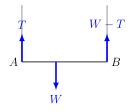
Suppose the centre of mass of the rod is $x$ away from $A$.

\begin{align*}
\overset{\curvearrowleft}{B}: && (3l-x)W - 3lT &= 0 \\
\Rightarrow && x &= \frac{3l(W-T)}{W} \tag{1}
\end{align*}

\begin{center}
    \begin{tikzpicture}
        \coordinate (A) at (0,0);
        \coordinate (B) at (3,0);
        \coordinate (G) at (1.2,0);
        \draw[thick] (A) -- (B);


        \node[left] at (A) {$A$};
        \node[right] at (B) {$B$};

        % \draw (A) -- ++(0,2);
        \draw (B) -- ++(0,2);

        % \draw[-latex, ultra thick, blue] (A) -- ++(0,1) node[above] {$T$};
        \filldraw (1,0) circle (0.1);
        \draw[-latex, ultra thick, blue] (B) -- ++(0,1) node[above] {$T$};
        \draw[-latex, ultra thick, blue] (G) -- ++(0,-1) node[below] {$W$};
        \draw[-latex, ultra thick, blue] (1,0) -- ++(0,0.4) node[above] {$?$};

    \end{tikzpicture}
\end{center}

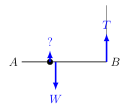
In the second set up we have:

\begin{align*}
\overset{\curvearrowleft}{\text{pivot}}: && 2lT - (x-l)W &= 0 \\
\Rightarrow && x &= \frac{2lT + lW}{W} \tag{2} \\
\\
(1) \text{ & } (2): && 3l(W-T) &= l(2T+W) \\
\Rightarrow && 2W &= 5T
\end{align*}


\begin{center}
    \begin{tikzpicture}
        \coordinate (A) at ({3+3*cos(160)},{3*sin(160)});
        \coordinate (B) at (3,0);
        \coordinate (G) at ({3+1.8*cos(160)},{1.8*sin(160)});
        \draw[thick] (A) -- (B);


        \node[left] at (A) {$A$};
        \node[right] at (B) {$B$};

        \coordinate (X) at (0,0);
        \coordinate (Y) at (3.5,0);

        \draw[dashed] (X) -- (Y);

        % \draw (A) -- ++(0,2);

        % \draw[-latex, ultra thick, blue] (A) -- ++(0,1) node[above] {$T$};
        \draw[-latex, ultra thick, blue] (A) -- ++(1,0) node[right] {$\frac12T$};
        \draw[-latex, ultra thick, blue] (B) -- ++(-1,0) node[left] {$F$};
        \draw[-latex, ultra thick, blue] (B) -- ++(0,1) node[right] {$R$};
        \draw[-latex, ultra thick, blue] (G) -- ++(0,-1) node[right] {$W$};

        \pic [draw, angle radius=.8cm, angle eccentricity=1.25, "$\theta$"] {angle = A--B--X};

    \end{tikzpicture}
\end{center}


\begin{align*}
&& x&= \frac{3l(W-T)}{W}\\
&&&= \frac{3l(W - \frac25 W)}{W} \\
&&&= \frac{9}{5}l\\
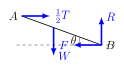
\overset{\curvearrowleft}{B}: && -\frac12 T (3l \sin \theta) + W \frac{6}{5}l \cos \theta &= 0 \\
\Rightarrow && \tan \theta &= \frac{4}{5} \frac{W}{T} \\
&&&= \frac45 \frac52 \\
&&&= 2 \\
\Rightarrow && \theta &= \tan^{-1} 2 \\
\\
\text{N2}(\uparrow): && R &= W \\
\text{N2}(\rightarrow): && F &= \frac12 T \\
\Rightarrow && F & \leq \mu R \\
\Rightarrow && \frac12 T &\leq \mu W \\
\Rightarrow && \mu &\geq \frac12 \frac{T}{W}  = \frac12 \frac25 = \frac15

\end{align*}