2021 Paper 3 Q10
Year: 2021
Paper: 3
Question Number: 10
Course: UFM Mechanics
Section: Circular Motion 1
Problem
- Obtain the Cartesian coordinates of the particle at this time. Find also an expression for the speed of the particle in terms of \(\theta\), \(\dot{\theta}\), \(a\) and \(b\).
- Show that \[ \dot{\theta}(b - a\theta) = u, \] where \(u\) is the initial speed of the particle.
- Show further that the tension in the string at time \(t\) is \[ \frac{mu^2}{\sqrt{b^2 - 2aut}}. \]
Solution
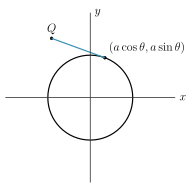
- The line to the circle is tangent, and the point it meets the circle is \((a \cos \theta, a \sin \theta)\) and it will be a distance \(b - a \theta\) away, therefore it is at \((a \cos \theta - (b-a \theta) \sin \theta, a \sin \theta + (b-a \theta) \cos \theta)\)
- The velocity will be \(\displaystyle \binom{-a \dot{\theta}\sin \theta-b \dot{\theta}\cos \theta + a \dot{\theta} \sin \theta + a \theta \dot{\theta} \cos \theta}{ a \dot{\theta} \cos \theta - b \dot{\theta} \sin \theta -a \dot{\theta} \cos \theta + a \theta \dot{\theta} \sin \theta}= \binom{-b \dot{\theta}\cos \theta + a \theta \dot{\theta} \cos \theta}{ - b \dot{\theta} \sin \theta + a \theta \dot{\theta} \sin \theta}\) Therefore the speed will be \(\dot{\theta}(b-a\theta)\)
- Conservation of energy and the fact that the tension is perpendicular to the velocity means no work is being done on the particle and hence it's speed is unchanged. So \(u = \dot{\theta}(b-a\theta)\).
- Note that the acceleration is \begin{align*} && \mathbf{a} &= \frac{\d}{\d t} \left (-\dot{\theta}(b-a\theta) \binom{\cos \theta}{\sin \theta} \right) \\ &&&=-u \dot{\theta}\binom{-\sin \theta}{\cos \theta} \\ \Rightarrow && T &= ma \\ &&&= \frac{mu^2}{b - a \theta} \end{align*} It would be valuable to have \(\theta\) in terms of \(t\), so we want to solve \begin{align*} &&\frac{\d \theta}{\d t} (b-a\theta) &= u \\ \Rightarrow && b \theta - a\frac{\theta^2}{2} + C &= ut \\ t = 0, \theta = 0: && C &= 0 \\ \Rightarrow && b\theta - \frac{a}{2} \theta^2 &= ut \\ \Rightarrow && \theta &= \frac{b \pm \sqrt{b^2-2aut}}{a} \end{align*} At \(t\) increases, \(\theta\) increases so \(a\theta = b -\sqrt{b^2-2aut}\) or \(b-a \theta = \sqrt{b^2-2aut}\) and the result follows
Examiner's report
— 2021 STEP 3, Question 10The total entry was a marginal increase from that of 2019, that of 2020 having been artificially reduced. Comfortably more than 90% attempted one of the questions, four others were very popular, and a sixth was attempted by 70%. Every question was attempted by at least 10% of the candidature. 85% of candidates attempted no more than 7 questions, though very nearly all the candidates made genuine attempts on at most six questions (the extra attempts being at times no more than labelling a page or writing only the first line or two). Generally, candidates should be aware that when asked to "Show that" they must provide enough working to fully substantiate their working, and that they should follow the instructions in a question, so if it says "Hence", they should be using the previous work in the question in order to complete the next part. Likewise, candidates should be careful when dividing or multiplying, that things are positive, or at other times non-zero.
Rating Information
Difficulty Rating: 1500.0
Difficulty Comparisons: 0
Banger Rating: 1500.0
Banger Comparisons: 0
Show LaTeX source
Problem source
The origin $O$ of coordinates lies on a smooth horizontal table and the $x$- and $y$-axes lie in the plane of the table. A cylinder of radius $a$ is fixed to the table with its axis perpendicular to the $x$--$y$ plane and passing through $O$, and with its lower circular end lying on the table. One end, $P$, of a light inextensible string $PQ$ of length $b$ is attached to the bottom edge of the cylinder at $(a, 0)$. The other end, $Q$, is attached to a particle of mass $m$, which rests on the table.

Initially $PQ$ is straight and perpendicular to the radius of the cylinder at $P$, so that $Q$ is at $(a, b)$. The particle is then given a horizontal impulse parallel to the $x$-axis so that the string immediately begins to wrap around the cylinder. At time $t$, the part of the string that is still straight has rotated through an angle $\theta$, where $a\theta < b$.

\begin{questionparts}
    \item Obtain the Cartesian coordinates of the particle at this time.

    Find also an expression for the speed of the particle in terms of $\theta$, $\dot{\theta}$, $a$ and $b$.

    \item Show that
    \[
        \dot{\theta}(b - a\theta) = u,
    \]
    where $u$ is the initial speed of the particle.

    \item Show further that the tension in the string at time $t$ is
    \[
        \frac{mu^2}{\sqrt{b^2 - 2aut}}.
    \]
\end{questionparts}
Solution source
\begin{center}
    \begin{tikzpicture}
        \tikzset{
            axis/.style={thick, draw=black!80, -{Stealth[scale=1.2]}},
            grid/.style={thin, dashed, gray!30},
            curveA/.style={very thick, color=cyan!70!black, smooth},
            curveB/.style={very thick, color=orange!90!black, smooth},
            curveC/.style={very thick, color=green!90!black, smooth},
            curveBlack/.style={very thick, color=black, smooth},
            dot/.style={circle, fill=black, inner sep=1.2pt},
            labelbox/.style={fill=white, inner sep=2pt, rounded corners=2pt} % Protects text from lines
        }

        \draw[curveBlack] (0,0) circle (1.5);

        \coordinate (R) at ({1.5*cos(70)}, {1.5*sin(70)});
        \coordinate (Q) at ({1.5*cos(70)-2*sin(70)}, {1.5*sin(70) + 2*cos(70)});

        \filldraw (R) circle (1.5pt) node[above right] {$(a \cos \theta, a \sin \theta)$};
        \filldraw (Q) circle (1.5pt) node[above] {$Q$};

        \draw[curveA] (R) -- (Q);


        \draw[axis] (-3, 0) -- (3,0) node[right] {$x$};
        \draw[axis] (0, -3) -- (0,3) node[right] {$y$};


    \end{tikzpicture}
\end{center}


\begin{questionparts}
\item The line to the circle is tangent, and the point it meets the circle is $(a \cos \theta, a \sin \theta)$ and it will be a distance $b - a \theta$ away, therefore it is at $(a \cos \theta - (b-a \theta) \sin \theta, a \sin \theta + (b-a \theta) \cos \theta)$

\item The velocity will be $\displaystyle \binom{-a \dot{\theta}\sin \theta-b \dot{\theta}\cos \theta + a \dot{\theta} \sin \theta + a \theta \dot{\theta} \cos \theta}{ a \dot{\theta} \cos \theta - b \dot{\theta} \sin \theta -a \dot{\theta} \cos \theta + a \theta \dot{\theta} \sin \theta}= \binom{-b \dot{\theta}\cos \theta  + a \theta \dot{\theta} \cos \theta}{  - b \dot{\theta} \sin \theta  + a \theta \dot{\theta} \sin \theta}$
Therefore the speed will be $\dot{\theta}(b-a\theta)$

\item Conservation of energy and the fact that the tension is perpendicular to the velocity means no work is being done on the particle and hence it's speed is unchanged. So $u = \dot{\theta}(b-a\theta)$.

\item Note that the acceleration is \begin{align*}
&& \mathbf{a} &= \frac{\d}{\d t} \left (-\dot{\theta}(b-a\theta) \binom{\cos \theta}{\sin \theta} \right) \\
&&&=-u \dot{\theta}\binom{-\sin \theta}{\cos \theta} \\
\Rightarrow && T &= ma \\
&&&= \frac{mu^2}{b - a \theta}
\end{align*}
It would be valuable to have $\theta$ in terms of $t$, so we want to solve

\begin{align*}
&&\frac{\d \theta}{\d t} (b-a\theta) &= u \\
\Rightarrow && b \theta - a\frac{\theta^2}{2} + C &= ut \\
t = 0, \theta = 0: && C &= 0 \\
\Rightarrow && b\theta - \frac{a}{2} \theta^2 &= ut \\
\Rightarrow && \theta &= \frac{b \pm \sqrt{b^2-2aut}}{a}
\end{align*}
At $t$ increases, $\theta$ increases so $a\theta = b -\sqrt{b^2-2aut}$ or $b-a \theta = \sqrt{b^2-2aut}$ and the result follows
\end{questionparts}
Whilst this was the least popular question, being attempted by a tenth of the candidature, it was the sixth most successful with a mean over 7/20. Part (i) was successfully attempted by many candidates, by correctly finding the coordinates of the particle and then using differentiation and Pythagoras to find the speed as required. In part (ii), many understood that they could use conservation of energy even though they failed to justify it. Many used the appropriate circular motion formula in part (iii), but then stumbled as they lacked justification of the evaluation of their constant of integration, or the choice of sign when taking the square root. Quite a few struggled to find the link between b − aθ and the given answer, and some attempted to jump to the given answer!