Problems
Filters
19 problems found
2019 Paper 3 Q8
A pyramid has a horizontal rectangular base \(ABCD\) and its vertex \(V\) is vertically above the centre of the base. The acute angle between the face \(AVB\) and the base is \(\alpha\), the acute angle between the face \(BVC\) and the base is \(\beta\) and the obtuse angle between the faces \(AVB\) and \(BVC\) is \(\pi - \theta\).
- The edges \(AB\) and \(BC\) are parallel to the unit vectors \(\mathbf{i}\) and \(\mathbf{j}\), respectively, and the unit vector \(\mathbf{k}\) is vertical. Find a unit vector that is perpendicular to the face \(AVB\). Show that $$\cos \theta = \cos \alpha \cos \beta.$$
- The edge \(BV\) makes an angle \(\phi\) with the base. Show that $$\cot^2 \phi = \cot^2 \alpha + \cot^2 \beta.$$ Show also that $$\cos^2 \phi = \frac{\cos^2 \alpha + \cos^2 \beta - 2 \cos^2 \theta}{1 - \cos^2 \theta} \geq \frac{2 \cos \theta - 2 \cos^2 \theta}{1 - \cos^2 \theta}$$ and deduce that \(\phi < \theta\).
Solution:
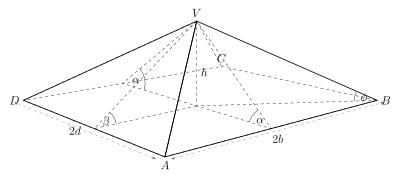
- Let \(A = (0,0,0)\) and then \(B = 22b \mathbf{i}, D = 2d\mathbf{j}, C = 2b\mathbf{i}+2d\mathbf{j}\) and \(V = b \mathbf{i} + d\mathbf{j} + h\mathbf{k}\) We also have \begin{align*} && \tan \alpha &= \frac{h}{d}\\ && \tan \beta &= \frac{d}{b} \\ && \vec{AV} \times \vec{VB} &= \begin{pmatrix} b \\ d \\ h \end{pmatrix} \times \begin{pmatrix} -b \\ d \\ h \end{pmatrix} \\ &&&= \begin{pmatrix} 0 \\ -2bh \\ 2db \end{pmatrix} \\ &&&= 2b \begin{pmatrix} 0 \\ -d \tan \alpha \\ d \end{pmatrix} \\ &&&= k \begin{pmatrix} 0 \\ - \sin \alpha \\ \cos \alpha \end{pmatrix} \end{align*} similarly for the vector perpendicular to the other face it must be \(\begin{pmatrix}-\sin \beta \\ 0 \\ \cos \beta \end{pmatrix}\) Looking at the angle between these perpendicular (to find the angles between the faces we see: \begin{align*} \begin{pmatrix} 0 \\ - \sin \alpha \\ \cos \alpha \end{pmatrix} \cdot \begin{pmatrix}-\sin \beta \\ 0 \\ \cos \beta \end{pmatrix} &= \cos \alpha \cos \beta \end{align*} But this is also \(\pi -\) the angle between the planes, ie \(\cos \theta = \cos \alpha \cos \beta\)
- \(\,\) \begin{align*} && \cot^2 \phi &= \frac{b^2+d^2}{h^2} \\ && \cot^2 \alpha &= \frac{d^2}{h^2} \\ && \cot^2 \beta &= \frac{b^2}{h^2} \\ \Rightarrow && cot^2 \phi &= \cot^2 \beta+\cot^2 \alpha \end{align*} \begin{align*} && \cos^2 \phi &= \frac{b^2+d^2}{b^2+d^2+h^2} \\ && \cos^2 \alpha &= \frac{d^2}{d^2+h^2} \\ && \cos^2 \beta &= \frac{b^2}{b^2+h^2} \\ && \frac{\cos^2 \alpha + \cos^2 \beta - 2 \cos^2 \theta}{1-\cos^2 \theta} &= \frac{\frac{d^2}{d^2+h^2}+\frac{b^2}{b^2+h^2}-2\cdot \frac{d^2}{d^2+h^2} \cdot \frac{b^2}{b^2+h^2}}{1 - \frac{d^2}{d^2+h^2} \cdot\frac{b^2}{b^2+h^2}} \\ &&&= \frac{d^2(b^2+h^2)+b^2(d^2+h^2)-2d^2b^2}{(d^2+h^2)(b^2+h^2)-d^2b^2} \\ &&&= \frac{h^2(b^2+d^2)}{h^2(b^2+d^2+h^2)} \\ &&&= \frac{b^2+d^2}{b^2+d^2+h^2} \\ &&&= \cos^2\phi \end{align*} Also notice that \begin{align*} && \cos^2 \alpha + \cos^2 \beta &\underbrace{\geq}_{AM-GM} 2 \cos \alpha \cos \beta \\ &&&= 2 \cos \theta \\ \Rightarrow && \frac{\cos^2 \alpha + \cos^2 \beta - 2 \cos^2 \theta}{1-\cos^2 \theta} &\geq \frac{2 \cos \theta - 2\cos^2 \theta}{1-\cos^2 \theta} \\ &&&= \frac{2\cos \theta}{1+\cos \theta} = \cos \theta \frac{2}{1+\cos \theta} \\ &&&> \cos^2 \theta \\ \Rightarrow && \phi &< \theta \end{align*}
2018 Paper 3 Q4
The point \(P(a\sec \theta, b\tan \theta )\) lies on the hyperbola \[ \dfrac{x^{2}}{a^{2}}-\dfrac{y^{2}}{b^{2}}=1\,, \] where \(a>b>0\,\). Show that the equation of the tangent to the hyperbola at \(P\) can be written as \[ bx- ay \sin\theta = ab \cos\theta \,. \]
- This tangent meets the lines \(\dfrac x a = \dfrac yb\) and \(\dfrac x a =- \dfrac y b\) at \(S\) and \(T\), respectively. How is the mid-point of \(ST\) related to \(P\)?
- The point \(Q(a\sec \phi, b\tan \phi)\) also lies on the hyperbola and the tangents to the hyperbola at \(P\) and \(Q\) are perpendicular. These two tangents intersect at \((x,y)\). Obtain expressions for \(x^2\) and \(y^2\) in terms of \(a\), \(\theta\) and \(\phi\). Hence, or otherwise, show that \(x^2+y^2 = a^2 -b^2\).
Solution: Note that \begin{align*} && \frac{\d a \sec \theta}{\d \theta} &= a \sec \theta \tan \theta \\ && \frac{\d b \tan \theta}{\d \theta} &= b \sec^2 \theta \\ \Rightarrow && \frac{\d y}{\d x} &= \frac{b \sec^2 \theta}{a \sec \theta \tan \theta} \\ &&&= \frac{b}{a} \frac{1}{\sin \theta} \\ \Rightarrow && \frac{y-b \tan \theta}{x - a \sec \theta} &= \frac{b}{a} \frac{1}{\sin \theta} \\ \Rightarrow && a \sin \theta y - ab \tan \theta \sin \theta &= bx -ab \sec \theta \\ \Rightarrow && bx-ay\sin \theta &= ab \sec x (1 - \sin ^2 \theta) \\ &&&= ab \cos \theta \end{align*}
- \begin{align*} S: &&& \begin{cases} bx-ay &= 0 \\ bx-ay \sin \theta &= ab \cos \theta \end{cases} \\ \Rightarrow && ay(1-\sin \theta) &= ab \cos \theta \\ \Rightarrow && y &= \frac{b \cos \theta}{1-\sin \theta} \\ &&x &=\frac{a\cos \theta}{1-\sin \theta} \\ T: &&& \begin{cases} bx+ay &= 0 \\ bx-ay \sin \theta &= ab \cos \theta \end{cases} \\ \Rightarrow && ay(1+\sin \theta) &= -ab \cos \theta \\ \Rightarrow && y &= \frac{-b \cos \theta}{1+\sin \theta} \\ &&x &=\frac{a\cos \theta}{1+\sin \theta} \\ M: && x &= \frac{a \cos \theta}{2} \frac{2}{1-\sin^2 \theta} \\ &&&= a \sec \theta \\ && y &= \frac{b \cos \theta}{2} \frac{2 \sin \theta}{1-\sin^2 \theta} \\ &&&= b \tan \theta \end{align*} The midpoint of \(ST\) is the same as \(P\).
- The tangents are perpendicular, therefore \(\frac{b}{a} \cosec \theta = - \frac{a}{b} \sin \phi\), ie \(b^2 = -a^2 \sin \phi \sin \theta\) The will intersect at: \begin{align*} &&& \begin{cases} bx - ay \sin \theta &= ab \cos \theta \\ bx - ay \sin \phi &= ab \cos \phi \end{cases} \\ \Rightarrow && ay ( \sin \theta - \sin \phi) &= ab(\cos \phi - \cos \theta) \\ \Rightarrow && y &= \frac{b(\cos \phi - \cos \theta)}{(\sin \theta - \sin \phi)} \\ && y^2 &= \frac{-a^2 \sin \phi \sin \theta (\cos\phi - \cos \theta)^2}{(\sin \theta - \sin \phi)^2} \\ \Rightarrow && bx(\sin \phi - \sin \theta) &= ab(\cos \theta \sin \phi - \cos \phi \sin \theta) \\ \Rightarrow && x &= \frac{a(\cos \theta \sin \phi - \cos \phi \sin \theta)}{\sin \phi - \sin \theta} \\ &&&= \frac{a^2(\cos \theta \sin \phi - \cos \phi \sin \theta)^2}{(\sin \phi - \sin \theta)^2} \end{align*} Therefore \begin{align*} && x^2+y^2 &= \frac{a^2}{(\sin \phi - \sin \theta)^2} \l (\cos \theta \sin \phi- \cos \phi \sin \theta)^2 - \sin \phi \sin \theta (\cos\phi - \cos \theta)^2 \r \\ &&&= \frac{a^2}{(\sin \phi - \sin \theta)^2} \l (\sin \phi - \sin \theta)(\cos^2 \theta \sin \phi - \sin \theta \cos^2 \phi) \r \\ &&&=a^2-b^2 \end{align*}
2017 Paper 2 Q8
All vectors in this question lie in the same plane. The vertices of the non-right-angled triangle \(ABC\) have position vectors \(\bf a\), \(\bf b\) and \(\bf c\), respectively. The non-zero vectors \(\bf u\) and \(\bf v\) are perpendicular to \(BC\) and \(CA\), respectively. Write down the vector equation of the line through \(A\) perpendicular to \(BC\), in terms of \(\bf u\), \(\bf a\) and a parameter \(\lambda \). The line through \(A\) perpendicular to \(BC\) intersects the line through \(B\) perpendicular to \(CA\) at \(P\). Find the position vector of \(P\) in terms of \(\bf a\), \(\bf b\), \(\bf c\) and \(\bf u\). Hence show that the line \(CP\) is perpendicular to the line \(AB\).
Solution: The line through \(A\) perpendicular to \(BC\) is \(\mathbf{a} + \lambda\mathbf{u}\). The line through \(B\) perpendicular to \(CA\) is \(\mathbf{b} + \mu \mathbf{v}\). They intersect when \(\mathbf{a} + \lambda\mathbf{u} = \mathbf{b} + \mu \mathbf{v}\). Since \(\mathbf{v}\) is perpendicular to \(CA\), we must have \begin{align*} && \mathbf{a} + \lambda\mathbf{u} &= \mathbf{b} + \mu \mathbf{v} \\ \Rightarrow && \mathbf{a}\cdot(\mathbf{c}-\mathbf{a}) + \lambda\mathbf{u}\cdot(\mathbf{c}-\mathbf{a}) &= \mathbf{b}\cdot(\mathbf{c}-\mathbf{a}) + \mu \mathbf{v}\cdot(\mathbf{c}-\mathbf{a}) \\ \\ \Rightarrow && \lambda &= \frac{\mathbf{b}\cdot(\mathbf{c}-\mathbf{a}) -\mathbf{a}\cdot(\mathbf{c}-\mathbf{a})}{\mathbf{u}\cdot(\mathbf{c}-\mathbf{a})} \\ &&&= \frac{(\mathbf{b}-\mathbf{a})\cdot(\mathbf{c}-\mathbf{a})}{\mathbf{u} \cdot(\mathbf{c}-\mathbf{a})} \end{align*} Therefore the point is \(\mathbf{a} + \frac{(\mathbf{b}-\mathbf{a})\cdot(\mathbf{c}-\mathbf{a})}{\mathbf{u} \cdot(\mathbf{c}-\mathbf{a})} \mathbf{u}\). The line \(CP\) is \(\mathbf{c} + \nu \left (\mathbf{p} - \mathbf{c} \right)\), to check this is perpendicular with \(AB\) we should dot \(\mathbf{p}-\mathbf{c}\) with \(\mathbf{a}-\mathbf{b}\), ie \begin{align*} && (\mathbf{p}-\mathbf{c}) \cdot (\mathbf{a}-\mathbf{b}) &= \left ( \mathbf{a} + \frac{(\mathbf{b}-\mathbf{a})\cdot(\mathbf{c}-\mathbf{a})}{\mathbf{u} \cdot(\mathbf{c}-\mathbf{a})} \mathbf{u} - \mathbf{c}\right) \cdot ( \mathbf{a}-\mathbf{b}) \\ &&&= \left ( \mathbf{a}- \mathbf{c} + \frac{(\mathbf{b}-\mathbf{a})\cdot(\mathbf{c}-\mathbf{a})}{\mathbf{u} \cdot(\mathbf{c}-\mathbf{a})} \mathbf{u} \right) \cdot ( \mathbf{a}-\mathbf{c}+(\mathbf{c}-\mathbf{b})) \\ &&&= (\mathbf{a}-\mathbf{c})\cdot(\mathbf{a}-\mathbf{c}) + \frac{(\mathbf{b}-\mathbf{a})\cdot(\mathbf{c}-\mathbf{a})}{\mathbf{u} \cdot(\mathbf{c}-\mathbf{a})}\mathbf{u} \cdot (\mathbf{a}-\mathbf{c}) + \\ &&&\quad (\mathbf{a}-\mathbf{c})\cdot(\mathbf{c}-\mathbf{b}) + \lambda \underbrace{\mathbf{u} \cdot (\mathbf{c}-\mathbf{b})}_{=0} \\ &&&=(\mathbf{a}-\mathbf{c})\cdot(\mathbf{a}-\mathbf{c}) -(\mathbf{b}-\mathbf{a})\cdot(\mathbf{c}-\mathbf{a})+ (\mathbf{a}-\mathbf{c})\cdot(\mathbf{c}-\mathbf{b}) \\ &&&= (\mathbf{a}-\mathbf{c})\cdot(\mathbf{a}-\mathbf{c}+\mathbf{b}-\mathbf{a}+\mathbf{c}-\mathbf{b}) \\ &&&= 0 \end{align*} as required.
2016 Paper 2 Q1
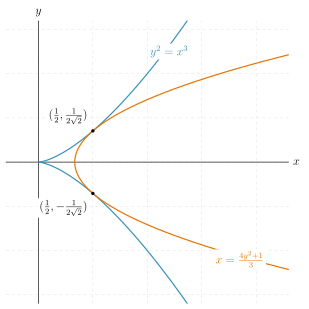
The curve \(C_1\) has parametric equations \(x=t^2\), \(y= t^3\), where \(-\infty < t < \infty\,\). Let \(O\) denote the point \((0,0)\). The points \(P\) and \(Q\) on \(C_1\) are such that \(\angle POQ\) is a right angle. Show that the tangents to \(C_1\) at \(P\) and \(Q\) intersect on the curve \(C_2\) with equation \(4y^2=3x-1\). Determine whether \(C_1\) and \(C_2\) meet, and sketch the two curves on the same axes.
Solution: \(\angle POQ = 90^\circ\) means that if \(P(p^2,p^3)\) and \(Q(q^2,q^3)\) are our points then \(OP^2+OQ^2 = PQ^2\), so \begin{align*} && p^4+p^6+q^4+q^6 &= (p^2-q^2)^2+(p^3-q^3)^2 \\ &&&= p^4+q^4-2p^2q^2+p^6+q^6-2p^3q^3 \\ \Rightarrow && 0 &= 2p^2q^2(1+pq) \\ \Rightarrow && pq &= -1 \\ \\ && \frac{\d y}{ \d x} &= \frac{\frac{\d y }{\d t}}{\frac{\d x}{\d t}} \\ &&&= \frac{3t^2}{2t} = \tfrac32t \\ \Rightarrow && \frac{y-p^3}{x-p^2} &= \tfrac32p \\ \Rightarrow && 2(y-p^3) &=3p(x-p^2) \\ && 2(y-q^3) &=3q(x-q^2) \\ \Rightarrow && 2(q^3-p^3) &= (3p-3q)x+3(q^3-p^3) \\ && p^3-q^3 &= 3(p-q)x \\ \Rightarrow && x &= \tfrac13(p^2+q^2+pq) \\ && 2y &= 3p(\tfrac13(p^2+q^2+pq)-p^2)+2p^3 \\ &&&= p(p^2+q^2+pq)-p^3 \\ &&&= pq^2+p^2q \\ &&&= -p-q \\ &&y&= -\frac{p+q}{2} \\ \\ && 4y^2 &= p^2+q^2 \\ && 3x-1 &= p^2+q^2 \\ \end{align*} To check if they meet, try \(4t^6=3t^2 - 1\). Consider \(y = 4x^3-3x+1\) \(y(0) = 1\) and \(y' = 12x^2-3 = 3(4x^2-1)\) which has roots at \(\pm \tfrac12\), therefore we need to test \(y(\tfrac12) = \tfrac12-\tfrac32 + 1 = 0\), so there is a one intersection at \(x = \tfrac1{2}, y = \tfrac1{2\sqrt{2}}\)
2010 Paper 1 Q10
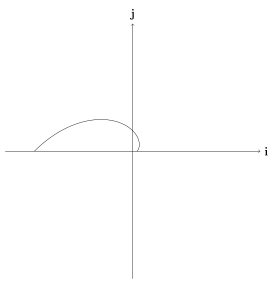
A particle \(P\) moves so that, at time \(t\), its displacement \( \bf r \) from a fixed origin is given by \[ {\bf r} =\left( \e^{t}\cos t \right) {\bf i}+ \left(\e^t \sin t\right) {\bf j}\,.\] Show that the velocity of the particle always makes an angle of \(\frac{\pi}{4}\) with the particle's displacement, and that the acceleration of the particle is always perpendicular to its displacement. Sketch the path of the particle for \(0\le t \le \pi\). A second particle \(Q\) moves on the same path, passing through each point on the path a fixed time \(T\) after \(P\) does. Show that the distance between \(P\) and \(Q\) is proportional to \(\e^{t}\).
Solution: \begin{align*} && {\bf r} &=\left( \e^{t}\cos t \right) {\bf i}+ \left(\e^t \sin t\right) {\bf j} \\ \Rightarrow && \dot{\bf r} &= \left( \e^{t}\cos t -\e^t \sin t\right) {\bf i}+ \left(\e^t \sin t+\e^t \cos t\right) {\bf j} \\ \Rightarrow && \mathbf{r}\cdot\dot{ \mathbf{r}} &= e^{2t}(\cos^2 t - \sin t \cos t) + e^{2t}(\sin^2 t+ \sin t \cos t) \\ &&&= e^{2t} (\cos^2 t + \sin ^2 t)\\ &&&= e^{2t} \\ \\ && | {\bf r}| &= e^{t} \\ && |{\bf \dot{r}}| &= e^t \sqrt{(\cos t - \sin t)^2 + (\sin t + \cos t)^2} \\ &&&= e^t \sqrt{2 \cos^2 t + 2 \sin^2 t} \\ &&&= \sqrt{2} e^t \\ \\ \Rightarrow && \frac{\mathbf{r}\cdot\dot{ \mathbf{r}}}{ |{\bf {r}}| |{\bf \dot{r}}|} &= \frac{e^{2t}}{\sqrt{2}e^te^t} \\ &&&= \frac{1}{\sqrt{2}} \end{align*} Therefore the angle between the velocity and displacement is \(\frac{\pi}{4}\). \begin{align*} && \ddot{\bf{r}} &= \left( \e^{t}(\cos t - \sin t) - \e^t (\sin t + \cos t)\right) {\bf i}+ \left(\e^t (\sin t + \cos t) + \e^t(\cos t - \sin t)\right) {\bf j} \\ &&&= \left ( -2\e^{t} \sin t \right) {\bf i}+ \left ( 2\e^{t} \cos t \right) {\bf j} \\ \Rightarrow && {\bf r} \cdot \ddot{\bf{r}} &= 2e^{2t} \left ( -\sin t \cos t + \sin t \cos t \right) \\ &&&= 0 \end{align*} Therefore the acceleration is perpendicular.
2010 Paper 3 Q5
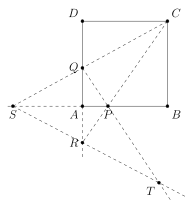
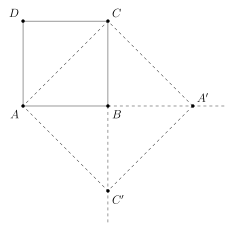
The vertices \(A\), \(B\), \(C\) and \(D\) of a square have coordinates \((0,0)\), \((a,0)\), \((a,a)\) and \((0,a)\), respectively. The points \(P\) and \(Q\) have coordinates \((an,0)\) and \((0,am)\) respectively, where \(0 < m < n < 1\). The line \(CP\) produced meets \(DA\) produced at \(R\) and the line \(CQ\) produced meets \(BA\) produced at \(S\). The line \(PQ\) produced meets the line \(RS\) produced at \(T\). Show that \(TA\) is perpendicular to \(AC\). Explain how, given a square of area \(a^2\), a square of area \(2a^2\) may be constructed using only a straight-edge. [Note: a straight-edge is a ruler with no markings on it; no measurements (and no use of compasses) are allowed in the construction.]
Solution:
2005 Paper 1 Q11
A particle moves so that \({\bf r}\), its displacement from a fixed origin at time \(t\), is given by \[{\bf r} = \l \sin{2t} \r {\bf i} + \l 2\cos t \r \bf{j}\,,\] where \(0 \le t < 2\pi\).
- Show that the particle passes through the origin exactly twice.
- Determine the times when the velocity of the particle is perpendicular to its displacement.
- Show that, when the particle is not at the origin, its velocity is never parallel to its displacement.
- Determine the maximum distance of the particle from the origin, and sketch the path of the particle.
Solution:
- It is at the origin when both \(\sin 2t\) and \(\cos t = 0\), but this \(\sin 2t = 2 \sin t \cos t\) so this happens precisely when \(\cos t = 0\), ie when \(t = \frac{\pi}{2}, \frac{3\pi}{2}\)
- \(\,\) \begin{align*} && \dot{\mathbf{r}} &= 2 \cos 2t \mathbf{i} - 2 \sin t \mathbf{j} \\ && \mathbf{r} \cdot \dot{\mathbf{r}} &= 2\cos 2t \sin 2t - 2 \sin t 2 \cos t \\ &&&= \sin 2t \left (2\cos 2t - 2 \right) \end{align*} Therefore they are perpendicular when \(\sin 2t = 0 \Rightarrow t = 0, \frac{\pi}{2}, \pi, \frac{3\pi}{2}, 2\pi\) and when \(\cos 2t = 1 \Rightarrow 2t = 0, 2\pi, 4\pi \Rightarrow t = 0, \pi, 2\pi\), therefore all solutions are \( t = 0, \frac{\pi}{2}, \pi, \frac{3\pi}{2}, 2\pi\)
- For \(\mathbf{r}\) and \(\dot{\mathbf{r}}\) to be parallel, we would need \begin{align*} && \frac{2 \cos 2t}{\sin 2t} &= \frac{-2 \sin t}{2 \cos t}\\ && 2 \cos 2t \cos t &= - \sin t \sin 2t \\ && 0 &= 2\cos t (\cos 2t + \sin ^2 t) \\ &&&= 2 \cos t (\cos^2 t) \\ &&&= 2 \cos^3 t \end{align*} Therefore the only time we can be parallel is when \(\cos t = 0\), which is when we are at the origin.
- \(\frac{\d }{\d t} (\mathbf{r} \cdot \mathbf{r}) = 2 \mathbf{r} \cdot \mathbf{\dot{r}}\) so we should check the values when velocity and displacement are perpendicular, ie \( t = 0, \frac{\pi}{2}, \pi, \frac{3\pi}{2}, 2\pi\) which have values \(\mathbf{r} = \binom{0}{2}, \binom{0}{0}, \binom{0}{-2}, \binom{0}{0}, \binom{0}{2}\). Therefore the maximum distance is \(2\).

2004 Paper 2 Q6
The vectors \({\bf a}\) and \({\bf b}\) lie in the plane \(\Pi\,\). Given that \(\vert {\bf a} \vert= 1\) and \({\bf a}.{\bf b} = 3,\) find, in terms of \({\bf a}\) and \({\bf b}\,\), a vector \({\bf p}\) parallel to \({\bf a}\) and a vector \({\bf q}\) perpendicular to \({\bf a}\,\), both lying in the plane \(\Pi\,\), such that $${\bf p}+{\bf q}={\bf a}+{\bf b}\;.$$ The vector \({\bf c}\) is not parallel to the plane \(\Pi\) and is such that \({\bf a}.{\bf c} = -2\) and \({\bf b}.{\bf c} = 2\,\). Given that \(\vert {\bf b} \vert = 5\,\), find, in terms of \({\bf a}, {\bf b}\) and \({\bf c},\) vectors \({\bf P}\), \({\bf Q}\) and \({\bf R}\) such that \({\bf P}\) and \({\bf Q}\) are parallel to \({\bf p}\) and \({\bf q},\) respectively, \({\bf R}\) is perpendicular to the plane \(\Pi\) and $${\bf P} + {\bf Q} + {\bf R} = {\bf a}+{\bf b}+{\bf c}\;.$$
Solution: Suppose \({\bf p} = \lambda {\bf a}\) and \({\bf p} + {\bf q} = {\bf a} + {\bf b}\) then \begin{align*} {\bf a} \cdot : && {\bf a} \cdot {\bf p} + {\bf a} \cdot {\bf p} &= {\bf a} \cdot {\bf a} + {\bf a} \cdot {\bf b} \\ && \lambda + 0 &= 1 + 3 = 4 \\ \Rightarrow && \mathbf{p} &= 4 \mathbf{a} \\ && \mathbf{q} &= \mathbf{b} - 3\mathbf{a} \\ \\ && \mathbf{P} &= 4p\mathbf{a} \\ && \mathbf{Q} &= q\mathbf{b} - 3q\mathbf{a} \\ \\ \mathbf{a} \cdot : && \mathbf{a} \cdot \mathbf{P} + \mathbf{a} \cdot \mathbf{Q} + \mathbf{a} \cdot \mathbf{R} &= \mathbf{a} \cdot \mathbf{a} + \mathbf{a} \cdot \mathbf{b} + \mathbf{a} \cdot \mathbf{c} \\ && 4p &= 1+3-2 \\ \Rightarrow && p &= \tfrac12 \\ \\ && {\bf P} + {\bf Q} + {\bf R} &= {\bf a}+{\bf b}+{\bf c} \\ \mathbf{b} \cdot : && \mathbf{b} \cdot \mathbf{P} + \mathbf{b} \cdot \mathbf{Q} + \mathbf{b} \cdot \mathbf{R} &= \mathbf{b} \cdot \mathbf{a} + \mathbf{b} \cdot \mathbf{b} + \mathbf{b} \cdot \mathbf{c} \\ && 12p + 25q - 9q &= 3+25+2 \\ && 6+16q &= 30 \\ \Rightarrow && q &= \tfrac{3}{2}\\ && \\ && \mathbf{P} &= 2\mathbf{a} \\ && \mathbf{Q} &= \tfrac32 \mathbf{b} - \tfrac92 \mathbf{a} \\ && \mathbf{R} &= \tfrac72\mathbf{a} -\tfrac12 \mathbf{b} + \mathbf{c} \end{align*}
2003 Paper 3 Q7
In the \(x\)--\(y\) plane, the point \(A\) has coordinates \((a\,,0)\) and the point \(B\) has coordinates \((0\,,b)\,\), where \(a\) and \(b\) are positive. The point \(P\,\), which is distinct from \(A\) and \(B\), has coordinates~\((s,t)\,\). \(X\) and \(Y\) are the feet of the perpendiculars from \(P\) to the \(x\)--axis and \(y\)--axis respectively, and \(N\) is the foot of the perpendicular from \(P\) to the line \(AB\,\). Show that the coordinates \((x\,,y)\) of \(N\) are given by \[ x= \frac {ab^2 -a(bt-as)}{a^2+b^2} \;, \ \ \ y = \frac{a^2b +b(bt-as)}{a^2+b^2} \;. \] Show that, if $\ds \ \left( \frac{t-b} s\right)\left( \frac t {s-a}\right) = -1\;\(, then \)N$ lies on the line \(XY\,\). Give a geometrical interpretation of this result.
2001 Paper 3 Q6
The plane \[ {x \over a} + {y \over b} +{z \over c} = 1 \] meets the co-ordinate axes at the points \(A\), \(B\) and \(C\,\). The point \(M\) has coordinates \(\left( \frac12 a, \frac12 b, \frac 12 c \right)\) and \(O\) is the origin. Show that \(OM\) meets the plane at the centroid \(\left( \frac13 a, \frac13 b, \frac 13 c \right)\) of triangle \(ABC\). Show also that the perpendiculars to the plane from \(O\) and from \(M\) meet the plane at the orthocentre and at the circumcentre of triangle \(ABC\) respectively. Hence prove that the centroid of a triangle lies on the line segment joining its orthocentre and circumcentre, and that it divides this line segment in the ratio \(2 : 1\,\). [The orthocentre of a triangle is the point at which the three altitudes intersect; the circumcentre of a triangle is the point equidistant from the three vertices.]
Solution: The line \(OM\) is \(\lambda \begin{pmatrix} a \\ b \\ c \end{pmatrix}\), then we need \(1 = \lambda \begin{pmatrix} a \\ b \\ c \end{pmatrix} \cdot \begin{pmatrix} \frac1{a} \\ \frac1b \\ \frac1c \end{pmatrix} = 3 \lambda \Rightarrow \lambda = \frac13\). Therefore \(OM\) meets the plane at the centroid. The orthocentre is the point \(\mathbf{h}\) such that \((\mathbf{a}-\mathbf{b}) \cdot (\mathbf{c} - \mathbf{h}) = 0 \Leftrightarrow \begin{pmatrix} a \\ -b \\ 0 \end{pmatrix} \cdot \begin{pmatrix} -p \\ -q \\ c-r \end{pmatrix} \Leftrightarrow ap-bq = 0\) \((\mathbf{b}-\mathbf{c}) \cdot (\mathbf{a} - \mathbf{h}) = 0 \Leftrightarrow \begin{pmatrix} 0 \\ b \\ -c \end{pmatrix} \cdot \begin{pmatrix} a-p \\ -q \\ -r \end{pmatrix} \Leftrightarrow bq-cr = 0\) \((\mathbf{c}-\mathbf{a}) \cdot (\mathbf{b} - \mathbf{h}) = 0 \Leftrightarrow \begin{pmatrix} -a \\ 0 \\ c \end{pmatrix} \cdot \begin{pmatrix} -p \\ b-q \\ -r \end{pmatrix} \Leftrightarrow cr-ap = 0\) ie \(ap = bq = cr\) but this is clearly on the line \(\lambda \begin{pmatrix} \frac1{a} \\ \frac1b \\ \frac1c \end{pmatrix}\) therefore the orthocentre is on the perpendicular from \(O\) \(M-A = \begin{pmatrix} -a/2 \\ b/2 \\ c/2 \end{pmatrix}\) so \(|M-A|=|M-B|=|M-C|\) Also by pythagoras the point of intersection satisfies \(|M-P|^2 + |P-A|^2 = |M-A|^2\) so \(|P-A|^2 = |P-B|^2 = |P-C|^2\), therefore \(P\) is the circumcentre. Since all these points are in the same plane and \(OGM\) is a line, we have the points are in a line. Similar triangles gives the desired ratio
2001 Paper 3 Q10
Three ships \(A\), \(B\) and \(C\) move with velocities \({\bf v}_1\), \({\bf v}_2\) and \(\bf u\) respectively. The velocities of \(A\) and \(B\) relative to \(C\) are equal in magnitude and perpendicular. Write down conditions that \(\bf u\), \({\bf v}_1\) and \({\bf v}_2\) must satisfy and show that \[ \left| {\bf u} -{\textstyle\frac12} \l {\bf v}_1 + {\bf v}_2 \r \right|^2 = \left|{\textstyle\frac12} \l {\bf v}_1 - {\bf v}_2 \r \right|^2 \] and \[ \l {\bf u} -{\textstyle\frac12} \l {\bf v}_1 + {\bf v}_2 \r \r \cdot \l {\bf v}_1 - {\bf v}_2 \r = 0 \;. \] Explain why these equations determine, for given \({\bf v}_1\) and \({\bf v}_2\), two possible velocities for \(C\,\), provided \({\bf v}_1 \ne {\bf v}_2 \,\). If \({\bf v}_1\) and \({\bf v}_2\) are equal in magnitude and perpendicular, show that if \({\bf u} \ne {\bf 0}\) then \({\bf u} = {\bf v}_1 + {\bf v}_2\,\).
1998 Paper 3 Q8
- Consider the sphere of radius \(a\) and centre the origin. %Show that the line through the point with position vector %\({\bf b}\) and parallel to a unit %vector \({\bf m}\) intersects the sphere at two points if %$$ %a^2 > {\bf b}.{\bf b} -({\bf b}.{\bf m})^2 \,. %$$ %What is the corresponding condition for there to be precisely one %point of intersection? %If this point has position vector \({\bf p}\), show that the line %is perpendicular to \({\bf p}\).
- Show that the line \({\bf r} ={\bf b} + \lambda {\bf m}\), where \(\bf m\) is a unit vector, intersects the sphere \({\bf r}\cdot {\bf r} = a^2\) at two points if $$ a^2 > {\bf b}\cdot{\bf b} -({\bf b}\cdot{\bf m})^2 \,. $$ Write down the corresponding condition for there to be precisely one point of intersection. If this point has position vector \({\bf p}\), show that \({\bf m}\cdot{\bf p}=0\).
- Now consider a second sphere of radius \(a\) and a plane perpendicular to a unit vector~\({\bf n}\). The centre of the sphere has position vector \({\bf d}\) and the minimum distance from the origin to the plane is \(l\). What is the condition for the plane to be tangential to this second sphere?
- Show that the first and second spheres intersect at right angles ({\em i.e.\ }the two radii to each point of intersection are perpendicular) if $$ {\bf d}\cdot{\bf d} = 2 a^2 \,. $$
1995 Paper 1 Q7
Let \(A,B,C\) be three non-collinear points in the plane. Explain briefly why it is possible to choose an origin equidistant from the three points. Let \(O\) be such an origin, let \(G\) be the centroid of the triangle \(ABC,\) let \(Q\) be a point such that \(\overrightarrow{GQ}=2\overrightarrow{OG},\) and let \(N\) be the midpoint of \(OQ.\)
- Show that \(\overrightarrow{AQ}\) is perpendicular to \(\overrightarrow{BC}\) and deduce that the three altitudes of \(\triangle ABC\) are concurrent.
- Show that the midpoints of \(AQ,BQ\) and \(CQ\), and the midpoints of the sides of \(\triangle ABC\) are all equidistant from \(N\).
1994 Paper 1 Q5
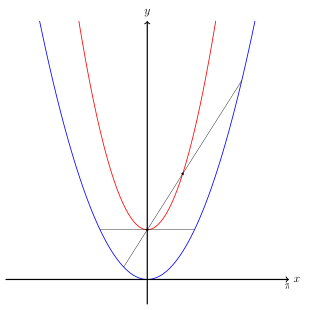
A parabola has the equation \(y=x^{2}.\) The points \(P\) and \(Q\) with coordinates \((p,p^{2})\) and \((q,q^{2})\) respectively move on the parabola in such a way that \(\angle POQ\) is always a right angle.
- Find and sketch the locus of the midpoint \(R\) of the chord \(PQ.\)
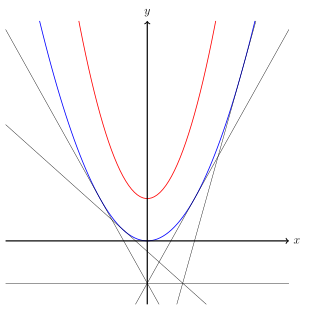
- Find and sketch the locus of the point \(T\) where the tangents to the parabola at \(P\) and \(Q\) intersect.
Solution:
- The line \(PO\) has gradient \(\frac{p^2}{p} = p\) and teh line \(QO\) has gradient \(q\), therefore we must have that \(pq = -1\). Therefore, \(R\) is the point
\begin{align*}
&& R &= \left ( \frac{p-\frac{1}{p}}{2}, \frac{p^2+\frac{1}{p^2}}{2} \right) \\
&&&= \left ( \frac12\left ( p - \frac{1}{p} \right),2\left (\frac12 \left(p-\frac{1}{p}\right) \right)^2+1 \right) \\
&&&= \left ( t, 2t^2+1\right)
\end{align*}
So we are looking at another parabola.
- The tangents are \(y = 2px+c\), ie \(p^2 = 2p^2+c\), ie \(y = 2px -p^2\) so we have
\begin{align*}
&& y - 2px &= -p^2 \\
&& y - 2qx &= -q^2 \\
\Rightarrow && (2p-2q)x &= p^2-q^2 \\
\Rightarrow && x &= \frac12 (p+q)\\
&& y &= p(p+q)-p^2 \\
&& y &= pq = -1
\end{align*}
Therefore \(x = \frac12(p - \frac1p), y= -1\), so we have the line \(y = -1\) (the directrix)
1990 Paper 2 Q5
The distinct points \(L,M,P\) and \(Q\) of the Argand diagram lie on a circle \(S\) centred on the origin and the corresponding complex numbers are \(l,m,p\) and \(q\). By considering the perpendicular bisectors of the chords, or otherwise, prove that the chord \(LM\) is perpendicular to the chord \(PQ\) if and only if \(lm+pq=0.\) Let \(A_{1},A_{2}\) and \(A_{3}\) be three distinct points on \(S\). For any given point \(A_{1}'\) on \(S\), the points \(A_{2}',A_{3}'\) and \(A_{1}''\) are chosen on \(S\) such that \(A_{1}'A_{2}',A_{2}'A_{3}'\) and \(A_{3}'A_{1}''\) are perpendicular to \(A_{1}A_{2},A_{2}A_{3}\) and \(A_{3}A_{1},\) respectively. Show that for exactly two positions of \(A_{1}',\) the points \(A_{1}'\) and \(A_{1}''\) coincide. If, instead, \(A_{1},A_{2},A_{3}\) and \(A_{4}\) are four given distinct points on \(S\) and, for any given point \(A_{1}',\) the points \(A_{2}',A_{3}',A_{4}'\) and \(A_{1}''\) are chosen on \(S\) such that \(A_{1}'A_{2}',A_{2}'A_{3}',A_{3}'A_{4}'\) and \(A_{4}'A_{1}''\) are respectively perpendicular to \(A_{1}A_{2},A_{2}A_{3},A_{3}A_{4}\) and \(A_{4}A_{1},\) show that \(A_{1}'\) coincides with \(A_{1}''.\) Give the corresponding result for \(n\) distinct points on \(S\).
Solution: The perpendicular bisector of the chords runs through the origin, therefore \(LM\) is perpendicular to \(PQ\) if and only if \(\frac{l+m}{2}\) is perpendicular to \(\frac{p+q}{2}\), ie \begin{align*} && (l+m) &= it (p+q) \\ \Leftrightarrow && \frac{l+m}{p+q} & \in i \mathbb{R} \\ \Leftrightarrow && 0 &= \frac{l+m}{p+q} + \frac{l^*+m^*}{p^*+q^*} \\ &&&= \frac{l+m}{p+q} + \frac{\frac{r^2}{l}+\frac{r^2}{m}}{\frac{r^2}{p}+\frac{r^2}{q}} \\ &&&=\frac{l+m}{p+q} + \frac{l+m}{p+q} \frac{pq}{lm} \\ &&&= \frac{l+m}{p+q} \left ( \frac{lm+pq}{lm} \right) \end{align*} Therefore as long as \(l+m, p+q \neq 0\) \(lm+pq = 0\) is equivalent to the chords being perpendicular. In the case where (say) \(l,m\) is a diameter, then the condition for the chords to be perpendicular is that \(p,q\) is also a diameter and at right angles, but clearly this is also equivalent to our condition. Suppose \(A_1, A_2, A_3\) are distinct points on \(S\), and \(A_1'\) is given and suppose \(a_i, a_i'\) are the corresponding complex numbers, then the conditions are: \begin{align*} A_1'A_2' \perp A_1A_2: && 0 &= a_1'a_2' + a_1a_2 \\ A_2'A_3' \perp A_2A_3: && 0 &= a_2'a_3' + a_2a_3 \\ A_3'A_1'' \perp A_3A_1: && 0 &= a_3'a_1'' + a_3a_1 \\ \\ \Rightarrow && a_2' &= -\frac{a_1a_2}{a_1'} \\ && a_3' &= -\frac{a_2a_3}{a_2'} \\ &&&= \frac{a_1'a_2a_3}{a_1a_2} \\ &&&= \frac{a_1'a_3}{a_1} \\ && a_1'' &= - \frac{a_3a_1}{a_3'} \\ &&&= \frac{a_3a_1a_1}{a_1'a_3} \\ &&&= \frac{a_1^2}{a_1'} \\ \Rightarrow && a_1'a_1'' &= a_1^2 \end{align*} Therefore \(a_1' = a_1''\) if \(a_1' = \pm a_1\) Suppose we have \(4\) points, then \begin{align*} A_1'A_2' \perp A_1A_2: && 0 &= a_1'a_2' + a_1a_2 \\ A_2'A_3' \perp A_2A_3: && 0 &= a_2'a_3' + a_2a_3 \\ A_3'A_4' \perp A_3A_4: && 0 &= a_3'a_4' + a_3a_4 \\ A_4'A_1'' \perp A_4A_1: && 0 &= a_4'a_1'' + a_4a_1 \\ \\ \Rightarrow && a_4' &= -\frac{a_3a_4}{a_3'} \\ &&&= -\frac{a_1a_3a_4}{a_1'a_3} \\ &&&= -\frac{a_1a_4}{a_1'} \\ \Rightarrow && a_1'' &= -\frac{a_4a_1}{a_4'} \\ &&&= \frac{a_4a_1a_1'}{a_1a_4} \\ &&&= a_1' \end{align*} So they coincide. For \(n\) points if there are an even number of points they coincide, an odd number and there are two points when they coincide.