2010 Paper 3 Q5
Year: 2010
Paper: 3
Question Number: 5
Course: LFM Pure
Section: Proof
Problem
Solution
Examiner's report
— 2010 STEP 3, Question 5About 80% of candidates attempted at least five questions, and well less than 20% made genuine attempts at more than six. Those attempting more than six questions fell into three camps which were those weak candidates who made very little progress on any question, those with four or five fair solutions casting about for a sixth, and those strong candidates that either attempted 7th or even 8th questions as an "insurance policy" against a solution that seemed strong but wasn't, or else for entertainment!
Rating Information
Difficulty Rating: 1700.0
Difficulty Comparisons: 0
Banger Rating: 1486.7
Banger Comparisons: 1
Show LaTeX source
Problem source
The vertices $A$, $B$, $C$ and $D$ of a square have coordinates $(0,0)$, $(a,0)$, $(a,a)$ and $(0,a)$, respectively.
The points $P$ and $Q$ have coordinates $(an,0)$ and $(0,am)$ respectively, where $0 < m < n < 1$.
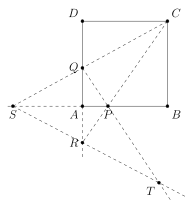
The line $CP$ produced meets $DA$ produced at $R$ and the line $CQ$ produced meets $BA$ produced at $S$.  The line $PQ$ produced meets the line $RS$ produced at $T$.
Show that $TA$ is perpendicular to $AC$.
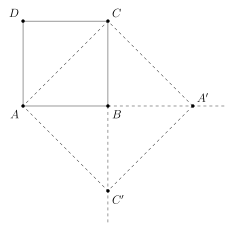
Explain how, given a square of area $a^2$, a square of area $2a^2$ may be constructed using only a straight-edge.

[\textbf{Note}: a straight-edge is a ruler with no markings on it;
no measurements (and no use of  compasses) are allowed in the construction.]
Solution source
\begin{center}
\begin{tikzpicture}

\def\a{3};
\def\n{.3};
\def\m{.45};

\coordinate (A) at (0,0);
\coordinate (B) at (\a,0);
\coordinate (C) at (\a,\a);
\coordinate (D) at (0,\a);

\coordinate (P) at ({\a*\n}, 0);
\coordinate (Q) at (0, {\a*\m});

\coordinate (R) at (0, {-\a*\n/(1-\n)});
\coordinate (S) at ({-\a*\m/(1-\m)}, 0);
\coordinate (T) at ({\a*\m*\n/(\m-\n)}, {-\a*\m*\n/(\m-\n)});

\filldraw (A) circle (1.5pt) node[below left] {$A$};
\filldraw (B) circle (1.5pt) node[below right] {$B$};
\filldraw (C) circle (1.5pt) node[above right] {$C$};
\filldraw (D) circle (1.5pt) node[above left] {$D$};
\filldraw (P) circle (1.5pt) node[below] {$P$};
\filldraw (Q) circle (1.5pt) node[left] {$Q$};
\filldraw (R) circle (1.5pt) node[left] {$R$};
\filldraw (S) circle (1.5pt) node[below] {$S$};
\filldraw (T) circle (1.5pt) node[below left] {$T$};


\draw (A) -- (B) -- (C) -- (D) -- cycle;

\draw[dashed] (A) -- ($(A)!-0.6!(D)$);
\draw[dashed] (A) -- ($(A)!-0.9!(B)$);
\draw[dashed] (Q) -- ($(P)!-2.5!(Q)$);
\draw[dashed] (S) -- ($(R)!-1.5!(S)$);
\draw[dashed] (C) -- (R);
\draw[dashed] (C) -- (S);

\end{tikzpicture}
\end{center}

Note that $CP$ has equation $\frac{y-0}{x-an} = \frac{a-0}{a-an} = \frac{1}{1-n} \Rightarrow y = \frac{x-an}{1-n}$
Therefore $R = (0, -\frac{an}{1-n})$

Note that $CQ$ has equation $\frac{y-am}{x} = \frac{a-am}{a} = 1-m \Rightarrow y = (1-m)x + am$
Therefore $S = (-\frac{am}{1-m}, 0)$

$PQ$ has equation $\frac{y}{x-an} = \frac{am-0}{0-an} \Rightarrow y = -\frac{m}{n}x +am$

$SR$ has equation $\frac{y}{x+\frac{am}{1-m}} = \frac{-\frac{an}{1-n}}{\frac{am}{1-m}} = -\frac{n(1-m)}{m(1-n)} \Rightarrow y =-\frac{n(1-m)}{m(1-n)} x -a\frac{n}{1-n}$

So $PQ \cap SR$ has
\begin{align*}
&& -\frac{m}{n}x +am &= -\frac{n(1-m)}{m(1-n)} x -a\frac{n}{1-n} \\
&& x \left (\frac{n(1-m)}{m(1-n)} - \frac{m}{n} \right) &= -am - \frac{an}{1-n} \\
\Rightarrow && x \left ( \frac{n^2(1-m)-m^2(1-n)}{nm(1-n)} \right) &= -\frac{a(m(1-n)+n)}{1-n} \\
\Rightarrow && x \left ( \frac{(m-n)(mn-n-m)}{mn(1-n)} \right) &= \frac{a(mn-m-n)}{1-n} \\
\Rightarrow && x &= \frac{amn}{m-n} \\
&& y &= -\frac{amn}{m-n}
\end{align*}

Therefore clearly $TA$ is perpendicular to $AC$ since they are the lines $y = -x$ and $y = x$

Given this method we can construct the perpendicular to the diagonal through the vertex. Doing this at $A$ we can construct $C'$ the reflection of $C$ in $AB$.

We can do the same to find the reflection of $A$ and so we have a square with sidelengths $\sqrt{2}a$ and hence area $2a^2$

\begin{center}
\begin{tikzpicture}

\def\a{3};
\def\n{.3};
\def\m{.45};

\coordinate (A) at (0,0);
\coordinate (Aa) at ({\a*2},0);
\coordinate (B) at (\a,0);
\coordinate (C) at (\a,\a);
\coordinate (Ca) at (\a,-\a);
\coordinate (D) at (0,\a);

\filldraw (A) circle (1.5pt) node[below left] {$A$};
\filldraw (B) circle (1.5pt) node[below right] {$B$};
\filldraw (C) circle (1.5pt) node[above right] {$C$};
\filldraw (D) circle (1.5pt) node[above left] {$D$};
\filldraw (Ca) circle (1.5pt) node[below right] {$C'$};
\filldraw (Aa) circle (1.5pt) node[above right] {$A'$};

\draw (A) -- (B) -- (C) -- (D) -- cycle;

\draw[dashed] (Aa) -- (C) -- (A) -- (Ca) -- cycle;
\draw[dashed] (B) -- ($(B)!-1.4!(C)$);
\draw[dashed] (B) -- ($(B)!-1.4!(A)$);
\end{tikzpicture}
\end{center}
This question resembled question 3 in popularity and success. Most were able to derive line equations reliably, and address the intersection problem. (Those that used an equally valid vector formulism had a low success rate for no apparent reason.) Very few addressed whether or not factors that were being divided by were non-zero. Mistaking m for n and vice versa, careless algebraic errors, and overlooking which equation represented which line caused problems in trying to find T. The idea of explaining the construction verbally in the last part exposed that many candidates are not used to expressing a formal argument in words. The nicety of this question is that whilst all candidates will have encountered geometrical constructions involving straight edge and compass, few will have previously met one that only requires a straight edge.