2010 Paper 1 Q10
Year: 2010
Paper: 1
Question Number: 10
Course: UFM Mechanics
Section: Circular Motion 1
Problem
Solution
Examiner's report
— 2010 STEP 1, Question 10There were significantly more candidates attempting this paper than last year (just over 1000), and the scores were much higher than last year (presumably due to the easier first question): fewer than 2% of candidates scored less than 20 marks overall, and the median mark was 61. The pure questions were the most popular as usual, though there was much more variation than in some previous years: questions 1, 3, 4 and 6 were the most popular, while question 7 (on vectors) was intensely unpopular. About half of all candidates attempted at least one mechanics question, and 15% attempted at least one probability question. The marks were unsurprising: the pure questions generally gained the better marks, while the mechanics and probability questions generally had poorer marks. A sizeable number of candidates ignored the advice on the front cover and attempted more than six questions, with a fifth of candidates trying eight or more questions. A good number of those extra attempts were little more than failed starts, but suggest that some candidates are not very effective at question-picking. This is an important skill to develop during STEP preparation. Nevertheless, the good marks and the paucity of candidates who attempted the questions in numerical order does suggest that the majority are being wise in their choices. Because of the abortive starts, I have often restricted my attention below to those attempts which counted as one of the six highest-scoring answers, and referred to these as "significant attempts". The majority of candidates did begin with question 1 (presumably as it appeared to be the easiest), but some spent far longer on it than was wise. Some attempts ran to over eight pages in length, especially when they had made an algebraic slip early on, and used time which could have been far better spent tackling another question. It is important to balance the desire to finish the question with an appreciation of when to stop and move on. Many candidates realised that for some questions, it was possible to attempt a later part without a complete (or any) solution to an earlier part. An awareness of this could have helped some of the weaker students to gain vital marks when they were stuck; it is generally better to do more of one question than to start another question, in particular if one has already attempted six questions. It is also fine to write "continued later" at the end of a partial attempt and then to continue the answer later in the answer booklet. As usual, though, some candidates ignored explicit instructions to use the previous work, such as "Hence", or "Deduce". They will get no credit if they do not do what they are asked to! (Of course, "Hence, or otherwise, show . . ." gives them the freedom to use any method of their choosing; often the "hence" will be the easiest, but in Question 5 this year, the "otherwise" approach was very popular.) On some questions, some candidates tried to work forwards from the given question and backwards from the answer, hoping that they would meet somewhere in the middle. While this worked on occasion, it often required fudging. It is wise to remember that STEP questions do require a greater facility with mathematics and algebraic manipulation than the A-level examinations, as well as a depth of understanding which goes beyond that expected in a typical sixth-form classroom.
Rating Information
Difficulty Rating: 1500.0
Difficulty Comparisons: 0
Banger Rating: 1500.0
Banger Comparisons: 0
Show LaTeX source
Problem source
A particle $P$ moves so that, at time $t$, its displacement $ \bf r $ from a fixed origin  is given by
\[
{\bf r} =\left( \e^{t}\cos t \right) {\bf i}+
\left(\e^t \sin t\right) {\bf j}\,.\]
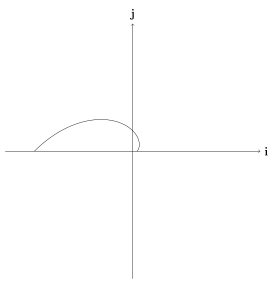
Show that the velocity of the particle always makes an angle of $\frac{\pi}{4}$ with the particle's displacement, and that the acceleration of the particle is always perpendicular to its displacement. Sketch the path of the particle for $0\le t \le \pi$.

A second particle $Q$ moves on the same path, passing through each point on the path a fixed time $T$ after $P$ does. Show that the distance between $P$ and $Q$ is proportional to $\e^{t}$.
Solution source
\begin{align*}
&& {\bf r} &=\left( \e^{t}\cos t \right) {\bf i}+
\left(\e^t \sin t\right) {\bf j} \\
\Rightarrow && \dot{\bf r} &= \left( \e^{t}\cos t -\e^t \sin t\right) {\bf i}+
\left(\e^t \sin t+\e^t \cos t\right) {\bf j} \\
\Rightarrow && \mathbf{r}\cdot\dot{ \mathbf{r}} &= e^{2t}(\cos^2 t - \sin t \cos t)  + e^{2t}(\sin^2 t+ \sin t \cos t) \\
&&&= e^{2t} (\cos^2 t + \sin ^2 t)\\
&&&= e^{2t} \\
\\
&& | {\bf r}| &= e^{t} \\
&& |{\bf \dot{r}}| &= e^t \sqrt{(\cos t - \sin t)^2  + (\sin t + \cos t)^2} \\
&&&= e^t \sqrt{2 \cos^2 t + 2 \sin^2 t} \\
&&&= \sqrt{2} e^t \\
\\
\Rightarrow && \frac{\mathbf{r}\cdot\dot{ \mathbf{r}}}{ |{\bf {r}}| |{\bf \dot{r}}|} &= \frac{e^{2t}}{\sqrt{2}e^te^t} \\
&&&= \frac{1}{\sqrt{2}}
\end{align*}

Therefore the angle between the velocity and displacement is $\frac{\pi}{4}$.

\begin{align*}
&& \ddot{\bf{r}} &= \left( \e^{t}(\cos t - \sin t) - \e^t (\sin t + \cos t)\right) {\bf i}+
\left(\e^t (\sin t + \cos t) + \e^t(\cos t - \sin t)\right) {\bf j} \\
&&&= \left ( -2\e^{t} \sin t \right) {\bf i}+
 \left ( 2\e^{t} \cos t \right) {\bf j} \\
\Rightarrow && {\bf r} \cdot \ddot{\bf{r}} &= 2e^{2t} \left ( -\sin t \cos t + \sin t \cos t \right) \\
&&&= 0
\end{align*}

Therefore the acceleration is perpendicular.


\begin{center}
    \begin{tikzpicture}[scale=0.15]

        \draw[->] (-30, 0) -- (30, 0) node[right] {$\bf i$};
        \draw[->] (0, -30) -- (0,30) node[above] {$\bf j$};


        \draw[domain = 0:pi, samples=180, variable = \x]
            plot ({exp(\x)*cos(deg(\x))},{exp(\x)*sin(deg(\x))});

    \end{tikzpicture}
\end{center}

$Q$ has position $\mathbf{r}' = \left( \e^{t-T}\cos (t-T) \right) {\bf i}+
\left(\e^{t-T} \sin (t-T)\right) {\bf j}$ for $t > T$.

\begin{align*}
&& {\bf r' \cdot r} &= e^{2t-T} \left (\cos t \cos (t-T) + \sin t \sin(t - T) \right) \\
&&&= e^{2t-T} \cos (t - (t-T)) \\
&&&= e^{2t-T} \cos T \\
\\
&& |{\bf r'}- {\bf r} |^2 &= |{\bf r}|^2 + |{\bf r}'|^2 - 2 {\bf r' \cdot r} \\
&&&= e^{2t} + e^{2(t-T)} - 2e^{2t-T} \cos T \\
&&&= e^{2t} \left (1 - 2e^{-T} \cos T + e^{-2T} \right) \\
\Rightarrow && |{\bf r'}- {\bf r} | &= e^{t} \sqrt{1 - 2e^{-T} \cos T + e^{-2T} }
\end{align*}

as required
This question was attempted by about 20% of the candidates, though many became stuck fairly early on in the question. For the first part of the question, the majority of candidates showed a good understanding of how to differentiate a vector, though close to half got no further than finding the velocity and acceleration (often correctly, often with errors). Most of the rest then went on to evaluate scalar products to find the angle between two vectors, usually successfully. A small number took the elegant geometric-trigonometric approach very successfully. Those who reached this point sketched the path of the particle, but with little thought for what they had just done: almost no candidates had a diagram in which the direction of motion was at 45° to the position of the particle even at the start point. Some drew a vague swirl, but most at least indicated one or two coordinates (usually correctly). Only two candidates were awarded full marks for their sketch, which required just a couple of coordinates and a clear (explicit or implicit) indication of the direction of motion somewhere along the path. The final part of the question was very poorly done. Few even attempted it, and of those who did, many thought that a time delay of T meant that rQ = e^(t+T) cos(t+T)i + ··· instead of using t − T. Those who got this far often concluded that PQ is proportional to e^t simply because they reached an equation of the form |PQ| = e^t × some expression involving t and T, without simplifying the square root to eliminate t.