2019 Paper 3 Q8
Year: 2019
Paper: 3
Question Number: 8
Course: LFM Pure
Section: Trigonometry 2
Problem
- The edges \(AB\) and \(BC\) are parallel to the unit vectors \(\mathbf{i}\) and \(\mathbf{j}\), respectively, and the unit vector \(\mathbf{k}\) is vertical. Find a unit vector that is perpendicular to the face \(AVB\). Show that $$\cos \theta = \cos \alpha \cos \beta.$$
- The edge \(BV\) makes an angle \(\phi\) with the base. Show that $$\cot^2 \phi = \cot^2 \alpha + \cot^2 \beta.$$ Show also that $$\cos^2 \phi = \frac{\cos^2 \alpha + \cos^2 \beta - 2 \cos^2 \theta}{1 - \cos^2 \theta} \geq \frac{2 \cos \theta - 2 \cos^2 \theta}{1 - \cos^2 \theta}$$ and deduce that \(\phi < \theta\).
Solution
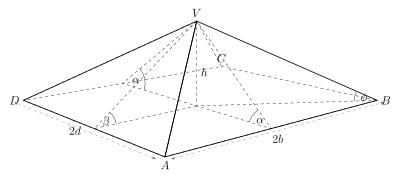
- Let \(A = (0,0,0)\) and then \(B = 22b \mathbf{i}, D = 2d\mathbf{j}, C = 2b\mathbf{i}+2d\mathbf{j}\) and \(V = b \mathbf{i} + d\mathbf{j} + h\mathbf{k}\) We also have \begin{align*} && \tan \alpha &= \frac{h}{d}\\ && \tan \beta &= \frac{d}{b} \\ && \vec{AV} \times \vec{VB} &= \begin{pmatrix} b \\ d \\ h \end{pmatrix} \times \begin{pmatrix} -b \\ d \\ h \end{pmatrix} \\ &&&= \begin{pmatrix} 0 \\ -2bh \\ 2db \end{pmatrix} \\ &&&= 2b \begin{pmatrix} 0 \\ -d \tan \alpha \\ d \end{pmatrix} \\ &&&= k \begin{pmatrix} 0 \\ - \sin \alpha \\ \cos \alpha \end{pmatrix} \end{align*} similarly for the vector perpendicular to the other face it must be \(\begin{pmatrix}-\sin \beta \\ 0 \\ \cos \beta \end{pmatrix}\) Looking at the angle between these perpendicular (to find the angles between the faces we see: \begin{align*} \begin{pmatrix} 0 \\ - \sin \alpha \\ \cos \alpha \end{pmatrix} \cdot \begin{pmatrix}-\sin \beta \\ 0 \\ \cos \beta \end{pmatrix} &= \cos \alpha \cos \beta \end{align*} But this is also \(\pi -\) the angle between the planes, ie \(\cos \theta = \cos \alpha \cos \beta\)
- \(\,\) \begin{align*} && \cot^2 \phi &= \frac{b^2+d^2}{h^2} \\ && \cot^2 \alpha &= \frac{d^2}{h^2} \\ && \cot^2 \beta &= \frac{b^2}{h^2} \\ \Rightarrow && cot^2 \phi &= \cot^2 \beta+\cot^2 \alpha \end{align*} \begin{align*} && \cos^2 \phi &= \frac{b^2+d^2}{b^2+d^2+h^2} \\ && \cos^2 \alpha &= \frac{d^2}{d^2+h^2} \\ && \cos^2 \beta &= \frac{b^2}{b^2+h^2} \\ && \frac{\cos^2 \alpha + \cos^2 \beta - 2 \cos^2 \theta}{1-\cos^2 \theta} &= \frac{\frac{d^2}{d^2+h^2}+\frac{b^2}{b^2+h^2}-2\cdot \frac{d^2}{d^2+h^2} \cdot \frac{b^2}{b^2+h^2}}{1 - \frac{d^2}{d^2+h^2} \cdot\frac{b^2}{b^2+h^2}} \\ &&&= \frac{d^2(b^2+h^2)+b^2(d^2+h^2)-2d^2b^2}{(d^2+h^2)(b^2+h^2)-d^2b^2} \\ &&&= \frac{h^2(b^2+d^2)}{h^2(b^2+d^2+h^2)} \\ &&&= \frac{b^2+d^2}{b^2+d^2+h^2} \\ &&&= \cos^2\phi \end{align*} Also notice that \begin{align*} && \cos^2 \alpha + \cos^2 \beta &\underbrace{\geq}_{AM-GM} 2 \cos \alpha \cos \beta \\ &&&= 2 \cos \theta \\ \Rightarrow && \frac{\cos^2 \alpha + \cos^2 \beta - 2 \cos^2 \theta}{1-\cos^2 \theta} &\geq \frac{2 \cos \theta - 2\cos^2 \theta}{1-\cos^2 \theta} \\ &&&= \frac{2\cos \theta}{1+\cos \theta} = \cos \theta \frac{2}{1+\cos \theta} \\ &&&> \cos^2 \theta \\ \Rightarrow && \phi &< \theta \end{align*}
Examiner's report
— 2019 STEP 3, Question 8There was a significant rise in the total entry this year with an increase of nearly 8.5% on 2018. One question was attempted by over 90%, two others were very popular, and three further questions were attempted by 60% or more. No question was generally avoided and even the least popular attracted more than 10% of the candidates. 88% restricted themselves to attempting no more than 7 questions, and only a handful, but not the very best, scored strongly attempting more than 7 questions.
Rating Information
Difficulty Rating: 1500.0
Difficulty Comparisons: 0
Banger Rating: 1500.0
Banger Comparisons: 0
Show LaTeX source
Problem source
A pyramid has a horizontal rectangular base $ABCD$ and its vertex $V$ is vertically above the centre of the base. The acute angle between the face $AVB$ and the base is $\alpha$, the acute angle between the face $BVC$ and the base is $\beta$ and the obtuse angle between the faces $AVB$ and $BVC$ is $\pi - \theta$.
\begin{questionparts}
\item The edges $AB$ and $BC$ are parallel to the unit vectors $\mathbf{i}$ and $\mathbf{j}$, respectively, and the unit vector $\mathbf{k}$ is vertical. Find a unit vector that is perpendicular to the face $AVB$.
Show that
$$\cos \theta = \cos \alpha \cos \beta.$$
\item The edge $BV$ makes an angle $\phi$ with the base. Show that
$$\cot^2 \phi = \cot^2 \alpha + \cot^2 \beta.$$
Show also that
$$\cos^2 \phi = \frac{\cos^2 \alpha + \cos^2 \beta - 2 \cos^2 \theta}{1 - \cos^2 \theta} \geq \frac{2 \cos \theta - 2 \cos^2 \theta}{1 - \cos^2 \theta}$$
and deduce that $\phi < \theta$.
\end{questionparts}
Solution source
\begin{tikzpicture}[scale=2]
    % Define the perspective view coordinates for a square base
    % Using a vanishing point approach for better perspective

    % Vanishing point (implicit, not drawn)
    \coordinate (VP1) at (15,4);
    \coordinate (VP2) at (-10,4);

    % Base coordinates with proper perspective distortion
    \coordinate (A) at (0, 0) ;     % Bottom left
    \coordinate (B) at ($(A)!0.25!(VP1)$);    % Bottom right
    \coordinate (C) at  ($(A)!0.25!(VP2)$);     % Top right
    \coordinate (D) at ($(B)!0.20!(VP2)$);    % Top left

    \coordinate (M1) at ($(A)!0.5!(C)$);
    \coordinate (M2) at ($(B)!0.5!(D)$);

    \coordinate (X) at ($(M1)!0.5!(M2)$);
    \coordinate (X1) at  ($(C)!0.5!(D)$);
    \coordinate (X2) at ($(A)!0.5!(B)$);

    % \coordinate (R) at (-0.5,2);
    \coordinate (R) at ($(X) + (0, 1.5)$);
    % \coordinate (S) at ($(R)!0.125!(VP1)$);

    \coordinate (Y) at  ($(A)!0.3!(B)$);

    \node[below] at (A) {$A$};
    \node[right] at (B) {$B$};
    \node[left] at (C) {$D$};
    \node[above] at (D) {$C$};

    \node[above] at (R) {$V$};


    % \draw[<->, thin, >=latex, gray, dashed] (X) -- (R) node[midway, left, label, black] {$h$};
    \draw[<->, thin, >=latex, gray, dashed] ($(A)!-0.01!(VP1)$) -- ($(C)!-0.01!(VP1)$) node[midway, left, label, black] {$2d$};
    \draw[<->, thin, >=latex, gray, dashed] ($(A)!-0.01!(VP2)$) -- ($(B)!-0.01!(VP2)$) node[midway, below, label, black] {$2b$};
    % \draw[<->, thin, >=latex, gray, dashed] ($(A)!0.01!(VP1)$) -- ($(M1)!0.01!(VP1)$) node[midway, left, label, black] {$p$};
    % \draw[<->, thin, >=latex, gray, dashed] ($(A)!0.01!(VP2)$) -- ($(Y)!0.01!(VP2)$) node[midway, above, label, black] {$p$};

    % Draw the base with perspective distortion
    \draw[thick] (A) -- (R) -- (C) -- cycle;
    \draw[thick] (A) -- (R) -- (B) -- cycle;
    % \draw[thick] (R) -- (S) -- (B);
    \draw[dashed] (A) -- (B) -- (D) -- (C) -- cycle;
    \draw[dashed] (D) -- (R) -- (C);
    % \draw[dashed] (R) -- (S);
    \draw [dashed] (R) -- (M1) -- (X);

    \pic [draw, angle radius=0.8cm, "$\beta$"] {angle = X--M1--R};
    % \pic [draw, angle radius=0.8cm, "$\theta$"] {angle = S--M2--X};
    \pic [draw, angle radius=0.8cm, "$\alpha$"] {angle = X--X1--R};
    \pic [draw, angle radius=0.8cm, "$\alpha$"] {angle = R--X2--X};
    \pic [draw, angle radius=0.8cm, "$\phi$"] {angle = R--B--X};

    % \draw[dashed] (R) -- (M1) -- (M2) -- (S);
    \draw[dashed] (R) -- (X) node[pos=0.6, right] {$h$};
    \draw[dashed] (R) -- (X1) -- (X2) -- (R);
    \draw[dashed] (B) -- (X);

\end{tikzpicture}

\begin{questionparts}
\item
Let $A = (0,0,0)$ and then $B = 22b \mathbf{i}, D = 2d\mathbf{j}, C = 2b\mathbf{i}+2d\mathbf{j}$ and $V = b \mathbf{i} + d\mathbf{j} + h\mathbf{k}$

We also have \begin{align*}
    && \tan \alpha &= \frac{h}{d}\\
    && \tan \beta &= \frac{d}{b} \\
    && \vec{AV} \times \vec{VB} &= \begin{pmatrix}
        b \\ d \\ h
    \end{pmatrix} \times \begin{pmatrix}
        -b \\ d \\ h
    \end{pmatrix} \\
    &&&= \begin{pmatrix}
        0 \\ -2bh \\ 2db
    \end{pmatrix} \\
    &&&= 2b \begin{pmatrix}
        0 \\ -d \tan \alpha \\ d
    \end{pmatrix} \\
    &&&= k \begin{pmatrix}
        0 \\ - \sin \alpha \\ \cos \alpha
    \end{pmatrix}
\end{align*}

similarly for the vector perpendicular to the other face it must be $\begin{pmatrix}-\sin \beta \\ 0 \\ \cos \beta \end{pmatrix}$


Looking at the angle between these perpendicular (to find the angles between the faces we see:

\begin{align*}
    \begin{pmatrix}
        0 \\ - \sin \alpha \\ \cos \alpha
    \end{pmatrix} \cdot \begin{pmatrix}-\sin \beta \\ 0 \\ \cos \beta \end{pmatrix} &=
        \cos \alpha \cos \beta
\end{align*}

But this is also $\pi -$ the angle between the planes, ie $\cos \theta = \cos \alpha \cos \beta$

\item $\,$

\begin{align*}
    && \cot^2 \phi &= \frac{b^2+d^2}{h^2} \\
    && \cot^2 \alpha &= \frac{d^2}{h^2} \\
    && \cot^2 \beta &= \frac{b^2}{h^2} \\
    \Rightarrow && cot^2 \phi &= \cot^2 \beta+\cot^2 \alpha
\end{align*}

\begin{align*}
    && \cos^2 \phi &= \frac{b^2+d^2}{b^2+d^2+h^2} \\
    && \cos^2 \alpha &= \frac{d^2}{d^2+h^2} \\
    && \cos^2 \beta &= \frac{b^2}{b^2+h^2} \\
    && \frac{\cos^2 \alpha + \cos^2 \beta - 2 \cos^2 \theta}{1-\cos^2 \theta} &= \frac{\frac{d^2}{d^2+h^2}+\frac{b^2}{b^2+h^2}-2\cdot \frac{d^2}{d^2+h^2} \cdot \frac{b^2}{b^2+h^2}}{1 - \frac{d^2}{d^2+h^2} \cdot\frac{b^2}{b^2+h^2}} \\
    &&&= \frac{d^2(b^2+h^2)+b^2(d^2+h^2)-2d^2b^2}{(d^2+h^2)(b^2+h^2)-d^2b^2} \\
    &&&= \frac{h^2(b^2+d^2)}{h^2(b^2+d^2+h^2)} \\
    &&&= \frac{b^2+d^2}{b^2+d^2+h^2} \\
    &&&= \cos^2\phi
\end{align*}

Also notice that \begin{align*}
    && \cos^2 \alpha + \cos^2 \beta &\underbrace{\geq}_{AM-GM} 2 \cos \alpha \cos \beta \\
    &&&= 2 \cos \theta  \\
    \Rightarrow && \frac{\cos^2 \alpha + \cos^2 \beta - 2 \cos^2 \theta}{1-\cos^2 \theta} &\geq \frac{2 \cos \theta - 2\cos^2 \theta}{1-\cos^2 \theta} \\
    &&&= \frac{2\cos \theta}{1+\cos \theta} = \cos \theta \frac{2}{1+\cos \theta} \\
    &&&> \cos^2 \theta \\
    \Rightarrow && \phi &< \theta
\end{align*}
\end{questionparts}
The least popular of the Pure questions it was attempted by about a quarter of the candidates. It was generally found quite challenging with many attempts receiving little or no credit and so it was one of the four least successfully attempted questions. Some struggled to handle the vectors in part (i) with some attempting to divide by vectors or confusing cross and dot products, or normals and tangents, though these sorts of errors were rare. Much more common were errors arising from incorrect signs in the projections onto the base vectors i, j, and k or failure to recognise whether the angle being calculated was θ or π−θ. In general, most candidates who took the time to establish a clear vector space set‐up did rather well, not just in (i) but in (ii) as well. Most who attempted the first result of (ii) did so successfully. The most challenging part of the question was found to be obtaining the expression for cos φ which required several small insights relating to trigonometric identities and a fair amount of calculation. A pleasing proportion attempting the calculation did so successfully but again a sound coordinate based set‐up rendered it manageable. A number of candidates failed to justify properly the, often elementary, steps for the final part losing credit by so failing to do. Overall the question was largely algebraic rather than geometric, but the best solutions used the interplay between these two aspects to great effect.