1994 Paper 1 Q5
Year: 1994
Paper: 1
Question Number: 5
Course: UFM Pure
Section: Conic sections
Difficulty: 1500.0
Banger: 1516.0
Problem
A parabola has the equation \(y=x^{2}.\) The points \(P\) and \(Q\) with coordinates \((p,p^{2})\) and \((q,q^{2})\) respectively move on the parabola in such a way that \(\angle POQ\) is always a right angle.
- Find and sketch the locus of the midpoint \(R\) of the chord \(PQ.\)
- Find and sketch the locus of the point \(T\) where the tangents to the parabola at \(P\) and \(Q\) intersect.
Solution
- The line \(PO\) has gradient \(\frac{p^2}{p} = p\) and teh line \(QO\) has gradient \(q\), therefore we must have that \(pq = -1\). Therefore, \(R\) is the point
\begin{align*}
&& R &= \left ( \frac{p-\frac{1}{p}}{2}, \frac{p^2+\frac{1}{p^2}}{2} \right) \\
&&&= \left ( \frac12\left ( p - \frac{1}{p} \right),2\left (\frac12 \left(p-\frac{1}{p}\right) \right)^2+1 \right) \\
&&&= \left ( t, 2t^2+1\right)
\end{align*}
So we are looking at another parabola.
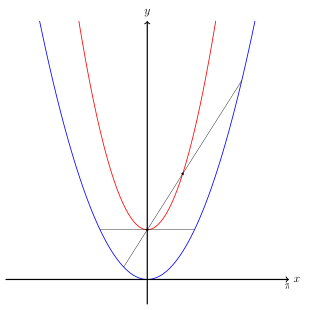
- The tangents are \(y = 2px+c\), ie \(p^2 = 2p^2+c\), ie \(y = 2px -p^2\) so we have
\begin{align*}
&& y - 2px &= -p^2 \\
&& y - 2qx &= -q^2 \\
\Rightarrow && (2p-2q)x &= p^2-q^2 \\
\Rightarrow && x &= \frac12 (p+q)\\
&& y &= p(p+q)-p^2 \\
&& y &= pq = -1
\end{align*}
Therefore \(x = \frac12(p - \frac1p), y= -1\), so we have the line \(y = -1\) (the directrix)
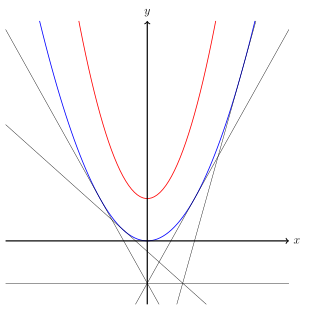
Rating Information
Difficulty Rating: 1500.0
Difficulty Comparisons: 0
Banger Rating: 1516.0
Banger Comparisons: 1
Show LaTeX source
Problem source
A parabola has the equation $y=x^{2}.$ The points $P$ and $Q$ with coordinates $(p,p^{2})$ and $(q,q^{2})$ respectively move on the parabola in such a way that $\angle POQ$ is always a right angle.
\begin{questionparts}
\item Find and sketch the locus of the midpoint $R$ of the chord $PQ.$
\item Find and sketch the locus of the point $T$ where the tangents to the parabola at $P$ and $Q$ intersect.
\end{questionparts}
Solution source
\begin{questionparts}
\item  The line $PO$ has gradient $\frac{p^2}{p} = p$ and teh line $QO$ has gradient $q$, therefore we must have that $pq = -1$. Therefore, $R$ is the point
\begin{align*}
&& R &= \left ( \frac{p-\frac{1}{p}}{2}, \frac{p^2+\frac{1}{p^2}}{2} \right) \\
&&&= \left ( \frac12\left ( p - \frac{1}{p} \right),2\left (\frac12 \left(p-\frac{1}{p}\right) \right)^2+1 \right) \\
&&&= \left ( t, 2t^2+1\right)
\end{align*}

So we are looking at another parabola.


\begin{center}
    \begin{tikzpicture}
    \def\functionf(#1){1/cos(#1*180/pi)};
    \def\xl{-3};
    \def\xu{3};
    \def\yl{-0.5};
    \def\yu{5.2};

    % Calculate scaling factors to make the plot square
    \pgfmathsetmacro{\xrange}{\xu-\xl}
    \pgfmathsetmacro{\yrange}{\yu-\yl}
    \pgfmathsetmacro{\xscale}{10/\xrange}
    \pgfmathsetmacro{\yscale}{10/\yrange}

    % Define the styles for the axes and grid
    \tikzset{
        axis/.style={very thick, ->},
        grid/.style={thin, gray!30},
        x=\xscale cm,
        y=\yscale cm
    }

    % Define the bounding region with clip
    \begin{scope}
        % You can modify these values to change your plotting region
        \clip (\xl,\yl) rectangle (\xu,\yu);

        % Draw a grid (optional)
        % \draw[grid] (-5,-3) grid (5,3);

        \draw[thick, blue, smooth, domain=\xl:\xu, samples=100]
            plot (\x, {\x*\x});
        \draw[thick, red, smooth, domain=\xl:\xu, samples=100]
            plot (\x, {2*\x*\x+1});
        \node[below left] at ({pi},0) {$\pi$};

        \draw (1,1) -- (-1,1);
        \filldraw (0,1) circle (1pt);

        \draw(2,4) -- (-0.5, 0.25);
        \filldraw ({(2-0.5)/2},{(4+0.25)*0.5}) circle (1pt);

    \end{scope}

    % Set up axes
    \draw[axis] (\xl,0) -- (\xu,0) node[right] {$x$};
    \draw[axis] (0,\yl) -- (0,\yu) node[above] {$y$};

    \end{tikzpicture}
\end{center}

\item The tangents are $y = 2px+c$, ie $p^2 = 2p^2+c$, ie $y = 2px -p^2$ so we have

\begin{align*}
&& y - 2px &= -p^2 \\
&& y - 2qx &= -q^2 \\
\Rightarrow && (2p-2q)x &= p^2-q^2 \\
\Rightarrow && x &= \frac12 (p+q)\\
&& y &= p(p+q)-p^2 \\
&& y &= pq = -1
\end{align*}

Therefore $x = \frac12(p - \frac1p), y= -1$, so we have the line $y = -1$ (the directrix)

\begin{center}
    \begin{tikzpicture}
    \def\functionf(#1){1/cos(#1*180/pi)};
    \def\xl{-3};
    \def\xu{3};
    \def\yl{-1.5};
    \def\yu{5.2};

    % Calculate scaling factors to make the plot square
    \pgfmathsetmacro{\xrange}{\xu-\xl}
    \pgfmathsetmacro{\yrange}{\yu-\yl}
    \pgfmathsetmacro{\xscale}{10/\xrange}
    \pgfmathsetmacro{\yscale}{10/\yrange}

    % Define the styles for the axes and grid
    \tikzset{
        axis/.style={very thick, ->},
        grid/.style={thin, gray!30},
        x=\xscale cm,
        y=\yscale cm
    }

    % Define the bounding region with clip
    \begin{scope}
        % You can modify these values to change your plotting region
        \clip (\xl,\yl) rectangle (\xu,\yu);

        % Draw a grid (optional)
        % \draw[grid] (-5,-3) grid (5,3);

        \draw[thick, blue, smooth, domain=\xl:\xu, samples=100]
            plot (\x, {\x*\x});
        \draw[thick, red, smooth, domain=\xl:\xu, samples=100]
            plot (\x, {2*\x*\x+1});

        % \draw (1,1) -- (-1,1);
        \draw (\xl, {2*\xl-1})--(\xu, {2*\xu-1});
        \draw (\xl, {-2*\xl-1})--(\xu, {-2*\xu-1});

        % \draw(2,4) -- (-0.5, 0.25);
        \draw (\xl, {4*\xl-4})--(\xu, {4*\xu-4});
        \draw (\xl, {-1*\xl-0.25})--(\xu, {-1*\xu-0.25});
        % \filldraw ({(2-0.5)/2},{(4+0.25)*0.5}) circle (1pt);

        \draw (\xl,-1) -- (\xu,-1);

    \end{scope}

    % Set up axes
    \draw[axis] (\xl,0) -- (\xu,0) node[right] {$x$};
    \draw[axis] (0,\yl) -- (0,\yu) node[above] {$y$};

    \end{tikzpicture}
\end{center}

\end{questionparts}