Problems
Filters
57 problems found
2025 Paper 2 Q10
The lower end of a rigid uniform rod of mass \(m\) and length \(a\) rests at point \(M\) on rough horizontal ground. Each of two elastic strings, of natural length \(\ell\) and modulus of elasticity \(\lambda\), is attached at one end to the top of the rod. Their lower ends are attached to points \(A\) and \(B\) on the ground, which are a distance \(2a\) apart. \(M\) is the midpoint of \(AB\). \(P\) is the point at the top of the rod and lies in the vertical plane through \(AMB\). Suppose that the rod is in equilibrium with angle \(PMB = 2\theta\), where \(\theta < 45°\) and \(\theta\) is such that both strings are in tension.
- Show that angle \(APB\) is a right angle.
Show that the force exerted on the rod by the elastic strings can be written as the sum of
- a force of magnitude \(\frac{2a\lambda}{\ell}\) parallel to the rod
- and a force of magnitude \(\sqrt{2}\lambda\) acting along the bisector of angle \(APB\).
- By taking moments about point \(M\), or otherwise, show that \(\cos\theta + \sin\theta = \frac{2\lambda}{mg}\). Deduce that it is necessary that \(\frac{1}{2}mg < \lambda < \frac{1}{2}\sqrt{2}mg\).
- \(N\) and \(F\) are the magnitudes of the normal and frictional forces, respectively, exerted on the rod by the ground at \(M\). Show, by taking moments about an appropriate point, or otherwise, that \[N - F\tan 2\theta = \frac{1}{2}mg.\]
Solution:

- Notice that \(AM = MB = MP\) in particular \(P\) lies on a semi-circle of radius \(a\) and therefore by Thales' theorem \(\angle APB = 90^{\circ}\). Notice that by angles in a triangle and the angles adding to \(90^{\circ}\), \(\angle APM = \theta\). Therefore, \begin{align*} && |PB| &= 2a \sin \theta \\ && |PA| &= 2a \cos \theta \\ && T_A &= \frac{\lambda}{l} \left (2a \cos \theta -l \right) \\ && T_B &= \frac{\lambda}{l} \left (2a \sin\theta -l \right) \\ \end{align*} Since \(T_A\) and \(T_B\) are perpendicular, we can consider the forces as having vector \(\frac{\lambda}{l}\binom{2a\cos \theta-l}{2a\sin \theta - l}\) in this coordinate system, ie the sum of a vector \(\frac{2\lambda a}{l}\binom{\cos \theta}{\sin \theta}\) and \(\displaystyle -\sqrt{2}\lambda \binom{\frac1{\sqrt{2}}}{\frac1{\sqrt{2}}}\) which are unit vectors parallel to the rod and along the bisector of \(APB\) respectively.
- \begin{align*} \overset{\curvearrowright}{M}: && 0 &= \frac{a}{2} \cdot mg \cos 2 \theta - a\cdot \sqrt{2}\lambda \cos (90-(45-\theta))\\ \Rightarrow && \cos 2 \theta &= \frac{\lambda}{mg} 2 \sqrt{2} \cos (45 + \theta) \\ \Rightarrow && \cos^2 \theta - \sin^2 \theta &= \frac{2\lambda}{mg} (\cos \theta - \sin \theta) \\ \underbrace{\Rightarrow}_{\theta < 45^{\circ}} && \cos \theta + \sin \theta &= \frac{2\lambda}{mg} \end{align*} Over \((0, 45^{\circ})\), \(\cos \theta + \sin \theta\) ranges from \(1\) to \(\sqrt{2}\), therefore \(1 < \frac{2 \lambda}{mg} < \sqrt{2} \Rightarrow \frac12 mg < \lambda < \frac12 \sqrt{2} mg\) as required.
- \begin{align*} \overset{\curvearrowright}{P}: && 0 &=- \frac{a}{2} \cdot \left ( mg \cos 2\theta \right) - a \cdot F \sin 2 \theta + a \cdot N \cos 2 \theta \\ \Rightarrow && \frac12 mg &= N - F \tan 2 \theta \end{align*} as required.
2025 Paper 3 Q10
A plank \(AB\) of length \(L\) initially lies horizontally at rest along the \(x\)-axis on a flat surface, with \(A\) at the origin. Point \(C\) on the plank is such that \(AC\) has length \(sL\), where \(0 < s < 1\). End \(A\) is then raised vertically along the \(y\)-axis so that its height above the horizontal surface at time \(t\) is \(h(t)\), while end \(B\) remains in contact with the flat surface and on the \(x\)-axis. The function \(h(t)\) satisfies the differential equation $$\frac{d^2h}{dt^2} = -\omega^2 h, \text{ with } h(0) = 0 \text{ and } \frac{dh}{dt} = \omega L \text{ at } t = 0$$ where \(\omega\) is a positive constant. A particle \(P\) of mass \(m\) remains in contact with the plank at point \(C\).
- Show that the \(x\)-coordinate of \(P\) is \(sL\cos\omega t\), and find a similar expression for its \(y\)-coordinate.
- Find expressions for the \(x\)- and \(y\)-components of the acceleration of the particle.
- \(N\) and \(F\) are the upward normal and frictional components, respectively, of the force of the plank on the particle. Show that $$N = mg(1 - k\sin\omega t)\cos\omega t$$ and that $$F = mgsk\frac{\omega^2}{g}\tan\omega t$$ where \(k = \frac{L\omega^2}{g}\).
- The coefficient of friction between the particle and the plank is \(\tan\alpha\), where \(\alpha\) is an acute angle.
Show that the particle will not slip initially, provided \(sk < \tan\alpha\).
Show further that, in this case, the particle will slip
- while \(N\) is still positive,
- when the plank makes an angle less than \(\alpha\) to the horizontal.
Solution:
- Since we have \(h'' + \omega^2 h = 0\) we must have that \(h(t) = A \cos \omega t + B \sin \omega t\). The initial conditions tell us that \(A = 0\) and \(B = L\), so \(h(t) = L \sin \omega t\).
Therefore we can see the angle at \(B\) is \(\omega t\) and so \(P\) has \(y\)-coordinate \((1-s)L \sin \omega t\) and \(x\)-coordinate \(sL \cos \omega t\)
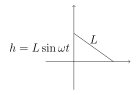
- If the position is \(\binom{sL \cos \omega t}{(1-s) L \sin \omega t}\) then the acceleration is \(-\omega^2 \binom{sL \cos \omega t}{(1-s) L \sin \omega t}\)
- \begin{align*} \text{N2}(\rightarrow): && - F\cos \omega t + N \sin \omega t &= -m\omega^2 sL \cos \omega t\\ \text{N2}(\uparrow): && -mg + F\sin \omega t + N \cos \omega t &= -m\omega^2 (1-s) L \sin \omega t \\ \Rightarrow && \begin{pmatrix} \cos \omega t & -\sin \omega t \\ \sin \omega t & \cos \omega t \end{pmatrix} \begin{pmatrix} F \\ N \end{pmatrix} &= \begin{pmatrix} m\omega^2 s L \cos \omega t \\ mg - m\omega^2(1-s)L \sin \omega t \end{pmatrix} \\ \Rightarrow && \begin{pmatrix}F \\ N \end{pmatrix} &= \begin{pmatrix} \cos \omega t & \sin \omega t \\ -\sin \omega t & \cos \omega t \end{pmatrix} \begin{pmatrix} m\omega^2 s L \cos \omega t \\ mg - m\omega^2(1-s)L \sin \omega t \end{pmatrix} \\ \Rightarrow && N &= m \omega^2 s L (-\sin \omega t \cos \omega t) + mg \cos \omega t - m \omega^2 (1-s)L \sin \omega t \cos \omega t \\ &&&=mg \cos \omega t - m \omega^2 L \sin \omega t \cos \omega t \\ &&&= mg \cos \omega t \left (1 - \frac{L \omega^2}{g} \sin \omega t \right) \\ &&&= mg (1 - k \sin \omega t) \cos \omega t \\ \Rightarrow && F &= m \omega^2 s L \cos^2 \omega t + mg \sin \omega t - m \omega^2 (1-s) L \sin ^2 \omega t \\ &&&= m \omega^2 s L + mg \sin \omega t - m \omega^2 L \sin^2 \omega t \\ &&&= mg \frac{\omega^2 L}{g} s + mg(1-\frac{\omega^2 L}{g} \sin \omega t)\sin \omega t \\ &&&= mg sk + mg(1-k \sin \omega t) \cos \omega t \tan \omega t \\ &&&= mgsk + N \tan \omega t \end{align*}
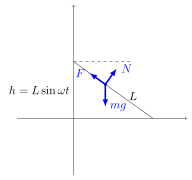
- The particle will not slip if \(F < \tan \alpha N\). When \(t = 0\), \(N = mg, F = mgsk\), but clearly \(sk < \tan \alpha \Rightarrow mgsk = F < \tan \alpha mg = \tan \alpha N\). The particle will slip when: \(F > \tan \alpha N\), but we have \(F = mgsk + N \tan \omega t\). Clearly when \(\omega t = \alpha\) we have reached a point where \(F > \tan \alpha N\). Therefore we must slip before we reach this point, ie at a point where the plank makes an angle of less than \(\alpha\) to the horizontal. Notice also that \(N\) changes sign when \(1-k \sin \omega t = 0\), however, to do this \(N\) must become very small, smaller than \(mgsk\), therefore we must slip before this point too. Since we slip before either condition occurs, we must be in a position when \(N\) is positive AND the plank still makes a shallow angle.
2024 Paper 3 Q10
A cube of uniform density \(\rho\) is placed on a horizontal plane and a second cube, also of uniform density \(\rho\), is placed on top of it. The lower cube has side length \(1\) and the upper cube has side length \(a\), with \(a \leqslant 1\). The centre of mass of the upper cube is vertically above the centre of mass of the lower cube and all the edges of the upper cube are parallel to the corresponding edges of the lower cube. The contacts between the two cubes, and between the lower cube and the plane, are rough, with the same coefficient of friction \(\mu < 1\) in each case. The midpoint of the base of the upper cube is \(X\) and the midpoint of the base of the lower cube is \(Y\). A horizontal force \(P\) is exerted, perpendicular to one of the vertical faces of the upper cube, at a point halfway between the two vertical edges of this face, and a distance \(h\), with \(h < a\), above the lower edge of this face.
- Show that, if the two cubes remain in equilibrium, the normal reaction of the plane on the lower cube acts at a point which is a distance \[\frac{P(1+h)}{(1+a^3)\rho g}\] from \(Y\), and find a similar expression for the distance from \(X\) of the point at which the normal reaction of the lower cube on the upper cube acts.
- Show that, if neither cube topples, equilibrium will be broken by the slipping of the upper cube on the lower cube, and not by the slipping of the lower cube on the ground.
- Show that, if \(a = 1\), then equilibrium will be broken by the slipping of the upper cube on the lower cube if \(\mu(1+h) < 1\) and by the toppling of the lower and upper cube together if \(\mu(1+h) > 1\).
- Show that, in a situation where \(a < 1\) and \(h\bigl(1 + a^3(1-a)\bigr) > a^4\), and no slipping occurs, equilibrium will be broken by the toppling of the upper cube.
- Show, by considering \(a = \frac{1}{2}\) and choosing suitable values of \(h\) and \(\mu\), that the situation described in (iv) can in fact occur.
2023 Paper 3 Q10
A thin uniform beam \(AB\) has mass \(3m\) and length \(2h\). End \(A\) rests on rough horizontal ground and the beam makes an angle of \(2\beta\) to the vertical, supported by a light inextensible string attached to end \(B\). The coefficient of friction between the beam and the ground at \(A\) is \(\mu\). The string passes over a small frictionless pulley fixed to a point \(C\) which is a distance \(2h\) vertically above \(A\). A particle of mass \(km\), where \(k < 3\), is attached to the other end of the string and hangs freely.
- Given that the system is in equilibrium, find an expression for \(k\) in terms of \(\beta\) and show that \(k^2 \leqslant \dfrac{9\mu^2}{\mu^2 + 1}\).
- A particle of mass \(m\) is now fixed to the beam at a distance \(xh\) from \(A\), where \(0 \leqslant x \leqslant 2\). Given that \(k = 2\), and that the system is in equilibrium, show that \[\frac{F^2}{N^2} = \frac{x^2 + 6x + 5}{4(x+2)^2}\,,\] where \(F\) is the frictional force and \(N\) is the normal reaction on the beam at \(A\). By considering \(\dfrac{1}{3} - \dfrac{F^2}{N^2}\), or otherwise, find the minimum value of \(\mu\) for which the beam can be in equilibrium whatever the value of \(x\).
2022 Paper 2 Q9
A rectangular prism is fixed on a horizontal surface. A vertical wall, parallel to a vertical face of the prism, stands at a distance \(d\) from it. A light plank, making an acute angle \(\theta\) with the horizontal, rests on an upper edge of the prism and is in contact with the wall below the level of that edge of the prism and above the level of the horizontal plane. You may assume that the plank is long enough and the prism high enough to make this possible. The contact between the plank and the prism is smooth, and the coefficient of friction at the contact between the plank and the wall is \(\mu\). When a heavy point mass is fixed to the plank at a distance \(x\), along the plank, from its point of contact with the wall, the system is in equilibrium.
- Show that, if \(x = d\sec^3\theta\), then there is no frictional force acting between the plank and the wall.
- Show that, if \(x > d\sec^3\theta\), it is necessary that \[\mu \geqslant \frac{x - d\sec^3\theta}{x\tan\theta}\] and give the corresponding inequality if \(x < d\sec^3\theta\).
- Show that \[\frac{x}{d} \geqslant \frac{\sec^3\theta}{1 + \mu\tan\theta}\,.\] Show also that, if \(\mu < \cot\theta\), then \[\frac{x}{d} \leqslant \frac{\sec^3\theta}{1 - \mu\tan\theta}\,.\]
- Show that if \(x\) is such that the point mass is fixed to the plank somewhere between the edge of the prism and the wall, then \(\tan\theta < \mu\).
2020 Paper 3 Q9
Two inclined planes \(\Pi_1\) and \(\Pi_2\) meet in a horizontal line at the lowest points of both planes and lie on either side of this line. \(\Pi_1\) and \(\Pi_2\) make angles of \(\alpha\) and \(\beta\), respectively, to the horizontal, where \(0 < \beta < \alpha < \frac{1}{2}\pi\). A uniform rigid rod \(PQ\) of mass \(m\) rests with \(P\) lying on \(\Pi_1\) and \(Q\) lying on \(\Pi_2\) so that the rod lies in a vertical plane perpendicular to \(\Pi_1\) and \(\Pi_2\) with \(P\) higher than \(Q\).
- It is given that both planes are smooth and that the rod makes an angle \(\theta\) with the horizontal. Show that \(2\tan\theta = \cot\beta - \cot\alpha\).
- It is given instead that \(\Pi_1\) is smooth, that \(\Pi_2\) is rough with coefficient of friction \(\mu\) and that the rod makes an angle \(\phi\) with the horizontal. Given that the rod is in limiting equilibrium, with \(P\) about to slip down the plane \(\Pi_1\), show that \[ \tan\theta - \tan\phi = \frac{\mu}{(\mu + \tan\beta)\sin 2\beta} \] where \(\theta\) is the angle satisfying \(2\tan\theta = \cot\beta - \cot\alpha\).
2019 Paper 1 Q9
A box has the shape of a uniform solid cuboid of height \(h\) and with a square base of side \(b\), where \(h > b\). It rests on rough horizontal ground. A light ladder has its foot on the ground and rests against one of the upper horizontal edges of the box, making an acute angle of \(\alpha\) with the ground, where \(h = b \tan \alpha\). The weight of the box is \(W\). There is no friction at the contact between ladder and box. A painter of weight \(kW\) climbs the ladder slowly. Neither the base of the ladder nor the box slips, but the box starts to topple when the painter reaches height \(\lambda h\) above the ground, where \(\lambda < 1\). Show that:
- \(R = k\lambda W \cos \alpha\), where \(R\) is the magnitude of the force exerted by the box on the ladder;
- \(2k\lambda \cos 2\alpha + 1 = 0\);
- \(\mu \geq \frac{\sin 2\alpha}{1 - 3 \cos 2\alpha}\), where \(\mu\) is the coefficient of friction between the box and the ground.
Solution:

- \(\,\) \begin{align*} \overset{\curvearrowright}{X}:&& kW \cdot \lambda h\cos \alpha - R h &= 0 \\ \Rightarrow && R &= k\lambda W \cos \alpha \\ \end{align*}
- \(\,\) \begin{align*} \overset{\curvearrowright}{C}:&& R \sin \alpha \cdot h-R\cos \alpha \cdot b-W\frac{b}{2} &= 0 \\ && k\lambda W \cos \alpha \sin \alpha \cdot b \tan \alpha- k\lambda W \cos \alpha\cos \alpha \cdot h-W\frac{b}{2} &= 0 \\ && k \lambda (\cos^2 \alpha - \sin^2 \alpha) +\frac12 &= 0 \\ \Rightarrow && 2k \lambda \cos 2\alpha + 1 &= 0 \end{align*}
- \(\,\) \begin{align*} \text{N2}(\uparrow): && R_b -W-R\cos \alpha &= 0 \\ \Rightarrow && R_b &= W + k\lambda W \cos^2 \alpha\\ \text{N2}(\rightarrow): && R\sin \alpha - F_b &= 0 \\ \Rightarrow && F_b &= R \sin \alpha \\ \\ && F_b &\leq \mu R \\ \Rightarrow && k\lambda W \cos \alpha \sin \alpha &= \mu (W + k\lambda W \cos^2 \alpha) \\ \Rightarrow && \mu &\geq \frac{k\lambda \cos \alpha \sin \alpha}{1 + k\lambda \cos^2 \alpha} \\ &&&= \frac{k\lambda \sin 2\alpha}{2 + 2k\lambda cos^2 \alpha} \\ &&&= \frac{k\lambda \sin 2\alpha}{2 + k\lambda (\cos 2 \alpha+1)} \\ &&&= \frac{k\lambda \sin 2\alpha}{-4k\lambda \cos 2 \alpha + k\lambda (\cos 2 \alpha+1)} \\ &&&= \frac{\sin 2 \alpha}{1 -3 \cos 2\alpha} \end{align*}
2019 Paper 2 Q10
A small light ring is attached to the end \(A\) of a uniform rod \(AB\) of weight \(W\) and length \(2a\). The ring can slide on a rough horizontal rail. One end of a light inextensible string of length \(2a\) is attached to the rod at \(B\) and the other end is attached to a point \(C\) on the rail so that the rod makes an angle of \(\theta\) with the rail, where \(0 < \theta < 90^{\circ}\). The rod hangs in the same vertical plane as the rail. A force of \(kW\) acts vertically downwards on the rod at \(B\) and the rod is in equilibrium.
- You are given that the string will break if the tension \(T\) is greater than \(W\). Show that (assuming that the ring does not slip) the string will break if $$2k + 1 > 4 \sin \theta.$$
- Show that (assuming that the string does not break) the ring will slip if $$2k + 1 > (2k + 3)\mu \tan \theta,$$ where \(\mu\) is the coefficient of friction between the rail and the ring.
- You are now given that \(\mu \tan \theta < 1\). Show that, when \(k\) is increased gradually from zero, the ring will slip before the string breaks if $$\mu < \frac{2 \cos \theta}{1 + 2 \sin \theta}.$$
Solution:

- \(\,\) \begin{align*} \overset{\curvearrowright}{A}:&& W \cos \theta \cdot a + kW \cos \theta \cdot 2a - T \cos \theta \sin \theta \cdot 2a - T \sin \theta \cos \theta \cdot 2a &= 0 \\ && (2k+1) \cos \theta W &= T \cos \theta \cdot 4 \sin \theta \\ \Rightarrow && T &= \frac{2k+1}{4 \sin \theta} W \\ \Rightarrow && \text{breaks if }\quad \quad 2k+1 &> 4 \sin \theta \end{align*}
- \(\,\) \begin{align*} \text{N2}(\uparrow): && R - W - kW - T \sin \theta &= 0 \\ \Rightarrow && R &= (k+1)W - T \sin \theta \\ &&&= (k+1)W - \frac{2k+1}{4} W \\ &&&= \frac{2k+3}{4}W \\ \text{N2}(\leftarrow): && F_A - T \cos \theta &= 0 \\ \Rightarrow && F_A &= \frac{2k+1}{4 }\cot \theta \\ \Rightarrow && \text{slips if }\quad \quad\quad \quad\quad \quad F_A &> \mu R \\ \Rightarrow && \text{slips if }\quad \quad \frac{2k+1}{4 }\cot \theta &> \mu \frac{2k+3}{4}W \\ \Rightarrow && 2k+1 &> (2k+3) \mu \tan \theta \end{align*}
- The condition for breaking is \(k > 2\sin \theta -\frac12\). The condition for slipping is equivalent to: \begin{align*} && 2k+1 &> (2k+3) \mu \tan \theta \\ \Leftrightarrow && 2k(1- \mu \tan \theta) &> 3 \mu \tan \theta-1 \\ \Leftrightarrow && k &> \frac{3 \mu \tan \theta-1}{2(1- \mu \tan \theta)} \end{align*} Therefore we will slip first if: \begin{align*} && \frac{3 \mu \tan \theta-1}{2(1- \mu \tan \theta)} &< 2 \sin \theta - \frac12 \\ \Leftrightarrow && 3 \mu \tan \theta-1 &< 4 \sin \theta (1- \mu \tan \theta) - (1- \mu \tan \theta) \\ &&&=4 \sin \theta - 1 + \mu \tan \theta (1-4 \sin \theta) \\ \Leftrightarrow && 3 \mu \tan \theta &< 4 \sin \theta + \mu \tan \theta (1- 4 \sin \theta) \\ \Leftrightarrow && \mu \tan \theta(3-1+4\sin \theta) &< 4 \sin \theta \\ \Leftrightarrow && \mu &< \frac{2 \cos \theta}{1+2 \sin \theta} \end{align*}
2018 Paper 2 Q11
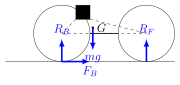
The axles of the wheels of a motorbike of mass \(m\) are a distance \(b\) apart. Its centre of mass is a horizontal distance of \(d\) from the front axle, where \(d < b\), and a vertical distance \(h\) above the road, which is horizontal and straight. The engine is connected to the rear wheel. The coefficient of friction between the ground and the rear wheel is \(\mu\), where \(\mu < b/h\), and the front wheel is smooth. You may assume that the sum of the moments of the forces acting on the motorbike about the centre of mass is zero. By taking moments about the centre of mass show that, as the acceleration of the motorbike increases from zero, the rear wheel will slip before the front wheel loses contact with the road if \[ \mu < \frac {b-d}h\,. \tag{*} \] If the inequality \((*)\) holds and the rear wheel does not slip, show that the maximum acceleration is \[ \frac{ \mu dg}{b-\mu h} \,. \] If the inequality \((*)\) does not hold, find the maximum acceleration given that the front wheel remains in contact with the road.
Solution:
2017 Paper 1 Q11
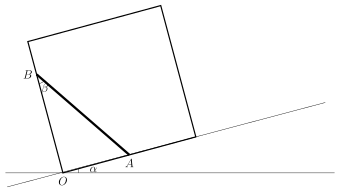
A plane makes an acute angle \(\alpha\) with the horizontal. A box in the shape of a cube is fixed onto the plane in such a way that four of its edges are horizontal and two of its sides are vertical. A uniform rod of length \(2L\) and weight \(W\) rests with its lower end at \(A\) on the bottom of the box and its upper end at \(B\) on a side of the box, as shown in the diagram below. The vertical plane containing the rod is parallel to the vertical sides of the box and cuts the lowest edge of the box at \(O\). The rod makes an acute angle~\(\beta\) with the side of the box at \(B\). The coefficients of friction between the rod and the box at the two points of contact are both \(\tan \gamma\), where \(0 < \gamma < \frac12\pi\). %The frictional force on the rod at \(A\) acts toward \(O\), %and the frictional force on the rod at~\(B\) %acts away from \(O\). The rod is in limiting equilibrium, with the end at \(A\) on the point of slipping in the direction away from \(O\) and the end at \(B\) on the point of slipping towards \(O\). Given that \(\alpha < \beta\), show that \(\beta = \alpha + 2\gamma\). [\(Hint\): You may find it helpful to take moments about the midpoint of the rod.]
Solution:

2017 Paper 2 Q9
Two identical rough cylinders of radius \(r\) and weight \(W\) rest, not touching each other but a negligible distance apart, on a horizontal floor. A thin flat rough plank of width \(2a\), where \(a < r\), and weight \(kW\) rests symmetrically and horizontally on the cylinders, with its length parallel to the axes of the cylinders and its faces horizontal. A vertical cross-section is shown in the diagram below.
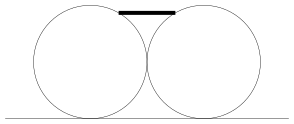
- Let \(F\) be the frictional force between one cylinder and the floor, and let \(R\) be the normal reaction between the plank and one cylinder. Show that \[ R\sin\theta = F(1+\cos\theta)\,, \] where \(\theta\) is the acute angle between the plank and the tangent to the cylinder at the point of contact. Deduce that \(2\sin\theta \le 1+\cos\theta\,\).
- Show that \[ N= \left( 1+\frac2 k\right)\left(\frac{1+\cos\theta}{\sin\theta} \right) F \,, \] where \(N\) is the normal reaction between the floor and one cylinder. Write down the condition that the cylinder does not slip on the floor and show that it is satisfied with no extra restrictions on \(\theta\).
- Show that \(\sin\theta\le\frac45\,\) and hence that \(r\le5a\,\).
Solution:
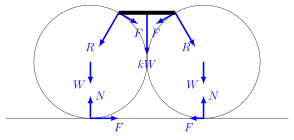
- \(\,\) \begin{align*} \text{N2}(\rightarrow, \text{ one cylinder}): && F\cos \theta + F - R \sin \theta &= 0 \\ \Rightarrow && F(1+\cos \theta) &= R \sin \theta \\ && F \leq \tfrac12 R \\ \Rightarrow && R \sin \theta &\leq \frac12 R(1+\cos \theta) \\ \Rightarrow && 2 \sin \theta &\leq 1 + \cos \theta \end{align*}
- \(\,\) \begin{align*} \text{N2}(\uparrow, \text{system}): && 2N-(k+2)W &= 0 \\ \Rightarrow && W &= \left ( \frac{2}{k+2} \right)N \\ \text{N2}(\uparrow, \text{one cylinder}): && N - W - R\cos \theta -F\sin \theta &= 0 \\ \Rightarrow && N - \left ( \frac{2}{k+2} \right)N - F \left ( \frac{1+\cos \theta}{\sin \theta} \right) \cos \theta - F \sin \theta &= 0 \\ \Rightarrow && \left ( \frac{k}{k+2} \right)N &= \left ( \frac{\cos \theta + \cos^2 \theta + \sin^2 \theta}{\sin \theta} \right) F\\ \Rightarrow && N &= \left ( 1 + \frac2{k} \right) \left ( \frac{\cos \theta + 1}{\sin \theta} \right) F \end{align*} The cylinder does not slip if \(F \leq \tfrac12 N\), ie \begin{align*} && N &\leq \left ( 1 + \frac2{k} \right) \left ( \frac{\cos \theta + 1}{\sin \theta} \right) \frac12 N \\ \Rightarrow && 2\sin \theta &\leq \left ( 1 + \frac2{k} \right) \left ( \cos \theta + 1 \right) \end{align*} but since \(2 \sin \theta \leq (1 + \cos \theta)\) and \((1+\frac2k) > 1\) this inequality is obviously satisfied.
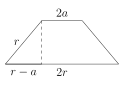
- We can notice that \(2\sin \theta = 1 + \cos \theta\) is satisfied by a \(3-4-5\) triangle, where \(\sin \theta = 4/5, \cos \theta = 3/5\) and hence if \(\sin \theta \leq \frac45\) the condition must hold.
So \(\sin \theta = \frac{r-a}{r} \leq \frac45 \Rightarrow 5r-5a \leq 4r \Rightarrow r \leq 5a\)
2016 Paper 1 Q9
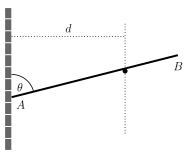
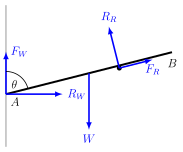
A horizontal rail is fixed parallel to a vertical wall and at a distance \(d\) from the wall. A uniform rod \(AB\) of length \(2a\) rests in equilibrium on the rail with the end \(A\) in contact with the wall. The rod lies in a vertical plane perpendicular to the wall. It is inclined at an angle \(\theta\) to the vertical (where \(0 < \theta < \frac12\pi\)) and \(a\sin\theta < d\), as shown in the diagram.
Solution:
2015 Paper 1 Q11
Two long circular cylinders of equal radius lie in equilibrium on an inclined plane, in \mbox{contact} with one another and with their axes horizontal. The weights of the upper and lower \mbox{cylinders} are \(W_1\) and \(W_2\), respectively, where \(W_1>W_2\)\,. The coefficients of friction \mbox{between} the \mbox{inclined} plane and the upper and lower cylinders are \(\mu_1\) and \(\mu_2\), respectively, and the \mbox{coefficient} of friction \mbox{between} the two cylinders is \(\mu\). The angle of inclination of the plane is~\(\alpha\) (which is positive).
- Let \(F\) be the magnitude of the frictional force between the two cylinders, and let \(F_1\) and \(F_2\) be the magnitudes of the frictional forces between the upper cylinder and the plane, and the lower cylinder and the plane, respectively. Show that \(F=F_1=F_2\,\).
- Show that \[ \mu \ge \dfrac{W_1+W_2}{W_1-W_2} \,,\] and that \[ \tan\alpha \le \frac{ 2 \mu_1 W_1}{(1+\mu_1)(W_1+ W_2)}\,. \]
2015 Paper 3 Q11
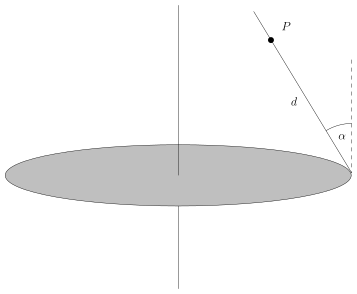
- A horizontal disc of radius \(r\) rotates about a vertical axis through its centre with angular speed \(\omega\). One end of a light rod is fixed by a smooth hinge to the edge of the disc so that it can rotate freely in a vertical plane through the centre of the disc. A particle \(P\) of mass \(m\) is attached to the rod at a distance \(d\) from the hinge. The rod makes a constant angle \(\alpha\) with the upward vertical, as shown in the diagram, and \(d\sin\alpha < r\).
By considering moments about the hinge for the (light) rod, show that the force exerted on the rod by \(P\) is parallel to the rod. Show also that \[ r\cot\alpha = a + d \cos\alpha \,, \] where \(a = \dfrac {g \;} {\omega^2}\,\). State clearly the direction of the force exerted by the hinge on the rod, and find an expression for its magnitude in terms of \(m\), \(g\) and \(\alpha\).
- The disc and rod rotate as in part (i), but two particles (instead of \(P\)) are attached to the rod. The masses of the particles are \(m_1\) and \(m_2\) and they are attached to the rod at distances \(d_1\) and \(d_2\) from the hinge, respectively. The rod makes a constant angle \(\beta\) with the upward vertical and \(d_1\sin\beta < d_2\sin\beta < r\). Show that \(\beta\) satisfies an equation of the form \[ r\cot\beta = a+ b \cos\beta \,, \] where \(b\) should be expressed in terms of \(d_1\), \(d_2\), \(m_1\) and \(m_2\).
Solution:
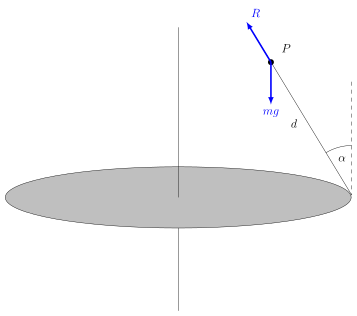
- Since the particle is not moving (relative to the hinge) there is no moment about the hinge and in particular the only forces must be directed towards the hinge, ie parallel to the rod.
\begin{align*} \text{N2}(\uparrow): && R \cos \alpha &= mg \\ \\ \text{N2}(\leftarrow, \text{radially}): && R \sin \alpha &= m (r-d\sin \alpha) \omega^2 \\ \Rightarrow && \cot \alpha &= \frac{g}{(r-d\sin \alpha) \omega^2} \\ \Rightarrow && r\cot \alpha-d \cos \alpha &= a \\ \Rightarrow && r \cot \alpha &= a + d \cos \alpha \end{align*} The force of the hinge is acting in the same direction and magnitude as the rod on the particle (the force \(R\) in the diagram). It has magnitude \(mg \sec \alpha\)
- \(\,\)
\begin{align*} \overset{\curvearrowleft}{\text{hinge}}: && gm_1d_1 \sin \beta+gm_2d_2 \sin \beta &= m_1 (r-d_1 \sin \beta) \omega^2 d_1 \cos \beta + m_2 (r-d_2 \sin \beta) \omega^2 d_2 \cos \beta \\ \Rightarrow && a(m_1d_1+m_2d_2) \tan \beta &= r(m_1d_1+m_2d_2) - (m_1d_1^2+m_2d_2^2) \sin \beta \\ \Rightarrow && r\cot \beta &= a + \frac{m_1d_1^2+m_2d_2^2}{m_1d_1+m_2d_2} \cos \beta \end{align*}

2014 Paper 2 Q9
A uniform rectangular lamina \(ABCD\) rests in equilibrium in a vertical plane with the \(A\) in contact with a rough vertical wall. The plane of the lamina is perpendicular to the wall. It is supported by a light inextensible string attached to the side \(AB\) at a distance \(d\) from \(A\). The other end of the string is attached to a point on the wall above \(A\) where it makes an acute angle \(\theta\) with the downwards vertical. The side \(AB\) makes an acute angle \(\phi\) with the upwards vertical at \(A\). The sides \(BC\) and \(AB\) have lengths \(2a\) and \(2b\) respectively. The coefficient of friction between the lamina and the wall is \(\mu\).
- Show that, when the lamina is in limiting equilibrium with the frictional force acting upwards, \begin{equation} d\sin(\theta +\phi) = (\cos\theta +\mu \sin\theta)(a\cos\phi +b\sin\phi)\,. \tag{\(*\)} \end{equation}
- How should \((*)\) be modified if the lamina is in limiting equilibrium with the frictional force acting downwards?
- Find a condition on \(d\), in terms of \(a\), \(b\), \(\tan\theta\) and \(\tan\phi\), which is necessary and sufficient for the frictional force to act upwards. Show that this condition cannot be satisfied if \(b(2\tan\theta+ \tan \phi) < a\).
Solution:
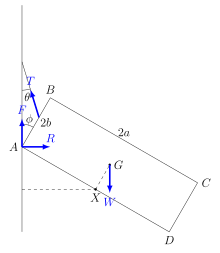
- \begin{align*} \text{N2}(\uparrow): && T \cos \theta + F -W &= 0 \\ && W &= T\cos \theta + \mu R \tag{1} \\ \text{N2}(\rightarrow): && R-T\sin \theta &= 0 \\ && R &= T \sin \theta \tag{2}\\ \\ (1)+(2): && W&=(\cos \theta + \mu \sin \theta)T \tag{3} \\ \overset{\curvearrowright}{A}: && 0 &= W(b\sin \phi + a \cos \phi) - Td\sin(\phi+\theta) \tag{4} \\ \\ (3)+(4): && 0 &= (\cos \theta + \mu \sin \theta)(b\sin \phi + a \cos \phi)-d\sin(\phi+\theta) \\ \Rightarrow && d\sin(\phi+\theta) &= (\cos \theta + \mu \sin \theta)(b\sin \phi + a \cos \phi) \end{align*} as required.
- If \(F\) is operating downwards, it's equivalent to \(-\mu\), ie: \[d\sin(\phi+\theta) = (\cos \theta - \mu \sin \theta)(b\sin \phi + a \cos \phi)\]
- For the frictional force to be acting upwards, we need \begin{align*} && d\sin(\phi+\theta) &\geq \cos \theta(b\sin \phi + a \cos \phi) \\ \Rightarrow && d &\geq \frac{\cos \theta(b\sin \phi + a \cos \phi)}{\sin(\phi + \theta)} \\ &&&= \frac{\cos \theta(b\sin \phi + a \cos \phi)}{\sin\phi \cos\theta+\cos\phi\sin \theta)}\\ &&&= \frac{(b\sin \phi + a \cos \phi)}{\sin\phi+\cos \phi \tan \theta)}\\ &&&= \frac{a+b\tan \phi}{\tan\theta+\tan\phi }\\ \end{align*} We know that \(d < 2b\), so \begin{align*} && 2b &>\frac{a+b\tan \phi}{\tan\theta+\tan\phi }\\ \Rightarrow && 2b \tan \theta + 2b \tan \phi &> a + b \tan \phi \\ \Rightarrow &&b(2 \tan \theta + \tan \phi) &> a\\ \end{align*} Therefore we will have problems if the inequality is reversed!